
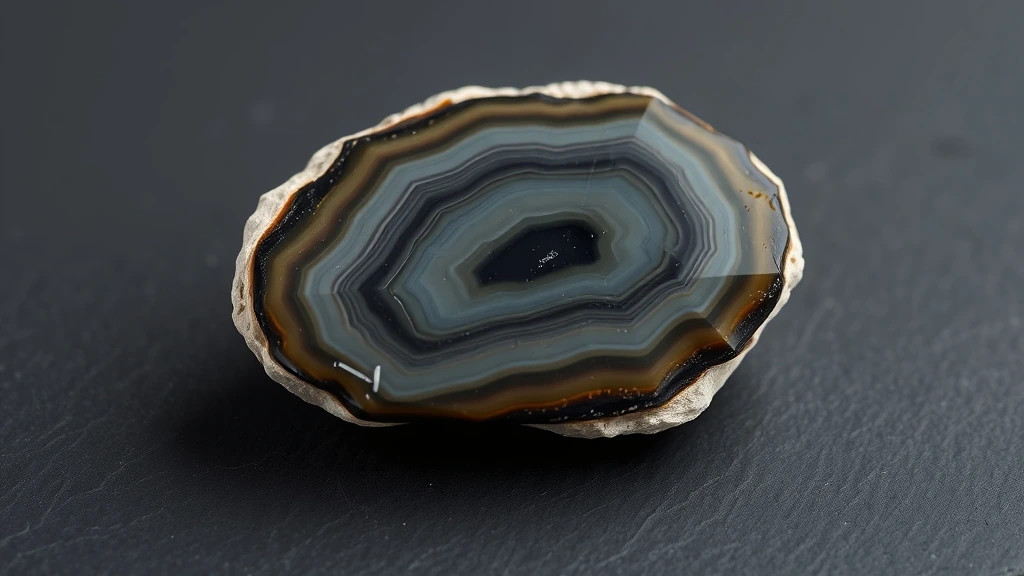
Turritella Agate belongs to the silicate family, specifically the chalcedony subgroup of cryptocrystalline quartz. Formed from silica‑rich fluids that percolate through marine sediments, the stone incorporates fossilized Turritella gastropod shells, giving it a distinctive banded appearance. Its microcrystalline texture results from tightly packed quartz fibers, producing a smooth, waxy luster that is prized in ornamental lapidary work.
What is Turritella Agate? Geological Overview & Definition
Turritella Agate is not a true mineral but a fossiliferous silica rock composed of minute quartz fibers that have replaced the original shell material. The fossil shells, often preserved in cross‑section, create concentric rings that contrast with the surrounding chalcedony matrix, producing the stone’s characteristic pattern.
The formation occurs in shallow marine environments where silica‑saturated waters precipitate quartz around the shells of *Turritella* snails. Over millions of years, diagenetic processes cement the fibers into a cohesive aggregate, preserving both the organic imprint and the silicate framework.
Turritella Agate Chemical Composition & Crystallographic Properties
The aggregate’s primary constituent is silicon dioxide (SiO₂) in the form of cryptocrystalline quartz, organized as fibrous trigonal aggregates. Although the rock lacks a single lattice, each quartz fiber adheres to the trigonal crystal system, producing a continuous network of interlocking microcrystals.
Cation substitution is minimal; trace amounts of iron, manganese, or titanium may replace silicon within the silica lattice, creating subtle chromophore centers that generate the stone’s brown to amber hues. These impurities are responsible for the color zoning observed across the bands.
Turritella Agate is acid‑sensitive; exposure to strong acids can dissolve the silica framework, eroding both the matrix and the fossil outlines. Consequently, cleaning should employ mild, pH‑neutral solutions to preserve the delicate surface.
Thermally, the stone remains stable up to about 600 °C, beyond which dehydroxylation of trace impurities can cause color fading. Heating below this threshold can enhance the stone’s translucency, a technique sometimes used by lapidaries to improve visual depth.
| Property | Specification |
|---|---|
| Mineral Group | Silicates (Chalcedony / Cryptocrystalline Quartz) |
| Chemical Formula | SiO₂ (Silicon Dioxide) |
| Mohs Hardness | 6.5 – 7.0 |
| Crystal System | Trigonal (Microcrystalline / Cryptocrystalline fibrous aggregates) |
| Specific Gravity (Density) | 2.60 – 2.65 |
| Refractive Index | 1.544 – 1.553 |
| Color & Optical Properties | Natural Turritella Agate color spectrum and optical dispersion |
| Primary Mining Localities | Brazil, Uruguay, Turkey, India, Madagascar |
| Water & Chemical Resistance | High (Safe for gentle warm water and mild soap; avoid harsh acids and chlorine) |
| Chakra Alignment (Traditional) | Root Chakra and Sacral Chakra |
| Zodiac Affinity (Traditional) | Gemini, Virgo, Taurus |
| Symbolic Meaning (Traditional) | Grounding, emotional balance, physical endurance, and protection |
Turritella Agate Varieties & Color Spectrum
Turritella agate exhibits a diverse range of coloration driven by trace elemental impurities during its cryptocrystalline formation. The most common morphs feature earthy tones that reflect the specific iron oxide content within the host sedimentary matrix. These natural variations provide lapidaries with a broad palette for carving and tumbler production.
Classic Brown and Tan Turritella
This dominant variety displays warm brown, tan, and beige hues resulting from manganese and iron inclusions. The fibrous texture often creates a subtle, swirling pattern that mimics the original marine worm tube structure. It is the most abundant form found in commercial gemstone markets worldwide.
Deep Red and Rust Turritella
Richer specimens exhibit deep red, rust, or maroon colors due to high concentrations of hematite and other iron oxides. These stones often possess a darker, more opaque appearance that enhances the visibility of the fossilized tube impressions. Collectors prize these darker morphs for their intense, saturated visual depth.
Greenish and Olive Turritella
Less common, these varieties feature olive, sage, or pale green tones attributed to chlorite or other greenish mineral impurities. The coloration is typically muted and earthy, blending seamlessly with the surrounding matrix. This morph is often sought after for its unique, subdued aesthetic appeal in jewelry design.
Banded and Zoned Turritella
Some specimens display distinct banding or zonation where color changes abruptly across the stone’s surface. These patterns form as the silica solution deposited in successive layers over millions of years. The contrast between light and dark bands highlights the intricate internal geometry of the fossilized tubes.
White and Cream Turritella
Pale white, cream, or light gray varieties occur when the silica matrix remains relatively pure with minimal metallic impurities. These stones offer a high-contrast canvas that makes the fossilized tube structures exceptionally clear and visible. They are frequently chosen for detailed intaglio carving and intricate lapidary work.
Where is Turritella Agate Found? Geological Mining & Extraction
Turritella agate forms in Cretaceous and Paleogene sedimentary basins where marine worm tubes were buried and replaced by silica. The host rocks are typically fine-grained limestones or marls that underwent extensive diagenetic alteration. This geological process preserves the delicate internal structure of the ancient marine organisms.
Primary extraction occurs in regions with exposed Cretaceous marine deposits, such as parts of Europe, North America, and Asia. Miners often extract large blocks from open-pit quarries or riverbeds where weathering has exposed the agatized layers. Careful cutting is required to maximize the yield of well-preserved fossil tubes for the gem trade.
Historical Significance & Cultural Lore of Turritella Agate
Ancient civilizations valued agate for its protective properties and intricate natural patterns, often associating it with stability and endurance. In Greco-Roman culture, agate carvings were used as seals and amulets to ward off evil spirits and ensure safe travel. Egyptian artisans also incorporated agate into jewelry and funerary objects, symbolizing the eternal nature of the soul.
Throughout early archaeological records, these stones appear in various cultural contexts as symbols of grounding and physical strength. Vedic traditions and other ancient belief systems attributed healing qualities to the stone, linking it to the earth’s energy. This enduring legacy continues to influence modern metaphysical practices and collector interest today.
Modern Uses & Jewelry Applications of Turritella Agate
Lapidaries primarily process Turritella Agate into smooth, polished cabochons to showcase its distinctive fossilized spiral patterns without obscuring the intricate details. The stone’s moderate Mohs hardness of 6.5 to 7.0 allows for precise carving and engraving, making it ideal for ornamental pendants and decorative inlays. Its earthy tones and organic textures appeal to collectors seeking unique, nature-inspired gemstone pieces.
- Cabochon Cutting: The standard cut for this variety, preserving the visible Turritella fossil impressions on the surface.
- Ornamental Carving: Used in sculptural jewelry and decorative objects where the fibrous cryptocrystalline structure provides a matte, tactile finish.
- Polished Slabs: Often cut into thin, flat tiles for use in architectural accents or high-end desk accessories.
Metaphysical Properties & Traditional Meaning of Turritella Agate
According to historical traditions and metaphysical lore, Turritella Agate is revered for its profound grounding capabilities and connection to the earth’s physical endurance. Ancient Mediterranean lapidaries often associated fossil-bearing stones with the passage of time and the resilience of life cycles. This stone is believed to foster emotional balance, helping wearers navigate stress with steady composure and inner calm.
In broader esoteric practices, the stone is regarded as a protective talisman that enhances physical endurance and stability. Its spiral fossil patterns symbolize continuous growth and the cyclical nature of existence. Practitioners suggest that holding the stone during meditation can anchor the mind, promoting a sense of security and protection against negative environmental influences.
Which Chakra and Zodiac Signs Align with Turritella Agate?
Turritella Agate is canonically aligned with the Root Chakra and the Sacral Chakra, facilitating a deep connection to physical stability and creative flow. The Root Chakra association supports feelings of safety and groundedness, while the Sacral Chakra link encourages emotional expression and vitality. This dual alignment helps balance the body’s physical needs with its creative and emotional capacities.
Astrologically, this stone resonates most strongly with Taurus, Gemini, and Virgo. Taurus finds stability and comfort in the stone’s earthy energy, while Gemini benefits from its ability to organize mental chatter. Virgo appreciates the stone’s grounding influence, which supports their natural desire for order and precision in daily life.
How to Identify Real vs. Fake Turritella Agate
Artificial imitations of Turritella Agate often involve synthetic glass, dyed chalcedony, or resin composites designed to mimic the fossil patterns. These fakes may lack the natural specific gravity and thermal properties of genuine silica-based agate. Careful examination is essential to distinguish authentic specimens from these manufactured alternatives, which can be visually convincing to the untrained eye.
Practical At-Home Authenticity Tests
- Temperature Test (Thermal Feel): Genuine agate feels cool to the touch initially and warms slowly, whereas plastic or resin imitations warm up almost instantly upon contact with skin.
- Specific Gravity & Weight Test: Real Turritella Agate has a density of 2.60–2.65, making it feel noticeably heavier than similarly sized glass or plastic replicas.
- Scratch & Hardness Test (Mohs Comparison): With a Mohs hardness of 6.5–7.0, the stone will scratch glass (hardness 5.5) but will not be scratched by a steel knife blade (hardness 5.5).
- Microscopic & Loupe Inspection (Internal Inclusions): Use a 10x loupe to check for natural cryptocrystalline textures and fossil details; fakes often show uniform bubbles, swirls, or overly perfect, repeating patterns.
Turritella Agate Valuation Factors, Grading & Pricing
Color saturation drives the top tier of market value; specimens that display deep, vivid bands of amber, brown, and rust command premium prices. Collectors prize a natural energetic luster that appears to glow from within, distinguishing high‑grade pieces from muted, faded examples. The intensity of hue often reflects the original marine sediment composition and the degree of diagenetic alteration.
Crystal size and weight in grams are the primary quantitative metrics, with larger, heavier blocks offering greater surface area for display and carving. Raw, unpolished material is priced lower than tumbled, high‑gloss polish that reveals the characteristic spiral fossil patterns. Natural matrix inclusions such as fossil fragments or quartz veins can add intrigue, but excessive fractures reduce structural integrity and thus price.
Ethical sourcing and locality premium have become decisive in both holistic and collector markets. Specimens harvested from responsibly managed quarries in the western United States, especially those documented with provenance records, attract higher bids. Buyers increasingly value transparency, ensuring that extraction respects indigenous lands and avoids environmentally damaging practices.
How to Clean and Care for Turritella Agate
Warm soapy water is ideal for solid agates; gently submerge the stone in lukewarm water with a mild, pH‑neutral soap, then rinse with clean water and pat dry with a soft microfiber cloth. Avoid ultrasonic cleaners unless the piece is confirmed to be untreated and free of dyes, as vibration can dislodge fragile fossil inclusions. Do not expose the agate to harsh acids, chlorine, or abrasive scrubbing pads, which can erode the silica surface.
Cleansing and Recharging Turritella Agate (Energetic Care)
A safe dry method for energetic renewal is to place the agate on a clean selenite slab for several hours, allowing the neutralizing properties of selenite to clear lingering vibrations. Alternatively, a brief session of herbal smudging with sage or cedar can disperse stagnant energy without introducing moisture or heat.
Moonlight exposure offers another gentle recharge; set the stone on a windowsill or outdoor tray during a clear night, allowing lunar photons to bathe the surface for 30‑60 minutes. This practice respects the mineral’s crystalline stability while aligning the agate with subtle lunar rhythms.
Frequently Asked Questions About Turritella Agate
Turritella Agate displays distinct mineralogical characteristics across its geological varieties and structural habits. Gemologists evaluate these natural varieties based on crystal habit, trace chromophore concentrations, and visual luster.
Primary Natural Turritella Agate
The benchmark natural variety exhibiting diagnostic color saturation and classic crystallographic symmetry.
Distinct Geological Morphs of Turritella Agate
Secondary regional and structural varieties formed under localized geological temperature and pressure conditions.
What is Turrisella Agate made of?
It is a form of microcrystalline quartz composed of SiO₂. The stone consists of tightly packed, fibrous trigonal aggregates that give it a distinctive banded appearance resembling fossilized snail shells, and it shares the physical properties typical of agate, such as a Mohs hardness of 6.5‑7.
Is Turritella Agate safe to wear in the shower?
Yes, it tolerates gentle warm water and mild soap. Because the material is a durable silicon dioxide variety, routine exposure to water does not degrade it, though prolonged contact with harsh acids or chlorine should be avoided to preserve its luster.
How should I clean a dyed Turritella Agate necklace?
Use warm soapy water and a soft brush, then rinse with clean water. This method removes surface grime without stripping the dye, but if the piece is heavily fractured or has undergone treatments, limit cleaning to a gentle wipe to prevent color loss.
Can I use an ultrasonic cleaner on Turritella Agate?
Warm soapy water is ideal; ultrasonic cleaning is not recommended for treated or dyed specimens. The vibrations can exacerbate fractures or cause dye leaching, so a manual cleaning approach ensures the stone’s structural integrity and visual appeal remain intact.
Which zodiac signs are associated with Turritella Agate?
Gemini, Virgo, and Taurus are the aligned signs. In astrological tradition, these earth‑ and air‑oriented signs are thought to benefit from the stone’s grounding energy, enhancing mental clarity and practical decision‑making.
Which chakras does Turritella Agate balance?
It resonates with the Root Chakra and Sacral Chakra. By anchoring energy to the base of the spine and stimulating the lower abdomen, the stone is believed to promote grounding and emotional balance, supporting both physical endurance and creative flow.
Is Turritella Agate suitable for everyday jewelry?
Its hardness of 6.5‑7 makes it robust enough for daily wear. The stone’s resistance to scratches and its stable crystalline structure allow it to endure routine contact, though care should be taken to avoid impacts that could cause internal fracturing.
Does Turritella Agate have any known metaphysical properties?
It is linked to grounding, emotional balance, physical endurance, and protection. Practitioners claim that the stone’s energetic vibration aligns with the lower chakras, helping wearers feel more stable, resilient, and shielded from negative influences.