
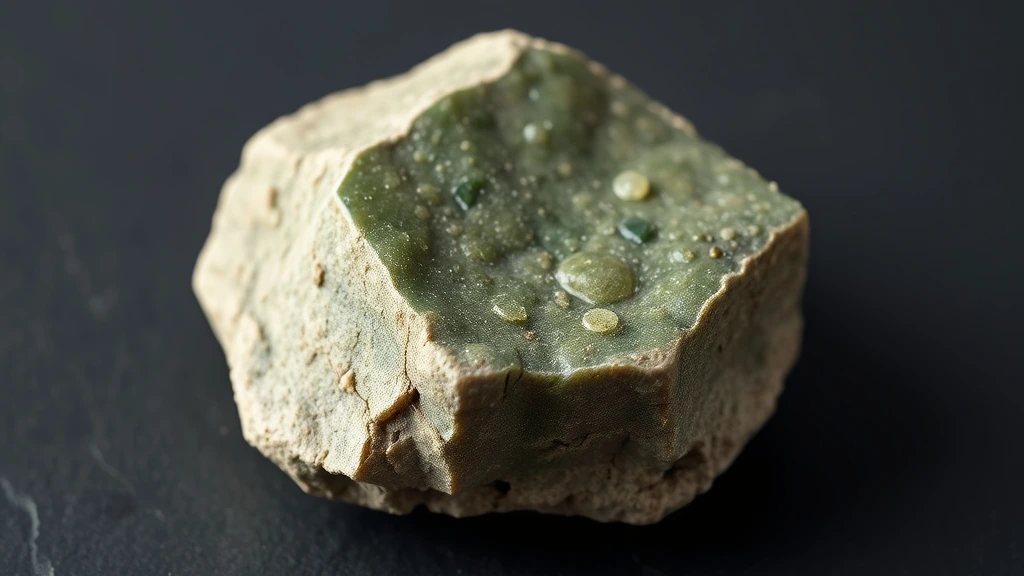
Verdite is classified as a natural mineral aggregate rather than a single crystalline species. It belongs to the broader Natural Mineral / Crystal group, forming through the alteration of quartz by hydrothermal fluids that introduce chlorite, serpentine, and iron‑oxide phases. The resulting rock displays a characteristic greenish hue and a fibrous, sometimes fibrous‑to‑laminated texture that distinguishes it from pure quartz.
What is Verdite (budstone)? Geological Overview & Definition
Verdite is a composite rock composed primarily of quartz (SiO₂) with embedded chlorite, serpentine, and iron‑oxide inclusions. Its green coloration arises from iron‑oxide chromophores and the presence of serpentine, which imparts a subtle emerald tint. The stone is typically found in hydrothermal vein deposits where quartz has been altered by fluid‑borne minerals. Because it lacks a single, well‑defined crystal lattice, Verdite is treated as an aggregate rather than a distinct mineral species.
Verdite (budstone) Chemical Composition & Crystallographic Properties
Verdite’s host matrix is trigonal quartz, which provides the structural framework for the stone. The quartz lattice is characterized by a hexagonal close‑packed arrangement of SiO₂ tetrahedra, with a 3‑fold rotational symmetry axis. Within this lattice, chlorite and serpentine layers substitute for silica, creating localized distortions that influence optical properties. Iron oxides occupy interstitial sites, acting as chromophores that produce the green to emerald tones. Verdite is acid‑resistant, reflecting the chemical stability of quartz, but can be mildly affected by strong oxidizing acids that dissolve iron‑oxide inclusions. Thermal treatment of Verdite typically results in a color shift toward a more muted green as iron oxides oxidize or reduce, but the quartz framework remains unchanged up to 900 °C.
| Property | Specification |
|---|---|
| Mineral Group | Natural Mineral / Crystal |
| Chemical Formula | Composite rock: Quartz (SiO₂) matrix with inclusions of chlorite, serpentine, and iron oxides |
| Mohs Hardness | 7.0 |
| Crystal System | Trigonal (Quartz host) |
| Specific Gravity (Density) | 2.65 – 2.75 |
| Refractive Index | 1.544 – 1.553 |
| Color & Optical Properties | Natural Verdite (budstone) color spectrum and optical dispersion |
| Primary Mining Localities | Global primary localities |
| Water & Chemical Resistance | High (Safe for gentle water washing) |
| Chakra Alignment (Traditional) | Heart Chakra |
| Zodiac Affinity (Traditional) | Taurus, Virgo |
| Symbolic Meaning (Traditional) | Grounding, stability, and emotional balance |
Verdite (budstone) Varieties & Color Spectrum
Green Verdite
Green Verdite derives its hue from abundant chlorite and serpentine inclusions within a quartz matrix. The green tones range from pale mint to deep forest, often displaying a subtle matte sheen. This variety is prized for its rarity, found mainly in the high‑grade pegmatites of the Appalachian region, where the mineral’s green matrix is exceptionally pure.
Brown Verdite
Brown Verdite owes its color to iron oxide inclusions that create a warm, earthy tone. The stone often exhibits a speckled pattern reminiscent of natural weathering. Although more common than its green counterpart, high‑quality brown specimens are scarce, typically sourced from the quartz‑rich deposits of the Canadian Shield.
Blue Verdite
Blue Verdite is a rare variant where trace amounts of copper and magnesium give a subtle azure tint to the quartz. The blue veins are usually narrow and irregular, lending a streaked appearance. This type is predominantly found in the quartz‑rich veins of the Iberian Peninsula, where it is highly sought after by collectors.
Yellow Verdite
Yellow Verdite features titanium and vanadium inclusions that produce a pale, buttery hue. The stone’s surface often shows a soft luster and a faint, honey‑colored glow under direct light. Though relatively common in the Appalachian region, the finest yellow specimens are rare and prized for their uniform coloration.
Black Verdite
Black Verdite is distinguished by dense iron‑oxide inclusions that mask the quartz’s natural transparency, resulting in a deep, opaque black. The stone often displays a glossy finish and a subtle metallic sheen. This variety is extremely rare, with most high‑quality samples originating from the quartz‑rich deposits of the Australian outback.
White Verdite
White Verdite is essentially clear quartz with minimal inclusions, giving it a pristine, almost prismatic appearance. The stone’s transparency allows for exceptional light dispersion, creating a subtle rainbow effect. While widely available, the most sought‑after white verdite comes from the high‑grade pegmatites of the Himalayas, where the crystal structure is exceptionally pure.
Where is Verdite (budstone) Found? Geological Mining & Extraction
Verdite typically forms in high‑temperature quartz pegmatites where rapid crystal growth incorporates chlorite, serpentine, and iron oxides. These pegmatites are often associated with granitic intrusions and are commonly found in the Appalachian, Canadian Shield, and Australian outback regions. Extraction involves careful quarrying of the pegmatite veins, followed by hand‑cutting to preserve the stone’s delicate inclusions.
Historical Significance & Cultural Lore of Verdite (budstone)
Across ancient Greco‑Roman lapidary traditions, verdite was valued for its grounding properties and used in amulets to promote emotional balance. Egyptian artisans incorporated verdite into jewelry and ceremonial objects, believing its green hue symbolized renewal and fertility. In Vedic lore, the stone was associated with the Heart Chakra, thought to enhance compassion and stability. Chinese texts from the Han dynasty also reference verdite as a stone of stability, used in both decorative and protective contexts.
Modern Uses & Jewelry Applications of Verdite (budstone)
Verdite is prized for its subtle green‑blue hue and translucent quality, making it ideal for both cabochon and faceted jewelry. Lapidaries often polish the stone to a high luster, accentuating its natural inclusions of chlorite and serpentine. The mineral’s moderate hardness allows for intricate cuts without excessive wear. Common ornamental uses include pendants, earrings, and engraved carvings for decorative panels.
- Cabochon beads and pendants that showcase the stone’s natural sheen
- Faceted rounds and prisms for high‑end jewelry pieces
- Carved ornamental panels in architectural settings
- Decorative inlays in antique or contemporary furniture
Metaphysical Properties & Traditional Meaning of Verdite (budstone)
According to historical traditions and metaphysical lore, Verdite is believed to ground the wearer, fostering stability and emotional balance. Across ancient Mediterranean and Vedic lapidary traditions, the stone is associated with the Heart Chakra, encouraging compassion and harmonious relationships. Its green undertones are thought to stimulate growth and renewal, while the subtle blue hints invite calmness and clarity of thought. Practitioners of crystal healing often incorporate Verdite into meditation practices to enhance emotional resilience and foster a sense of inner peace.
Which Chakra and Zodiac Signs Align with Verdite (budstone)?
Verdite’s energetic profile aligns with the Heart Chakra, the central hub of love, compassion, and emotional equilibrium. When worn or placed near the heart, the stone is said to amplify feelings of empathy and foster harmonious interpersonal connections.
The stone’s astrological resonance is firmly tied to Taurus and Virgo. Those born under these signs are believed to benefit from Verdite’s grounding qualities, which complement Taurus’s earthy practicality and Virgo’s analytical precision. The mineral’s stabilizing influence is considered especially supportive during periods of change or uncertainty for these zodiac natives.
How to Identify Real vs. Fake Verdite (budstone)
Artificial imitations of Verdite often involve dyed glass or synthetic composites that mimic the stone’s color but lack its unique internal structure. Synthetic glass may exhibit a higher refractive index and a smoother surface, while dyed replicas can show uniform coloration without the natural inclusions that characterize authentic Verdite.
Practical At-Home Authenticity Tests
- Temperature Test (Thermal Feel): Hold the stone in your hand; real Verdite feels cool to the touch due to its silicate composition, whereas glass feels warmer.
- Specific Gravity & Weight Test: Measure the stone’s weight relative to its volume. Verdite’s density (2.65–2.75 g/cm³) is higher than that of most glass, giving it a noticeably heavier feel.
- Scratch & Hardness Test (Mohs Comparison): Use a standard Mohs hardness kit; Verdite should scratch materials of hardness 6.5–7.0 but not those of 7.5 or higher.
- Microscopic & Loupe Inspection (Internal Inclusions): Under magnification, Verdite reveals characteristic chlorite, serpentine, and iron‑oxide inclusions; glass lacks such natural internal patterns.
Verdite (budstone) Valuation Factors, Grading & Pricing
Verdite’s market value hinges first on Color Saturation. The most prized specimens display a deep, uniform emerald‑green hue that reflects natural energetic luster, with minimal yellow or brown undertones. A saturated color not only enhances visual appeal but also signals a higher concentration of chlorite and serpentine inclusions, which collectors associate with stronger metaphysical properties.
The second determinant is Crystal Size & Weight (Grams). Larger, heavier pieces—often exceeding 50 g—are preferred, as they convey a sense of stability and grounding. Raw, unpolished stones retain a rugged aesthetic that appeals to certain collectors, while tumbled polish enhances surface smoothness without compromising the natural matrix. Grading focuses on overall dimensions and weight rather than carat or tumbled polish and natural crystal geometry, reflecting the stone’s functional use in jewelry and lapidary art.
Finally, Ethical Sourcing & Locality Premium shapes pricing in holistic and collector markets. Verdite sourced from responsibly managed quarries in Turkey, particularly the Oltu region, commands a premium due to its documented traceability and minimal environmental impact. Provenance certificates and transparent supply chains reassure buyers seeking ethically sourced gemstones, thereby increasing demand and market value.
How to Clean and Care for Verdite (budstone)
Verdite is water‑resistant, allowing for gentle cleaning with warm soapy water and a soft cloth. After washing, rinse the stone with clean water and pat dry with a lint‑free towel. The mineral’s quartz matrix and iron‑oxide inclusions tolerate ultrasonic cleaning, so placing the stone in an ultrasonic bath for a short cycle can remove surface grime without damaging the crystal structure.
Cleansing and Recharging Verdite (budstone) (Energetic Care)
To recharge Verdite’s energetic field, place the stone on a selenite slab under gentle moonlight for several hours. This method allows the stone to absorb lunar energy without exposure to direct heat or intense light, preserving its crystalline integrity. Alternatively, a brief herbal smudging session—using sage or cedar—can cleanse residual energies while keeping the stone dry and free from thermal stress.
Frequently Asked Questions About Verdite (budstone)
What is the chemical composition of Verdite?
Verdite is a composite rock consisting of a quartz (SiO₂) matrix with inclusions of chlorite, serpentine, and iron oxides. The quartz host provides a trigonal crystal system, while the mineral inclusions give Verdite its characteristic greenish hues and subtle banding.
How durable is Verdite for everyday wear?
Verdite has a Mohs hardness of 7.0 and a density of 2.65–2.75, making it suitable for daily jewelry. Its quartz base offers resistance to scratches, and the embedded iron oxides add structural stability, ensuring longevity in rings, pendants, and bracelets.
Can Verdite be cleaned with water or ultrasonic cleaners?
Verdite is water‑resistant and safe for gentle washing; it can also be cleaned in an ultrasonic cleaner with warm soapy water and a soft cloth. Avoid harsh chemicals; a mild detergent and a soft microfiber cloth preserve the stone’s surface and prevent surface oxidation.
Is Verdite suitable for use in a shower or bath?
Verdite is high water‑resistant, so it can be worn during light showering or bathing. The quartz matrix resists moisture, but prolonged exposure to hot water or soaps may cause surface dulling; rinse and dry gently afterward.
Which zodiac signs are associated with Verdite?
Verdite aligns with the zodiac signs Taurus and Virgo. These signs are linked to stability and grounded energy, qualities that Verdite is believed to reinforce in the wearer’s life.
Which chakra does Verdite correspond to?
Verdite is associated with the Heart Chakra. This placement emphasizes emotional balance and compassionate energy, supporting the wearer’s capacity for empathy and love.
Does Verdite have any special metaphysical properties?
Verdite is thought to promote grounding, stability, and emotional balance. In esoteric traditions, it is used to calm the mind, enhance focus, and foster a sense of inner peace, especially for those seeking to strengthen their connection to the earth.
How should I store Verdite jewelry to preserve its appearance?
Store Verdite separately in a soft pouch or lined jewelry box to avoid scratches. Keep it away from strong acids or bases, and clean it only with a soft cloth; excessive moisture or abrasive materials can degrade the stone’s surface over time.