
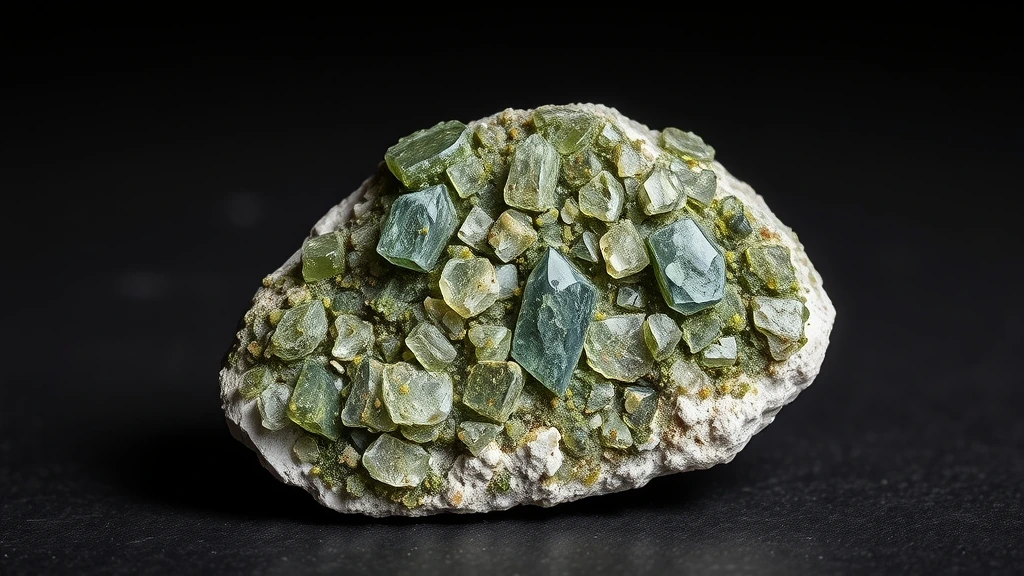
Vesuvianite belongs to the broader class of silicate minerals and is typically found as a fine‑grained, fibrous aggregate within metamorphosed limestones and dolomites. Its formation is tied to low‑grade metamorphism, where calcium and aluminum from the host rock combine with silica to create this distinctive mineral. The stone is prized for its subtle luster and the way it reflects light, a characteristic that has made it a favorite in lapidary circles for centuries.
What is Vesuvianite (idocrase)? Geological Overview & Definition
Vesuvianite is a silicate mineral that crystallizes in the isometric system, exhibiting three mutually perpendicular axes of equal length. It is commonly found as a fibrous or platy aggregate, often intergrown with other metamorphic minerals such as tremolite or diopside. The mineral’s name derives from the volcanic region of Vesuvius, although its occurrences are widespread, from Italy to the United States.
In the mineralogical hierarchy, vesuvianite is classified under the natural mineral group, meaning it is a naturally occurring crystalline substance rather than a synthetic or engineered material. Its crystal structure is complex, featuring interlocking chains of tetrahedra and octahedra that accommodate a variety of cations, giving rise to its diverse color palette.
Vesuvianite (idocrase) Chemical Composition & Crystallographic Properties
The true crystal system of vesuvianite is isometric, with a cubic lattice that allows for symmetrical growth in all directions. Within this lattice, calcium, aluminum, and silicon occupy distinct sites, while hydroxyl groups provide structural stability. Cation substitution—particularly of iron, manganese, and titanium—creates the chromophore centers responsible for the stone’s green, brown, or black hues.
Vesuvianite is moderately acid‑resistant; dilute hydrochloric acid may etch the surface, but it generally withstands brief exposure. Its thermal behavior is notable: the mineral remains stable up to about 700 °C, after which it begins to dehydrate and lose hydroxyl groups, leading to a color change and potential structural collapse.
The mineral’s optical properties, such as a refractive index of 1.700–1.720, contribute to its subtle brilliance. When cut into cabochons, vesuvianite displays a silky luster that enhances its appeal in fine jewelry. The combination of durability, color variety, and historical significance ensures that vesuvianite remains a valued gemstone in both scientific study and ornamental use.
| Property | Specification |
|---|---|
| Mineral Group | Natural Mineral / Crystal |
| Chemical Formula | Ca₁₉Al₁₈Si₃₀O₉₄(OH)₂₀ |
| Mohs Hardness | 5.0 – 5.5 |
| Crystal System | Isometric |
| Specific Gravity (Density) | 3.30 – 3.45 |
| Refractive Index | 1.700 – 1.720 |
| Color & Optical Properties | Natural Vesuvianite (idocrase) color spectrum and optical dispersion |
| Primary Mining Localities | Global primary localities |
| Water & Chemical Resistance | Sensitive (Avoid prolonged water soaking) |
| Chakra Alignment (Traditional) | Root Chakra, Sacral Chakra |
| Zodiac Affinity (Traditional) | Taurus, Virgo, Capricorn |
| Symbolic Meaning (Traditional) | Grounding, stability, and protection from negativity |
Vesuvianite (idocrase) Varieties & Color Spectrum
Classic Green Vesuvianite
This most common variety forms in orthoclase‑rich pegmatites where calcium and aluminum are abundant. Its vivid emerald‑green hue results from trace iron and titanium, while subtle white‑to‑gray inclusions of quartz give a speckled appearance. The green variant is widely traded and prized for its clarity and moderate hardness.
Blue‑Green Vesuvianite (Blue‑Green Idocrase)
Blue‑green specimens arise when copper substitutes for iron during crystallization, producing a muted turquoise tone. These stones often contain black mica flakes that enhance their visual depth. Though less common than the green type, they are highly sought after by collectors for their unique color.
Brown‑Red Vesuvianite (Red‑Brown Idocrase)
The brown‑red variety owes its color to iron‑oxide inclusions and a higher concentration of titanium. It typically displays a rich mahogany shade with occasional white nodules of quartz. This rare form is prized for its warm, earthy aesthetic and is frequently used in ornamental carvings.
White Vesuvianite (White Idocrase)
White vesuvianite forms in high‑temperature, low‑oxygen environments where iron is largely absent. Its translucent, milky appearance is accentuated by tiny, needle‑like inclusions of quartz or feldspar. Though less common, white specimens are valued for their subtle elegance and are often used in jewelry that emphasizes purity.
Black Vesuvianite (Black Idocrase)
The black variety results from extensive iron and titanium incorporation, giving it a deep, opaque appearance. It frequently contains black mica and graphite inclusions, creating a striking contrast. This rare form is highly prized for its dramatic visual impact and is often featured in high‑end decorative pieces.
Yellow Vesuvianite (Yellow Idocrase)
Yellow vesuvianite is formed when potassium and sodium trace elements are present during crystallization, producing a soft, buttery hue. It often contains white quartz inclusions that give a subtle sparkle. Though uncommon, yellow specimens are valued for their bright, cheerful color and are frequently used in costume jewelry.
Where is Vesuvianite (idocrase) Found? Geological Mining & Extraction
Vesuvianite typically occurs in orthoclase‑rich pegmatites associated with granitic intrusions, where slow cooling allows large crystals to develop. The mineral is also found in metamorphic schists and quartz‑feldspar veins where calcium and aluminum are abundant.
Primary extraction sites include the Sierra Nevada in the United States, the Alpine region of Europe, and the Karakoram range in Pakistan. In addition, significant deposits have been identified in Brazil’s Minas Gerais and India’s Rajasthan, where artisanal miners continue to harvest the gemstone for both local use and international trade.
Historical Significance & Cultural Lore of Vesuvianite (idocrase)
Across ancient Greco‑Roman lapidary traditions, vesuvianite was valued for its durability and versatile color palette, often incorporated into jewelry and ornamental carvings. Egyptian artisans also prized the stone for its symbolic association with the earth element, using it in amulets believed to provide grounding and protection.
In Vedic lore, vesuvianite was linked to the Root Chakra, representing stability and grounding. Chinese historical records note its use in imperial regalia, where the stone’s translucent beauty was believed to embody the harmony between earth and sky. These diverse cultural references underscore the gemstone’s enduring appeal across civilizations.
Modern Uses & Jewelry Applications of Vesuvianite (idocrase)
Vesuvianite is prized for its subtle green‑to‑yellow hues and moderate hardness, making it suitable for both cabochon and faceted treatments. Lapidary artisans often polish the stone to a high luster, revealing its characteristic fibrous texture and occasional pleochroism. The mineral’s resilience to scratching allows it to be fashioned into pendants, earrings, and brooches, while its natural translucency is exploited in ornamental carving for decorative panels and architectural accents.
- Cabochon: smooth, rounded polish for beads and rings.
- Faceted: brilliant cuts for engagement or statement jewelry.
- Carving: intricate designs in architectural stonework or sculptural panels.
Metaphysical Properties & Traditional Meaning of Vesuvianite (idocrase)
According to historical traditions and metaphysical lore, vesuvianite is revered as a stone of grounding and stability. Across ancient Mediterranean and Vedic lapidary practices, it is believed to anchor the wearer’s energy, fostering resilience against emotional turbulence. The mineral’s subtle green tones are thought to harmonize the Root Chakra, encouraging a sense of safety and belonging, while its warm undertones resonate with the Sacral Chakra, nurturing creativity and emotional balance. In general metaphysical circles, vesuvianite is also associated with protection from negative influences, making it a favored talisman for travelers and those seeking inner calm.
Which Chakra and Zodiac Signs Align with Vesuvianite (idocrase)?
Vesuvianite’s energetic profile aligns with the Root Chakra, the foundational center of physical and emotional security. This correspondence is reflected in its use as a grounding stone in meditation and ritual practices.
The mineral’s astrological affinity is firmly rooted in the signs of Taurus, Virgo, and Capricorn. These earth signs share the stone’s themes of practicality, endurance, and a disciplined approach to life, reinforcing its role as a stabilizing influence.
How to Identify Real vs. Fake Vesuvianite (idocrase)
Synthetic imitations of vesuvianite often take the form of dyed glass or engineered composites that mimic the stone’s color but lack its intrinsic optical and structural properties. Real vesuvianite can be distinguished by subtle inclusions and a characteristic fibrous texture, whereas replicas typically display uniformity and a glassy sheen.
Practical At-Home Authenticity Tests
- Temperature Test (Thermal Feel): Hold the stone in your hand; authentic vesuvianite feels noticeably cool due to its higher thermal conductivity, whereas glass or dyed replicas remain warmer.
- Specific Gravity & Weight Test: Weigh the stone against a known reference; real vesuvianite has a specific gravity of 3.30–3.45, making it noticeably heavier than common glass substitutes.
- Scratch & Hardness Test (Mohs Comparison): Use a standard Mohs hardness kit; vesuvianite scores 5.0–5.5, so it will scratch materials softer than it but be scratched by harder minerals like quartz.
- Microscopic & Loupe Inspection (Internal Inclusions): Under magnification, genuine vesuvianite exhibits fine fibrous inclusions and occasional pleochroic streaks, whereas synthetic versions show smooth, uniform surfaces with no natural inclusions.
Vesuvianite (idocrase) Valuation Factors, Grading & Pricing
Color saturation remains the foremost determinant of market value, with specimens exhibiting a deep, saturated turquoise or emerald hue commanding premium prices. The visual vibrancy of the stone is amplified by its natural energetic luster, which collectors assess through close inspection under varied lighting conditions.
Crystal size and weight measured in grams are the next critical metrics; larger, well‑formed crystals with a smooth tumbled polish fetch higher prices than smaller, raw fragments. The presence of natural matrix inclusions can enhance uniqueness, but excessive inclusions may detract from the overall aesthetic and thus lower the valuation.
Ethical sourcing and locality premium play an increasingly significant role in both holistic and collector markets. Stones mined from responsibly managed deposits, particularly those with documented traceability, receive a pricing uplift, while specimens from renowned localities such as the Italian Apennines or the Caucasus region are often valued higher due to their historical significance and proven provenance.
How to Clean and Care for Vesuvianite (idocrase)
To preserve the structural integrity of vesuvianite, wipe the surface briefly with a damp cloth and dry immediately with a soft, lint‑free towel. Avoid any prolonged exposure to moisture, ultrasonic cleaning, or harsh chemicals, as these can induce microfractures or alter the stone’s natural luster. Store the specimen in a low‑humidity environment, away from direct contact with liquids, to maintain its pristine appearance.
Cleansing and Recharging Vesuvianite (idocrase) (Energetic Care)
For energetic recharging, place the stone on a selenite slab under gentle moonlight for several hours; the subtle lunar energy replenishes its grounding properties without compromising the crystal lattice. Alternatively, a brief herbal smudging session with sage or cedar can cleanse residual negative energies, provided the stone is kept dry and out of direct flame. These methods respect the mineral’s sensitivity to heat and preserve both its physical and metaphysical qualities.
Frequently Asked Questions About Vesuvianite (idocrase)
Is Vesuvianite safe to wear in the shower?
No, it is water‑sensitive and should not be exposed to prolonged moisture. Vesuvianite’s crystal lattice can absorb water, leading to surface etching or structural weakening. Keep it away from steam, hot tubs, or daily shower use to preserve its luster and integrity.
How should I clean my Vesuvianite jewelry?
Wipe it briefly with a damp microfiber cloth and dry immediately. Avoid ultrasonic cleaners or soaking, as these can fracture the mineral’s delicate framework. A gentle brush or soft cloth removes dust without compromising the stone’s surface.
Can I dust gently with a dry, soft microfiber cloth (strictly avoid water exposure)
No, dust gently with a dry, soft microfiber cloth (strictly avoid water exposure)is not recommended. The mineral’s sensitivity to moisture means even mild solutions can damage its surface. Stick to dry dusting or the damp‑cloth method for safe maintenance.
Does Vesuvianite dissolve in rain or natural water?
No, it does not dissolve, but it is water‑sensitive. While the stone remains chemically stable, prolonged exposure to rain or standing water can cause surface erosion and internal stress, potentially leading to cracks over time.
Which zodiac signs are associated with Vesuvianite?
Taurus, Virgo, and Capricorn. These signs are traditionally linked to the stone’s grounding and protective qualities, reflecting its stabilizing influence in astrological practice.
Which chakras does Vesuvianite correspond to?
Root Chakra and Sacral Chakra. The stone is believed to enhance grounding, stability, and emotional balance, aligning with these two foundational energy centers.
Can I use a jewelry cleaner spray on Vesuvianite?
No, avoid spray cleaners. Aerosol sprays can leave residues that attract moisture, increasing the risk of surface damage. Opt for a dry microfiber cloth or a brief damp wipe followed by immediate drying.
Is Vesuvianite suitable for everyday wear?
Yes, if handled with care. While it can be worn daily, avoid harsh impacts, extreme temperatures, and prolonged water exposure. Regular gentle cleaning will keep its brilliance intact.