
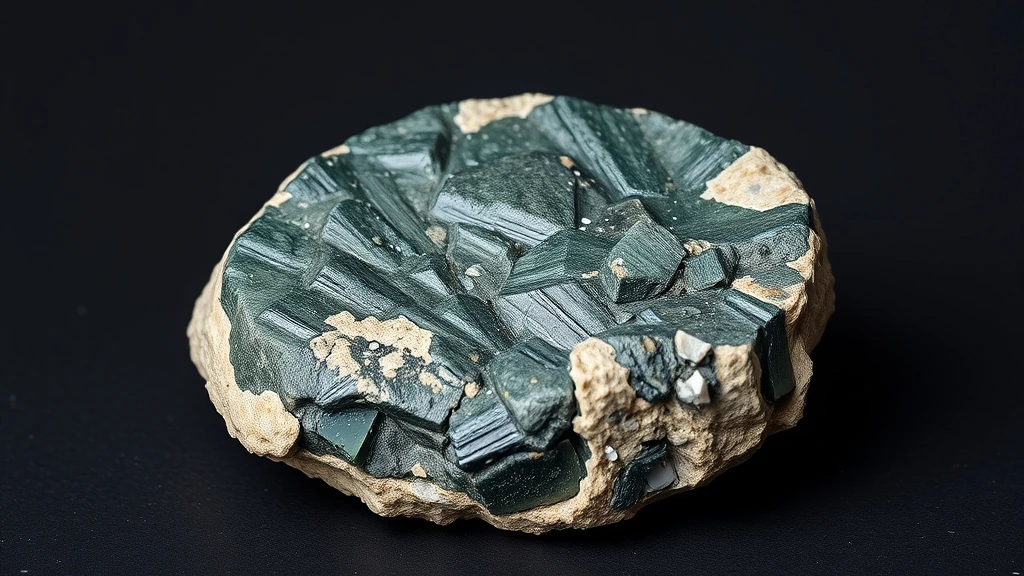
Tremolite belongs to the amphibole mineral group, a major class of inosilicates characterized by double chains of silica tetrahedra. As a natural mineral, it forms through metamorphic processes in mafic igneous rocks. Its fibrous habit distinguishes it from other amphiboles, making it a key component in talc-schist and tremolite schist. This classification places it firmly within the silicate supergroup, sharing structural similarities with actinolite and hornblende.
What is Tremolite? Geological Overview & Definition
Tremolite typically occurs as prismatic crystals or massive aggregates, often found in contact metamorphic zones. It forms when dolomitic limestone reacts with mafic igneous intrusions at moderate temperatures. This geological setting favors the growth of long, needle-like fibers that can align into schistose textures.
The mineral is frequently associated with talc, chlorite, and quartz in metamorphic schists. Its presence indicates specific pressure-temperature conditions during regional metamorphism. Geologists use tremolite as an index mineral to map metamorphic facies boundaries. Understanding its formation helps reconstruct the thermal history of ancient rock sequences.
Tremolite Chemical Composition & Crystallographic Properties
Tremolite crystallizes in the monoclinic system, featuring a unique lattice structure with a single non-right angle. The amphibole structure consists of double chains of SiO₄ tetrahedra linked by cations. This arrangement creates distinct channels along the c-axis, facilitating the characteristic fibrous growth habit. The unit cell parameters reflect the asymmetry inherent in monoclinic symmetry.
Cation substitution occurs primarily at the M1 and M2 sites, where magnesium and iron ions exchange. This solid solution series allows for compositional variation without disrupting the overall framework. Iron content directly influences color, shifting the stone from white to greenish hues. Higher iron concentrations can also slightly increase the mineral’s measured density.
The mineral exhibits moderate acid sensitivity, reacting slowly with strong hydrofluoric acid. This reactivity is typical of silicate minerals with accessible structural channels. Thermal behavior shows stability up to approximately 1,000°C, where it begins to dehydrate. Above this threshold, the structure collapses, releasing water molecules and forming a glassy residue.
Color centers arise from chromophore impurities, specifically Fe²⁺ ions within the lattice. These ions absorb specific wavelengths of visible light, producing the observed pale green tint. Pure tremolite remains colorless or white, indicating minimal trace element contamination. The refractive index values range from 1.599 to 1.637, confirming its optical anisotropy.
| Property | Specification |
|---|---|
| Mineral Group | Natural Mineral / Crystal |
| Chemical Formula | Ca₂(Mg,Fe)₅Si₈O₂₂(OH)₂ |
| Mohs Hardness | 5–6 |
| Crystal System | Monoclinic |
| Specific Gravity (Density) | 2.99–3.03 |
| Refractive Index | n α = 1.599 – 1.612 n β = 1.613 – 1.626 n γ = 1.625 – 1.637 |
| Color & Optical Properties | Natural Tremolite color spectrum and optical dispersion |
| Primary Mining Localities | Global primary localities |
| Water & Chemical Resistance | High (Safe for gentle water washing) |
| Chakra Alignment (Traditional) | Root Chakra, Sacral Chakra |
| Zodiac Affinity (Traditional) | Virgo, Capricorn, Taurus |
| Symbolic Meaning (Traditional) | Grounding, stability, and emotional balance |
Tremolite Varieties & Color Spectrum
Tremolite exhibits a diverse range of color morphs driven by trace element substitutions within its crystal lattice. The most common form is the pure, magnesium-rich variety, which appears as a translucent white or pale green stone. This stoichiometric purity results in high clarity, making it highly sought after for lapidary work and industrial applications.
White Tremolite
This variety forms in low-temperature hydrothermal veins where magnesium dominates the cation sites. It typically displays a fibrous texture that can range from silky to granular, depending on crystal growth conditions. White tremolite is the most abundant form, often found in association with talc and calcite in metamorphic schists.
Green Tremolite
Trace amounts of iron and chromium impurities impart a distinct green hue to this variety. It commonly occurs in serpentine-hosted deposits, where hydrothermal fluids introduce these chromophores during metamorphism. The color intensity varies from pale celadon to deep forest green, with darker stones often exhibiting higher opacity due to increased inclusion density.
Blue Tremolite
Rare blue specimens result from specific structural defects or minor titanium substitutions within the silicate framework. These stones are frequently found in ophiolite complexes, where high-pressure metamorphism stabilizes unique electron configurations. Blue tremolite is exceptionally rare in the gem market, with most specimens displaying a subtle, dusty blue tint rather than a vibrant sapphire-like color.
Brown Tremolite
Oxidation of iron-bearing impurities creates the characteristic brown to honey tones seen in this variety. It often forms in contact metamorphic zones where thermal alteration modifies the original mineral composition. Brown tremolite is frequently confused with other amphiboles, but its specific refractive index and cleavage angle confirm its identity.
Black Tremolite
High concentrations of iron and manganese produce a deep black or dark grey appearance in this form. These stones are typically opaque and dense, forming in high-grade metamorphic environments where extensive chemical alteration has occurred. Black tremolite is less common in gem-quality specimens but remains significant in industrial contexts for its thermal stability.
Where is Tremolite Found? Geological Mining & Extraction
Tremolite primarily occurs in metamorphic rocks such as schists, gneisses, and serpentinites, where it forms through the alteration of mafic igneous rocks. It is frequently associated with other minerals like talc, calcite, and chlorite, creating complex mineral assemblages in hydrothermal veins. These geological settings provide the necessary chemical environment for the stable formation of the amphibole structure.
Major commercial deposits are located in the United States, particularly in California and New York, where large-scale mining operations extract tremolite for industrial use. Significant gem-quality material is also sourced from Russia, Brazil, and Madagascar, where pegmatite dikes host exceptional crystals. Extraction methods vary from open-pit mining for bulk industrial material to careful hand-picking for gem-grade specimens, ensuring minimal damage to the delicate fibrous structure.
Historical Significance & Cultural Lore of Tremolite
Ancient civilizations utilized tremolite for its durability and workability, carving it into tools, beads, and decorative objects. Archaeological evidence from Neolithic sites in Europe and Asia reveals tremolite artifacts that demonstrate early human understanding of mineral properties. These stones were often traded over long distances, indicating their value as both practical tools and status symbols in prehistoric societies.
In modern esoteric traditions, tremolite is associated with grounding energies and emotional stability, linking it to the root and sacral chakras. While historical records do not document specific mystical beliefs about tremolite, contemporary practitioners value its perceived ability to promote balance and resilience. This cultural significance complements its geological importance, bridging scientific understanding with spiritual practice.
Modern Uses & Jewelry Applications of Tremolite
Tremolite is most often fashioned into cabochons or modestly faceted stones, capitalizing on its silky luster and occasional pale green hue. Lapidary artisans favor gentle polishing techniques to avoid fracturing the monoclinic crystals, which can be brittle along cleavage planes. Its subtle coloration makes it a popular accent in vintage Art‑Deco settings, while larger, clear specimens are prized for ornamental carving.
- Cabochon pendants and earrings showcasing the stone’s translucency
- Faceted beads for delicate necklaces or bracelet strands
- Carved cameos and intaglios used in heirloom jewelry pieces
Safety & Mineral Profile of Tremolite
Handling tremolite requires protective gloves and a dust mask, as fine particles can be inhaled and pose respiratory hazards similar to other amphibole asbestos minerals. The mineral is chemically stable under normal conditions, resisting alteration by moisture or mild acids, which aids its longevity in display cases. It is primarily a collector’s mineral valued for scientific study and specimen exhibition, not for crystal‑healing practices; any historical metaphysical claims should be treated with strict epistemic caution.
Mineralogical Group and Planetary Lore of Tremolite
Tremolite belongs to the tremolite‑actinolite series within the amphibole group, characterized by double‑chain silicate structures and a monoclinic crystal system. Its composition, Ca₂(Mg,Fe)₅Si₈O₂₂(OH)₂, reflects a solid‑solution series where iron substitutes for magnesium, influencing color from white to pale green.
In traditional planetary symbolism, tremolite has been linked to Saturn, embodying themes of grounding, stability, and disciplined structure. Astrologically, it aligns with the Root and Sacral Chakras and the zodiac signs Virgo, Capricorn, and Taurus, reinforcing its reputed role in fostering emotional balance and practical focus—always secondary to its scientific significance.
How to Identify Real vs. Fake Tremolite
Artificial imitations of tremolite include synthetic glass, resin composites, and dyed quartz that mimic its pale green tint. These substitutes often lack the characteristic cleavage and specific gravity of true tremolite, and they may exhibit a glassy sheen rather than the subtle luster of natural stone. Careful testing can quickly separate authentic specimens from these common replicas.
Practical At-Home Authenticity Tests
- Temperature Test (Thermal Feel): Real tremolite feels cool to the touch and retains that coolness longer than glass or plastic, which quickly equilibrate to ambient temperature.
- Specific Gravity & Weight Test: With a density of 2.99–3.03 g/cm³, genuine tremolite feels noticeably heavier than quartz (2.65 g/cm³) of comparable size; a simple water‑displacement test can confirm this.
- Scratch & Hardness Test (Mohs Comparison): Using a steel file (hardness ~6.5), tremolite (hardness 5–6) will be scratched, whereas glass (hardness ~5.5) may resist; a copper coin (hardness ~3) will not affect either.
- Microscopic & Loupe Inspection (Internal Inclusions): Under 10×–30× magnification, natural tremolite displays characteristic amphibole cleavage, fine fibrous inclusions, or tiny mineral intergrowths, whereas synthetic glass appears uniformly homogenous and free of such features.
Tremolite Valuation Factors, Grading & Pricing
Specimen aesthetic quality drives market interest, with collectors seeking crystal habit perfection and a lustrous, translucent appearance. Undamaged matrix and clear, well‑defined cleavage planes enhance visual appeal, while any surface scratches or fractures sharply reduce value. Provenance documentation further validates the specimen’s authenticity and desirability.
Rarity and specimen dimensions are pivotal, especially when the piece exhibits intact crystal clusters measured in centimeters and grams. Larger, unfractured aggregates command premium prices, whereas fragmented or weathered samples fetch modest offers. The absence of handling damage, such as chips or abrasions, is essential for high‑grade classification.
Mineralogical provenance and locality value heavily influence collector and museum markets, with tremolite from renowned metamorphic belts like the Dolomites or the Appalachian region prized for geological significance. Historical mining sites and documented discovery contexts add scholarly weight, often resulting in auction premiums. Provenance certificates and peer‑reviewed publications further cement a specimen’s standing in elite collections.
How to Clean and Care for Tremolite
Use warm soapy water and a soft cloth to gently remove surface dust, taking care not to scrub aggressively. Rinse briefly with clean lukewarm water, then pat dry with a lint‑free microfiber cloth. Avoid ultrasonic cleaners, as the vibrations can create micro‑fractures in the monoclinic lattice. Store the mineral in a stable, low‑humidity environment, away from direct sunlight and chemicals that could alter its surface chemistry.
Cleansing and Recharging Tremolite (Energetic Care)
For energetic maintenance, gently smudge the specimen with herbal sage or lavender smoke, allowing the vapor to pass over the surface without soaking it. This method clears stagnant energy while preserving the mineral’s structural integrity, and the brief exposure can be repeated weekly as needed.
Alternatively, place the tremolite on a selenite charging slab or expose it to soft moonlight for several hours, ensuring it rests on a clean, dry surface. Both approaches replenish the stone’s grounding properties without introducing heat or moisture, aligning with its esoteric associations of stability and emotional balance.
Frequently Asked Questions About Tremolite
Is tremolite safe to wear in the shower or during swimming?
Yes, tremolite tolerates gentle water exposure. Its monoclinic structure and moderate hardness (5–6 on the Mohs scale) allow safe rinsing, but prolonged immersion or harsh detergents can weaken surface lusters. For routine cleaning, a brief rinse with lukewarm water and a soft cloth is sufficient.
How should I clean a tremolite without damaging it?
Clean with warm soapy water and a soft cloth, avoiding ultrasonic devices. The mineral’s layered amphibole lattice can fracture under high‑frequency vibrations, so manual wiping preserves its refractive index stability and prevents micro‑cracks that could impair brilliance.
Can ultrasonic cleaners be used on tremolite jewelry?
No, ultrasonic cleaning is not recommended for tremolite. The rapid cavitation forces can separate the (Mg,Fe) layers within the crystal, leading to internal fractures that are difficult to detect without magnification.
What zodiac signs are most closely associated with tremolite?
Virgo, Capricorn, and Taurus are the aligned zodiac signs. In astrological tradition, these earth‑signs resonate with tremolite’s grounding energy, reinforcing emotional balance and stability for the wearer.
Which chakras does tremolite activate in crystal therapy?
Root Chakra and Sacral Chakra are the primary activation points. These centers correspond to the stone’s grounding qualities, supporting physical security and creative flow while encouraging a steady emotional foundation.
How hard is tremolite compared to other common gemstones?
Tremolite rates 5–6 on the Mohs hardness scale. This places it between apatite and orthoclase, making it softer than quartz but harder than calcite; therefore, it should be protected from scratches by harder stones such as diamonds or sapphires.
What is the typical density of tremolite and why does it matter?
Its density ranges from 2.99 to 3.03 g/cm³. This specific gravity helps gemologists distinguish tremolite from visually similar amphiboles, as variations in Fe/Mg substitution subtly alter mass without affecting external appearance.
Does tremolite exhibit any notable optical properties?
Yes, it displays birefringence with refractive indices nα = 1.599–1.612, nβ = 1.613–1.626, nγ = 1.625–1.637. These values produce a mild pleochroism and a characteristic luster that can be enhanced by proper polishing and careful handling.