
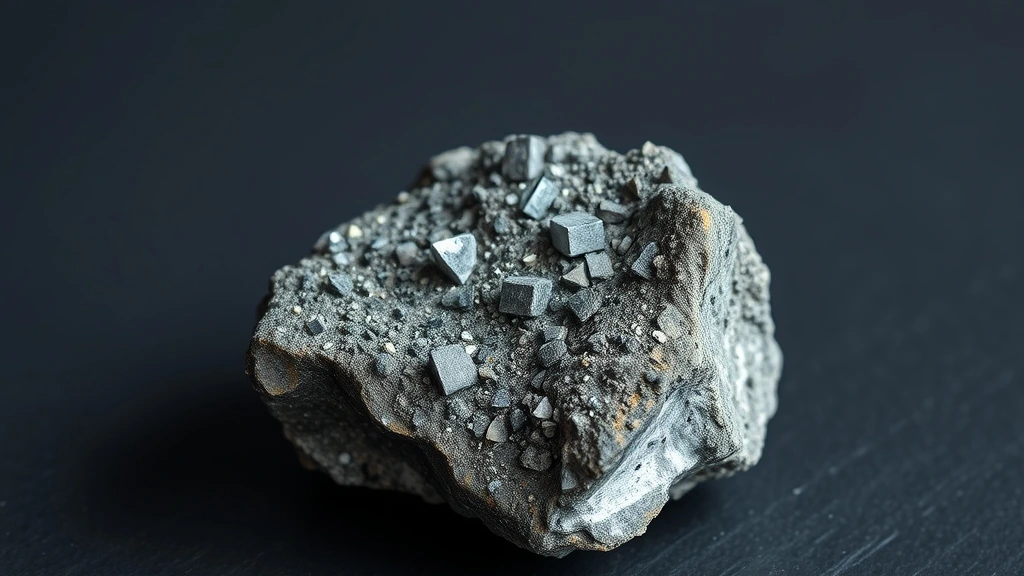
Arsenopyrite belongs to the natural mineral family of sulfide‑arsenides and is classified as a monoclinic crystal within the broader group of metallic sulfide minerals. Its dense, opaque habit and high specific gravity (5.9–6.2 g/cm³) reflect a tightly packed lattice of iron, arsenic, and sulfur atoms, a composition that has been mined historically for both ore and ornamental purposes.
What is Arsenopyrite? Geological Overview & Definition
Arsenopyrite is the most common arsenic‑bearing sulfide, occurring in hydrothermal veins, metamorphic schists, and as a minor constituent in gold‑bearing quartz reefs. Across ancient lapidary traditions, its metallic luster was prized for ornamental inlays, though its toxicity limited widespread decorative use.
The mineral forms prismatic to tabular crystals that often display a distinctive monoclinic symmetry, with cleavage parallel to {010} and a conchoidal fracture. Its occurrence is frequently associated with pyrite, chalcopyrite, and native gold, indicating a reducing environment rich in sulfur and arsenic during formation.
Arsenopyrite Chemical Composition & Crystallographic Properties
The ideal formula FeAsS represents a stoichiometric balance of iron, arsenic, and sulfur, yet natural specimens may exhibit minor cation substitution where nickel or cobalt replace iron in the lattice. This substitution subtly alters density and magnetic susceptibility without changing the overall monoclinic crystal system.
Arsenopyrite’s lattice is built from chains of FeS₆ octahedra linked by As atoms, creating a robust framework that resists deformation but reacts sharply with strong acids, releasing arsenic‑bearing gases. The mineral’s chromophore color centers arise from electronic transitions between Fe²⁺ and As³⁺, imparting its characteristic silver‑gray sheen.
Thermally, arsenopyrite is stable up to about 550 °C; beyond this, it decomposes, liberating arsenic vapor and forming iron oxides. This behavior is critical in ore‑processing, where controlled roasting separates valuable metals while managing hazardous emissions.
Esoteric Associations (Contextual Note)
In metaphysical lore, arsenopyrite is linked to the Root and Sacral chakras, where practitioners claim it supports grounding and material manifestation. Astrologically, it is associated with Capricorn and Scorpio, symbols of endurance and transformation, echoing the mineral’s resilience under geological pressure.
| Property | Specification |
|---|---|
| Mineral Group | Natural Mineral / Crystal |
| Chemical Formula | FeAsS |
| Mohs Hardness | 5.5–6 |
| Crystal System | Monoclinic |
| Specific Gravity (Density) | 5.9–6.2 |
| Refractive Index | 2.540 – 2.700 |
| Color & Optical Properties | Natural Arsenopyrite color spectrum and optical dispersion |
| Primary Mining Localities | Global primary localities |
| Water & Chemical Resistance | High (Safe for gentle water washing) |
| Chakra Alignment (Traditional) | Root Chakra, Sacral Chakra |
| Zodiac Affinity (Traditional) | Capricorn, Scorpio |
| Symbolic Meaning (Traditional) | Grounding, protection from negativity, and manifestation of material abundance |
Arsenopyrite Varieties & Color Spectrum
Arsenopyrite presents a diverse visual palette, ranging from deep steel-gray to lustrous brassy tones. The chemical composition of FeAsS dictates its metallic sheen and specific gravity. Crystallographic imperfections often create unique surface textures that distinguish high-grade specimens.
Classic Steel-Gray Arsenopyrite
This primary variety exhibits a uniform, dark metallic luster with distinct striae on crystal faces. It typically forms in hydrothermal veins associated with quartz and pyrite. The monoclinic crystal system allows for elongated, prismatic habits that are highly sought after by collectors.
Brassy-Gold Arsenopyrite
Weathering and oxidation can impart a warm, golden-bronze hue to the surface of this mineral. This color morph often indicates partial alteration or the presence of minor sulfide inclusions. Its refractive index remains high, ensuring a brilliant, mirror-like reflectivity under direct light.
Striated Prismatic Arsenopyrite
Characterized by prominent, parallel grooves running along the length of the crystal, this variety is a hallmark of the species. These growth striations result from periodic changes in the chemical environment during crystallization. Such specimens are prized for their geometric precision and diagnostic crystallographic features.
Massive Arsenopyrite
Occurring in dense, non-crystalline aggregates, this form lacks distinct geometric faces but retains a strong metallic luster. It is frequently found in massive sulfide deposits alongside pyrrhotite and chalcopyrite. The high density of 5.9–6.2 makes these chunks feel significantly heavier than their visual size suggests.
Quartz-Hosted Arsenopyrite
In this common geological association, arsenopyrite crystals are embedded within clear or smoky quartz matrices. The contrast between the transparent silica and the opaque, metallic arsenopyrite creates a striking visual aesthetic. These specimens are often cut into cabochons to highlight the inclusion patterns and crystal termination.
Where is Arsenopyrite Found? Geological Mining & Extraction
Arsenopyrite primarily forms in hydrothermal veins and skarn deposits, where hot, mineral-rich fluids interact with surrounding rock. It is frequently associated with other sulfide minerals such as pyrite, chalcopyrite, and sphalerite. These geological settings provide the necessary chemical conditions for the stable formation of the FeAsS structure.
Major mining regions include the Erzgebirge in Germany, the Andes in Chile, and the Appalachian Mountains in the United States. In many of these locations, arsenopyrite is extracted as a byproduct of copper and lead mining operations. The monoclinic crystal habit is particularly well-developed in the high-altitude deposits of the Andes, where rapid cooling preserves intricate crystal faces.
Historical Significance & Cultural Lore of Arsenopyrite
Ancient alchemists and early metallurgists often confused arsenopyrite with pyrite due to their similar metallic appearances. However, the presence of arsenic made it a critical, albeit dangerous, source for early arsenic compounds used in medicine and pigment production. Roman texts reference the use of arsenic-bearing minerals in glassmaking and metalworking, highlighting its industrial significance long before its gemological value was appreciated.
In Vedic and Greco-Roman traditions, minerals containing arsenic were viewed with a mix of reverence and caution. They were believed to possess potent protective properties against spiritual negativity, aligning with modern esoteric associations with the Root Chakra. Archaeological evidence suggests that processed arsenic from such ores was used in ancient Egyptian mummification processes and Chinese alchemical experiments.
Modern Uses & Jewelry Applications of Arsenopyrite
Arsenopyrite is prized by lapidarists for its metallic luster and distinctive greenish‑brown hue, making it suitable for cabochon and faceted pieces that showcase its monoclinic crystal structure. Jewelers often polish it into smooth, rounded cabochons for rings, pendants, and earrings, while larger specimens are carved into ornamental motifs for decorative panels or architectural accents. The mineral’s moderate hardness (5.5–6 on the Mohs scale) allows careful faceting without excessive wear.
- Cabochon cuts highlight the stone’s reflective surface.
- Faceted cuts accentuate its internal crystal planes.
- Ornamental carving emphasizes its natural growth habits.
Safety & Mineral Profile of Arsenopyrite
Arsenopyrite contains arsenic, a toxic element that can release hazardous vapors when heated or ground. Safe handling requires gloves, eye protection, and adequate ventilation, especially during polishing or cutting. Chemically, it is stable under normal conditions but may oxidize to brownish arsenates when exposed to air. As a collector mineral, it is valued primarily for scientific study and display rather than for crystal healing; any historical metaphysical claims should be approached with caution and verified against reputable sources.
Mineralogical Group and Planetary Lore of Arsenopyrite
Arsenopyrite belongs to the arsenide group, characterized by iron–arsenic sulfides. Its crystal system is monoclinic, and it typically forms in hydrothermal veins associated with copper and gold deposits. Historically, ancient cultures such as the Egyptians and Greeks recognized its metallic sheen and used it in jewelry and ornamental objects, though it was not widely ascribed symbolic meaning. In modern planetary geology, arsenopyrite has been detected on Mars, suggesting similar hydrothermal processes may have occurred on the Red Planet, thereby extending its significance beyond Earth.
How to Identify Real vs. Fake Arsenopyrite
Collectors often encounter artificial imitations of arsenopyrite, including dyed glass, synthetic iron sulfides, and polished stones that mimic its color. These replicas typically lack the mineral’s characteristic metallic luster and internal structure, and they may exhibit different hardness or density values.
Practical At-Home Authenticity Tests
- Temperature Test (Thermal Feel): Hold the stone in your hand; a genuine arsenopyrite will feel cool due to its relatively low thermal conductivity, whereas glass replicas will feel warmer.
- Specific Gravity & Weight Test: Weigh the specimen against a known mass of a similarly sized piece of quartz; arsenopyrite’s higher density (5.9–6.2 g/cm³) will make it noticeably heavier.
- Scratch & Hardness Test (Mohs Comparison): Use a standard Mohs hardness kit; arsenopyrite should scratch a piece of glass (hardness 5.5–6) but be scratched by a steel file (hardness 6.5).
- Microscopic & Loupe Inspection (Internal Inclusions): Under a 10× loupe, look for characteristic metallic inclusions or twinned crystal growth; synthetic glass will show uniform texture without such inclusions.
Arsenopyrite Valuation Factors, Grading & Pricing
Specimen aesthetic quality is the first decisive factor in market valuation. A pristine, well‑formed crystal habit with a vivid metallic luster and minimal surface oxidation commands a premium. Collectors prize specimens that display a clear, unbroken crystal face and a clean matrix that reveals the mineral’s characteristic *FeAsS* composition without intrusive host rock.
Rarity and specimen dimensions drive secondary price tiers. Larger, intact crystal clusters measured in centimeters or grams are highly sought after, especially when they exhibit no handling damage or surface abrasion. The absence of fractures or weathering preserves the mineral’s structural integrity, ensuring a higher value in both scientific and collector circles.
Mineralogical provenance and locality confer additional prestige. Specimens sourced from renowned arsenopyrite deposits—such as the Sudbury Basin in Canada or the Erzurum region of Turkey—carry a documented history that appeals to museum curators and academic researchers. Provenance records, including precise geographic coordinates and geological context, enhance the specimen’s credibility and market appeal.
How to Clean and Care for Arsenopyrite
Cleaning should be performed with warm soapy water and a soft cloth, gently wiping the surface to remove dust and oils. After cleaning, rinse the specimen with distilled water and pat dry with a lint‑free cloth. Avoid ultrasonic cleaners, as the vibration can induce microfractures in the monoclinic crystal lattice, compromising structural stability.
Cleansing and Recharging Arsenopyrite (Energetic Care)
To recharge the mineral’s energetic properties, place the cleaned specimen in a quiet, dimly lit space and allow it to absorb gentle moonlight for several hours. Herbal smudging with sage or palo santo can be used to clear residual energies, but the mineral should never be exposed to direct heat or intense sunlight, as thermal stress can alter its crystalline structure. Resting the arsenopyrite on a selenite charging slab during the night can further enhance its grounding and protective qualities, completing a safe, holistic care routine.
Frequently Asked Questions About Arsenopyrite
Arsenopyrite displays distinct mineralogical characteristics across its geological varieties and structural habits. Gemologists evaluate these natural varieties based on crystal habit, trace chromophore concentrations, and visual luster.
Primary Natural Arsenopyrite
The benchmark natural variety exhibiting diagnostic color saturation and classic crystallographic symmetry.
Distinct Geological Morphs of Arsenopyrite
Secondary regional and structural varieties formed under localized geological temperature and pressure conditions.
Is arsenopyrite safe to wear in the shower?
Yes, gentle water exposure is safe for this durable mineral. Arsenopyrite possesses high water resistance, allowing it to withstand brief contact with shower water without immediate degradation. However, prolonged submersion should be avoided to maintain surface luster. Always dry the stone thoroughly after exposure to prevent potential tarnishing of associated metallic inclusions.
How should I clean my arsenopyrite jewelry?
Use warm soapy water and a soft cloth for gentle maintenance. This method effectively removes oils and dust without damaging the crystal structure. Avoid using ultrasonic cleaners, as the vibrations can cause structural fractures in the monoclinic lattice. A soft-bristled brush helps dislodge debris from crevices safely.
What is the chemical composition of arsenopyrite?
The primary chemical formula is FeAsS, representing iron arsenic sulfide. This sulfosalt mineral forms through the combination of iron, arsenic, and sulfur in specific geological environments. Its composition distinguishes it from simpler sulfides like pyrite. Understanding this formula is crucial for identifying crystallographic properties and potential reactivity.
Which zodiac signs are aligned with arsenopyrite?
Capricorn and Scorpio are the primary astrological associations for this stone. These earth and water signs resonate with the mineral’s grounding energy and protective qualities. In historical metaphysical lore, these alignments emphasize stability and deep introspection. Wearers often seek this stone to enhance material abundance and personal resilience.
What chakras does arsenopyrite activate?
It primarily activates the Root Chakra and the Sacral Chakra. These energy centers govern physical stability, survival instincts, and creative vitality. The mineral’s dense, metallic nature supports deep grounding practices. It helps anchor spiritual energy into the physical body, promoting a sense of security and presence.
Is arsenopyrite toxic to handle or wear?
While the mineral itself is stable, caution is advised due to arsenic content. Arsenopyrite contains arsenic, a heavy metal that can be harmful if ingested or inhaled as dust. Skin contact with intact crystals is generally considered safe for most users. However, avoid crushing or polishing the stone without proper ventilation and protective equipment.
How hard is arsenopyrite on the Mohs scale?
It registers between 5.5 and 6 on the Mohs hardness scale. This moderate hardness makes it suitable for jewelry but less durable than quartz or corundum. It can be scratched by harder materials like topaz or diamond. Careful handling is required to prevent surface abrasions that may compromise its refractive index and visual appeal.
What is the crystal system of arsenopyrite?
Arsenopyrite crystallizes in the monoclinic system, often forming prismatic or tabular habits. This structural arrangement influences its cleavage patterns and overall geometric appearance. The crystals frequently exhibit a metallic luster with distinct striations on their faces. Recognizing these crystallographic features aids in accurate identification and differentiation from similar sulfides.