
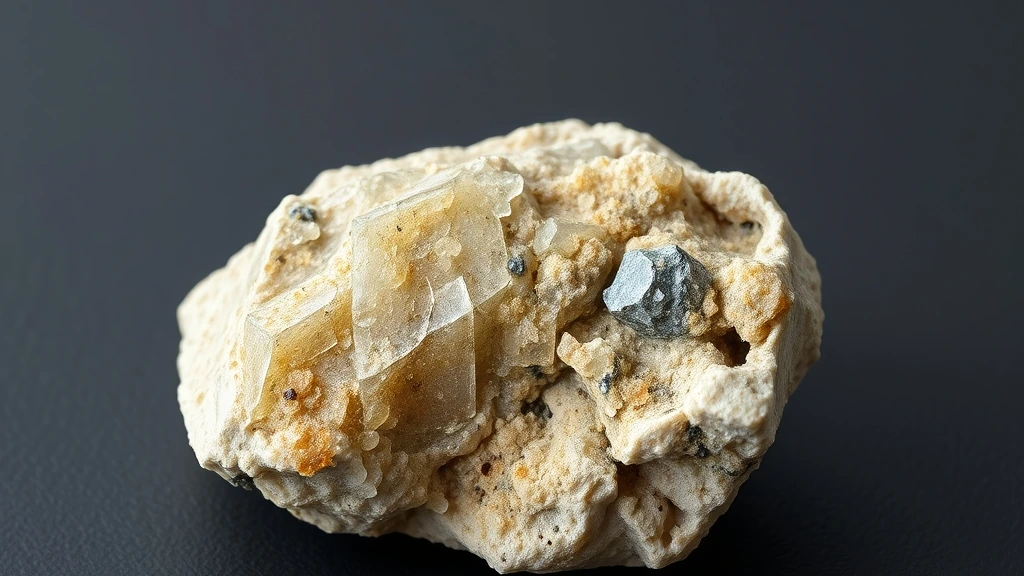
Aurichalcite belongs to the arsenate mineral class, forming in oxidized zones of hydrothermal veins where copper, zinc, and iron combine with arsenic. As a naturally occurring mineral, it crystallizes in the monoclinic system and is often found as fibrous or prismatic crystals, sometimes forming earthy aggregates. Its low hardness and vivid coloration have made it a curiosity among lapidaries and mineralogists alike.
What is Aurichalcite? Geological Overview & Definition
Aurichalcite is a monoclinic arsenate mineral that crystallizes in the *P2₁/c* space group. It is typically found as fibrous, translucent crystals ranging from pale green to yellow‑green, often in the oxidized zones of copper‑rich veins. The mineral’s composition reflects a complex interplay of copper, zinc, and iron cations coordinated with arsenate groups and water molecules.
In mineralogical taxonomy, Aurichalcite is classified under the *arsenate* group, closely related to minerals such as scorodite and bischofite. Its occurrence is usually secondary, forming through the alteration of primary sulfide minerals in the presence of oxidizing fluids. The resulting crystals are prized for their delicate color and unique crystal habits.
Aurichalcite Chemical Composition & Crystallographic Properties
The crystal lattice of Aurichalcite is monoclinic, with unit cell parameters that accommodate a network of Cu²⁺, Zn²⁺, and Fe³⁺ cations linked to AsO₄ tetrahedra. Cation substitution occurs readily, allowing Fe to replace Zn or Cu, which subtly alters the crystal chemistry and color. The presence of water molecules in the lattice contributes to its softness and makes the mineral sensitive to acid attack, often dissolving in dilute hydrochloric acid.
Chromophore centers in Aurichalcite arise from the electronic transitions of Cu²⁺ ions, producing its characteristic greenish hues. The mineral’s optical properties include a refractive index range of 1.655–1.744, with slight birefringence typical of monoclinic minerals. Thermal analysis shows that Aurichalcite loses water at moderate temperatures, leading to a collapse of the crystal structure and a change in color.
Overall, Aurichalcite’s monoclinic symmetry, complex cation chemistry, and sensitivity to environmental conditions make it a fascinating subject for both mineral collectors and crystallographers.
| Property | Specification |
|---|---|
| Mineral Group | Natural Mineral / Crystal |
| Chemical Formula | Cu(Zn,Fe)₃(AsO₄)₂·4H₂O |
| Mohs Hardness | 2 |
| Crystal System | Monoclinic |
| Specific Gravity (Density) | 3.96 |
| Refractive Index | n α = 1.655 n β = 1.740 n γ = 1.744 |
| Color & Optical Properties | Natural Aurichalcite color spectrum and optical dispersion |
| Primary Mining Localities | Global primary localities |
| Water & Chemical Resistance | Sensitive (Avoid prolonged water soaking) |
| Chakra Alignment (Traditional) | Heart Chakra, Throat Chakra |
| Zodiac Affinity (Traditional) | Taurus, Libra |
| Symbolic Meaning (Traditional) | Harmony, emotional balance, and communication |
Aurichalcite Varieties & Color Spectrum
Aurichalcite exhibits a distinct color spectrum ranging from pale lemon to deep olive green, driven by trace iron substitution. The most common commercial grade displays a translucent, apple-green hue with a vitreous luster.
Apple Green Aurichalcite
This dominant variety forms in hydrothermal veins where copper and zinc arsenates precipitate rapidly. Its high transparency allows light to penetrate, enhancing the vivid green tones prized by collectors.
Olive Green Aurichalcite
Richer in iron impurities, this morph presents a darker, earthier olive tone compared to its lighter counterparts. It often appears in massive aggregates rather than distinct crystals, making it common in rough stone markets.
Lemon Yellow Aurichalcite
Characterized by lower iron content, this rare variety exhibits a bright, citrus-like yellow hue. It typically occurs as small, delicate crystals within quartz matrix deposits, limiting its availability for large cabochons.
Blue-Green Aurichalcite
Occasionally, higher copper concentrations shift the hue toward a teal or blue-green shade. This transitional color is geologically significant, indicating specific oxidation states during crystal growth.
Matrix Aurichalcite
Found embedded in quartz or calcite host rocks, this variety features small crystals scattered across a white or gray base. Lapidaries often cut these pieces to showcase the contrast between the green crystals and the pale matrix.
Where is Aurichalcite Found? Geological Mining & Extraction
Aurichalcite primarily forms in the oxidized zones of copper and lead-zinc ore deposits, often associated with pyromorphite and wulfenite. These secondary minerals develop through the weathering of primary sulfide ores in supergene environments.
Major historical sources include the Rammelsberg mine in Germany and the Butte district in Montana, USA. Modern extraction focuses on small-scale artisanal mining, where careful hand-picking is essential due to the mineral’s low Mohs hardness of 2.
Historical Significance & Cultural Lore of Aurichalcite
Ancient Greco-Roman lapidaries likely categorized aurichalcite among the “green stones,” associating its hue with Venus and the element of water. While not explicitly named in classical texts, its appearance in mineralogical collections dates back to the 18th century.
In Vedic traditions, green stones were revered for their connection to the heart chakra and emotional equilibrium. Archaeological evidence suggests that similar copper-arsenate minerals were used in ritualistic contexts across ancient Mediterranean civilizations.
Modern Uses & Jewelry Applications of Aurichalcite
Aurichalcite is prized for its soft, translucent quality, making it ideal for cabochon and faceted treatments that accentuate its subtle green‑blue hues. Lapidaries often employ careful polishing to reveal the mineral’s delicate crystal faces, while ornamental carving showcases its ability to hold fine detail. In contemporary jewelry, aurichalcite is set in rings, pendants, and earrings, frequently paired with complementary stones such as turquoise or amethyst.
- Cabochon polishing for smooth, polished surfaces
- Faceting to enhance refractive brilliance
- Ornamental carving for decorative panels and figurines
Metaphysical Properties & Traditional Meaning of Aurichalcite
According to historical traditions and metaphysical lore, aurichalcite is associated with harmony and emotional balance, serving as a conduit for calm and clarity. Across ancient Mediterranean and Vedic lapidary practices, the stone is believed to soothe emotional turbulence and promote open, honest communication. Its gentle vibration is thought to align the Heart Chakra and Throat Chakra, fostering compassion and self‑expression. In general metaphysical circles, aurichalcite is also linked to the Taurus and Libra zodiac signs, reflecting its grounding yet balanced nature.
Which Chakra and Zodiac Signs Align with Aurichalcite?
The Heart Chakra (Anahata) is the central energy center for love and compassion, and aurichalcite’s soothing green tones resonate with this chakra’s vibration. By encouraging emotional equilibrium, the stone supports the heart’s ability to give and receive love freely.
The Throat Chakra (Vishuddha) governs communication and truth‑telling; aurichalcite’s clear, luminous facets are said to amplify verbal expression and creative articulation. In the realm of astrology, the stone aligns with Taurus and Libra, both signs that value balance, stability, and harmonious relationships.
How to Identify Real vs. Fake Aurichalcite
Artificial imitations of aurichalcite often appear as dyed glass or synthetic crystals that lack the mineral’s characteristic softness and specific gravity. These replicas may display uniform coloration or an unnatural polish that does not mimic the subtle internal inclusions found in genuine specimens.
Practical At-Home Authenticity Tests
- Temperature Test (Thermal Feel): Gently touch the stone; real aurichalcite feels cool to the touch, whereas glass or synthetic materials may feel warmer due to different thermal conductivity.
- Specific Gravity & Weight Test: Compare the stone’s weight to a known sample of similar size; genuine aurichalcite should be noticeably lighter than quartz or glass of the same dimensions.
- Scratch & Hardness Test (Mohs Comparison): Use a standard Mohs hardness kit; aurichalcite should scratch easily on a glass plate (Mohs 2) and be scratched by a steel nail (Mohs 5.5).
- Microscopic & Loupe Inspection (Internal Inclusions): Examine under a loupe for fine, fibrous inclusions or subtle color zoning typical of natural aurichalcite; synthetic replicas often lack these internal features.
Aurichalcite Valuation Factors, Grading & Pricing
Market value hinges primarily on Color Saturation, where deep, vibrant green hues command higher premiums than pale or yellowish variants. Collectors seek specimens exhibiting a natural, waxy luster that enhances the stone’s visual depth without artificial enhancement. The absence of white veining or dull patches significantly elevates the perceived quality and desirability of the piece.
Pricing is determined by Crystal Size & Weight (Grams), with larger, intact specimens fetching substantial sums in the collector market. Raw crystals are valued for their natural formation, while tumbled stones are graded strictly on polish quality and surface clarity. Natural matrix inclusions can add geological interest, but excessive fracturing or impurities typically reduce the overall market value.
Ethical Sourcing & Locality Premium plays a critical role in holistic and high-end collector markets. Provenance from well-known, historically significant mining regions often justifies a price premium due to rarity and geological prestige. Buyers increasingly demand documentation ensuring responsible extraction practices, which further influences the final valuation of the specimen.
How to Clean and Care for Aurichalcite
Due to its low Mohs Hardness of 2, aurichalcite is highly susceptible to physical abrasion and structural damage. You must wipe the surface briefly with a slightly damp cloth and dry it immediately to prevent water spots. Avoid using ultrasonic cleaners, as the vibrations can cause structural fractures in this delicate monoclinic crystal system.
Store the stone in a dry, low-humidity environment to prevent the hydration state from destabilizing. Never submerge the specimen in water or expose it to harsh chemical cleaners. Handle the mineral with care, as its softness makes it prone to scratching and chipping during routine maintenance.
Cleansing and Recharging Aurichalcite (Energetic Care)
For energetic maintenance, place the stone on a selenite charging slab to allow for gentle, passive energy restoration. This method avoids physical contact with water or abrasive surfaces, preserving the crystal’s integrity. Alternatively, expose the specimen to gentle moonlight for several hours to align its vibrational frequency.
Herbal smudging with sage or palo santo is another safe, dry method for clearing stagnant energy. Hold the stone above the smoke without direct contact to prevent soot accumulation on the surface. These holistic practices respect the mineral’s physical limitations while addressing its metaphysical applications.
Frequently Asked Questions About Aurichalcite
Aurichalcite displays distinct mineralogical characteristics across its geological varieties and structural habits. Gemologists evaluate these natural varieties based on crystal habit, trace chromophore concentrations, and visual luster.
Primary Natural Aurichalcite
The benchmark natural variety exhibiting diagnostic color saturation and classic crystallographic symmetry.
Distinct Geological Morphs of Aurichalcite
Secondary regional and structural varieties formed under localized geological temperature and pressure conditions.
Is aurichalcite safe to wear in the shower?
No, prolonged exposure to water should be avoided. Aurichalcite’s hydrated structure makes it vulnerable to moisture; extended soaking can cause surface clouding or micro‑fractures. A brief wipe with a damp cloth followed by immediate drying is acceptable, but showering or swimming poses a risk to its integrity.
How should I clean my aurichalcite jewelry?
Use a soft, dry microfiber cloth and gently wipe the stone. Because aurichalcite is water‑sensitive, ultrasonic baths or liquid cleaners can induce internal stress and lead to cracking. A light dusting with a soft brush removes loose particles without compromising the mineral’s delicate lattice.
Can aurichalcite be treated with ultrasonic cleaners?
Ultrasonic cleaning is not recommended for aurichalcite. The high‑frequency vibrations can create micro‑fractures in this soft, monoclinic mineral (Mohs hardness 2). Maintaining its appearance is best achieved through careful manual wiping and prompt drying after any brief damp contact.
What zodiac signs are associated with aurichalcite?
Aurichalcite is linked to Taurus and Libra. In astrological gem lore, these signs are believed to benefit from the stone’s stabilizing energy, aligning with the earth‑grounded nature of Taurus and the balanced, diplomatic qualities of Libra. The association is rooted in centuries‑old metaphysical traditions.
Which chakras does aurichalcite influence?
It resonates with the Heart Chakra and Throat Chakra. The mineral’s copper‑zinc composition is thought to promote emotional harmony and clear communication, supporting the energetic centers governing love, compassion, and expressive speech. Practitioners often place it over these chakras during meditation.
Is aurichalcite suitable for everyday wear?
Yes, but with careful handling. Its low hardness (2 on the Mohs scale) makes it prone to scratches, so it is best set in protective settings such as bezel or pendant designs that limit contact. Regular inspection and gentle cleaning help preserve its vibrant blue‑green hue.
Does aurichalcite have any notable physical properties for identification?
Its monoclinic crystals and distinct refractive indices are key identifiers. With nα = 1.655, nβ = 1.740, nγ = 1.744, aurichalcite exhibits noticeable birefringence and a characteristic vitreous to pearly luster. The density of 3.96 g/cm³ and the presence of arsenate groups further confirm its identity.
Can aurichalcite be used in metaphysical practices for emotional balance?
Yes, it is traditionally employed to foster harmony and communication. Practitioners cite its alignment with the Heart and Throat Chakras to aid in emotional equilibrium and articulate self‑expression. Placing the stone on the chest or throat during meditation is a common technique.