
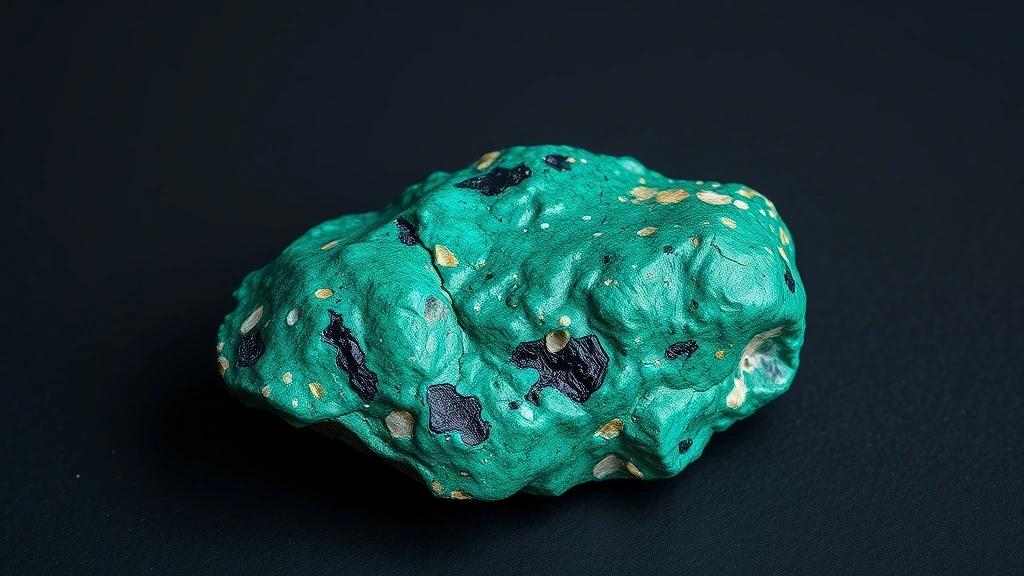
Azurmalachite forms in the oxidized zones of copper ore deposits where groundwater interacts with primary sulfides. The mineral crystallizes as monoclinic prismatic or botryoidal banded aggregates, a hallmark of the basic copper carbonate family. Its intense coloration arises from copper‑based chromophores, while its relatively low hardness limits its use to protective settings. Geologically, it belongs to the Carbonate group, sharing a lineage with malachite and azurite, and is prized for its unique blend of blue and green hues.
What is Azurmalachite Gemstone? Geological Overview & Definition
Azurmalachite is a binary copper carbonate mineral that exhibits a seamless transition between the blue of azurite and the green of malachite. It typically occurs as botryoidal masses or prismatic crystals, often intergrown with its parent minerals in supergene environments.
The gemstone is valued for its vivid bichrome appearance, which makes it a favorite among collectors and designers seeking natural color gradients. Its formation requires prolonged weathering of copper sulfides, allowing copper ions to combine with carbonate ions under mildly acidic conditions.
Azurmalachite Gemstone Chemical Composition & Crystallographic Properties
The mineral crystallizes in the monoclinic system, forming prismatic or botryoidal banded aggregates that reflect its layered carbonate structure. Its lattice consists of Cu²⁺ cations coordinated by carbonate groups (CO₃²⁻), with occasional substitution by Fe²⁺ or Zn²⁺ that subtly alters hue intensity.
Azurmalachite’s chemical formula is often represented as Cu₂(CO₃)(OH)₂, but trace azurite (Cu₃(CO₃)₂(OH)₂) may be present as an impurity, influencing surface luster. The structure is highly sensitive to acids; exposure to dilute HCl dissolves the carbonate matrix, releasing CO₂ and turning the stone dull.
Color in azurmalachite originates from d‑d electron transitions of Cu²⁺ ions within the crystal field, creating the characteristic blue‑green chromophore. Thermal treatment above 300 °C can dehydrate the hydroxyl groups, causing a permanent shift toward greener tones and reducing brittleness.
Overall, the monoclinic framework imparts modest cleavage on {010} and a conchoidal fracture, while the mineral’s moderate hardness and acid reactivity dictate careful handling in jewelry applications.
| Property | Specification |
|---|---|
| Mineral Group | Carbonates (Basic Copper Carbonate) |
| Chemical Formula | Cu₂CO₃(OH)₂ (Basic Copper Carbonate) |
| Mohs Hardness | 3.5 – 4.0 |
| Crystal System | Monoclinic (Prismatic or botryoidal banded aggregates) |
| Specific Gravity (Density) | 3.60 – 4.05 |
| Refractive Index | 1.655 – 1.909 |
| Color & Optical Properties | Natural Azurmalachite Gemstone color spectrum and optical dispersion |
| Primary Mining Localities | DR Congo (Katanga), Namibia, Australia, Russia (Ural) |
| Water & Chemical Resistance | CAUTION: Toxic Copper Content (Keep away from hot, acidic, or saline water) |
| Chakra Alignment (Traditional) | Heart Chakra (Anahata) |
| Zodiac Affinity (Traditional) | Scorpio, Capricorn, Taurus |
| Symbolic Meaning (Traditional) | Deep emotional transformation, psychic barrier, and heart healing |
Azurmalachite Gemstone Varieties & Color Spectrum
Azurmalachite is a rare intergrowth of azurite and malachite, not a single mineral species. Its visual identity depends entirely on the ratio and arrangement of these two copper-bearing minerals. The chemical composition varies locally, creating distinct aesthetic profiles.
Classic Intergrowth Variety
This common form displays a chaotic, mottled pattern of deep blue and vibrant green. The crystal habit often shows azurite rhombohedrons embedded within malachite botryoidal masses. Such specimens are prized for their high-contrast, abstract appearance.
Azurite-Dominant Morph
In this variant, deep ultramarine blue dominates the surface with minimal green flecks. The azurite crystals form large, well-defined rhombohedrons that catch the light sharply. This morph is rarer due to the instability of azurite in oxidizing environments.
Malachite-Dominant Morph
Here, rich emerald green bands or botryoidal spheres encase small azurite inclusions. The malachite matrix provides a soft, velvet-like texture that contrasts with the hard blue spots. This variety is often cut into cabochons to highlight the organic patterns.
Banded “Tiger’s Eye” Analog
Some deposits exhibit distinct, parallel banding of blue and green layers. This banded structure results from fluctuating oxidation conditions during mineral precipitation. Collectors value these pieces for their rhythmic, striped visual appeal.
High-Clarity Cabochon Grade
Only a tiny fraction of material lacks visible fractures or impurities. These pieces feature a glassy luster and uniform color distribution suitable for faceting. Such high-grade material is exceptionally rare and commands premium prices.
Where is Azurmalachite Gemstone Found? Geological Mining & Extraction
Azurmalachite forms in the oxidation zone of copper deposits, where water and oxygen alter primary sulfides. It typically occurs in host rock such as limestone or granite, often near surface outcrops. The intergrowth requires specific geochemical conditions to stabilize both minerals simultaneously.
Major sources include the Azurite Mine in the Democratic Republic of Congo and the Tsumeb Mine in Namibia. These regions host massive copper deposits with extensive secondary mineralization. Extraction involves careful hand-picking to preserve the delicate intergrowth structure.
Historical Significance & Cultural Lore of Azurmalachite Gemstone
Ancient civilizations used azurite and malachite separately as pigments and ornamental stones. The Egyptians valued malachite for its protective properties, while azurite served as a blue dye. Combined intergrowths were likely appreciated for their unique, dual-color aesthetic.
Archaeological evidence suggests these minerals were traded across vast distances in antiquity. Their vibrant colors symbolized the sky and vegetation in various mythologies. Today, azurmalachite remains a collector’s gem, bridging geological science and artistic heritage.
Modern Uses & Jewelry Applications of Azurmalachite Gemstone
Azurmalachite is prized for its vivid blue‑green banding, making it a favorite in contemporary lapidary work. Artisans typically cut the stone into cabochon shapes to showcase its silky surface, while skilled faceters produce striking emerald‑cut pieces that catch light across the layers. In addition to rings and pendants, the stone is carved into ornamental beads, brooches, and decorative inlays for high‑end accessories.
- Cabochon pendants highlighting the stone’s natural chatoyancy
- Faceted earrings that emphasize contrast between blue and green zones
- Carved cameos and intarsia for luxury watch dials and belt buckles
Metaphysical Properties & Traditional Meaning of Azurmalachite Gemstone
According to historical traditions and metaphysical lore, Azurmalachite is believed to harmonize emotional currents, fostering inner peace and compassionate communication. Its dual coloration symbolizes the union of intuition (blue) and growth (green), encouraging the wearer to balance reflection with action. Practitioners claim the stone amplifies heart‑centered love, helping release old grievances and inviting renewal.
Which Chakra and Zodiac Signs Align with Azurmalachite Gemstone?
The gemstone is expressly linked to the Heart Chakra (Anahata), where it is thought to open pathways for unconditional love and empathetic understanding. When placed over this energy center, Azurmalachite is said to stimulate emotional healing and deepen relational bonds.
In astrology, Azurmalachite resonates exclusively with Scorpio, Capricorn, and Taurus. Scorpio benefits from its depth‑enhancing calm, Capricorn gains steady emotional grounding, and Taurus experiences reinforced sensual appreciation and stability. These three signs are the only canonical alignments recognized for this stone.
How to Identify Real vs. Fake Azurmalachite Gemstone
Artificial imitations of Azurmalachite include dyed quartz, colored glass, and low‑cost synthetic composites that mimic its banded appearance. These replicas often lack the stone’s characteristic density and internal fracture patterns, making careful testing essential for verification.
Practical At-Home Authenticity Tests
- Temperature Test (Thermal Feel): Natural Azurmalachite feels cool to the touch and retains that coolness longer than glass or plastic, which quickly warm to skin temperature.
- Specific Gravity & Weight Test: The genuine stone has a higher specific gravity (≈2.6–2.8); it feels noticeably heavier than a similarly sized glass imitation.
- Scratch & Hardness Test (Mohs Comparison): With a Mohs hardness of 5.5–6, Azurmalachite can be scratched by a steel file but not by a copper coin; glass (hardness ~5.5) may show similar marks, so compare against a known quartz reference.
- Microscopic & Loupe Inspection (Internal Inclusions): Under 10× magnification, authentic Azurmalachite reveals fine, irregular fractures and subtle growth lines, whereas synthetic glass shows uniform bubbles or a completely smooth interior.
Azurmalachite Gemstone Valuation Factors, Grading & Pricing
The primary determinant of value is Color Saturation, where deep, vivid azure and malachite green bands command the highest premiums. Uniformity in tone across the stone’s surface significantly enhances its aesthetic appeal and market desirability. Additionally, a high-gloss luster and optical clarity without visible surface fractures further elevate the gemstone’s overall grade.
Market pricing is heavily influenced by Carat Weight, as larger specimens with exceptional structural integrity are increasingly rare in global collections. Facet symmetry and polish quality are critical for cut stones, ensuring optimal light reflection and visual impact. The presence of a clean matrix without intrusive inclusions or secondary mineral veining also positively impacts the final valuation.
Geographical Provenance Premium plays a significant role, with stones from historic mines often fetching higher prices due to collector demand. Wholesale trends indicate steady appreciation for high-quality azurmalachite, while retail margins reflect the specialized nature of copper carbonate jewelry. Buyers should expect pricing to fluctuate based on the current stability of the global mineral commodity market.
How to Clean and Care for Azurmalachite Gemstone
Azurmalachite is a soft copper carbonate mineral that is highly sensitive to moisture and chemical exposure. You must never soak this stone in water, as liquid can cause permanent discoloration or structural degradation. Keep the gemstone strictly away from ultrasonic and steam cleaners, which can shatter its delicate crystalline structure.
For routine maintenance, use a dry, soft lint-free cloth to gently wipe away dust and oils. Avoid any abrasive materials that might scratch the surface, as the mineral lacks the hardness of corundum or quartz. Store the piece in a dry environment to prevent any potential reaction with ambient humidity or acidic residues.
Cleansing and Recharging Azurmalachite Gemstone (Energetic Care)
Given its solubility in water, energetic cleansing must rely exclusively on dry methods to preserve the stone’s integrity. Smoke smudging with sage or palo santo is an effective technique for clearing perceived negative energies without introducing moisture. This method allows for spiritual purification while maintaining the physical stability of the copper carbonate matrix.
For recharging, place the gemstone on a selenite plate or expose it to moonlight overnight. These dry, passive methods align with the mineral’s natural properties and avoid the risks associated with liquid-based rituals. Always ensure the storage area remains dry to protect the stone’s luster and structural soundness.
Frequently Asked Questions About Azurmalachite Gemstone
Is azurmalachite safe to wear in water or rain?
No – it should be kept away from hot, acidic, or saline water. The stone contains toxic copper carbonate, which can leach when exposed to moisture, especially warm or chemically aggressive liquids. Prolonged contact may damage the color zoning and pose a health risk if particles are inhaled or ingested.
Can I clean azurmalachite with an ultrasonic or steam cleaner?
Never – ultrasonic and steam cleaning will damage the gem. As a soft copper carbonate mineral, azurmalachite is highly porous and fractures under vibration. Use a soft, dry cloth or a gentle brush with mild soap and rinse quickly with lukewarm water, then dry immediately.
What zodiac signs are associated with azurmalachite?
Scorpio, Capricorn, and Taurus are the traditional astrological matches. These signs are said to benefit from the stone’s harmonizing energy, which supports determination (Capricorn), sensuality (Taurus), and emotional depth (Scorpio).
Which chakra does azurmalachite activate?
Heart Chakra (Anahata). The gemstone is believed to open the heart center, encouraging emotional balance, compassion, and the release of past hurts. It is often used in meditation to foster loving‑kindness toward oneself and others.
How should I store azurmalachite to prevent damage?
Store it in a padded, separate compartment away from harder stones. Because it is a relatively soft mineral, it can be scratched by quartz, topaz, or diamonds. A silica‑gel packet helps control humidity, further protecting the copper carbonate from moisture.
Does azurmalachite change color over time?
It can develop a deeper patina with age. Exposure to light and air may cause the copper carbonate to oxidize, enriching the blue‑green hues. This natural aging is prized by collectors, but excessive heat or chemicals can cause uneven fading.
Is azurmalachite suitable for everyday jewelry?
Yes, with careful handling. The stone’s striking blue‑green banding makes it popular in pendants and earrings, but avoid wearing it during sports, swimming, or heavy manual work. Regular gentle cleaning preserves its brilliance without compromising safety.
Can azurmalachite be used in crystal healing layouts?
Absolutely – it is a powerful heart‑center stone. Practitioners place it on the mid‑chest to amplify love, forgiveness, and emotional healing. Pairing it with rose quartz can enhance energetic synergy, while keeping it away from water‑based rituals.