
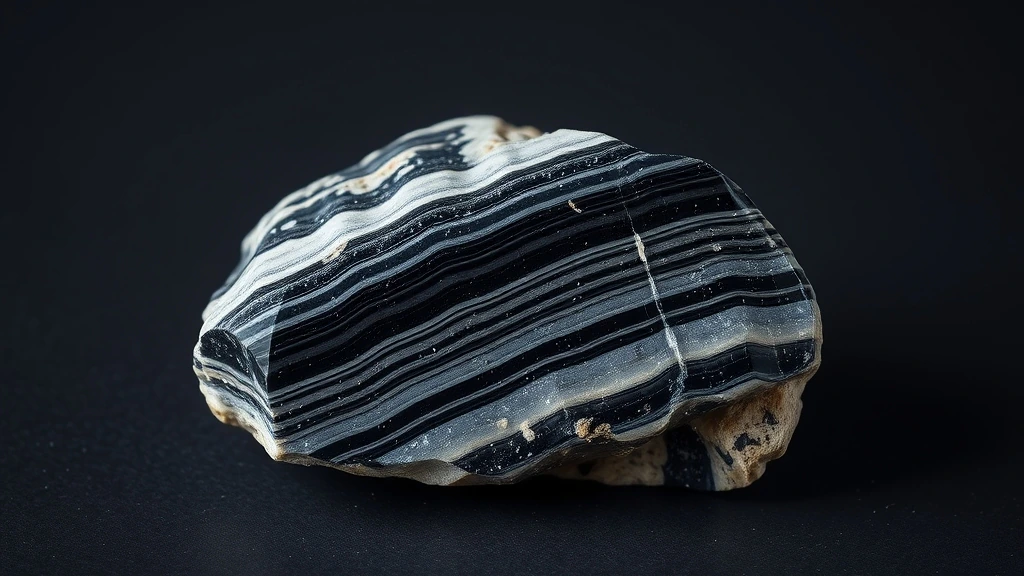
Black Banded Onyx belongs to the silicate mineral class, specifically the chalcedony subgroup of quartz. As a microcrystalline aggregate, it forms through the slow precipitation of silica in silica‑rich cavities, resulting in a fibrous, fibrous‑trigonal lattice that is visually distinct yet structurally homogeneous. The stone’s banding pattern is a product of alternating layers of pure silica and silica infused with trace iron or manganese, giving it its characteristic contrast.
What is Black Banded Onyx? Geological Overview & Definition
Black Banded Onyx is a microcrystalline form of quartz, classified within the chalcedony group. Its defining feature is the rhythmic banding of black or dark gray layers interspersed with lighter bands, created by variations in trace element concentration during formation. The stone is typically found in volcanic or sedimentary cavities where silica-rich fluids have slowly crystallized. Its fibrous, trigonal lattice confers a subtle internal texture that enhances its optical play.
Black Banded Onyx Chemical Composition & Crystallographic Properties
The true crystal system of Black Banded Onyx is Trigonal (Microcrystalline fibrous Chalcedony), meaning its internal structure consists of short, parallel fibrous chains aligned along a single axis. The lattice is essentially that of quartz (SiO₂), but the fibrous arrangement leads to a highly anisotropic microstructure. Cation substitution is minimal; however, trace amounts of iron (Fe²⁺/Fe³⁺) and manganese (Mn²⁺) act as chromophores, producing the characteristic black bands. In comparative mineralogical collections, practitioners and geologists frequently study Blue Pacific Agate alongside this crystal to appreciate their subtle energetic and structural differences.
Black Banded Onyx is chemically inert to most acids, resisting etching by dilute hydrofluoric or nitric acid. Its thermal stability is high; it can withstand temperatures up to 600 °C before undergoing structural changes, though prolonged heating may cause slight color fading due to the loss of trace chromophores. The stone’s refractive index ranges from 1.544 to 1.553, giving it a moderate brilliance that is enhanced by the banding.
| Property | Specification |
|---|---|
| Mineral Group | Silicates (Chalcedony / Quartz Group) |
| Chemical Formula | SiO₂ (Microcrystalline Chalcedony with parallel banding) |
| Mohs Hardness | 6.5 – 7.0 |
| Crystal System | Trigonal (Microcrystalline fibrous Chalcedony) |
| Specific Gravity (Density) | 2.60 – 2.65 |
| Refractive Index | 1.544 – 1.553 |
| Color & Optical Properties | Natural Black Banded Onyx color spectrum and optical dispersion |
| Primary Mining Localities | Brazil, India, Madagascar, Uruguay, Germany |
| Water & Chemical Resistance | High (Safe in warm soapy water) |
| Chakra Alignment (Traditional) | Root Chakra (Muladhara) |
| Zodiac Affinity (Traditional) | Leo, Capricorn, Scorpio |
| Symbolic Meaning (Traditional) | Willpower, emotional discipline, grounding protection, and stamina |
Black Banded Onyx Varieties & Color Spectrum
Black Banded Onyx displays distinct mineralogical characteristics across its geological varieties and structural habits. Gemologists evaluate these natural varieties based on crystal habit, trace chromophore concentrations, and visual luster.
Primary Natural Black Banded Onyx
The benchmark natural variety exhibiting diagnostic color saturation and classic crystallographic symmetry.
Distinct Geological Morphs of Black Banded Onyx
Secondary regional and structural varieties formed under localized geological temperature and pressure conditions.
Classic Black Onyx
This variety features a jet-black body with distinct white or light gray bands. The banding results from alternating layers of chalcedony and silica-rich impurities during deposition. It is the most commercially recognized form for carvings and jewelry.
Banded Onyx
Characterized by multiple parallel bands of varying colors, including brown, gray, and white. These stripes form through rhythmic changes in silica saturation within the host rock. The pattern is highly sought after for decorative architectural elements.
Agate Onyx
This hybrid displays a more chaotic, less uniform banding pattern than classic onyx. It often contains conchoidal fractures and irregular color transitions. Geologists classify it as a transitional form between agate and true onyx.
Black Onyx with Red Inclusions
Rare specimens exhibit deep black bands interspersed with vivid red or orange streaks. These colors arise from iron oxide impurities trapped during crystal growth. Such pieces are prized for their dramatic visual contrast.
Brazilian Black Onyx
Originating from the state of Minas Gerais, this variety is known for its intense, uniform darkness. It typically lacks prominent banding, appearing almost solid black to the naked eye. This high-quality material is preferred for high-end lapidary work.
African Black Onyx
Found primarily in Madagascar and South Africa, this type often shows subtle gray or white banding. The stone possesses a waxy luster and exceptional translucency in thin slices. It is widely used in modern fashion jewelry and talismans.
Where is Black Banded Onyx Found? Geological Mining & Extraction
Black banded onyx forms in hydrothermal cavities within volcanic and sedimentary rocks. These deposits typically occur in basaltic lava flows where silica-rich fluids precipitated over millions of years. The banding reflects periodic changes in fluid chemistry and temperature.
Major commercial sources include Brazil, India, Madagascar, and Uruguay. Mining operations often involve open-pit extraction to access large, contiguous blocks of stone. The material is then cut into slabs for further processing and polishing.
Historical Significance & Cultural Lore of Black Banded Onyx
Ancient civilizations revered onyx for its perceived protective and grounding properties. In Greco-Roman mythology, the stone was associated with the god Apollo and used in amulets. Egyptian artisans carved onyx into scarabs and seals, believing it offered spiritual defense.
Throughout history, onyx has been a symbol of strength and emotional stability. Vedic texts reference the stone for its ability to anchor the wearer to the earth. Its enduring legacy persists in modern gemology as a stone of resilience.
Modern Uses & Jewelry Applications of Black Banded Onyx
Lapidaries primarily cut black banded onyx into cabochons to showcase its smooth, polished surface and distinct parallel banding. Faceting is less common due to the stone’s microcrystalline structure, which lacks the transparency needed for brilliant light return. The material’s durability makes it ideal for everyday jewelry and intricate ornamental carvings.
- Cabochon Cuts: Dominant in rings, pendants, and earrings to highlight the stone’s luster and banding patterns.
- Ornamental Carvings: Used in cameos, intaglios, and architectural inlays for its resistance to chipping.
- Watch Components: Frequently carved into bezels and dials for luxury timepieces due to its Mohs hardness of 6.5–7.0.
- Sculptural Elements: Employed in decorative boxes and small statues where a matte or high-polish finish is desired.
Metaphysical Properties & Traditional Meaning of Black Banded Onyx
According to historical traditions and metaphysical lore, black banded onyx is revered as a stone of profound emotional discipline and inner strength. Ancient Mediterranean cultures often associated the dark bands with stability, believing the stone helped practitioners maintain composure during turbulent times. The rhythmic layering of the mineral is symbolically linked to the concept of enduring resilience.
In Vedic and broader esoteric traditions, the stone is viewed as a powerful tool for grounding protection and willpower. Practitioners historically used it to anchor the spirit to the physical body, fostering stamina and mental clarity. The deep black tones are believed to absorb negative energies, acting as a shield for the wearer.
Which Chakra and Zodiac Signs Align with Black Banded Onyx?
Black banded onyx is canonically aligned with the Root Chakra (Muladhara), which governs survival, security, and physical vitality. This energetic connection stems from the stone’s deep black coloration, which resonates with the earth element. It is believed to stabilize the wearer’s foundation, promoting a sense of safety and tangible presence in the physical world.
Astrologically, the stone is specifically associated with Leo, Capricorn, and Scorpio. These zodiac signs are thought to benefit from the onyx’s reinforcing energy, which supports their inherent traits of leadership, ambition, and intensity. The stone is said to amplify their natural drive while providing the necessary grounding to prevent emotional burnout.
How to Identify Real vs. Fake Black Banded Onyx
Artificial imitations of black banded onyx are widespread, often involving synthetic glass or dyed chalcedony with painted banding. These replicas may appear visually similar but lack the natural microcrystalline structure and consistent density of genuine stone. Understanding the subtle differences in texture, weight, and internal features is crucial for accurate identification.
Practical At-Home Authenticity Tests
- Temperature Test (Thermal Feel): Genuine onyx feels cool to the touch initially and warms slowly, whereas plastic imitations warm up almost instantly due to their lower thermal conductivity.
- Specific Gravity & Weight Test: Real onyx has a density of 2.60–2.65, making it feel noticeably heavier than glass or plastic replicas of the same size.
- Scratch & Hardness Test (Mohs Comparison): With a Mohs hardness of 6.5–7.0, genuine onyx will scratch glass but will not be scratched by a steel knife blade.
- Microscopic & Loupe Inspection (Internal Inclusions): Use a 10x loupe to check for natural microcrystalline fibrous structures; fake stones often show air bubbles, swirls, or perfectly uniform, painted bands.
Black Banded Onyx Valuation Factors, Grading & Pricing
The first key factor is Color Saturation. Stones with deep, evenly distributed black bands and a bright, almost metallic sheen command higher prices because they reflect light more vividly and convey a stronger energetic presence.
The second factor revolves around Crystal Size & Weight (Grams). Larger, heavier specimens that retain their natural matrix and exhibit a flawless tumbled polish are prized over smaller, lightly polished pieces. The absence of visible fractures or inclusions further boosts value, and collectors often prefer raw, uncut forms that showcase the stone’s full dimensionality.
Finally, Ethical Sourcing & Locality Premium plays a decisive role. Black Banded Onyx sourced from responsibly managed quarries—especially those in regions with transparent mining practices—attracts premium pricing in both holistic and high‑end collector markets. Provenance documentation and certification of fair‑trade compliance add significant worth to each specimen.
How to Clean and Care for Black Banded Onyx
Cleaning is straightforward: rinse the stone in warm, soapy water and wipe it gently with a soft cloth. Afterward, dry it with a clean, dry microfiber cloth to remove any residual moisture. Ultrasonic cleaners should generally be avoided or used with extreme caution, as high-frequency vibrations can cause microscopic fissures.
Cleansing and Recharging Black Banded Onyx (Energetic Care)
To recharge the stone’s energetic properties, place it in a quiet, dimly lit area under gentle moonlight for several hours. This natural light restores its vibrancy without exposing it to heat or direct sunlight.
Alternatively, allow the stone to rest on a selenite slab or a clean quartz surface during a full‑moon ritual. The selenite’s conductive properties help transfer subtle energies, while the quartz acts as a neutral medium that preserves the onyx’s grounding attributes.
Frequently Asked Questions About Black Banded Onyx
Black Banded Onyx displays distinct mineralogical characteristics across its geological varieties and structural habits. Gemologists evaluate these natural varieties based on crystal habit, trace chromophore concentrations, and visual luster.
Primary Natural Black Banded Onyx
The benchmark natural variety exhibiting diagnostic color saturation and classic crystallographic symmetry.
Distinct Geological Morphs of Black Banded Onyx
Secondary regional and structural varieties formed under localized geological temperature and pressure conditions.
Is black banded onyx safe to wear in the shower?
Yes, it can be worn in the shower. The stone’s high water resistance allows exposure to warm, soapy water without damage, though prolonged soaking is unnecessary. Rinse gently and pat dry with a soft cloth to prevent soap residue from dulling its luster.
How should I clean black banded onyx jewelry?
Clean it with warm soapy water and a soft cloth. Use a mild detergent, soak briefly, then gently rub with a lint‑free microfiber cloth; avoid abrasive pads. Ultrasonic cleaners are acceptable for undyed pieces, but dyed onyx may lose color under intense vibrations.
Can ultrasonic cleaners be used on black banded onyx?
Yes, but only if the stone is undyed. Ultrasonic waves safely remove grime from the microcrystalline chalcedony matrix, yet dyed specimens can experience color leaching. Test a small, hidden area first, or stick to manual cleaning for colored pieces.
What zodiac signs are associated with black banded onyx?
Leo, Capricorn, and Scorpio are the aligned signs. In astrological tradition, these fire and earth signs are believed to benefit from the stone’s grounding energy, enhancing willpower and emotional discipline for those born under these constellations.
Which chakra does black banded onyx balance?
It is linked to the Root Chakra (Muladhara). This energy center governs stability, survival instincts, and physical grounding; wearing the stone is thought to reinforce protective stamina and keep the wearer anchored during stressful situations.
Is black banded onyx a hard suitable for daily wear?
Its Mohs hardness of 6.5–7 makes it durable for everyday use. While tougher than many agates, it can still chip if struck sharply. Pair it with protective settings and avoid hard impacts to preserve the parallel banding that defines its appearance.
Does black banded onyx have any special care requirements compared to other chalcedonies?
Its care is similar to other quartz varieties but with attention to dye stability. Undyed onyx tolerates standard cleaning, whereas dyed pieces should avoid harsh chemicals and prolonged ultrasonic exposure to prevent color fading. Store separately to avoid scratches.
Can black banded onyx be used in metaphysical practices?
Yes, it is employed for grounding and emotional discipline. Practitioners place the stone on the Root Chakra during meditation to enhance stamina and protect against negative energies, aligning with its traditional esoteric keywords of willpower and stability.