
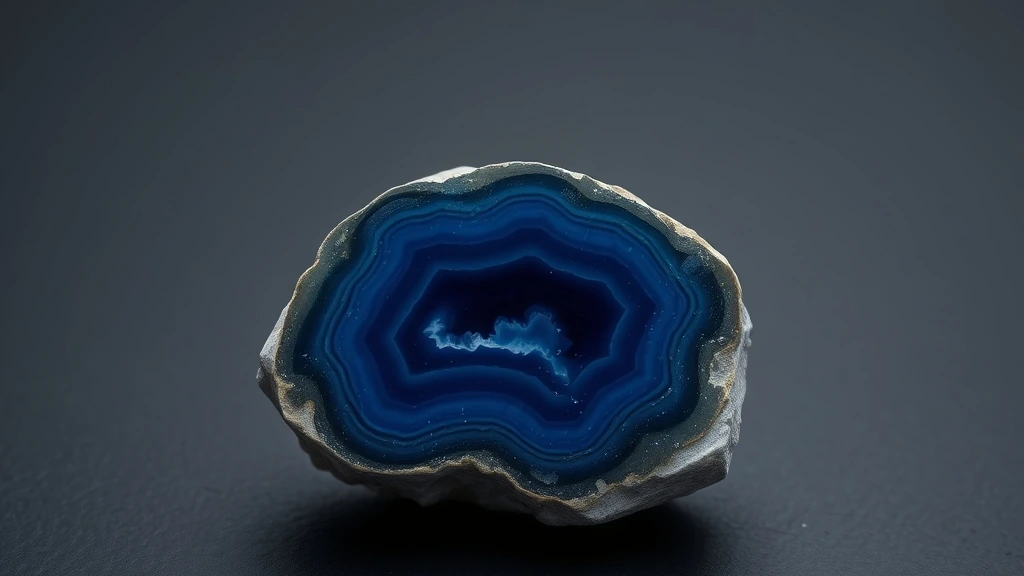
Blue Pacific Agate belongs to the silicate class, specifically the chalcedony subgroup of cryptocrystalline quartz. Its fibrous, fibrous‑aggregate structure forms within volcanic or sedimentary host rocks, where silica-rich fluids precipitate in narrow cavities. The resulting stone displays a characteristic banded pattern, often with subtle green or brown interlayers that enhance its visual appeal. As a member of the broader quartz family, it shares the same chemical backbone but differs in microstructure and optical properties.
What is Blue Pacific Agate? Geological Overview & Definition
Blue Pacific Agate is a variety of chalcedony, a cryptocrystalline form of quartz. It is distinguished by its vivid blue to indigo coloration, which arises from trace elements and structural defects within the silica lattice. The stone typically forms in volcanic or sedimentary fissures, where silica‑rich fluids deposit in fibrous aggregates. Its banded appearance and fine grain make it highly prized in lapidary work and jewelry.
Blue Pacific Agate Chemical Composition & Crystallographic Properties
The mineral’s chemical identity is SiO₂, with no distinct cationic substitution beyond trace impurities such as iron, manganese, or titanium. Its crystal system is Trigonal (Microcrystalline / Cryptocrystalline fibrous aggregates), meaning the silica chains align in a hexagonal lattice that repeats in a three‑fold rotational symmetry. This arrangement yields a fibrous microstructure that scatters light, producing the stone’s characteristic banding and translucency. This same trigonal microcrystalline structure underpins the formation of Breche Agate, where angular fragments of older agate are cemented by new silica growth, creating a distinctive brecciated texture within the same hexagonal lattice.
Because the crystal lattice is composed solely of silicon and oxygen, the stone is largely inert to dilute acids; however, strong acids can etch the surface, revealing the fibrous texture. Chromophore color centers—defects where electron traps form—are responsible for the blue hues; these centers are stabilized by the trigonal symmetry and can shift slightly with temperature. Thermal treatment above 600 °C can alter the color by collapsing some of these centers, but typical storage temperatures pose no risk to the stone’s appearance. In comparative mineralogical collections, practitioners and geologists frequently study Black Banded Onyx alongside this crystal to appreciate their subtle energetic and structural differences.
| Property | Specification |
|---|---|
| Mineral Group | Silicates (Chalcedony / Cryptocrystalline Quartz) |
| Chemical Formula | SiO₂ (Silicon Dioxide) |
| Mohs Hardness | 6.5 – 7.0 |
| Crystal System | Trigonal (Microcrystalline / Cryptocrystalline fibrous aggregates) |
| Specific Gravity (Density) | 2.60 – 2.65 |
| Refractive Index | 1.544 – 1.553 |
| Color & Optical Properties | Natural Blue Pacific Agate color spectrum and optical dispersion |
| Primary Mining Localities | Brazil, Uruguay, Turkey, India, Madagascar |
| Water & Chemical Resistance | High (Safe for gentle warm water and mild soap; avoid harsh acids and chlorine) |
| Chakra Alignment (Traditional) | Root Chakra and Sacral Chakra |
| Zodiac Affinity (Traditional) | Gemini, Virgo, Taurus |
| Symbolic Meaning (Traditional) | Grounding, emotional balance, physical endurance, and protection |
Blue Pacific Agate Varieties & Color Spectrum
Blue Pacific Agate displays distinct mineralogical characteristics across its geological varieties and structural habits. Gemologists evaluate these natural varieties based on crystal habit, trace chromophore concentrations, and visual luster.
Primary Natural Blue Pacific Agate
The benchmark natural variety exhibiting diagnostic color saturation and classic crystallographic symmetry.
Distinct Geological Morphs of Blue Pacific Agate
Secondary regional and structural varieties formed under localized geological temperature and pressure conditions.
Pacific Blue Agate
Pacific Blue Agate is the most celebrated variety, prized for its deep azure bands that run parallel to the crystal axis. Formed in pegmatitic veins of the Pacific Northwest, it often contains fine silica inclusions that give a subtle opalescent sheen. Its rarity stems from the limited size of the veins and the delicate balance of silica and water during crystallization.
Pacific Sky Agate
Pacific Sky Agate displays a lighter, sky‑blue hue with occasional white veining. The mineral crystallizes in cryptocrystalline aggregates, creating a smooth, translucent appearance. Its scarcity is due to the narrow band of silica concentration required for the pale coloration, making large, well‑formed specimens uncommon.
Pacific Sapphire Agate
This variety exhibits a striking sapphire‑blue tone, often interlaced with faint black or gray bands. The bands are formed by alternating layers of silica and iron‑rich inclusions, giving the stone a subtle metallic luster. Pacific Sapphire Agate is rarer than its counterparts because the iron content must be precisely balanced to avoid turning the stone brown.
Pacific Midnight Agate
Pacific Midnight Agate is characterized by deep indigo to black bands that contrast sharply with lighter veins. The dark coloration results from high concentrations of iron and manganese during formation. Its limited distribution in the deeper, cooler parts of the pegmatite makes it a prized find among collectors.
Pacific Turquoise Agate
This variety shows a turquoise to teal wash across the stone, with occasional golden flecks. The turquoise tone arises from trace amounts of copper incorporated into the silica matrix. The rarity of copper‑rich deposits in the Pacific region contributes to its scarcity.
Pacific Celestial Agate
Pacific Celestial Agate presents a pale blue background with subtle silver or white streaks that resemble a starry sky. The silver streaks are caused by microscopic metallic inclusions of tin or zinc. Because these inclusions are rare, large, well‑defined specimens are highly sought after.
Where is Blue Pacific Agate Found? Geological Mining & Extraction
Blue Pacific Agate is predominantly sourced from pegmatitic formations along the Pacific Coast, particularly in the Oregon and Washington states. These pegmatites are part of the larger Cascadia tectonic boundary, where slow cooling of silica‑rich magma allows for the growth of fibrous agate crystals. Extraction typically involves open‑pit mining followed by careful hand‑sorting to preserve the delicate banding.
In addition to the Pacific Northwest, smaller deposits have been identified in the Alaska Peninsula and the Bering Sea region. These sites yield smaller, more fragmented specimens due to the harsher climatic conditions and more rapid cooling rates. Modern extraction methods emphasize environmental stewardship, with reclamation projects ensuring minimal ecological impact.
Historical Significance & Cultural Lore of Blue Pacific Agate
Across ancient Greco-Roman lapidary traditions, blue agates were valued for their perceived protective qualities, often set in amulets to ward off illness and misfortune. In Egyptian tombs, fragments of blue agate were found alongside turquoise, suggesting a symbolic association with the heavens and the afterlife. Chinese artisans incorporated blue agate into jade‑like carvings, believing its hue represented calmness and clarity of mind.
In Vedic lore, blue agate was linked to the sacral chakra, symbolizing emotional balance and spiritual insight. Archaeological findings from Mesoamerican sites reveal that the stone was used in ceremonial contexts, possibly as a conduit for divine communication. These diverse cultural references underscore the stone’s enduring appeal across continents and epochs.
Modern Uses & Jewelry Applications of Blue Pacific Agate
Lapidaries primarily cut Blue Pacific Agate into smooth, polished cabochons to showcase its serene, translucent blue hues and subtle banding patterns. The stone’s moderate Mohs hardness of 6.5 to 7.0 allows for intricate ornamental carving without excessive risk of chipping during the shaping process. This durability makes it ideal for both contemporary jewelry settings and traditional decorative objects.
- Cabochon Cutting: The primary method for displaying the stone’s soft, milky blue color and internal fibrous textures.
- Faceted Jewelry: Occasionally cut into simple faceted shapes for pendants or earrings, though the microcrystalline structure limits brilliance.
- Ornamental Carving: Used for small figurines, beads, and inlays due to its workability and consistent coloration.
- Tumbled Stones: Polished into smooth, rounded shapes for meditation tools and casual jewelry collections.
Metaphysical Properties & Traditional Meaning of Blue Pacific Agate
According to historical traditions and metaphysical lore, Blue Pacific Agate is revered for its profound capacity to promote emotional balance and inner tranquility. Ancient Mediterranean and Vedic lapidary practices often associated blue silicate stones with the calming influence of water and the stabilizing power of earth. Practitioners believed this gemstone helped soothe anxiety and foster a sense of physical endurance during challenging times.
In broader esoteric contexts, the stone is viewed as a protective talisman that shields the wearer from negative energy. Its cool blue tones are thought to encourage mental clarity and steady focus, aiding in decision-making processes. This alignment with stability and protection has maintained its relevance in modern holistic practices worldwide.
Which Chakra and Zodiac Signs Align with Blue Pacific Agate?
Blue Pacific Agate is canonically aligned with the Root Chakra and the Sacral Chakra. The Root Chakra connection stems from the stone’s grounding properties, which help anchor the user’s energy to the earth and promote a sense of security. Meanwhile, its association with the Sacral Chakra reflects its role in balancing creative flow and emotional resilience.
Astrologically, this gemstone resonates most strongly with Gemini, Virgo, and Taurus. These earth and air signs benefit from the stone’s ability to harmonize mental activity with physical stability. For these zodiac signs, Blue Pacific Agate serves as a tool for enhancing patience, precision, and emotional grounding.
How to Identify Real vs. Fake Blue Pacific Agate
Artificial imitations of Blue Pacific Agate often involve synthetic glass, plastic, or dyed chalcedony that lacks the natural fibrous structure of genuine specimens. Synthetic glass may appear too perfect, with uniform coloration and a lack of natural inclusions or subtle banding variations. Dyed replicas might show color concentration in cracks or fissures, which is a common indicator of artificial treatment.
Practical At-Home Authenticity Tests
- Temperature Test (Thermal Feel): Genuine agate feels cool to the touch initially and warms up slowly, whereas plastic imitations tend to feel warm immediately and heat up rapidly.
- Specific Gravity & Weight Test: Real Blue Pacific Agate has a density of 2.60 to 2.65, making it feel noticeably heavier than similarly sized glass or plastic fakes.
- Scratch & Hardness Test (Mohs Comparison): With a Mohs hardness of 6.5 to 7.0, genuine agate will not be scratched by a steel knife (hardness 5.5), while softer imitations may show marks.
- Microscopic & Loupe Inspection (Internal Inclusions): Using a 10x loupe, look for natural microcrystalline textures or subtle banding; glass often contains tiny bubbles or swirls, while plastic may show mold lines.
Blue Pacific Agate Valuation Factors, Grading & Pricing
Market value is primarily driven by Color Saturation, which dictates the stone’s visual appeal and perceived energetic potency. Deep, uniform oceanic blues command higher premiums than pale or mottled specimens, reflecting consistent mineral impurities. The natural energetic luster of the surface further enhances desirability, as a vibrant, glassy finish signals high-quality formation and minimal surface imperfections.
Pricing structures rely heavily on Crystal Size & Weight (Grams), with larger specimens commanding significant premiums in the raw market. Tumbled stones are graded by polish quality, where a smooth, high-gloss finish indicates superior craftsmanship and durability. The presence of natural matrix inclusions can either increase or decrease value, depending on whether the patterns are aesthetically pleasing or viewed as structural flaws.
Collector markets place a distinct premium on Ethical Sourcing & Locality Premium, verifying the origin of each specimen. Provenance documentation ensures transparency, which is increasingly critical for buyers seeking authentic, responsibly harvested materials. Stones from verified, sustainable mines often fetch higher prices due to their documented history and environmental stewardship.
How to Clean and Care for Blue Pacific Agate
For routine maintenance, warm soapy water is the ideal cleaning method for solid, untreated agate specimens. Use a mild, phosphate-free soap and a soft-bristled toothbrush to gently remove dirt from surface crevices. Rinse thoroughly under lukewarm running water to eliminate all soap residue, then dry immediately with a lint-free microfiber cloth.
Ultrasonic cleaners must be strictly avoided if the specimen is dyed, heavily fractured, or has undergone any thermal treatment. These devices can exacerbate existing fractures or leach out artificial colorants, permanently damaging the stone’s integrity. For treated pieces, stick to gentle manual cleaning with a damp cloth to preserve the surface finish and structural stability.
Cleansing and Recharging Blue Pacific Agate (Energetic Care)
Holistic practitioners often employ herbal smudging to clear residual energies from the stone’s lattice. Pass the agate gently through the smoke of sage or palo santo, ensuring the mineral remains cool and dry throughout the process. This traditional method is believed to reset the stone’s vibrational frequency without risking physical damage to the crystal structure.
Alternatively, placing the agate on a selenite charging slab allows for passive energetic replenishment. This dry method avoids moisture exposure, making it safe for all agate varieties, including those with delicate inclusions. The gentle, non-invasive nature of selenite ensures the stone recharges without the risk of thermal shock or chemical alteration.
Frequently Asked Questions About Blue Pacific Agate
Blue Pacific Agate displays distinct mineralogical characteristics across its geological varieties and structural habits. Gemologists evaluate these natural varieties based on crystal habit, trace chromophore concentrations, and visual luster.
Primary Natural Blue Pacific Agate
The benchmark natural variety exhibiting diagnostic color saturation and classic crystallographic symmetry.
Distinct Geological Morphs of Blue Pacific Agate
Secondary regional and structural varieties formed under localized geological temperature and pressure conditions.
Is Blue Pacific Agate safe to wear in the shower?
Yes, it tolerates gentle warm water and mild soap. The stone’s silicon dioxide matrix is non‑porous, so routine exposure to warm water and a mild detergent will not degrade its surface. Harsh acids, chlorine, or abrasive scrubbing should be avoided to preserve its vivid blue bands.
How should I clean a dyed Blue Pacific Agate?
Clean with warm soapy water and a soft brush, then rinse gently. Because many Pacific agates are artificially enhanced, ultrasonic cleaning can cause dye leaching or micro‑fracture propagation. A soft toothbrush and lukewarm, mild‑detergent solution will remove grime without compromising the coloration.
Can I use an ultrasonic cleaner on untreated Blue Pacific Agate?
Avoid ultrasonic cleaners even for untreated specimens. While the quartz base is robust, the micro‑crystalline fabric can develop internal stresses under high‑frequency vibrations, especially if the stone has unseen fractures. Hand cleaning with warm, soapy water remains the safest method.
What zodiac signs are associated with Blue Pacific Agate?
Gemini, Virgo, and Taurus are the aligned zodiac signs. In astrological gem lore, these earth‑air signs are said to benefit from the stone’s stabilizing energy, which complements the grounding qualities attributed to its mineral composition and color palette.
Which chakras does Blue Pacific Agate balance?
It resonates with the Root Chakra and the Sacral Chakra. The deep blue hues are believed to anchor personal energy to the earth while stimulating creative flow in the lower abdomen, aligning with traditional chakra balancing practices across many cultures.
Is Blue Pacific Agate suitable for everyday jewelry?
Yes, its Mohs hardness of 6.5‑7 makes it durable for regular wear. The cryptocrystalline structure provides resistance to scratches, though prolonged impact or exposure to harsh chemicals can dull its surface polish. Routine cleaning with mild soap will keep its luster intact.
Does Blue Pacific Agate have any known health benefits?
It is traditionally linked to physical endurance and emotional balance. Practitioners claim the stone aids grounding and supports the nervous system, helping to mitigate stress while promoting stamina during physical activity, though scientific validation remains anecdotal.
How can I tell if a Blue Pacific Agate is natural or dyed?
Examine the color zones and perform a mild acid test on an inconspicuous edge. Natural agates display gradual band transitions and may show subtle inclusions, whereas dyed specimens often have unnaturally vivid, uniform hues. A gentle drop of diluted acetic acid will not affect genuine quartz but may reveal surface treatments.