
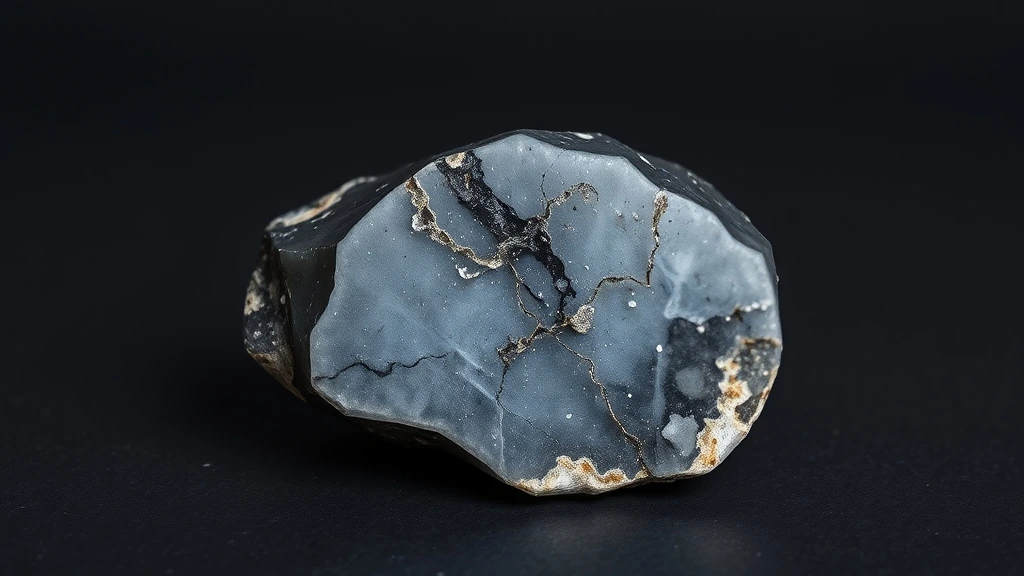
Onyx belongs to the silicate family, specifically the chalcedony subgroup of the quartz group. It forms as a dense, fine‑grained aggregate of fibrous silica crystals that develop in sedimentary cavities or volcanic fissures. The characteristic parallel banding results from successive layers of differing impurity concentrations during growth. Its durability and striking contrast have made it a favorite in ornamental carving and high‑end gem settings worldwide.
What is Onyx Gemstone? Geological Overview & Definition
Onyx is defined as a banded variety of chalcedony, a microcrystalline form of quartz that exhibits alternating dark and light layers. These layers are not separate minerals but zones of varying iron oxide or manganese content that impart the classic black‑and‑white pattern.
Geologically, onyx forms in low‑temperature hydrothermal environments where silica‑rich fluids precipitate within cavities, veins, or nodules. Over time, the fine fibrous crystals interlock, creating a compact aggregate that resists cleavage yet can be polished to a high sheen.
Onyx Gemstone Chemical Composition & Crystallographic Properties
The aggregate is composed of SiO₂ microcrystals arranged in a trigonal (microcrystalline fibrous chalcedony) lattice, consistent with the quartz family’s crystal symmetry. Although the bulk material lacks a single stoichiometric formula, each constituent crystal follows the quartz structure, giving onyx its overall density of 2.60–2.65 g/cm³.
Cation substitution is limited; trace amounts of Fe³⁺, Mn²⁺, and Ti⁴⁺ replace silicon in the lattice, creating the chromophore centers responsible for the dark bands. These impurities do not alter the fundamental trigonal symmetry but affect optical properties such as the refractive index (1.544–1.553).
Onyx is chemically stable under neutral conditions but can be etched by strong acids, which dissolve the silica framework and reveal the underlying banding pattern. Thermal treatment above 600 °C may cause recrystallization, potentially fading the contrast as impurity zones homogenize.
Overall, the gemstone’s microcrystalline trigonal framework, combined with impurity‑driven color zoning, gives onyx its distinctive appearance, durability, and suitability for both ornamental and metaphysical uses.
| Property | Specification |
|---|---|
| Mineral Group | Silicates (Chalcedony / Quartz Group) |
| Chemical Formula | SiO₂ (Microcrystalline Chalcedony with parallel banding) |
| Mohs Hardness | 6.5 – 7.0 |
| Crystal System | Trigonal (Microcrystalline fibrous Chalcedony) |
| Specific Gravity (Density) | 2.60 – 2.65 |
| Refractive Index | 1.544 – 1.553 |
| Color & Optical Properties | Natural Onyx Gemstone color spectrum and optical dispersion |
| Primary Mining Localities | Brazil, India, Madagascar, Uruguay, Germany |
| Water & Chemical Resistance | High (Safe in warm soapy water) |
| Chakra Alignment (Traditional) | Root Chakra (Muladhara) |
| Zodiac Affinity (Traditional) | Leo, Capricorn, Scorpio |
| Symbolic Meaning (Traditional) | Willpower, emotional discipline, grounding protection, and stamina |
Onyx Gemstone Varieties & Color Spectrum
Classic Black Onyx
Formed in silica‑rich volcanic lavas, classic black onyx is a microcrystalline chalcedony that develops parallel banding during slow cooling. The stone’s deep jet‑black matrix is often interspersed with thin white or gray layers, a result of minute gas bubbles trapped in the melt. High‑grade material is sourced mainly from Brazil and Uruguay, where the mineral occurs in alluvial deposits and is prized for its uniform darkness and excellent polishability.
Sardonyx (Red‑White Banding)
Sardonyx displays alternating carmine‑red and creamy‑white bands, produced when iron oxides infiltrate the silica gel during crystallization. The red layers originate from hematite inclusions, while the white zones are pure chalcedony. Historically mined in the Caucasus region, especially in the Zaqatala district, sardonyx is rarer than black onyx because the precise red‑white banding requires a narrow window of oxidation conditions.
Green Onyx (Chrysoprase‑Like)
Although technically a chlorite‑rich chalcedony, green onyx exhibits a translucent to opaque emerald hue caused by trace nickel and chromium. It forms in low‑temperature hydrothermal veins where silica precipitates around mineralized fluids rich in transition metals. Notable deposits occur in Madagascar’s Antsirabe basin, where the stone’s vivid color and fine banding make it a collector’s favorite, though its scarcity limits large‑scale commercial use.
Blue Onyx (Lapis‑Like)
Blue onyx acquires its hue from cobalt and copper impurities that substitute into the silica lattice during formation in basaltic lava flows. The resulting stone shows a deep sapphire‑blue background with subtle white or gray banding, reminiscent of lapis lazuli but with a finer texture. Significant sources are found in Pakistan’s Khyber Pakhtunkhwa province, where tectonic uplift exposed the mineral in fissure veins; the rarity of true blue onyx makes it highly sought after for high‑end jewelry.
Banded Onyx (Mosaic Pattern)
Banded onyx, sometimes called “mosaic onyx,” exhibits multicolored concentric rings ranging from brown and gray to amber and black. These patterns arise from successive episodes of silica deposition interspersed with mineral‑rich fluids, each layer recording a distinct geochemical environment. The most spectacular specimens are quarried in Mexico’s Oaxaca state, where tectonic activity created thick, layered chalcedony sheets that are both visually striking and relatively uncommon.
White Onyx (Alabaster‑Like)
White onyx, often confused with true alabaster, is a pure, milky chalcedony formed in sedimentary basins where silica precipitates from silica‑saturated groundwater. Its translucency and smooth, creamy texture make it a favorite for carving and ornamental objects. Major deposits occur in Turkey’s Anatolian plateau, where the stone’s consistent color and lack of banding contribute to its high market value for both artistic and architectural applications.
Where is Onyx Gemstone Found? Geological Mining & Extraction
Onyx typically occurs within silica‑rich volcanic tuffs, lava flows, and hydrothermal veins, where rapid cooling and subsequent recrystallization produce the characteristic banded microcrystalline texture. In many locales, the gemstone is extracted from alluvial placer deposits, where weathering liberates the dense crystals and gravity separation concentrates them in river gravels.
The most productive mining districts include Brazil’s Minas Gerais, Uruguay’s Cerro Largo, Madagascar’s Antsirabe, and Pakistan’s Khyber Pakhtunkhwa. Modern extraction combines hand‑sorting of gravels with mechanized crushing and flotation, allowing miners to isolate the high‑clarity onyx fragments while minimizing damage to the delicate banding patterns.
Historical Significance & Cultural Lore of Onyx Gemstone
Ancient Egyptians fashioned intaglio seals and funerary amulets from black onyx, believing the stone protected the deceased from malevolent forces and ensured safe passage to the afterlife. In the Roman Empire, onyx was carved into cameos and signet rings, symbolizing authority and legal power; archaeological finds from Pompeii reveal intricate onyx portraiture dating to the 1st century CE.
In Eastern traditions, onyx was associated with the Root Chakra (Muladhara), grounding the wearer’s energy and fostering emotional discipline. Medieval Islamic texts praised onyx for its protective qualities against envy and ill intent, while Persian poetry linked the stone’s layered darkness to the depth of human willpower, a motif that persists in contemporary esoteric practice.
Modern Uses & Jewelry Applications of Onyx Gemstone
Lapidaries primarily cut onyx into cabochons to showcase its smooth, lustrous surface and distinct parallel banding. Because the stone lacks transparency, faceting is rarely employed for aesthetic purposes. Instead, carvers exploit its hardness and uniform color for intricate intaglio work.
- Cabochon Cutting: The standard method for rings and pendants, emphasizing the stone’s waxy luster.
- Ornamental Carving: Used for cameos, seals, and architectural inlays due to its durability.
- Bead Manufacturing: Polished into uniform spheres for bracelets and necklaces.
- Intaglio Engraving: Historically significant for deep-carved artistic motifs and gemstones.
Metaphysical Properties & Traditional Meaning of Onyx Gemstone
According to historical traditions and metaphysical lore, onyx is revered as a stone of emotional discipline and profound inner strength. It is believed to help users maintain composure during times of stress or conflict. Practitioners often associate the stone with grounding protection, creating a shield against negative energies.
The gemstone is said to enhance willpower and physical stamina, making it a popular choice for athletes and leaders. Its dark, opaque nature symbolizes the absorption of chaotic emotions, promoting mental clarity. By stabilizing the wearer’s energy field, onyx supports consistent action and decisive thinking.
Which Chakra and Zodiac Signs Align with Onyx Gemstone?
In chakra theory, onyx is intrinsically linked to the Root Chakra (Muladhara). This energy center governs survival, security, and one’s connection to the physical world. The stone’s deep black color resonates with the earthy, stabilizing vibrations of this base chakra, helping to anchor spiritual energy.
Astrologically, onyx is the traditional birthstone for Leo, Capricorn, and Scorpio. These signs benefit from the stone’s ability to reinforce their inherent strengths, such as leadership, ambition, and intensity. It is believed to balance their powerful natures with necessary restraint and focus.
How to Identify Real vs. Fake Onyx Gemstone
Distinguishing natural onyx from imitations requires attention to subtle visual and physical cues. Common fakes include dyed chalcedony, which may show uneven color saturation, and synthetic glass, which often lacks natural banding. Plastic replicas are also prevalent in low-cost jewelry markets.
Practical At-Home Authenticity Tests
- Temperature Test (Thermal Feel): Genuine onyx feels cool to the touch initially and warms slowly. Plastic imitations tend to feel warm or neutral almost immediately upon contact with skin.
- Specific Gravity & Weight Test: Real onyx has a specific gravity of 2.60–2.65, making it feel noticeably heavier than its size suggests. Glass or plastic copies will feel lighter and less dense in the hand.
- Scratch & Hardness Test (Mohs Comparison): Onyx rates 6.5–7.0 on the Mohs hardness scale. It will scratch glass (hardness 5.5) but cannot be scratched by a steel knife (hardness 5.5).
- Microscopic & Loupe Inspection (Internal Inclusions): Use a 10x loupe to examine the surface. Natural onyx displays fine, parallel fibrous inclusions and banding. Glass often contains tiny bubbles or swirls, while plastic may show mold lines.
Onyx Gemstone Valuation Factors, Grading & Pricing
Color Saturation is the foremost driver of price. Deep, uniform black or banded hues command premium rates, while pale or uneven tones reduce value. Buyers also assess optical clarity; a high‑gloss luster and minimal surface blemishes signal superior craftsmanship. Consistency across the stone’s surface is essential for market confidence.
Carat Weight influences pricing but interacts with cut quality. Larger onyx pieces are rarer, yet a well‑proportioned stone with precise facet symmetry can outshine a heavier, poorly cut specimen. Inclusions such as matrix bands are acceptable when they enhance the characteristic banding pattern, but random fractures or cloudiness lower the grade.
Geographical Provenance Premium adds a distinct markup, especially for onyx sourced from historic quarries in Mexico, Brazil, or the Himalayas. Provenance certificates boost buyer trust and often justify higher wholesale prices. Retail trends show a steady rise in demand for ethically mined, sustainably sourced onyx, pushing retail values upward each year.
How to Clean and Care for Onyx Gemstone
Clean onyx with warm, soapy water and a soft, lint‑free cloth. Gently wipe the surface to remove dust and oils, then pat dry with another soft cloth. Avoid abrasive pads or harsh chemicals, as they can dull the stone’s natural luster.
Ultrasonic cleaners may be used only on undyed onyx; dyed pieces should never be subjected to ultrasonic agitation. The vibration can erode surface dyes, causing uneven coloration. For all onyx, store the gemstone in a padded pouch away from direct sunlight to prevent thermal shock.
Cleansing and Recharging Onyx Gemstone (Energetic Care)
Because onyx is a microcrystalline form of silica, it is insoluble in water, making dry energetic methods safe. Pass the stone through smoke smudging with sage or palo santo to disperse stagnant energy and reinforce grounding properties.
Expose the gemstone to moonlight or place it on a selenite charging plate overnight to restore vibrational clarity. Both methods respect the stone’s mineral stability while enhancing its esoteric attributes of willpower and emotional discipline.
Frequently Asked Questions About Onyx Gemstone
What is the chemical composition of onyx?
Onyx is a microcrystalline form of chalcedony composed of silicon dioxide (SiO₂). It belongs to the trigonal crystal system, displaying parallel banding that gives the stone its characteristic black-and-white layers, and it shares the same silica framework as other quartz varieties.
How hard is onyx and can it be used in everyday jewelry?
Onyx rates 6.5–7 on the Mohs hardness scale, making it suitable for most jewelry pieces. Its durability resists scratches from everyday wear, though it should be protected from hard impacts. Regular cleaning with a soft cloth preserves its polished luster.
Is onyx safe to wear in water or during showering?
Yes, onyx has high water resistance and is safe in warm, soapy water. You can wear it while washing hands or showering, but avoid prolonged exposure to harsh chemicals. Rinse gently and dry with a lint‑free cloth to maintain its finish.
Can I clean onyx with an ultrasonic cleaner?
Onyx can be cleaned with warm soapy water and a soft cloth; ultrasonic cleaners are safe unless the stone is dyed. The gentle agitation removes grime without damaging the surface. For dyed pieces, stick to hand cleaning to prevent color leaching.
Which zodiac signs are traditionally linked to onyx?
Onyx is aligned with the zodiac signs Leo, Capricorn, and Scorpio. Astrologers believe the stone amplifies the strengths of these signs, offering grounding energy that supports ambition, discipline, and emotional resilience in their respective planetary influences.
Which chakra does onyx correspond to in crystal healing?
Onyx is associated with the Root Chakra (Muladhara). This connection is said to promote grounding, stability, and protection, helping wearers feel more anchored and secure, especially during stressful or high‑energy situations.
Does onyx have any specific metaphysical properties?
Onyx is reputed to enhance willpower, emotional discipline, and stamina. Practitioners claim it creates a protective shield against negative energies, fostering a sense of inner strength that aids in decision‑making and personal empowerment.
What is the typical density and refractive index of onyx?
Onyx has a density of 2.60–2.65 g/cm³ and a refractive index of 1.544–1.553. These physical properties reflect its quartz heritage, influencing how light interacts with the stone and contributing to its characteristic deep, lustrous appearance.