
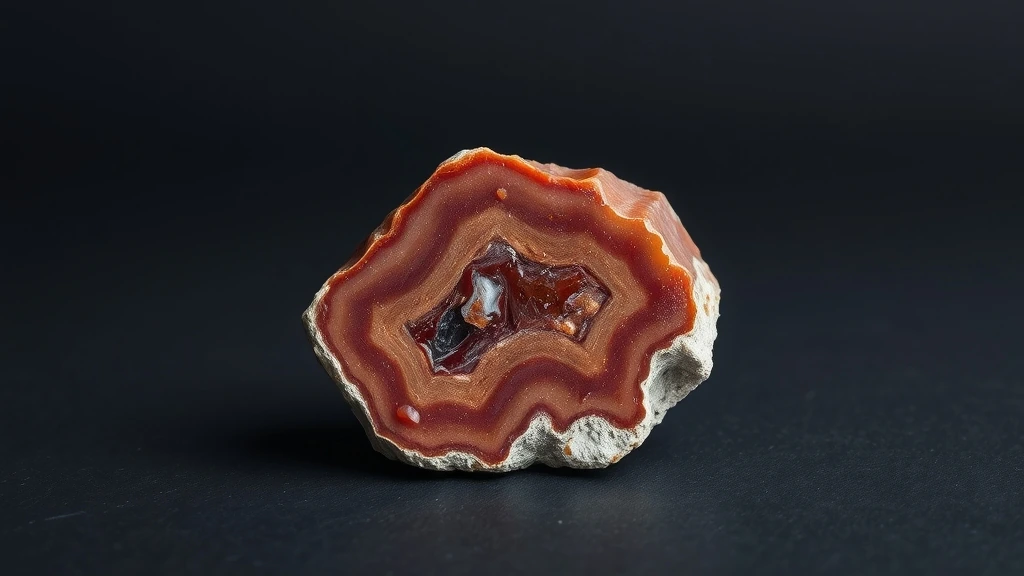
Sardonyx belongs to the Silicates supergroup, specifically within the Chalcedony / Quartz Group. This stone forms through the slow precipitation of silica gel in volcanic or sedimentary cavities. Its geological origin is deeply tied to hydrothermal activity, where silica-rich fluids cool and crystallize over millions of years. The resulting microcrystalline structure creates the distinctive parallel banding that defines this gemstone. In comparative mineralogical collections, practitioners and geologists frequently study Blue Onyx alongside this crystal to appreciate their subtle energetic and structural differences.
What is Sardonyx? Geological Overview & Definition
Sardonyx is defined by its parallel banding of red sard and white chalcedony. These bands result from periodic changes in silica concentration and impurity levels during formation. The red coloration typically stems from trace iron oxides, while the white layers remain relatively pure silica. This agate variety is prized for its banded pattern and historical significance in intaglio carving.
Geologically, it forms in volcanic rocks and sedimentary basins where silica gel infiltrates cavities. The slow deposition process allows for the development of fine, distinct layers. Unlike amorphous silica, sardonyx exhibits a fibrous microstructure that gives it a waxy luster. This microcrystalline fibrous nature distinguishes it from macrocrystalline quartz varieties.
Sardonyx Chemical Composition & Crystallographic Properties
The fundamental chemical identity of sardonyx is SiO₂, existing as a microcrystalline fibrous chalcedony. It does not form large, visible crystals but rather consists of interlocking microscopic fibers. This aggregate structure contributes to its high toughness and resistance to cleavage. The trigonal crystal system governs the internal arrangement of these silica units.
The lattice structure features a hexagonal close-packed arrangement of oxygen atoms with silicon ions occupying tetrahedral sites. Cation substitution is minimal, as the structure is highly stable and resistant to ionic exchange. This purity ensures that the optical properties remain consistent across different geological deposits. The stone exhibits low acid sensitivity, remaining inert in most non-hydrofluoric acid solutions.
Color centers arise from trace iron oxide inclusions within the sard bands. These chromophores absorb specific wavelengths of light, producing the characteristic reddish-brown hue. The white chalcedony bands lack these impurities, resulting in a translucent, milky appearance. Thermal behavior is stable, with no significant phase transitions occurring at standard jewelry temperatures.
| Property | Specification |
|---|---|
| Mineral Group | Silicates (Chalcedony / Quartz Group) |
| Chemical Formula | SiO₂ (Microcrystalline Chalcedony with parallel banding) |
| Mohs Hardness | 6.5 – 7.0 |
| Crystal System | Trigonal (Microcrystalline fibrous Chalcedony) |
| Specific Gravity (Density) | 2.60 – 2.65 |
| Refractive Index | 1.544 – 1.553 |
| Color & Optical Properties | Natural Sardonyx color spectrum and optical dispersion |
| Primary Mining Localities | Brazil, India, Madagascar, Uruguay, Germany |
| Water & Chemical Resistance | High (Safe in warm soapy water) |
| Chakra Alignment (Traditional) | Root Chakra (Muladhara) |
| Zodiac Affinity (Traditional) | Leo, Capricorn, Scorpio |
| Symbolic Meaning (Traditional) | Willpower, emotional discipline, grounding protection, and stamina |
Sardonyx Varieties & Color Spectrum
Classic Banded Sardonyx
Formed in silica‑rich hydrothermal veins, classic sardonyx displays alternating white and deep brown or black layers that result from rhythmic changes in mineral saturation. The bands are composed of microcrystalline chalcedony intergrown with fine iron oxide inclusions, giving a striking parallel banding. This variety is abundant in Brazil and India, yet high‑contrast specimens with sharp, evenly spaced layers are prized for their rarity.
Red‑Brown Sardonyx (Rhodonite‑Sardonyx)
Rhodonite‑sardonyx originates where manganese‑rich fluids infiltrate chalcedony, imparting a rich copper‑red hue to the darker bands. The red tones are enhanced by microscopic hematite crystals that scatter light, creating a warm glow. Found primarily in the Urals and Madagascar, the deep coloration and limited deposits make it a collector’s favorite.
Green‑Tinted Sardonyx (Chrysoprase‑Sardonyx)
In regions where nickel and chromium are present, the chalcedony matrix absorbs green wavelengths, producing a subtle emerald‑green band. The green layers often contain minute nickel‑bearing inclusions that give a faint metallic sheen. Notable sources include the Zaire (now DRC) and western Australia, where the mineral’s scarcity elevates its market value.
Blue‑Veined Sardonyx (Azurite‑Stained)
Rare blue‑veined specimens form when trace amounts of azurite or copper carbonate precipitate within the chalcedony, creating delicate sky‑blue streaks against a brown background. These veins are typically thin and irregular, offering a dramatic contrast that appeals to high‑end jewelers. The most celebrated examples come from the Potosí region of Bolivia, where geological conditions favor copper enrichment.
White‑On‑White Sardonyx (Alabaster‑Like)
A subtle variant, white‑on‑white sardonyx, exhibits faint creamy bands rather than stark color contrast, resulting from variations in silica particle size during crystallization. The lack of strong pigments makes it less conspicuous, yet its translucency and smooth texture are highly sought after for minimalist designs. This form is primarily mined in the United States (California) and southern France.
Black‑Bordered Sardonyx (Onyx‑Sardonyx Hybrid)
When the outer layers of sardonyx undergo additional silica deposition, they develop a deep black margin that frames the inner brown and white bands. The black border is a product of manganese‑oxide enrichment during late-stage fluid flow. This hybrid is most frequently encountered in Turkish mines, where the combination of onyx and sardonyx characteristics creates a distinctive aesthetic.
Where is Sardonyx Found? Geological Mining & Extraction
Sardonyx occurs within silicified vein fillings of volcanic tuffs, limestone fissures, and metamorphic schists, where low‑temperature hydrothermal solutions precipitate microcrystalline chalcedony. The host rocks provide the necessary silica saturation and trace metal ions that generate the characteristic banding, while the fibrous texture reflects its trigonal microcrystalline structure.
Major extraction centers include the Marmara region of Turkey, the Ural Mountains of Russia, and the Maharashtra state of India, each offering distinct band patterns due to local geochemistry. Modern mining employs selective hand‑picking and low‑impact crushing to preserve the delicate layers, followed by washing and grading processes that separate premium specimens from lower‑grade material.
Historical Significance & Cultural Lore of Sardonyx
Ancient Egyptians fashioned sardonyx intaglios for amulets, believing the stone’s grounding energy protected pharaohs from malevolent forces; examples appear in tombs of the New Kingdom. The Romans prized sardonyx signet rings, inscribing legal documents with the stone’s durable microcrystalline chalcedony matrix, which resisted wear over centuries.
In medieval Europe, sardonyx was associated with the Root Chakra (Muladhara), symbolizing willpower and emotional discipline, and it was set into clergy vestments as a talisman against negative energies. Folklore across the Middle East describes sardonyx as a protective shield for travelers, a belief that persists in contemporary crystal healing practices.
Modern Uses & Jewelry Applications of Sardonyx
Lapidaries primarily cut sardonyx into smooth cabochons to showcase its distinctive parallel banding, which is often impossible to reveal through faceting. The stone’s durability makes it ideal for intricate intaglio carving, a technique popularized in ancient Roman and Byzantine art for signet rings and cameos. Modern jewelry designers frequently pair this earthy gemstone with gold or silver settings to highlight its natural contrast.
- Cabochon Cuts: Polished domes that emphasize the stone’s luster and layered color patterns.
- Intaglio Carvings: Deeply engraved designs used for seals and ceremonial jewelry.
- Ornamental Objects: Vases, bowls, and architectural inlays that utilize the stone’s resistance to wear.
- Beaded Jewelry: Polished spheres and barrel beads for necklaces and bracelets.
Metaphysical Properties & Traditional Meaning of Sardonyx
According to historical traditions and metaphysical lore, sardonyx is revered as a stone of profound emotional discipline and inner strength. Practitioners believe it fosters willpower, helping individuals maintain composure during periods of stress or conflict. This gemstone is often associated with grounding protection, serving as a shield against negative energies.
In spiritual contexts, the stone’s dual nature of red and white bands symbolizes the balance between passion and calm. It is thought to enhance stamina and physical endurance, making it a popular choice for athletes and those facing demanding challenges. The stone’s energy is described as stabilizing, encouraging a steady and focused approach to life’s obstacles.
Which Chakra and Zodiac Signs Align with Sardonyx?
Sardonyx is canonically aligned with the Root Chakra (Muladhara), which governs feelings of safety, survival, and physical grounding. This connection stems from the stone’s earthy tones and its reputed ability to anchor the wearer to the present moment. By stimulating this energy center, the gemstone is believed to promote a sense of security and stability.
In astrological practice, this gemstone is specifically recommended for individuals born under the signs of Leo, Capricorn, and Scorpio. These zodiac signs are thought to benefit from the stone’s reinforcing energy, which supports their inherent traits of leadership, ambition, and intensity. Wearing sardonyx is believed to amplify these positive attributes while mitigating potential emotional volatility.
How to Identify Real vs. Fake Sardonyx
Distinguishing genuine sardonyx from artificial imitations requires attention to subtle visual and physical cues, as synthetic glass and dyed replicas are common in the market. While high-quality fakes can mimic the banding, they often lack the natural irregularities and depth found in authentic microcrystalline chalcedony. Understanding the specific gravity and thermal properties of the real stone is essential for accurate identification.
Practical At-Home Authenticity Tests
- Temperature Test (Thermal Feel): Genuine sardonyx feels cool to the touch initially due to its thermal conductivity, whereas plastic or resin imitations warm up quickly to room temperature.
- Specific Gravity & Weight Test: Real sardonyx has a density of 2.60 – 2.65, making it feel heavier than similarly sized glass or plastic substitutes when held in the hand.
- Scratch & Hardness Test (Mohs Comparison): With a Mohs hardness of 6.5 – 7.0, sardonyx can scratch glass but will not be scratched by a steel knife blade, distinguishing it from softer imitations.
- Microscopic & Loupe Inspection (Internal Inclusions): Using a 10x loupe, look for natural internal inclusions and irregular banding patterns; synthetic glass often contains tiny air bubbles or perfectly uniform, artificial-looking stripes.
Sardonyx Valuation Factors, Grading & Pricing
The foremost determinant of market value is color saturation. Stones displaying vivid, sharply contrasting bands of black, white, and deep red command premium prices, especially when the hues appear naturally luminous rather than artificially enhanced. Collectors also assess the uniformity of the banding pattern, rewarding specimens that exhibit a seamless, energetic luster across the entire surface.
Crystal size & weight (grams) constitute the second pricing pillar. Larger, heavier pieces that retain a solid, unfractured structure are priced per gram, with raw blocks typically fetching less than expertly tumbled and polished cabochons of comparable mass. Natural matrix inclusions such as quartz veining can either augment intrigue or diminish value, depending on their visibility and impact on overall clarity.
The third critical factor is ethical sourcing & locality premium. Sardonyx sourced from regions with transparent mining practices and fair‑trade certification often carries a higher price tag, reflecting both responsible stewardship and the cultural heritage associated with historic quarries. Holistic markets also reward stones linked to traditional healing locales, where provenance adds perceived energetic potency for collectors.
How to Clean and Care for Sardonyx
Cleaning sardonyx is straightforward: immerse the piece in warm soapy water, gently rub with a soft cloth, and rinse thoroughly before drying with a lint‑free microfiber towel. This method removes surface grime without harming the microcrystalline chalcedony structure. Ultrasonic cleaners may be employed safely for undyed specimens, as the vibration does not abrade the stone’s polished surface. Store the gemstone in a dry pouch away from harsh chemicals to preserve its natural luster.
Cleansing and Recharging Sardonyx (Energetic Care)
For holistic maintenance, lightly smudge the stone with dried sage or palo santo, allowing the aromatic smoke to drift over the surface while avoiding direct flame contact. This practice is believed to clear residual energetic debris without introducing moisture or heat that could compromise the crystal lattice.
Alternatively, place the sardonyx on a clean selenite charging slab or expose it to gentle moonlight for several hours, permitting subtle lunar energy to revitalize its vibrational field. Both methods respect the mineral’s physical integrity while supporting its traditional metaphysical attributes.
Frequently Asked Questions About Sardonyx
Is sardonyx safe to wear in the shower?
Yes, sardonyx can be worn in the shower. Its microcrystalline chalcedony structure is highly water‑resistant, so warm, soapy water will not degrade the stone. However, prolonged exposure to harsh detergents may dull the polish, so rinsing and gentle drying are advisable after use.
How should I clean a sardonyx necklace?
Clean sardonyx with warm soapy water and a soft cloth. The stone tolerates mild surfactants, and a gentle wipe removes oils without scratching the parallel banding. Avoid abrasive pads; a microfiber cloth preserves the surface while maintaining the stone’s natural luster.
Can I use an ultrasonic cleaner on sardonyx?
Ultrasonic cleaning is safe for undyed sardonyx. The vibration gently dislodges debris without harming the SiO₂ lattice. If the piece has been artificially dyed, limit ultrasonic exposure, as heat may affect color stability. Always follow the cleaner’s recommended cycle time.
What is the hardness of sardonyx and how does it affect everyday wear?
Sardonyx ranks 6.5–7 on the Mohs scale. This makes it resistant to scratches from most metals and everyday objects, though it can be marked by harder materials like quartz or diamond. Its durability suits rings and bracelets, provided impact is avoided.
Which zodiac signs are associated with sardonyx?
Leo, Capricorn, and Scorpio are the aligned zodiac signs. In astrological tradition, these signs are believed to benefit from sardonyx’s willpower‑enhancing properties, helping them maintain focus and emotional discipline during challenging periods.
Which chakra does sardonyx balance?
Sardonyx is linked to the Root Chakra (Muladhara). This connection is said to promote grounding, physical stamina, and protection against negative energies, reinforcing a sense of stability and inner strength during stressful situations.
Does sardonyx have any notable optical properties?
Its refractive index ranges from 1.544 to 1.553. This modest dispersion gives sardonyx a subtle brilliance, while the parallel banding creates striking contrast between brown‑black and white layers, enhancing its appeal in cameo and beadwork.
Is sardonyx suitable for use in jewelry that will be exposed to chemicals?
Sardonyx tolerates mild chemicals but should avoid strong acids or bases. The silica‑based composition resists most household cleaners, yet prolonged contact with harsh reagents can etch the surface. Rinse promptly and dry with a soft cloth after any chemical exposure.