
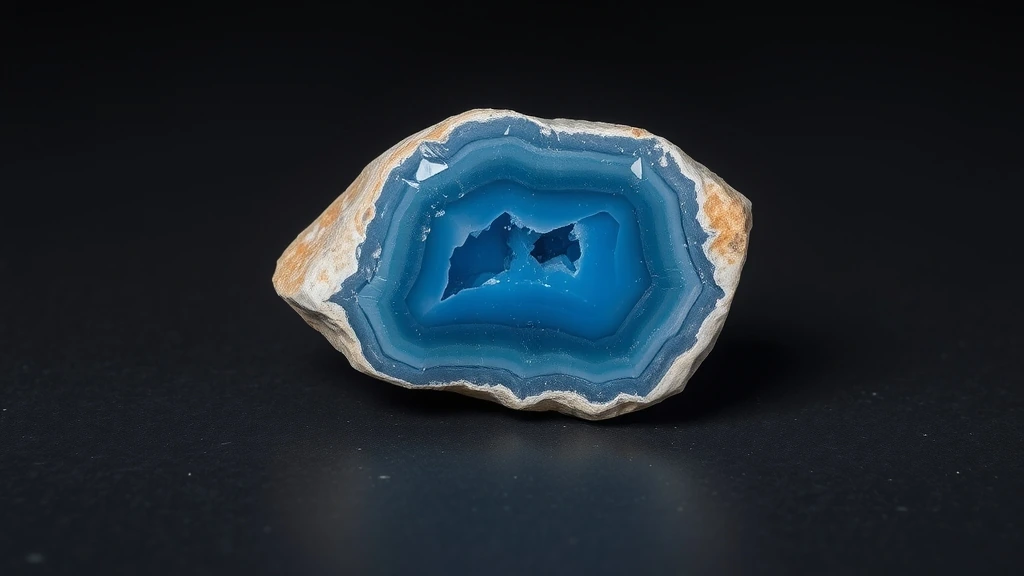
Blue Onyx belongs to the silicate family, specifically the chalcedony subgroup of the quartz group. It forms as a fibrous, microcrystalline aggregate in the trigonal crystal system, where parallel banding gives the stone its characteristic layered appearance. The mineral’s formation occurs in volcanic tuffs and sedimentary basins where silica‑rich fluids precipitate fine‑grained chalcedony, later colored by trace elements and structural defects.
What is Blue Onyx? Geological Overview & Definition
Blue Onyx is an aggregate of microcrystalline chalcedony, not a single crystal, and its banded structure results from rhythmic variations in silica deposition during formation. The stone’s blue coloration is typically induced by inclusions of copper, iron, or organic compounds that act as chromophoric centers, rather than by a distinct chemical impurity. In comparative mineralogical collections, practitioners and geologists frequently study Blue Flower Agate alongside this crystal to appreciate their subtle energetic and structural differences.
In the field, Blue Onyx is found in alluvial deposits and secondary vein fillings, often alongside other quartz varieties such as agate and carnelian. Its trigonal symmetry is inherited from the underlying quartz lattice, even though the aggregate lacks visible crystal faces.
Blue Onyx Chemical Composition & Crystallographic Properties
The primary constituent of Blue Onyx is silicon dioxide (SiO₂) arranged in a tightly packed, fibrous network of chalcedony crystals. Because it is an aggregate, the stone does not possess a single stoichiometric formula beyond the silica base, but the microcrystals share the same trigonal (microcrystalline fibrous) structure as quartz. In comparative mineralogical collections, practitioners and geologists frequently study Black Banded Onyx alongside this crystal to appreciate their subtle energetic and structural differences.
Lattice parameters reflect the typical quartz framework, with slight distortions caused by cation substitution of trace metals such as Cu²⁺ or Fe³⁺ that occupy interstitial sites. These substitutions create localized color centers that absorb specific wavelengths, producing the characteristic blue hue.
Blue Onyx is moderately sensitive to strong acids; prolonged exposure to hydrochloric or sulfuric acid can dissolve surface layers, revealing a milky interior. However, brief contact with dilute acids usually only etches the outer rind without compromising structural integrity.
Thermally, the stone is stable up to about 573 °C, the quartz inversion temperature, beyond which the microcrystalline framework may recrystallize into macrocrystalline quartz, potentially altering its banding and color. Controlled heating can sometimes enhance the blue tone by activating additional chromophoric sites, a technique employed in some lapidary treatments.
| Property | Specification |
|---|---|
| Mineral Group | Silicates (Chalcedony / Quartz Group) |
| Chemical Formula | SiO₂ (Microcrystalline Chalcedony with parallel banding) |
| Mohs Hardness | 6.5 – 7.0 |
| Crystal System | Trigonal (Microcrystalline fibrous Chalcedony) |
| Specific Gravity (Density) | 2.60 – 2.65 |
| Refractive Index | 1.544 – 1.553 |
| Color & Optical Properties | Natural Blue Onyx color spectrum and optical dispersion |
| Primary Mining Localities | Brazil, India, Madagascar, Uruguay, Germany |
| Water & Chemical Resistance | High (Safe in warm soapy water) |
| Chakra Alignment (Traditional) | Root Chakra (Muladhara) |
| Zodiac Affinity (Traditional) | Leo, Capricorn, Scorpio |
| Symbolic Meaning (Traditional) | Willpower, emotional discipline, grounding protection, and stamina |
Blue Onyx Varieties & Color Spectrum
Natural blue onyx is exceedingly rare, with most market specimens undergoing thermal treatment or dyeing to achieve their hue. The authentic geological variant features subtle blue-grey banding within a microcrystalline chalcedony matrix. This natural coloration arises from trace impurities rather than the intense saturation seen in commercial stones.
Natural Blue-Grey Onyx
This rare morph exhibits soft, muted blue-grey stripes against a white or light grey background. The coloration results from minute inclusions of iron oxides and other trace minerals during formation. Such specimens are highly prized by collectors for their unaltered, geologically authentic appearance.
Dyed Blue Onyx
The vast majority of blue onyx in the trade is chemically dyed to produce vibrant, uniform hues. Manufacturers often use cobalt blue or other synthetic dyes to penetrate the porous stone structure. While visually striking, this process alters the stone’s natural spectral signature and reduces its value among purists.
Treated Blue Onyx
Some stones undergo heat treatment to enhance existing grey tones into a deeper blue appearance. This method is less common than dyeing but can stabilize the color over time. The resulting stone retains its natural banding pattern while gaining a richer, more saturated visual depth.
Brazilian Blue Onyx
Originating primarily from Minas Gerais, this regional variety is known for its distinct, sharp banding. The stone often displays a polychromatic palette including blue, grey, and white layers. Brazilian deposits are renowned for producing high-quality material suitable for cabochon cutting and jewelry.
African Blue Onyx
Sourced from regions in South Africa and Madagascar, this variety often features broader, less defined bands. The coloration tends to be softer, with a misty blue overlay on a darker base. These stones are frequently used in architectural applications due to their durability and consistent color distribution.
Where is Blue Onyx Found? Geological Mining & Extraction
Blue onyx forms within sedimentary basins where silica-rich fluids precipitate in parallel layers over millions of years. The primary host rocks are often sandstone or limestone, providing the necessary porous environment for chalcedony growth. These geological conditions allow for the development of the characteristic fibrous microcrystalline structure.
Major commercial deposits are located in Brazil, India, and Mexico, where open-pit mining is prevalent. In Brazil, the Minas Gerais region remains a critical source for high-grade, naturally banded specimens. Extraction involves careful blasting and cutting to preserve the integrity of the delicate parallel banding patterns.
Historical Significance & Cultural Lore of Blue Onyx
Ancient Greco-Roman civilizations valued onyx for its protective properties, often carving it into intaglio seals and amulets. The stone was believed to ward off evil spirits and promote emotional stability during times of conflict. Archaeological findings in Rome and Greece reveal intricate onyx carvings used in both religious and personal adornment contexts.
In Vedic traditions, onyx was associated with the root chakra, symbolizing grounding and physical vitality. Ancient Egyptian artisans incorporated onyx into funerary objects, believing it ensured safe passage in the afterlife. These historical uses highlight the stone’s enduring reputation as a protective talisman across diverse global cultures.
Modern Uses & Jewelry Applications of Blue Onyx
Lapidaries primarily cut blue onyx into smooth cabochons or polished beads due to its microcrystalline structure, which lacks the transparency required for brilliant faceting. The stone’s deep, uniform coloration makes it ideal for creating elegant, understated pieces that complement both modern and vintage designs. Its durability allows for intricate carving, where artisans can exploit the subtle banding to create detailed ornamental objects and intaglio seals.
- Cabochon Cutting: The standard method for maximizing the stone’s deep blue hue and smooth luster.
- Beadwork & Carving: Frequently used in meditation tools, rosaries, and decorative architectural inlays.
- Intaglio Seals: Historically valued for its ability to hold fine, detailed engravings without chipping.
Metaphysical Properties & Traditional Meaning of Blue Onyx
According to historical traditions and metaphysical lore, blue onyx has long been revered as a stone of emotional discipline and mental clarity. Ancient Mediterranean practitioners often associated it with the ability to calm the mind and foster a sense of inner peace during turbulent times. In Vedic traditions, similar stones were utilized to enhance focus and promote a steady, grounded state of consciousness.
Throughout early archaeological records, this mineral was believed to provide grounding protection, acting as a shield against negative influences. It is traditionally viewed as a tool for strengthening willpower, helping individuals maintain resolve and stamina in the face of adversity. The stone’s dark, absorbing nature symbolizes the containment of chaotic energies, allowing the wearer to remain centered and composed.
Which Chakra and Zodiac Signs Align with Blue Onyx?
In esoteric crystal healing practices, blue onyx is primarily aligned with the Root Chakra (Muladhara). This energy center, located at the base of the spine, governs feelings of security, stability, and physical survival. The stone’s deep, earthy tones are thought to resonate with this chakra, helping to anchor the wearer’s energy and promote a sense of safety and groundedness.
Astrologically, blue onyx is canonically associated with the signs of Leo, Capricorn, and Scorpio. For Leos, it is believed to temper fiery impulses with discipline; for Capricorns, it reinforces their natural drive for structure and achievement; and for Scorpios, it supports their deep emotional intensity and transformative power. These alignments emphasize the stone’s role in fostering strength, resilience, and focused intent.
How to Identify Real vs. Fake Blue Onyx
The market for blue onyx is frequently saturated with artificial imitations, including synthetic glass and dyed chalcedony or quartz. Because natural blue onyx is relatively rare, many commercial stones are treated with dyes or created entirely in laboratories to mimic the coveted deep blue hue. Distinguishing genuine mineral specimens from these replicas requires careful observation of physical properties and internal characteristics.
Practical At-Home Authenticity Tests
- Temperature Test (Thermal Feel): Genuine onyx feels cool to the touch initially and warms up slowly, whereas plastic or glass imitations may heat up more quickly or feel uniformly warm.
- Specific Gravity & Weight Test: Real onyx has a specific gravity of 2.60–2.65, making it feel noticeably heavier than similarly sized pieces of glass or plastic.
- Scratch & Hardness Test (Mohs Comparison): With a Mohs hardness of 6.5–7.0, genuine onyx can scratch glass but will not be scratched by a steel knife. Imitations often scratch more easily or leave marks on the stone.
- Microscopic & Loupe Inspection (Internal Inclusions): Under a 10x loupe, real onyx may show subtle parallel banding or tiny mineral inclusions. Synthetic glass often contains tiny air bubbles or swirls, while dyed stones may show color concentration in cracks.
Blue Onyx Valuation Factors, Grading & Pricing
The market value of blue onyx is first and foremost driven by color saturation. A specimen that exhibits a deep, uniform azure hue with minimal banding irregularities commands the highest price, as collectors prize visual vibrancy that reflects the stone’s natural energetic luster. Secondary to color, the crystal size and weight play a decisive role; larger, heavier pieces—measured in grams—are more desirable, especially when they retain a raw, unpolished surface that showcases the stone’s fibrous microcrystalline structure. Finally, ethical sourcing and locality premium influence pricing in both holistic and collector markets; stones extracted from responsibly managed mines or with documented provenance from renowned localities such as the Caucasus or the United States receive a premium for their traceability and environmental stewardship.
How to Clean and Care for Blue Onyx
To preserve the integrity of blue onyx, clean the stone with warm soapy water and a soft cloth. Gently wipe the surface, avoiding excessive pressure that could damage the microcrystalline fabric. After cleaning, allow the stone to air dry completely before storing it in a cool, dry environment. Ultrasonic cleaners should generally be avoided or used with extreme caution, as high-frequency vibrations can cause microscopic fissures.
Cleansing and Recharging Blue Onyx (Energetic Care)
For energetic renewal, place the blue onyx under gentle moonlight for several hours, allowing the subtle lunar energy to recharge the stone’s vibrational field. Alternatively, rest the onyx on a selenite charging slab during the night; the selenite’s conductive properties will help cleanse and amplify the onyx’s grounding and protective qualities. Herbal smudging with sage or cedar can also be employed, but the incense should be kept at a safe distance to prevent any heat damage to the crystal lattice. These dry, low‑energy methods ensure the stone’s structural integrity while supporting its metaphysical attributes.
Frequently Asked Questions About Blue Onyx
Blue Onyx displays distinct mineralogical characteristics across its geological varieties and structural habits. Gemologists evaluate these natural varieties based on crystal habit, trace chromophore concentrations, and visual luster.
Primary Natural Blue Onyx
The benchmark natural variety exhibiting diagnostic color saturation and classic crystallographic symmetry.
Distinct Geological Morphs of Blue Onyx
Secondary regional and structural varieties formed under localized geological temperature and pressure conditions.
Is blue onyx safe to wear in the shower?
Yes, blue onyx can be worn in the shower. Its microcrystalline chalcedony structure is highly water‑resistant, so warm, soapy water will not damage the stone. However, prolonged exposure to harsh detergents may dull the surface polish, so rinsing and gentle drying are recommended after use.
How should I clean blue onyx jewelry?
Clean blue onyx with warm soapy water and a soft cloth. The stone tolerates mild detergents, and a damp microfiber cloth will remove oils without scratching the parallel banding. Ultrasonic cleaners should generally be avoided or used with extreme caution, as high-frequency vibrations can cause microscopic fissures.
Can I use an ultrasonic cleaner on blue onyx?
Ultrasonic cleaning is safe for natural blue onyx. The gentle vibrations dislodge grime without harming the SiO₂ lattice. If the stone has been artificially dyed, limit ultrasonic exposure to brief cycles, as heat and vibration can affect the dye stability.
What is the hardness of blue onyx, and will it scratch easily?
Blue onyx rates 6.5–7 on the Mohs scale. This makes it resistant to everyday wear but still vulnerable to scratches from harder minerals like quartz or topaz. Store the stone separately in a soft pouch and avoid contact with abrasive surfaces to preserve its smooth, polished finish.
Which zodiac signs are associated with blue onyx?
Blue onyx aligns with Leo, Capricorn, and Scorpio. In astrological tradition, the stone is believed to amplify the traits of these signs, offering willpower and emotional grounding. Wearers often select blue onyx as a talisman during key planetary transits for these zodiaces.
Which chakra does blue onyx balance?
Blue onyx is linked to the Root Chakra (Muladhara). This energy center governs stability, security, and physical vitality. The stone’s deep blue hue is thought to anchor the wearer, promoting grounding protection and a sense of inner steadiness during stressful situations.
Is blue onyx a natural or synthetic?
Blue onyx is a natural variety of chalcedony. Its characteristic parallel banding results from microcrystalline quartz growth in a trigonal system. While some market pieces are dyed to enhance color, authentic natural blue onyx exhibits subtle variations in tone and translucency.
Does blue onyx have any notable metaphysical properties?
Blue onyx is reputed to strengthen willpower and emotional discipline. Practitioners cite its ability to provide stamina and protect against negative energies, especially when placed on the Root Chakra. Historically, the stone has been used in amulets across cultures to foster resilience and focus.