
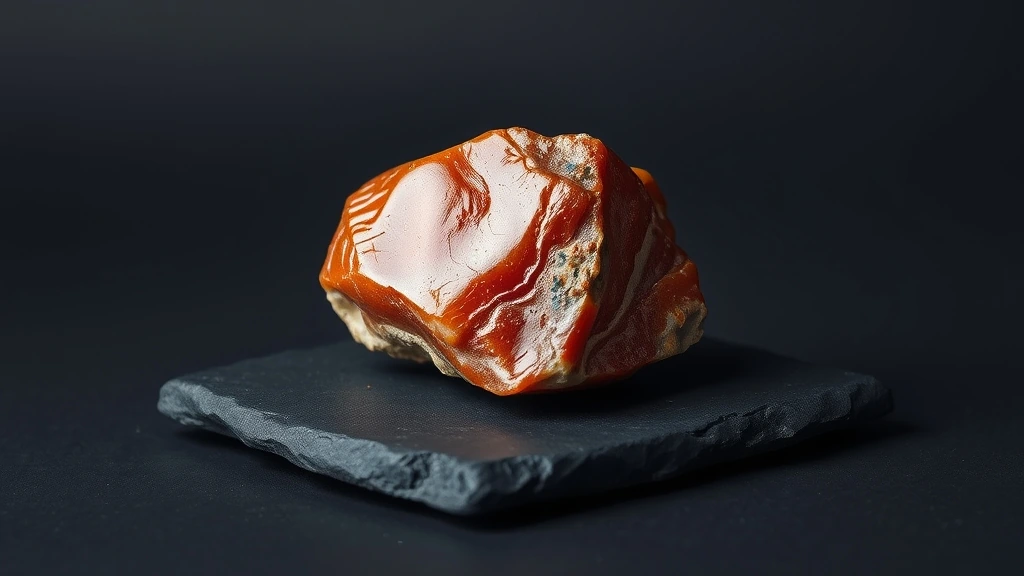
Carnelian belongs to the Natural Mineral / Crystal group, specifically as a microcrystalline quartz variety. It forms through the precipitation of silica-rich fluids in volcanic or sedimentary rocks. This geological process creates dense, banded structures distinct from macrocrystalline quartz. The stone’s formation often occurs in cavities or veins within host rocks.
What is Carnelian Gemstone? Geological Overview & Definition
Carnelian is defined as a microcrystalline quartz variety, characterized by its fine-grained, interlocking crystal structure. Unlike clear quartz, its opacity stems from microscopic inclusions and structural imperfections. These features scatter light, producing the stone’s characteristic waxy luster and translucency.
Geologically, it typically forms in volcanic rocks or hot spring deposits. The specific coloration arises from trace iron impurities within the silica lattice. This natural origin ensures each specimen displays unique banding patterns. Understanding this formation is key to authenticating genuine stones.
Carnelian Gemstone Chemical Composition & Crystallographic Properties
The primary crystal system for carnelian is Trigonal (quartz), reflecting its silica-based lattice structure. However, some varieties contain monoclinic (moganite), a high-temperature polymorph of silica. This dual classification highlights the complex thermal history of the stone. The lattice consists of silicon and oxygen tetrahedra arranged in a helical chain.
Coloration is driven by chromophore color centers, primarily involving iron impurities. These trace elements alter how the crystal lattice absorbs light. The specific shade depends on the oxidation state and concentration of iron. This mechanism distinguishes carnelian from other chalcedony varieties.
The stone exhibits moderate acid sensitivity, resisting most weak acids but dissolving in strong hydrofluoric acid. Thermal behavior is stable under normal jewelry conditions, though extreme heat can alter color. Proper care ensures the preservation of its optical and structural integrity.
| Property | Specification |
|---|---|
| Mineral Group | Natural Mineral / Crystal |
| Chemical Formula | SiO₂ (silicon dioxide) |
| Mohs Hardness | 6.5–7.0 |
| Crystal System | Trigonal (quartz), monoclinic (moganite) |
| Specific Gravity (Density) | 2.58–2.64 |
| Refractive Index | 1.535–1.539 |
| Color & Optical Properties | Natural Carnelian Gemstone color spectrum and optical dispersion |
| Primary Mining Localities | Global primary localities |
| Water & Chemical Resistance | High (Safe for gentle water washing) |
| Chakra Alignment (Traditional) | Root Chakra, Sacral Chakra |
| Zodiac Affinity (Traditional) | Taurus, Leo |
| Symbolic Meaning (Traditional) | Courage, vitality, and creative passion |
Carnelian Gemstone Varieties & Color Spectrum
Carnelian exhibits a warm, translucent range from pale orange to deep reddish-brown. This coloration primarily stems from trace amounts of iron oxide dispersed within the silica matrix. The stone’s hue is not uniform, often displaying subtle banding or mottling patterns. These variations are critical for gemological identification and valuation.
Standard Carnelian
This variety features a consistent, medium-orange body color with high translucency. It typically forms in chalcedony nodules within volcanic or sedimentary host rocks. The stone lacks distinct banding, offering a uniform, honey-like appearance. It is the most common and commercially available form of the gem.
Red Carnelian
Distinguished by its intense, blood-red to deep orange-red saturation, this morph is highly prized. The deep color results from a higher concentration of hematite inclusions or lattice defects. Such stones are rarer than standard orange varieties and command premium prices. They often exhibit a velvety, opaque quality in thicker cuts.
Banded Carnelian
This variety displays distinct, parallel bands of contrasting orange, red, and white hues. The banding forms due to rhythmic changes in silica deposition during geological formation. Each band represents a different phase of mineral accretion. Collectors value these stones for their intricate, striped visual patterns.
White Carnelian
Also known as “white chalcedony,” this variety appears pale pinkish-white or cream. It contains minimal iron impurities, resulting in a very light, delicate tone. The stone often shows faint, ghostly banding that is barely visible to the naked eye. It is less common in the commercial market than its orange counterparts.
Black Carnelian
This rare morph presents a dark, smoky brown to nearly black appearance. The darkness is caused by dense, microscopic carbonaceous inclusions or high iron content. It is frequently mistaken for smoky quartz but differs in hardness and luster. Due to its scarcity, it is highly sought after by collectors.
Where is Carnelian Gemstone Found? Geological Mining & Extraction
Carnelian primarily occurs in sedimentary rocks and volcanic tuffs, often associated with basaltic lava flows. It forms in cavities, geodes, or as nodules within these host rocks. The mineral is also found in alluvial deposits where weathering has liberated the stones. These secondary deposits are easier to mine and yield well-rounded, polished specimens.
Major mining regions include India, Brazil, Madagascar, and the United States. India remains a significant source, particularly from the Deccan Traps region. Brazil provides high-quality material from the Minas Gerais state. In the US, deposits in New Mexico and Arizona have historically supplied the market.
Historical Significance & Cultural Lore of Carnelian Gemstone
Ancient civilizations revered carnelian for its protective and energizing properties. It was widely used in Mesopotamian and Egyptian jewelry, often set in gold rings. The Romans believed it brought good luck and courage to soldiers. Archaeological finds reveal its use in seals and amulets across the Mediterranean.
In medieval Europe, carnelian was associated with the zodiac sign Taurus. It was carved into intaglios for official seals and personal adornment. The stone symbolized vitality and passion in various cultural traditions. Its enduring legacy continues to influence modern gemological appreciation.
Modern Uses & Jewelry Applications of Carnelian Gemstone
Carnelian’s warm, translucent hue makes it a versatile material for both faceted gemstones and smooth cabochon cuts. Lapidaries often choose the cabochon style to maximize the stone’s body color and waxy luster, which is particularly effective for pendants and rings. Its moderate hardness allows for intricate ornamental carving, a tradition dating back to ancient seals and intaglios.
- Cabochon Jewelry: Ideal for showcasing the stone’s rich orange-red saturation without light dispersion.
- Faceted Cuts: Used in smaller stones where brilliance is desired, though less common than cabochons.
- Ornamental Carvings: Frequently sculpted into beads, cameos, and decorative architectural elements.
Metaphysical Properties & Traditional Meaning of Carnelian Gemstone
According to historical traditions and metaphysical lore, carnelian is revered as a stone of courage and enduring vitality. Practitioners believe it helps overcome fear and hesitation, fostering a sense of grounded confidence in challenging situations. This emotional resonance stems from its association with the earth element and fiery energy.
In contemporary spiritual practices, the stone is often used to ignite creative passion and physical stamina. It is thought to balance the body’s energy levels, preventing burnout while sustaining motivation. Users frequently report a heightened sense of purpose and clarity when wearing this gemstone.
Which Chakra and Zodiac Signs Align with Carnelian Gemstone?
Carnelian is canonically aligned with the Root Chakra, which governs survival, security, and physical presence. This connection supports the stone’s traditional role in grounding energy and enhancing physical resilience. By stabilizing the base of the energy system, it helps users feel secure and connected to the earth.
Additionally, the gemstone resonates strongly with the Sacral Chakra, the center of creativity, emotion, and passion. This alignment explains its reputation for stimulating artistic expression and vital life force. For individuals seeking to balance emotional depth with creative output, carnelian serves as a powerful focal point.
Astrologically, carnelian is the traditional birthstone for Taurus and Leo. Taurus, an earth sign, benefits from the stone’s grounding properties and stability. Leo, a fire sign, draws on carnelian’s energetic warmth to enhance confidence and leadership qualities.
How to Identify Real vs. Fake Carnelian Gemstone
Distinguishing natural carnelian from imitations requires attention to subtle visual and physical cues, as synthetic glass and dyed chalcedony are common fakes. Synthetic glass often appears too perfect, lacking the natural inclusions found in genuine stones. Dyed replicas may show color concentration in fractures or along the surface, which is atypical for natural formation.
Practical At-Home Authenticity Tests
- Temperature Test (Thermal Feel): Genuine carnelian feels cool to the touch initially and warms slowly, whereas plastic or glass imitations often reach room temperature much faster.
- Specific Gravity & Weight Test: Natural carnelian has a density of 2.58–2.64, making it feel slightly heavier than similarly sized glass or plastic substitutes.
- Scratch & Hardness Test (Mohs Comparison): With a Mohs hardness of 6.5–7.0, carnelian will not be scratched by a steel knife (hardness 5.5) but may scratch glass (hardness 5.0).
- Microscopic & Loupe Inspection (Internal Inclusions): Use a 10x loupe to look for natural inclusions like tiny bubbles or flow lines; glass often contains circular bubbles, while natural stones have irregular mineral traces.
Carnelian Gemstone Valuation Factors, Grading & Pricing
The primary driver of value is Color Saturation, which should exhibit a deep, uniform orange-red hue. Gemologists assess tone consistency across the stone, as banding or color zoning significantly reduces market appeal. High optical clarity and a vitreous luster further enhance the stone’s visual impact and desirability.
Carat Weight directly influences pricing, with larger, flawless specimens commanding exponential premiums over smaller stones. Facet symmetry is critical, as precise cutting maximizes light return and minimizes visible imperfections. The presence of matrix or internal inclusions often lowers the grade, though some collectors appreciate unique inclusions.
Geographical Provenance Premium plays a significant role, with stones from historic mines like India or Brazil often valued higher. Wholesale prices vary based on supply, while retail margins reflect brand prestige and certification. Current market trends show steady demand for high-clarity, medium-to-large carat weights.
How to Clean and Care for Carnelian Gemstone
To maintain the stone’s integrity, immerse it in a bowl of warm soapy water for a few minutes. Gently scrub the surface using a soft cloth to remove oils and dust without scratching the finish. Rinse thoroughly with clean water and dry immediately with a lint-free towel.
It is crucial to avoid ultrasonic cleaners entirely, as the high-frequency vibrations can induce structural fractures in the quartz lattice. Steam cleaning is also discouraged due to the risk of thermal shock. Regular, gentle manual cleaning preserves the stone’s luster and prevents long-term damage.
Cleansing and Recharging Carnelian Gemstone (Energetic Care)
For energetic maintenance, place the gemstone on a selenite plate overnight to absorb negative energies. Alternatively, expose it to moonlight for several hours to restore its vibrational balance. These dry methods are safe and do not compromise the stone’s physical structure.
You may also use smoke smudging with sage or palo santo to purify the stone’s aura. Ensure the smoke does not directly contact the gemstone to avoid soot residue. This ritualistic approach complements physical care by aligning with traditional metaphysical practices.
Frequently Asked Questions About Carnelian Gemstone
Is carnelian safe to wear in the shower?
Yes, carnelian is safe for gentle water washing. As a variety of chalcedony, it possesses high water resistance and does not dissolve or degrade upon contact. However, avoid prolonged soaking in hot water to maintain the stone’s luster.
Can I clean carnelian in an ultrasonic cleaner?
No, you should avoid ultrasonic cleaners for this gemstone. The vibrations can cause structural fractures in the microcrystalline quartz structure. Instead, use warm soapy water and a soft cloth for safe, effective cleaning.
What is the chemical composition of carnelian?
Carnelian is composed of silicon dioxide (SiO₂). This silica-based mineral belongs to the quartz family, specifically the chalcedony variety. Its distinctive orange hue results from trace iron oxide inclusions within the crystal lattice.
Which zodiac signs are associated with carnelian?
Carnelian is traditionally linked to Taurus and Leo. These signs resonate with the stone’s vibrant energy and grounding properties. Wearing carnelian is believed to enhance personal strength and confidence for these astrological profiles.
Which chakras does carnelian align with?
Carnelian primarily activates the Root and Sacral Chakras. This alignment supports physical vitality and creative expression. It helps anchor energy to the earth while stimulating passion and motivation in the wearer.
How hard is carnelian on the Mohs scale?
Carnelian rates between 6.5 and 7.0 on the Mohs scale. This moderate hardness makes it durable for everyday jewelry but susceptible to scratching by harder minerals like topaz or diamond. Handle with care to preserve its polish.
What is the specific gravity of carnelian?
Carnelian has a density of 2.58–2.64 g/cm³. This specific gravity helps distinguish it from other orange gemstones like citrine or amber. Gemologists use this metric alongside refractive index to verify authenticity.
What is the crystal system of carnelian?
Carnelian forms in the trigonal crystal system. As a chalcedony variety, it typically appears in massive or banded forms rather than distinct crystals. Its structure is cryptocrystalline, meaning the individual crystals are too small to see.