
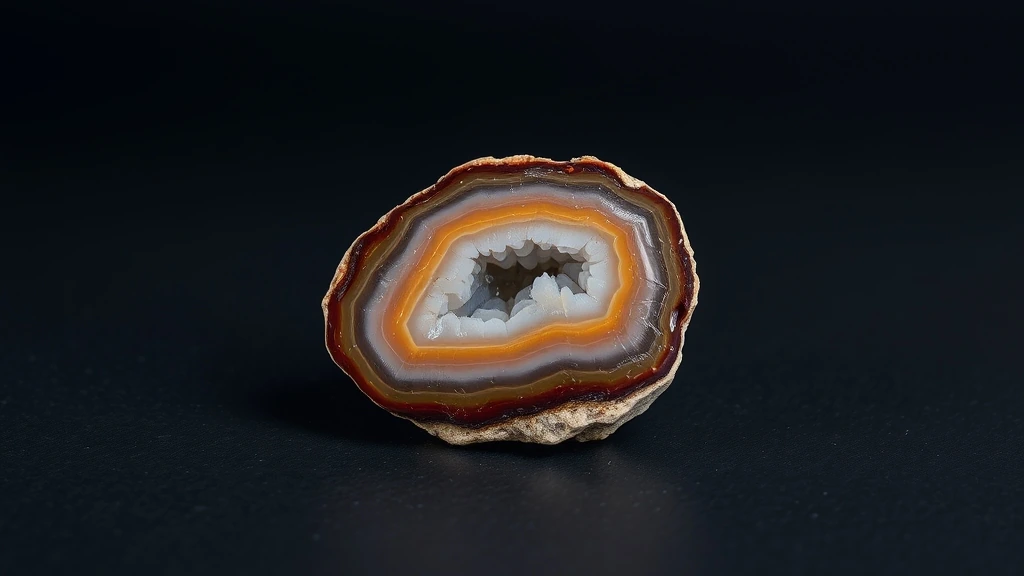
Fire agate belongs to the silicate mineral group, specifically classified as a variety of chalcedony. Unlike macrocrystalline quartz, it consists of cryptocrystalline quartz aggregates with fibers too small to see individually. This unique microstructure allows light to scatter, creating the stone’s characteristic fiery play-of-color. Geologists identify it as a secondary mineral formed within volcanic tuff.
What is Fire Agate Gemstone? Geological Overview & Definition
Fire agate forms in volcanic tuff and ash deposits, often associated with ancient lava flows. The stone develops as silica-rich fluids precipitate within porous volcanic rock over millions of years. This process creates distinct layers of chalcedony interbedded with iron oxide minerals. The resulting banding is a direct record of changing chemical conditions during formation.
The term “fire” refers to the iridescent luster caused by thin-film interference. Light waves reflect off microscopic layers of silica and iron, producing vibrant spectral colors. This optical phenomenon distinguishes fire agate from common banded agates. Collectors value specimens that display intense, rainbow-like hues across the surface.
Fire Agate Gemstone Chemical Composition & Crystallographic Properties
The primary chemical formula is silicon dioxide (SiO₂), with trace impurities driving coloration. The crystal system is trigonal, specifically as microcrystalline or cryptocrystalline fibrous aggregates. Unlike single crystals, these structures consist of countless tiny, interlocking quartz fibers. This arrangement gives the stone its characteristic waxy to vitreous luster.
Cation substitution is minimal, but trace iron oxides act as critical chromophores. These impurities create the red, orange, and yellow bands seen in high-quality specimens. The stone is chemically stable but sensitive to strong acids, which can etch the surface. Thermal behavior is stable under normal conditions, though extreme heat can alter internal stress patterns.
The refractive index ranges from 1.530 to 1.543, typical for quartz varieties. Density measures between 2.60 and 2.64 g/cm³, confirming its silica composition. No significant lattice defects are visible without advanced microscopy. Understanding these properties ensures accurate identification and proper care for collectors.
| Property | Specification | |
|---|---|---|
| Mineral Group | Silicates (Chalcedony / Cryptocrystalline Quartz) | |
| Chemical Formula | SiO₂ (Silicon Dioxide) | |
| Mohs Hardness | 6.5-7 | |
| Crystal System | Trigonal (Microcrystalline / Cryptocrystalline fibrous aggregates) | |
| Specific Gravity (Density) | 2.60- 2.64 | |
| Refractive Index | 1.530 to 1.543 | |
| Color & Optical Properties | Natural Fire Agate Gemstone color spectrum and optical dispersion | |
| Primary Mining Localities | Brazil, Uruguay, Turkey, India, Madagascar | |
| Water & Chemical Resistance | High (Safe for gentle warm water and mild soap; avoid harsh acids and chlorine) | |
| Chakra Alignment (Traditional) | Root Chakra and Sacral Chakra | |
| Zodiac Affinity (Traditional) | Gemini, Virgo, Taurus | |
| Symbolic Meaning (Traditional) | Grounding, emotional balance, physical endurance, and protection |
Agate Varieties & Comprehensive Sub‑Types
Blue Lace Agate
Blue Lace Agate forms in low‑temperature silica‑rich cavities where microscopic chalcedony fibers align in delicate, sky‑blue and white undulating ribbons. The banding results from light diffraction across nanometer‑scale fibers, giving the stone its signature lace‑like appearance. It is a modest‑priced variety prized by crystal healers for throat‑chakra alignment and a soothing vibrational frequency.
Moss Agate
Moss Agate crystallizes in volcanic tuffs, filling voids with translucent chalcedony that traps green hornblende or chlorite dendritic inclusions resembling mossy foliage. The dendrites grow along micro‑fractures, producing a botanical pattern that is both decorative and symbolic. Historically, it served as an agricultural talisman, believed to promote grounding and fertility.
Fire Agate
Fire Agate develops as botryoidal chalcedony within basaltic lava flows, where alternating nanolayers of iron oxides (limonite, goethite) and silica create a vivid Schiller effect. The iridescent flashes shift from copper to gold as the stone is turned, a phenomenon linked to thin‑film interference. Rare and sought after, primary sources lie in Mexico’s Sonora region and Arizona’s volcanic fields, commanding premium market prices.
Botswana Agate
Botswana Agate originates in ancient basaltic lava that cooled slowly, allowing ultrafine concentric banding in muted greys, peach, salmon, and lilac. The dense, tightly packed layers give the stone a silky sheen and exceptional durability for cabochon work. Because of its subtle palette, it is favored by designers for high‑end jewelry and collector pieces.
Dendritic Agate
Formed in silica‑rich sedimentary veins, Dendritic Agate displays black or dark‑brown fern‑like branches of manganese‑iron oxides that infiltrate a milky‑white chalcedony matrix. These oxides precipitate along micro‑fractures, creating dramatic, landscape‑like patterns. Lapidaries prize it for scenic cabochons and ornamental carvings, often marketed as “nature’s artwork.”
Crazy Lace Agate
Crazy Lace Agate is a Mexican variety from the Chihuahua region, where rapid cooling of volcanic ash yields multicolored zig‑zag ribbons of yellow, red, orange, and cream. High iron content pigments the bands, while the fine‑grained chalcedony matrix preserves the intricate lace‑like design. Its vibrant look makes it a favorite for statement jewelry and metaphysical collections.
Tree Agate
Tree Agate forms in volcanic ash deposits, featuring an opaque white chalcedony base overlaid with deep‑green chlorite dendrites that mimic foliage. Unlike the translucent Moss Agate, the solid white background gives a non‑translucent appearance, enhancing the contrast of the “leaves.” It is popular among collectors for its botanical motif and rarity.
Flower Agate
Exclusive to Madagascar, Flower Agate develops in silica‑rich pockets where opaque chalcedony inclusions grow in three‑dimensional clusters resembling cherry‑blossom petals. These inclusions are embedded in a soft pink‑to‑caramel translucent matrix, creating a floral tableau. The rarity and artistic appeal drive its high collector value and limited market supply.
Modern Uses & Jewelry Applications of Fire Agate Gemstone
Fire agate is most often fashioned into a cabochon to showcase its iridescent fire‑storm pattern, though skilled lapidaries also produce limited faceted pieces for high‑gloss sparkle. The stone’s moderate Mohs hardness (6.5‑7) allows precise grinding without fracturing, making it ideal for rings, pendants, and earrings. Artisans also carve ornamental beads and intaglios, exploiting the stone’s natural color bands for decorative motifs.
- Cabochon pendants highlighting the “fire” effect
- Faceted rings and earrings for modern, geometric aesthetics
- Carved beads, intaglios, and miniature sculptures for ornamental art
Metaphysical Properties & Traditional Meaning of Fire Agate Gemstone
According to historical traditions and metaphysical lore, fire agate is revered as a grounding stone that stabilizes emotional turbulence and encourages inner courage. It is believed to transmute fear into confidence, fostering resilience during periods of change, while its shimmering hues are said to stimulate creative inspiration. Practitioners also associate the gemstone with emotional balance, helping wearers release suppressed anger and cultivate a calm, centered mindset.
Which Chakra and Zodiac Signs Align with Fire Agate Gemstone?
Fire agate resonates strongly with the Root Chakra, supporting physical vitality, security, and a sense of belonging to the earth. It also harmonizes the Sacral Chakra, enhancing sensuality, pleasure, and the flow of creative energy throughout the body.
In astrology, fire agate is expressly linked to Gemini, Virgo, and Taurus. Gemini benefits from the stone’s mental clarity, Virgo finds grounding for practical pursuits, and Taurus receives reinforcement of stability and sensual appreciation—no other zodiac signs are traditionally paired with this gem.
How to Identify Real vs. Fake Fire Agate Gemstone
Artificial imitations of fire agate include dyed quartz, synthetic glass, and resin‑filled composites that mimic the stone’s colorful layers but lack its natural internal structure. These replicas often feel lighter, display uniform coloration, or exhibit surface bubbles not found in genuine fire agate. Recognizing these differences is essential for collectors and buyers seeking authentic material.
Practical At-Home Authenticity Tests
- Temperature Test (Thermal Feel): Real fire agate feels cool to the touch initially and warms slowly, whereas glass or plastic replicas adjust temperature rapidly.
- Specific Gravity & Weight Test: Genuine fire agate has a density of 2.60‑2.64 g/cm³; a simple water‑displacement test will reveal a heavier feel compared with lighter synthetic imitations.
- Scratch & Hardness Test (Mohs Comparison): Using a steel file (hardness ~6.5), a genuine fire agate will resist scratching, while glass (≈5.5) or dyed quartz (≈7) will show distinct marks.
- Microscopic & Loupe Inspection (Internal Inclusions): Under 10× magnification, authentic fire agate displays fine, irregular silica inclusions and layered color bands; synthetic glass shows uniform bubbles or a lack of natural fracture patterns.
Fire Agate Gemstone Valuation Factors, Grading & Pricing
The primary driver of value is Color Saturation, specifically the intensity of red, orange, and yellow bands. Collectors prize specimens with high optical clarity and a vibrant, glassy luster that enhances the iridescent play-of-color. Uniform tone distribution across the stone significantly elevates its aesthetic appeal and market desirability.
Carat Weight influences pricing, though large, high-quality specimens remain rare and command premium rates. Precise facet symmetry is crucial for maximizing light reflection and revealing the internal banding structure effectively. The presence of unwanted matrix or dark inclusions can diminish value, while clean, unblemished stones fetch higher prices.
Geographical Provenance Premium often applies to stones from renowned localities like Mexico or Brazil, which are historically significant. Wholesale prices vary based on cut quality, but retail margins typically increase for certified, high-grade gemstones. Market trends show steady demand for unique, naturally colored fire agates over dyed alternatives.
How to Clean and Care for Fire Agate Gemstone
For routine maintenance, warm soapy water is the ideal cleaning method for solid fire agate specimens. Use a soft brush to gently remove dirt from crevices, ensuring no abrasive particles scratch the surface. Rinse thoroughly with lukewarm water and dry immediately with a lint-free cloth to prevent residue buildup.
Strictly avoid ultrasonic cleaners if the specimen is dyed, heavily fractured, or has undergone any treatments. These devices can exacerbate existing cracks or strip away artificial colorants, causing irreversible damage to the gemstone. Always inspect the stone for fractures before submerging it in any liquid solution.
Cleansing and Recharging Fire Agate Gemstone (Energetic Care)
For energetic cleansing, use smoke smudging with sage or palo santo to purify the stone without moisture. This dry method respects the mineral’s structure while addressing metaphysical energy concerns. Ensure the area is well-ventilated to allow the smoke to dissipate safely around the gem.
Place the fire agate on a selenite plate or expose it to moonlight for recharging purposes. These methods avoid direct water contact, preserving the stone’s integrity and any potential treatments. Allow the gem to rest overnight to absorb ambient energy before wearing it again.
Frequently Asked Questions About Fire Agate Gemstone
Is fire agate safe to wear in the shower?
Yes, fire agate is generally safe for gentle warm water and mild soap. As a durable variety of chalcedony, it withstands occasional moisture without structural damage. However, you should avoid harsh acids and chlorine found in some shower products. These chemicals can degrade surface treatments or dull the stone’s vibrant iridescence over time.
Can I use an ultrasonic cleaner on my fire agate?
Warm soapy water is the ideal cleaning method for solid agates. You must avoid ultrasonic cleaners if the specimen is dyed, heavily fractured, or treated. High-frequency vibrations can loosen internal fractures or strip away artificial color enhancements. Always inspect the stone for fractures before selecting any cleaning method to ensure longevity.
What is the chemical composition of fire agate?
Fire agate is composed primarily of silica, or silicon dioxide (SiO₂). This mineral belongs to the quartz group, which explains its high durability and resistance to scratching. The specific arrangement of microscopic layers within the silica structure creates the unique optical effects seen in this gemstone.
How hard is fire agate on the Mohs scale?
Fire agate rates between 6.5 and 7 on the Mohs hardness scale. This makes it significantly harder than many other gemstones, such as opal or pearl. It is durable enough for daily wear in rings or bracelets. However, it remains susceptible to sharp impacts that could cause chipping despite its overall toughness.
Which zodiac signs are aligned with fire agate?
Fire agate is traditionally associated with Gemini, Virgo, and Taurus. These earth and air signs benefit from the stone’s grounding properties. In metaphysical practices, it is believed to enhance focus and stability. Wearing this gemstone may help these individuals maintain balance and clarity during stressful periods.
Which chakras does fire agate activate?
Fire agate primarily activates the Root Chakra and Sacral Chakra. These energy centers govern survival instincts, stability, and creative passion. The stone’s fiery tones resonate with the lower body’s energy flow. Practitioners use it to strengthen physical vitality and emotional security in daily life.
What is the refractive index of fire agate?
The refractive index of fire agate ranges from 1.530 to 1.543. This optical property determines how light bends as it enters the stone. It contributes to the gem’s subtle luster and internal fire. Understanding this value helps gemologists distinguish it from other silica-based minerals during identification.
What is the crystal system of fire agate?
Fire agate typically exhibits a trigonal crystal system, like quartz. Some varieties may contain moganite, which has a monoclinic structure. This structural variation affects the stone’s internal layering and optical behavior. The crystal lattice arrangement is crucial for producing the characteristic banding patterns.