
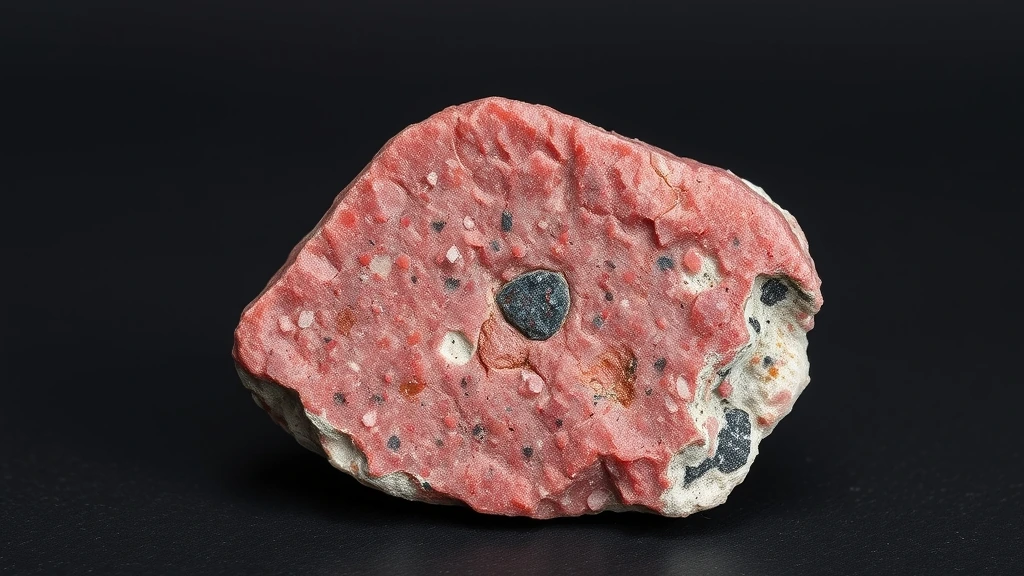
Rhodonite belongs to the natural mineral / crystal group, forming in metamorphic environments where manganese‑bearing rocks are subjected to heat and pressure. Its triclinic symmetry yields elongated, tabular crystals that often occur in massive aggregates. The stone’s pink to rose‑red coloration, sometimes veined with black manganese oxides, has made it a favored material for carvings, jewelry, and metaphysical practices worldwide. In comparative mineralogical collections, practitioners and geologists frequently study Clinoptilolite Zeolite alongside this crystal to appreciate their subtle energetic and structural differences.
What is Rhodonite? Geological Overview & Definition
Rhodonite is a silicate mineral that crystallizes in the triclinic system, typically found in metamorphic belts and manganese‑rich ore deposits. It commonly occurs alongside minerals such as garnet, calcite, and quartz, reflecting its formation under medium‑grade metamorphic conditions.
The mineral’s name derives from the Greek *rhodon* (rose) and *lithos* (stone), a nod to its distinctive pink coloration. In addition to gem‑quality crystals, rhodonite appears as massive, granular nodules that are widely used for ornamental carving and as a source of manganese in industrial processes. In comparative mineralogical collections, practitioners and geologists frequently study Lazulite alongside this crystal to appreciate their subtle energetic and structural differences.
Rhodonite Chemical Composition & Crystallographic Properties
The idealized formula (Mn²⁺, Fe²⁺, Mg, Ca)SiO₃ highlights the dominant role of manganese, with iron, magnesium, and calcium substituting within the same crystallographic sites. This cation substitution controls subtle variations in hue, ranging from soft pink to deep rose, and influences the mineral’s density, measured between 3.57–3.76 g/cm³.
Rhodonite’s triclinic crystal system lacks any axis of symmetry, resulting in three unequal axes that intersect at oblique angles. The lattice is built from chains of SiO₄ tetrahedra linked by Mn²⁺‑occupied octahedra, producing a robust yet slightly flexible framework.
Color arises from Mn²⁺ electronic transitions acting as chromophore centers; trace Fe²⁺ can deepen the tone, while manganese oxides create characteristic black veining. The mineral is acid‑sensitive, slowly dissolving in strong hydrochloric acid, which can be used to distinguish it from more resistant silicates.
When heated, rhodonite undergoes a reversible loss of structural water at temperatures above 600 °C, leading to a slight darkening of color and a modest reduction in hardness. This thermal behavior is important for gemstone cutting, as controlled heating can enhance clarity without compromising the stone’s integrity.
| Property | Specification |
|---|---|
| Mineral Group | Natural Mineral / Crystal |
| Chemical Formula | (Mn²⁺ , Fe²⁺ , Mg, Ca)SiO₃ |
| Mohs Hardness | 5.5–6.5 |
| Crystal System | Triclinic |
| Specific Gravity (Density) | 3.57–3.76 |
| Refractive Index | 1.680 – 1.710 |
| Color & Optical Properties | Natural Rhodonite color spectrum and optical dispersion |
| Primary Mining Localities | Global primary localities |
| Water & Chemical Resistance | High (Safe for gentle water washing) |
| Chakra Alignment (Traditional) | Heart Chakra |
| Zodiac Affinity (Traditional) | Taurus, Virgo |
| Symbolic Meaning (Traditional) | Emotional healing, forgiveness, and inner peace |
Rhodonite Varieties & Color Spectrum
Rhodonite exhibits a diverse range of color morphs driven by varying manganese oxidation states and trace element substitutions. The most prized specimens display a deep, saturated pink hue that intensifies with higher Mn²⁺ concentrations. Geologists classify these variations based on crystal clarity, inclusion density, and the specific geological environment of formation.
Classic Pink Rhodonite
This variety features a uniform, vibrant pink coloration with minimal black inclusions, making it highly sought after for cabochon cutting. It typically forms in metamorphic schists where manganese-rich fluids permeated silica-rich host rocks. The lack of significant iron impurities allows the pure manganese chromophore to dominate the visual spectrum.
Black-Veined Rhodonite
Characterized by distinct black dendritic patterns, this variety contains intergrown manganese oxides and iron silicates within the pink matrix. These veins often follow cleavage planes, creating a striking contrast that enhances the stone’s ornamental value. Such specimens are frequently found in high-pressure metamorphic zones where fluid migration was turbulent.
Pale Pink Rhodonite
Often referred to as “rose quartz mimic” in lower-grade markets, this variety possesses a lighter, more translucent pink tone. It generally contains higher levels of calcium and magnesium, which dilute the manganese concentration and reduce overall saturation. While less valuable than deep pink types, it is abundant in certain Central Asian deposits.
Opaque Rhodonite
This dense variety lacks transparency due to high internal scattering from fine-grained mineral inclusions and micro-fractures. It is primarily used for carving and tumbler stones rather than faceted gemstones. The triclinic crystal structure contributes to its characteristic cleavage, which can limit the size of intact rough material.
Manganese-Rich Rhodonite
Found in specific hydrothermal veins, this variety exhibits an unusually deep, almost purplish-pink hue. The intense coloration results from localized Mn²⁺ enrichment during late-stage mineral precipitation. Such specimens are rare and command premium prices in the collector market for their exceptional chromatic depth.
Iron-Substituted Rhodonite
This morph displays a brownish-pink tint caused by significant Fe²⁺ substitution for manganese in the crystal lattice. The iron content alters the absorption spectrum, shifting the perceived color towards warmer, earthy tones. It is commonly associated with iron-rich basaltic host rocks in volcanic regions.
Where is Rhodonite Found? Geological Mining & Extraction
Rhodonite primarily occurs in metamorphic rocks such as schists and gneisses, where high pressure and temperature facilitate its crystallization. It is also found in pegmatite dikes and hydrothermal veins associated with manganese ore deposits. The mineral often forms in close association with quartz, calcite, and various manganese oxides.
Major mining regions include the Ural Mountains in Russia, which have produced some of the finest gem-quality material for centuries. Significant deposits are also located in Brazil, particularly in Minas Gerais, as well as in China, India, and South Africa. Extraction methods typically involve open-pit mining for large deposits and careful hand-chipping for high-value gem rough.
Historical Significance & Cultural Lore of Rhodonite
Historical records indicate that rhodonite was valued in ancient Russian jewelry traditions, where it was often mistaken for rose quartz or carnelian. Archaeological findings suggest its use in ornamental carvings and decorative inlays during the 18th and 19th centuries. The stone’s distinctive pink color made it a popular substitute for more expensive gemstones in period jewelry.
In modern esoteric traditions, rhodonite is associated with emotional healing and the heart chakra, promoting forgiveness and inner peace. While its historical use was largely decorative, contemporary metaphysical practices have elevated its status in alternative wellness communities. This cultural resurgence has driven increased demand for high-quality, untreated specimens in the global gem market.
Modern Uses & Jewelry Applications of Rhodonite
Rhodonite is primarily valued as a cabochon gemstone due to its moderate Mohs hardness of 5.5–6.5, which makes faceting risky for large stones. Lapidaries often polish the mineral into smooth, domed shapes to showcase its distinctive pink-to-red hues and black manganese oxide patterns. Its durability is sufficient for pendants and earrings but requires caution in rings subject to daily impact.
- Cabochon Cutting: The most common cut, preserving the stone’s natural color zoning and intricate black veining.
- Ornamental Carving: Used in decorative boxes, vases, and architectural accents due to its unique aesthetic appeal.
- Beads and Carvings: Frequently shaped into prayer beads, pendants, and small figurines for collectors and spiritual practitioners.
- Lapidary Caution: Requires careful handling during polishing to avoid chipping, as the stone can be brittle along cleavage planes.
Metaphysical Properties & Traditional Meaning of Rhodonite
According to historical traditions and metaphysical lore, rhodonite is revered as a stone of emotional healing and deep forgiveness. Practitioners believe it helps release old resentment and fosters a sense of inner peace by balancing the heart’s energy. It is often used in meditation to promote self-compassion and emotional stability during periods of transition.
The stone’s pink tones are symbolically linked to the heart, encouraging users to open up to love and acceptance. By addressing emotional wounds, rhodonite is thought to create a pathway toward spiritual attributes of patience and understanding. This makes it a popular choice for those seeking to cultivate a more forgiving and compassionate mindset.
Which Chakra and Zodiac Signs Align with Rhodonite?
In esoteric practice, rhodonite is canonically aligned with the Heart Chakra, also known as the Anahata. This energy center governs love, compassion, and emotional balance, which aligns perfectly with the stone’s traditional association with emotional healing. By resonating with this chakra, the mineral is believed to facilitate the release of heartache and promote harmonious relationships.
Astrologically, rhodonite is specifically associated with the earth signs Taurus and Virgo. These zodiac signs value stability, practicality, and deep emotional connection, traits that the stone is said to enhance. Wearing rhodonite is thought to ground these individuals, helping them maintain inner peace while navigating the complexities of human emotion.
How to Identify Real vs. Fake Rhodonite
Artificial imitations of rhodonite often involve synthetic glass or dyed calcite, which lack the natural complexity of genuine specimens. These fakes may appear too uniform in color or exhibit artificial bubbles within the structure. Understanding the physical properties of the real mineral is essential for distinguishing it from these low-cost alternatives.
Practical At-Home Authenticity Tests
- Temperature Test (Thermal Feel): Genuine rhodonite feels cool to the touch initially and warms slowly, whereas plastic imitations warm up rapidly and feel lighter.
- Specific Gravity & Weight Test: Real rhodonite has a high density of 3.57–3.76, making it feel significantly heavier than its size suggests compared to glass or plastic.
- Scratch & Hardness Test (Mohs Comparison): With a Mohs hardness of 5.5–6.5, rhodonite can scratch glass but may be scratched by a steel knife, helping differentiate it from softer fakes.
- Microscopic & Loupe Inspection (Internal Inclusions): Use a 10x loupe to check for natural black manganese oxide inclusions; synthetic glass often contains circular bubbles or lacks natural veining.
Rhodonite Valuation Factors, Grading & Pricing
Market value is primarily driven by Color Saturation, where deep, uniform pink hues command the highest premiums. Stones exhibiting vibrant, unbroken coloration without excessive brownish oxidation are considered top-tier specimens. The natural energetic luster of the surface also significantly influences buyer perception and desirability.
Pricing structures rely heavily on Crystal Size & Weight (Grams) rather than gemological carat weights. Raw specimens are valued by their dimensions, while tumbled stones are graded on the quality of their polish. Natural matrix inclusions can enhance aesthetic appeal, provided they do not compromise the stone’s structural integrity.
Collector markets place a distinct premium on Ethical Sourcing & Locality Premium, favoring stones from verified, sustainable mines. Provenance documentation increases trust among holistic practitioners and serious mineral collectors alike. This transparency ensures the specimen’s journey aligns with modern ethical standards in the gem trade.
How to Clean and Care for Rhodonite
Rhodonite possesses a Mohs hardness of 5.5–6.5, making it durable enough for gentle cleaning with warm soapy water. Use a soft cloth to wipe the surface, ensuring all dirt and oils are removed without abrasive pressure. This method preserves the stone’s natural luster while maintaining its physical stability during routine maintenance.
It is critical to avoid ultrasonic cleaners, as high-frequency vibrations can induce structural fractures within the crystal lattice. The mineral’s triclinic structure may contain natural cleavage planes that are susceptible to mechanical stress. Always dry the stone thoroughly with a lint-free towel after washing to prevent any residual moisture damage.
Cleansing and Recharging Rhodonite (Energetic Care)
For holistic maintenance, practitioners often utilize herbal smudging to clear perceived energetic stagnation. Passing the stone through the smoke of sage or palo santo is a traditional, non-invasive method. This practice respects the mineral’s physical integrity while addressing metaphysical cleansing goals without requiring liquid exposure.
Alternatively, resting the specimen on a selenite charging slab under gentle moonlight is a popular recharging technique. This dry method avoids the risks associated with heat or intense sunlight, which can alter the stone’s appearance. Ensure the environment remains dry to protect the rhodonite’s surface finish during the overnight charging process.
Frequently Asked Questions About Rhodonite
Is rhodonite safe to wear in the shower or while swimming?
Yes, rhodonite is water‑resistant and can tolerate gentle water exposure. Its triclinic structure and moderate hardness (5.5–6.5 on the Mohs scale) allow safe cleaning with warm soapy water, but prolonged submersion or harsh detergents should be avoided to preserve surface luster.
How should I clean a rhodonite at home?
Clean rhodonite with warm soapy water and a soft cloth, never using ultrasonic cleaners. The mineral’s density (3.57–3.76 g/cm³) and fracture‑prone nature mean ultrasonic vibrations can cause micro‑cracks, while gentle hand washing removes oils without compromising the crystal lattice.
Can rhodonite be used in everyday jewelry despite its hardness?
Rhodonite’s hardness of 5.5–6.5 makes it suitable for pendants and earrings but less ideal for rings. Daily wear on high‑impact surfaces may lead to scratches; however, its attractive pink‑red hue and refractive index of 1.680–1.710 keep it popular in fashion pieces that receive moderate wear.
What zodiac signs are traditionally associated with rhodonite?
Rhodonite aligns with the zodiac signs Taurus and Virgo. These earth signs are believed to resonate with the stone’s stabilizing energy, supporting the grounded, practical qualities valued by both signs while enhancing emotional balance.
Which chakra does rhodonite primarily activate?
Rhodonite is linked to the Heart Chakra. This connection promotes emotional healing, forgiveness, and inner peace, encouraging the flow of compassionate energy throughout the body and fostering harmonious relationships.
Does rhodonite contain any hazardous elements?
Rhodonite’s composition is primarily manganese‑rich silicate with minor iron, magnesium, and calcium. While manganese can be toxic in large quantities, the mineral’s stable crystal lattice ensures that normal wear does not release harmful substances, making it safe for most users.
How can I tell if a rhodonite specimen is genuine?
Authentic rhodonite exhibits a characteristic pink to rose‑red color with black manganese oxide veining. Under magnification, the triclinic crystal habit and lack of fluorescence help differentiate it from dyed quartz or synthetic alternatives.
Is rhodonite suitable for use in metaphysical practices?
Yes, rhodonite is widely employed for emotional balance and forgiveness rituals. Practitioners place the stone on the Heart Chakra during meditation to amplify feelings of compassion, helping to release past grievances and foster inner tranquility.