
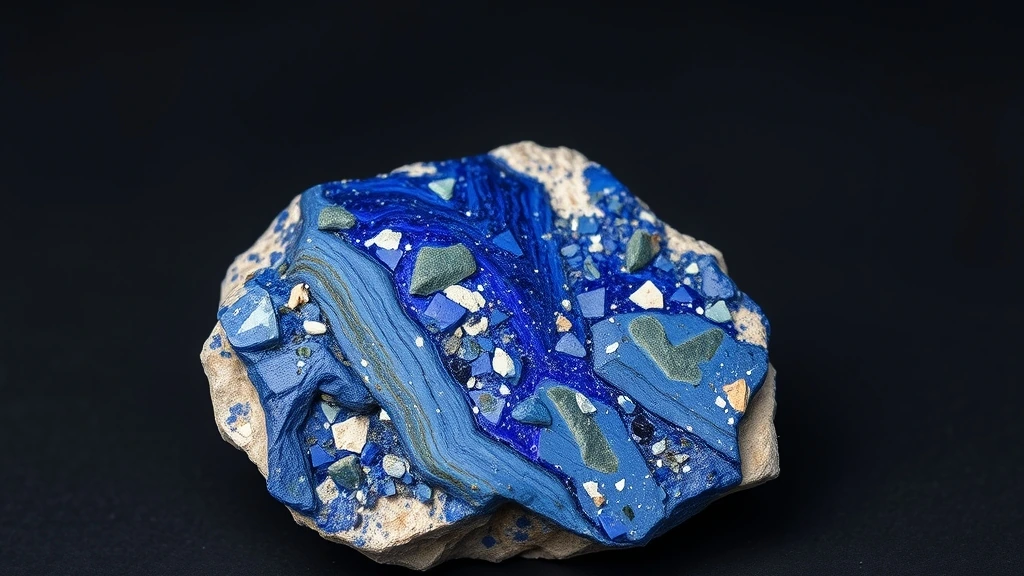
Lapis lazuli belongs to the silicate mineral group, specifically classified as a feldspathoid rock aggregate. It is not a single mineral but a complex mixture where lazurite serves as the primary blue component. This geological formation occurs in metamorphic rocks, typically within marble deposits. Understanding this composite nature is essential for accurate gemological identification.
What is Lapis Lazuli Gemstone? Geological Overview & Definition
Lapis lazuli is defined as a polymictic rock rather than a single crystalline mineral. Its value derives from the high concentration of lazurite, which provides the characteristic deep blue color. The matrix often includes pyrite flecks, calcite, and sodalite, creating a distinctive visual texture.
Geologically, this stone forms in ultramafic rocks subjected to contact metamorphism. The metamorphic process drives the chemical reactions that stabilize the lazurite phase. Major deposits are found in Afghanistan, Pakistan, and Russia. These locations host the highest quality material for gem cutting.
Lapis Lazuli Gemstone Chemical Composition & Crystallographic Properties
The lazurite component crystallizes in the isometric (cubic) system, forming a complex lattice structure. This cubic symmetry dictates the optical properties of the blue mineral phase. The rock aggregate itself lacks a single crystal orientation due to its mixed composition. This structural diversity influences the stone’s overall refractive index range.
Chemically, the formula reflects significant cation substitution between sodium and calcium ions. The anionic site accommodates sulfur, sulfate, or chloride, affecting charge balance. This solid solution behavior is critical for understanding its stability. Variations in these substitutions can subtly alter the physical properties.
The intense blue color arises from sulfur radical anions acting as chromophores. These color centers absorb specific wavelengths of light, reflecting the vibrant blue hue. Thermal behavior shows that high heat can degrade these delicate chromophores. Consequently, heat treatment is generally avoided to preserve color integrity.
Lapis lazuli exhibits moderate acid sensitivity, particularly in its calcite-rich matrix. Prolonged exposure to acidic substances can etch the surface and dull the luster. The lazurite mineral itself is more resistant but remains part of a fragile aggregate. Proper care ensures the longevity of this ancient gemstone.
| Property | Specification |
|---|---|
| Mineral Group | Silicates (Feldspathoid Rock Aggregate / Lazurite) |
| Chemical Formula | (Na,Ca)₈(AlSiO₄)₆(S,SO₄,Cl)₁₋₂ (Lazurite-rich rock aggregate) |
| Mohs Hardness | 5.0 – 5.5 |
| Crystal System | Isometric / Cubic (Lazurite component is cubic; rock aggregate) |
| Specific Gravity (Density) | 2.70 – 2.90 |
| Refractive Index | 1.500 – 1.670 |
| Color & Optical Properties | Natural Lapis Lazuli Gemstone color spectrum and optical dispersion |
| Primary Mining Localities | Afghanistan (Badakhshan), Chile (Ovalle), Russia (Lake Baikal) |
| Water & Chemical Resistance | Moderate/Sensitive (Porous aggregate containing pyrite; avoid soaking) |
| Chakra Alignment (Traditional) | Third Eye and Throat Chakra |
| Zodiac Affinity (Traditional) | Sagittarius, Aquarius, Libra |
| Symbolic Meaning (Traditional) | Royalty, intuitive wisdom, third eye activation, and universal truth |
Lapis Lazuli Gemstone Varieties & Color Spectrum
Lapis lazuli is not a single mineral but a complex rock aggregate dominated by lazurite. The visual quality depends heavily on the ratio of lazurite to calcite and pyrite. High-grade material exhibits a deep, uniform ultramarine hue with minimal white veining.
Badakhshan Imperial Blue
This variety originates from the Sar-e-Sang mines in Afghanistan, representing the gold standard for quality. It features an intense, saturated blue color with distinct golden pyrite inclusions. The absence of white calcite veins makes this material exceptionally rare and valuable.
Afghan Semi-Imperial
Semi-imperial lapis contains a higher percentage of calcite than imperial grade. This results in visible white streaks or patches within the deep blue matrix. While less valuable, it remains highly sought after for its rich color saturation.
Chilean Lapis Lazuli
Chilean deposits often produce material with a slightly lighter, more azure-blue tone. This variety typically contains fewer pyrite specks compared to its Afghan counterpart. The crystal structure of the lazurite here can appear slightly less dense.
Indian Lapis Lazuli
Found in the Himalayan regions, this variety often displays a paler, sky-blue coloration. It is characterized by a higher content of quartz and feldspar inclusions. This makes the stone lighter in density and less opaque than premium grades.
Synthetic Lapis Lazuli
Modern laboratories create synthetic versions using sintering techniques to mimic natural formation. These stones often lack the natural pyrite inclusions found in genuine material. Gemologists identify them through their uniform color distribution and lack of natural flaws.
Where is Lapis Lazuli Gemstone Found? Geological Mining & Extraction
Lapis lazuli forms in metamorphic rocks, specifically within marbles and schists subjected to high pressure. The primary host rock is often dolomitic marble, where sulfur compounds react with aluminosilicates. This geological process creates the characteristic blue lazurite mineral within the rock matrix.
The Sar-e-Sang mines in Badakhshan, Afghanistan, remain the world’s most famous source. Significant deposits also exist in Chile, Pakistan, and Russia, though quality varies widely. Extraction involves open-pit mining, where large blocks are cut and transported for processing.
Historical Significance & Cultural Lore of Lapis Lazuli Gemstone
Ancient civilizations prized lapis lazuli as a symbol of royalty and divine power. The Egyptians used it in jewelry and amulets, believing it offered protection in the afterlife. Cleopatra herself was famously adorned with lapis lazuli ornaments during her reign.
In Mesopotamia, the stone was associated with the goddess Inanna and used in temple rituals. Archaeological finds reveal its use in cuneiform tablets and intricate beadwork. Its enduring legacy reflects a timeless human connection to intuitive wisdom and universal truth.
Modern Uses & Jewelry Applications of Lapis Lazuli Gemstone
Lapidaries primarily cut lapis lazuli into cabochons to showcase its deep blue hue and pyrite inclusions, as its moderate hardness makes faceting less ideal for high-polish stones. The stone’s rich coloration also lends itself well to ornamental carving, where artisans sculpt intricate figurines and architectural elements.
- Cabochon Cutting: Smooth, domed surfaces that maximize the stone’s lustrous blue color and highlight metallic pyrite flecks.
- Ornamental Carving: Used for intaglio seals, cameos, and decorative inlays due to its workability at Mohs hardness 5.0 – 5.5.
- Beads & Pendants: Polished into uniform shapes for necklaces, bracelets, and earrings, often paired with gold settings.
Metaphysical Properties & Traditional Meaning of Lapis Lazuli Gemstone
According to historical traditions and metaphysical lore, lapis lazuli has long been revered as a stone of royalty and divine wisdom. Ancient civilizations believed it facilitated communication with higher realms and enhanced intuitive wisdom in the wearer.
This gemstone is traditionally associated with the pursuit of universal truth and spiritual clarity. Its deep blue energy is thought to calm the mind while simultaneously stimulating mental acuity and self-awareness.
Which Chakra and Zodiac Signs Align with Lapis Lazuli Gemstone?
In chakra theory, lapis lazuli is primarily aligned with the Third Eye Chakra, promoting intuition and inner vision. It also resonates strongly with the Throat Chakra, encouraging clear expression of truth and creative communication.
Astrologically, this stone is canonically linked to Sagittarius, Aquarius, and Libra. These air and fire signs benefit from the stone’s ability to enhance intellectual clarity and social harmony.
How to Identify Real vs. Fake Lapis Lazuli Gemstone
Artificial imitations of lapis lazuli are common, including synthetic glass, dyed howlite, and plastic composites. These fakes often lack the natural variation and specific mineral inclusions found in genuine specimens.
Practical At-Home Authenticity Tests
- Temperature Test (Thermal Feel): Genuine lapis feels cool to the touch initially, whereas plastic imitations warm up quickly due to poor thermal conductivity.
- Specific Gravity & Weight Test: Real lapis has a density of 2.70 – 2.90, making it feel noticeably heavier than similarly sized plastic or glass substitutes.
- Scratch & Hardness Test (Mohs Comparison): With a Mohs hardness of 5.0 – 5.5, genuine lapis can be scratched by a steel knife but will not scratch glass easily.
- Microscopic & Loupe Inspection (Internal Inclusions): Use a 10x loupe to look for natural lazurite crystals and pyrite flecks; fakes often show air bubbles or uniform, artificial dye patterns.
Lapis Lazuli Gemstone Valuation Factors, Grading & Pricing
The primary driver of value is Color Saturation, specifically the depth and uniformity of the blue hue. High-grade specimens exhibit a rich, royal blue tone without significant brownish or grayish undertones. Additionally, a consistent optical luster across the surface enhances the stone’s overall visual appeal and market desirability.
Carat Weight significantly influences pricing, as larger, flawless pieces are increasingly rare in the global market. Facet symmetry is critical for cut stones, ensuring optimal light reflection and structural integrity during the polishing process. The presence of matrix inclusions, such as pyrite flecks, can either add character or detract from value depending on client preference.
Geographical Provenance Premium remains a key factor, with stones from the historic Badakhshan mines in Afghanistan commanding the highest prices. Wholesale values fluctuate based on supply chain stability and mining output in these specific regions. Retail prices typically reflect a substantial markup over wholesale rates, accounting for retail overhead and brand prestige.
How to Clean and Care for Lapis Lazuli Gemstone
Lapis Lazuli is a porous rock aggregate that requires gentle, immediate care to prevent permanent damage. You must wipe quickly with a damp cloth and dry the stone immediately to avoid water absorption. Never submerge the gemstone in liquid, as the porous nature allows moisture to penetrate the internal structure.
Ultrasonic cleaning will damage the calcite matrix within the stone, causing irreversible structural degradation. Avoid steam cleaners and harsh chemical solutions that can erode the surface luster or dissolve mineral components. Always handle the gem with soft hands to prevent chipping, given its moderate Mohs hardness of 5.0 to 5.5.
Cleansing and Recharging Lapis Lazuli Gemstone (Energetic Care)
For energetic maintenance, utilize dry methods that respect the stone’s sensitivity to moisture and heat. Smoke smudging with sage or palo santo is an effective technique to clear stagnant energy without physical contact. This method ensures the mineral remains dry while addressing spiritual hygiene concerns associated with the stone.
Alternatively, place the gemstone on a selenite plate or expose it to moonlight for gentle recharging. These passive techniques avoid any risk of physical stress or chemical interaction with the delicate calcite matrix. Regular, gentle energetic care helps maintain the perceived vibrancy and metaphysical properties of the lapis lazuli.
Frequently Asked Questions About Lapis Lazuli Gemstone
Is lapis lazuli safe to wear in water or rain?
No – it is moderately water‑sensitive and should not be soaked. The stone is a porous rock aggregate containing pyrite and calcite; prolonged exposure to moisture can cause staining or weaken the matrix, so remove it before swimming, showering, or heavy rain.
Can I clean lapis lazuli with an ultrasonic cleaner?
Avoid ultrasonic cleaning; it will damage the stone. Lapis lazuli’s calcite matrix is brittle and fractures under ultrasonic vibrations. Instead, gently wipe the surface with a lightly damp cloth and dry immediately to preserve its vivid lazurite color.
What is the typical hardness of lapis lazuli on the Mohs scale?
Lapis lazuli rates 5.0 – 5.5 on the Mohs hardness scale. This moderate hardness means the stone scratches easily against quartz or topaz, so store it separately and avoid contact with harder gemstones during everyday wear.
How dense is lapis lazuli compared with other gemstones?
Its specific gravity ranges from 2.70 to 2.90. This relatively low density reflects the stone’s composition of light silicate minerals and calcite, making it feel lighter than denser gems like sapphire or emerald when held in the hand.
Which zodiac signs are traditionally linked to lapis lazuli?
Sagittarius, Aquarius, and Libra are the aligned zodiac signs. In astrological tradition, these signs are thought to benefit from lapis’s intuitive wisdom and “royal” energy, enhancing communication and truth‑seeking qualities associated with each sign.
Which chakras does lapis lazuli activate?
It is associated with the Third Eye and Throat Chakras. The deep blue lazurite stimulates third‑eye activation for inner vision, while the stone’s golden pyrite inclusions encourage clear expression through the throat chakra, supporting honest communication.
What is the primary chemical formula of the blue component in lapis lazuli?
The blue hue comes from lazurite, whose formula is (Na,Ca)₈(AlSiO₄)₆(S,SO₄,Cl)₁₋₂. This complex sulfur‑rich silicate creates the characteristic ultramarine color, while minor calcite and pyrite give the stone its white and metallic flecks.
How does lapis lazuli’s refractive index affect its appearance?
Its refractive index ranges from 1.500 to 1.670, giving a soft, non‑sparkling luster. Unlike high‑RI gems such as diamond, lapis displays a subtle vitreous to pearly sheen, allowing the deep blue to appear rich and uniform rather than overly brilliant.