
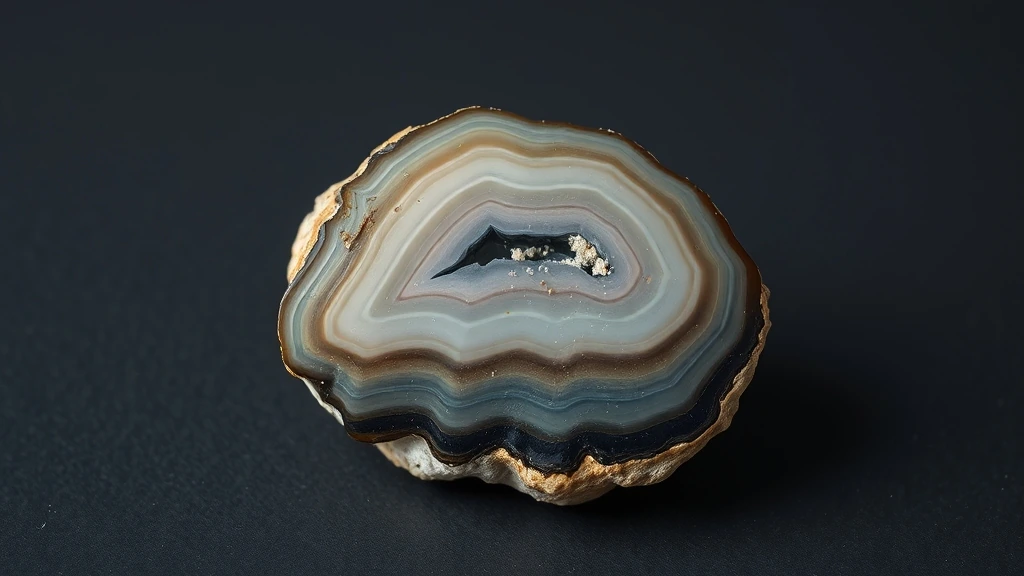
Banded agate belongs to the chalcedony family, a silicate assemblage of microcrystalline quartz that precipitates from silica‑rich hydrothermal fluids in fissures and cavities. Its characteristic concentric or parallel banding forms as successive layers of silica are deposited, often incorporating iron oxides or manganese that impart vivid hues. This gemstone is classified as a cryptocrystalline aggregate, meaning individual quartz crystals are too small to be seen without magnification, yet they collectively exhibit the trigonal symmetry of quartz.
What is Banded Agate Gemstone? Geological Overview & Definition
Banded agate is a microcrystalline quartz variety whose banded patterns result from rhythmic changes in mineral chemistry during formation. The bands may be uniform or irregular, reflecting fluctuations in temperature, pH, and trace element availability within the host vein.
In the field, banded agate is typically found in volcanic tuff, sedimentary breccias, or ancient river gravels where silica‑laden solutions infiltrated voids. Its durability stems from the interlocking quartz fibers, while its translucency varies from opaque to semi‑transparent depending on band thickness and impurity concentration.
Banded Agate Gemstone Chemical Composition & Crystallographic Properties
The gemstone’s chemical formula is SiO₂, identical to that of quartz, but its structure consists of trigonal, fibrous aggregates that are too fine to resolve individually. These aggregates retain the trigonal crystal system, producing a pseudo‑hexagonal habit observable only under polarized light.
Cation substitution is limited; trace amounts of Fe³⁺, Mn²⁺, and Ti⁴⁺ replace silicon in the lattice, creating chromophore color centers that generate the characteristic reds, browns, and yellows. These impurities are hosted in the interstitial spaces between the quartz fibers, influencing both hue and opacity.
Banded agate is moderately sensitive to strong acids; dilute hydrochloric acid may etch surface layers, revealing fresh banding but also risking damage. Its resistance to chemical weathering is higher than that of macrocrystalline quartz due to the protective silica gel that fills micro‑fractures.
Thermally, banded agate remains stable up to about 600 °C, beyond which dehydroxylation of trace hydroxyl groups can cause micro‑cracking. Rapid heating or cooling can induce thermal shock, especially in specimens with high iron oxide content, which expands at different rates than the silica matrix.
| Property | Specification |
|---|---|
| Mineral Group | Silicates (Chalcedony / Cryptocrystalline Quartz) |
| Chemical Formula | SiO₂ (Silicon Dioxide) |
| Mohs Hardness | 6.5 – 7.0 |
| Crystal System | Trigonal (Microcrystalline / Cryptocrystalline fibrous aggregates) |
| Specific Gravity (Density) | 2.60 – 2.65 |
| Refractive Index | 1.544 – 1.553 |
| Color & Optical Properties | Natural Banded Agate Gemstone color spectrum and optical dispersion |
| Primary Mining Localities | Brazil, Uruguay, Turkey, India, Madagascar |
| Water & Chemical Resistance | High (Safe for gentle warm water and mild soap; avoid harsh acids and chlorine) |
| Chakra Alignment (Traditional) | Root Chakra and Sacral Chakra |
| Zodiac Affinity (Traditional) | Gemini, Virgo, Taurus |
| Symbolic Meaning (Traditional) | Grounding, emotional balance, physical endurance, and protection |
Agate Varieties & Comprehensive Sub-Types
Blue Lace Agate
Formed in low‑temperature hydrothermal cavities, blue lace agate crystallizes from silica‑rich fluids that deposit microscopic chalcedony fibers. The fibers diffract light, producing the stone’s signature sky‑blue and white undulating lace‑like bands. Because the coloration is subtle, the material is prized for throat‑chakra alignment and is widely traded in the United States and Europe as a calming ornamental cabochon.
Moss Agate
Moss agate originates in volcanic tuff where silica precipitates around green hornblende or chlorite dendritic inclusions that mimic mossy foliage. The translucent chalcedony matrix enhances the contrast, creating a vivid botanical pattern prized by collectors. Historically it served as an agricultural talisman, and today it remains a staple in folk‑medicine jewelry markets across Brazil and India.
Fire Agate
Fire agate develops in basaltic lava flows, where alternating nanolayers of iron oxides (limonite or goethite) and silica create a Schiller iridescence that flashes orange‑red hues. The botryoidal habit yields rounded, semi‑transparent nodules that are cut into beads and cabochons. Rare deposits in Mexico’s Sonora region and Arizona’s Verde Valley command premium prices among lapidaries seeking dramatic color play.
Botswana Agate
This variety forms in ancient basaltic lava tubes of Botswana, where slow cooling yields ultrafine concentric banding in shades of grey, peach, salmon, and lilac. The dense, regular bands give the stone a refined aesthetic favored by high‑end designers. Limited mining operations and strict export controls keep Botswana agate scarce, reinforcing its status as a collector’s gem.
Dendritic Agite
Dendritic agate grows in sedimentary silica deposits, incorporating manganese and iron oxide minerals that crystallize as fern‑like black or dark brown branching patterns. The clear to milky matrix highlights the dramatic dendrites, making each stone a miniature landscape. Lapidaries value it for ornamental carving, and it is frequently sold as polished cabochons in the United States and Europe.
Crazy Lace Agate
Crazy lace agate is sourced from the Chihuahua region of Mexico, where rapid silica deposition creates multicolored zig‑zag ribbons of yellow, red, orange, and cream. High iron content intensifies the hues, producing a lively “laughter stone” pattern. Its vivid appearance makes it popular for statement jewelry, and it commands strong demand in the Asian gemstone market.
Tree Agate
Tree agate forms in volcanic ash layers, featuring an opaque white chalcedony base overlaid with deep green chlorite dendrites that resemble foliage. Unlike moss agate, the white host is non‑translucent, giving the stone a solid, matte appearance. It is chiefly mined in Brazil and marketed as a grounding stone for meditation beads.
Flower Agate
Rarely found in Madagascar, flower agate develops when silica replaces fossilized plant material, producing opaque 3D chalcedony inclusions that look like blooming cherry‑blossom petals. These petal‑like forms are set within a soft pink‑to‑caramel translucent matrix, creating a delicate floral tableau. Limited artisanal extraction keeps the stone exclusive, and it is highly sought after by luxury jewelers.
Modern Uses & Jewelry Applications of Banded Agate Gemstone
Lapidaries primarily cut banded agate into polished cabochons to showcase its distinct concentric patterns, as faceting would obscure the visual flow of the bands. The stone’s durability makes it ideal for intricate ornamental carving, including cameos and intaglios that highlight its layered aesthetic.
- Cabochon Cutting: The standard method for maximizing the visibility of the banded structure in rings and pendants.
- Ornamental Carving: Used for decorative objects, cameos, and intaglios where the stone’s natural layering creates artistic depth.
- Inlay Work: Frequently polished into thin sheets for architectural inlays and high-end watch dials.
Metaphysical Properties & Traditional Meaning of Banded Agate Gemstone
According to historical traditions and metaphysical lore, banded agate is revered as a stone of emotional balance and mental clarity. Practitioners believe its rhythmic bands mirror the natural cycles of life, helping to stabilize mood swings and promote calmness.
This gemstone is often associated with grounding energy, assisting individuals in feeling centered during periods of stress or change. Its traditional significance lies in fostering patience and resilience, making it a popular choice for meditation and personal growth.
Which Chakra and Zodiac Signs Align with Banded Agate Gemstone?
In metaphysical practice, banded agate is primarily aligned with the Root Chakra and the Sacral Chakra. The Root Chakra connection supports feelings of safety and stability, while the Sacral Chakra alignment enhances creativity and emotional fluidity.
Astrologically, this stone resonates strongly with Taurus, Gemini, and Virgo. Taurus appreciates its grounding nature, Gemini values its mental clarity, and Virgo finds harmony in its structured, banded appearance.
How to Identify Real vs. Fake Banded Agate Gemstone
Artificial imitations often use synthetic glass or dyed chalcedony to mimic the natural banding of agate. These fakes may lack the subtle color variations and organic flow found in genuine specimens.
Practical At-Home Authenticity Tests
- Temperature Test (Thermal Feel): Genuine agate feels cool to the touch initially and warms slowly, whereas glass imitations often feel neutral or warm immediately.
- Specific Gravity & Weight Test: Real agate is denser than glass; a genuine stone will feel heavier for its size compared to a glass replica.
- Scratch & Hardness Test (Mohs Comparison): Agate rates 6.5-7 on the Mohs scale, so it should not scratch with a steel knife (5.5), while glass may scratch more easily.
- Microscopic & Loupe Inspection (Internal Inclusions): Use a 10x loupe to look for natural inclusions or flow lines; glass often contains tiny bubbles or swirls.
Banded Agate Gemstone Valuation Factors, Grading & Pricing
Color Saturation is the foremost driver of price; deep, vivid hues command premiums, while pastel tones are priced modestly. Collectors also examine tone uniformity—consistent coloration across the banding pattern signals superior quality. Optical clarity and a high‑shine luster further elevate value, as surface polish reveals the stone’s inner fire.
Carat Weight directly influences market price, but weight alone is insufficient without good craftsmanship. Well‑executed facet symmetry maximizes light return, enhancing perceived brilliance and justifying higher fees. Conversely, a dense matrix or conspicuous inclusions can diminish clarity, reducing the stone’s grading and resale potential.
Geographical Provenance Premium rewards specimens from renowned localities such as Brazil, Uruguay, or the Czech Republic, where historic mining yields distinctive band patterns. These origins often fetch a 10‑20 % markup in wholesale channels and an even larger spread at retail. Market trends show steady demand, with prices rising modestly during gemstone‑focused seasons.
How to Clean and Care for Banded Agate Gemstone
Gentle physical cleaning is safest: soak the stone in warm, soapy water for a few minutes, then use a soft, lint‑free cloth or a very soft brush to remove surface dirt. Rinse with lukewarm water and pat dry with a microfiber towel. Avoid harsh acids, chlorine, or abrasive pads, as they can erode the polished surface.
Ultrasonic cleaners must be avoided when the agate is dyed, heavily fractured, or has undergone any treatment, because vibrations can cause color loss or fracture propagation. For untreated, solid specimens, the warm‑soapy‑water method remains the only recommended approach. Store the gemstone in a padded pouch or a fabric-lined box to protect it from knocks and scratches.
Cleansing and Recharging Banded Agate Gemstone (Energetic Care)
For energetic clearing, pass the stone through smoke smudging using white sage or palo santo; the gentle smoke lifts stagnant energy without contacting the mineral’s surface. Ensure the smoke is cool and the gemstone is held at a safe distance to prevent soot deposition.
Alternatively, place the agate on a selenite charging plate or under moonlight for several hours. Both methods infuse the stone with subtle, non‑physical energy, respecting its low solubility and preserving its natural luster.
Frequently Asked Questions About Banded Agate Gemstone
Is banded agate safe to wear in the shower?
Yes, it is water‑resistant for gentle warm water and mild soap. Banded agate will not degrade under normal shower conditions, but you should avoid harsh acids, chlorine, or abrasive scrubbing. Prolonged exposure to hot steam is fine, yet rinsing promptly helps preserve any surface treatments.
Can I clean banded agate with an ultrasonic cleaner?
Warm soapy water is the preferred cleaning method for solid banded agate. Ultrasonic cleaners can damage dyed, heavily fractured, or treated specimens, potentially causing micro‑cracks or color loss. Hand‑wash with a soft brush, rinse, and pat dry to maintain clarity and durability.
What zodiac signs are associated with banded agate?
Gemini, Virgo, and Taurus are the aligned zodiac signs. These signs are believed to benefit from the stone’s stabilizing energy, enhancing communication for Gemini, analytical focus for Virgo, and grounded practicality for Taurus. The connection is rooted in traditional astrological gem correspondences.
Which chakras does banded agate balance?
It works with the Root Chakra and the Sacral Chakra. The stone’s earthy tones support grounding, security, and survival instincts of the Root Chakra, while its warm hues stimulate creativity, passion, and emotional flow in the Sacral Chakra. Use during meditation to reinforce these centers.
How can I tell if my banded agate is natural or dyed?
Examine the color zones and perform a mild solvent test. Natural banded agate shows gradual, earthy banding; dyed pieces often have unnaturally bright or uniform colors that may bleed when a drop of acetone is applied to an inconspicuous area. Professional gemologists can confirm via spectroscopy.
Does banded agate improve mental focus?
Many users report enhanced concentration when wearing banded agate. The stone’s silica composition is thought to stabilize mental energy, reducing scattered thoughts. While scientific evidence is limited, anecdotal accounts link the stone to clearer thinking, especially for tasks requiring sustained attention.
What is the typical hardness of banded agate on the Mohs scale?
Banded agate rates about 6.5 to 7 on the Mohs hardness scale. This makes it relatively resistant to scratches from everyday wear, though it can be marked by harder minerals like quartz or topaz. Protect the stone from sharp impacts to avoid chipping the delicate banded layers.
Can banded agate be set in jewelry for daily wear?
Yes, its durability and water resistance make it suitable for everyday pieces. Choose secure prongs or bezel settings to protect the banded surface, and avoid exposing the stone to harsh chemicals or extreme temperature swings. Regular gentle cleaning will keep its natural luster intact.