
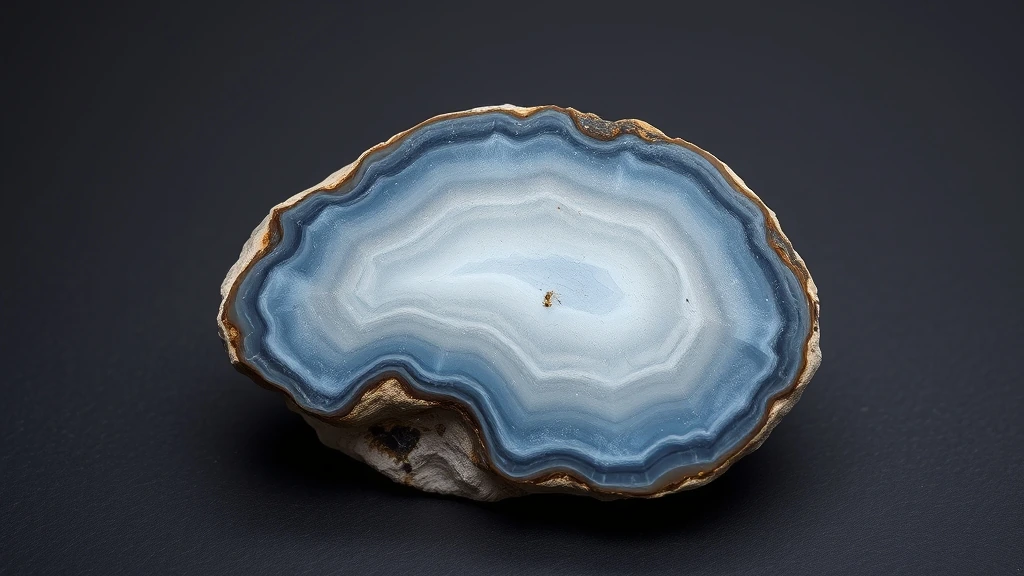
Blue Lace Agate belongs to the silicate family, specifically the cryptocrystalline quartz subgroup known as chalcedony. Formed in low‑temperature hydrothermal veins, its fine‑grained, fibrous aggregates create the characteristic lace‑like pattern that distinguishes it from other agates. This microcrystalline fabric records slow silica precipitation, yielding a stone prized for both aesthetic appeal and metaphysical use.
What is Blue Lace Agate Gemstone? Geological Overview & Definition
Blue Lace Agate is a cryptocrystalline aggregate of silica fibers that lacks visible crystals to the naked eye, yet its internal structure is ordered on a microscopic scale. The stone’s pastel blue bands arise from trace impurities and structural defects that act as chromophore centers, diffusing light to produce its signature lace pattern.
Classified within the chalcedony family, it is a member of the broader silicate group, sharing a common SiO₂ backbone with quartz, opal, and other agates. Its formation occurs in cavities of volcanic rocks where silica‑rich fluids deposit successive layers, each layer recording subtle changes in chemistry and temperature.
Blue Lace Agate Gemstone Chemical Composition & Crystallographic Properties
The material is fundamentally SiO₂, but as a cryptocrystalline aggregate it does not possess a single, well‑defined lattice; instead, countless microscopic quartz fibers interlock in a trigonal arrangement. These fibers are oriented in a fibrous aggregate that yields the overall trigonal symmetry despite the lack of macroscopic crystals.
Cation substitution is minimal, yet trace amounts of iron, manganese, or titanium can replace silicon in the lattice, creating the subtle blue hues through color‑center formation. Because the structure is microcrystalline, the stone is relatively acid‑sensitive; strong acids can dissolve the silica framework over time, especially along fracture surfaces.
Thermally, Blue Lace Agate is stable up to about 600 °C, beyond which dehydroxylation and recrystallization may occur, potentially altering its color pattern. Rapid heating can induce micro‑cracking due to differential expansion of the fibrous domains, so careful temperature control is essential during any heat‑treatment processes.
| Property | Specification |
|---|---|
| Mineral Group | Silicates (Chalcedony / Cryptocrystalline Quartz) |
| Chemical Formula | SiO₂ (Silicon Dioxide) |
| Mohs Hardness | 6.5 – 7.0 |
| Crystal System | Trigonal (Microcrystalline / Cryptocrystalline fibrous aggregates) |
| Specific Gravity (Density) | 2.60 – 2.65 |
| Refractive Index | 1.544 – 1.553 |
| Color & Optical Properties | Natural Blue Lace Agate Gemstone color spectrum and optical dispersion |
| Primary Mining Localities | Brazil, Uruguay, Turkey, India, Madagascar |
| Water & Chemical Resistance | High (Safe for gentle warm water and mild soap; avoid harsh acids and chlorine) |
| Chakra Alignment (Traditional) | Root Chakra and Sacral Chakra |
| Zodiac Affinity (Traditional) | Gemini, Virgo, Taurus |
| Symbolic Meaning (Traditional) | Grounding, emotional balance, physical endurance, and protection |
Agate Varieties & Comprehensive Sub-Types
Blue Lace Agate
Blue Lace Agate forms in microcrystalline chalcedony fibers that diffract light into delicate sky‑blue and milky‑white lace‑like bands. The banding results from periodic variations in silica concentration during slow cooling of silica‑rich volcanic tuffs. Because the bands are so fine, the stone is prized by lapidaries for its gentle throat‑chakra resonance and calming frequency, and it commands a steady presence in the global trade market.
Moss Agate
Moss Agate develops when green hornblende or chlorite dendrites infiltrate a translucent chalcedony host, creating botanical‑like foliage patterns. These inclusions precipitate from hydrothermal fluids that percolate through sedimentary basalts, leaving behind intricate, moss‑resembling veins. Historically, the stone was treasured as an agricultural talisman, and today it remains a popular ornamental material for jewelry and carvings.
Fire Agate
Fire Agate is a botryoidal chalcedony whose iridescent Schiller effect arises from alternating nanolayers of iron oxides (limonite/goethite) and silica. The layered structure forms in volcanic cavities where iron‑rich fluids repeatedly coat silica spheres, producing a flickering fire‑like play of color. Found chiefly in Mexico’s volcanic fields and Arizona’s basaltic flows, it is a relatively rare commodity prized by collectors.
Botswana Agate
Botswana Agate displays ultrafine concentric banding in muted greys, peaches, salmon, and lilac hues. The bands crystallize within ancient basaltic lava flows that have undergone extensive silica replacement, yielding an exceptionally dense pattern. Because of its subtle palette and high clarity, the stone is in steady demand for high‑end cabochons and artistic inlays.
Dendritic Agate
Dendritic Agate is characterized by dramatic black or dark‑brown fern‑like branches composed of manganese and iron oxides that grow within a milky‑white chalcedony matrix. These oxides precipitate along fracture lines in silica‑rich sediments, producing a landscape‑like network. Lapidaries prize it for its striking natural scenery, and it is frequently cut into polished slabs for wall art.
Crazy Lace Agate
Crazy Lace Agate, the “Laughter Stone” of Chihuahua, Mexico, showcases multicolored zig‑zag ribbons of yellow, red, orange, and cream formed by iron‑pigmented silica fibers. Rapid cooling of silica‑laden volcanic ash creates the chaotic, interwoven pattern that distinguishes it from other agates. Its vivid coloration makes it a favorite for bold jewelry pieces and decorative beads.
Tree Agate
Tree Agate differs from Moss Agate by its opaque white chalcedony base that hosts deep green chlorite dendrites resembling foliage. The solid, non‑translucent matrix forms in low‑temperature hydrothermal environments where chlorite precipitates in a uniform, tree‑like pattern. It is commonly used for ornamental carvings and as a focal point in metaphysical collections.
Flower Agate
Flower Agate is a rare Malagasy chalcedony containing three‑dimensional calcic inclusions that mimic blooming cherry‑blossom petals. These inclusions crystallize within a soft pink‑to‑caramel translucent matrix during slow cooling of silica‑rich sediments. Because of its scarcity and distinctive floral motif, it commands premium prices among collectors.
Modern Uses & Jewelry Applications of Blue Lace Agate Gemstone
Lapidaries primarily cut Blue Lace Agate into smooth cabochons to showcase its delicate, wavy banding patterns. Because the stone is microcrystalline, faceting is rare and often results in a dull appearance. Most high-quality material is carved into ornamental pieces, beads, or pendants that highlight its soothing blue and white layers.
- Cabochon Cutting: Polished domes maximize the visibility of the characteristic lace-like inclusions.
- Ornamental Carving: Skilled artisans sculpt the stone into figurines, cameos, and decorative architectural elements.
- Jewelry Settings: Soft metal settings like silver or white gold complement the stone’s cool, pastel aesthetic.
Metaphysical Properties & Traditional Meaning of Blue Lace Agate Gemstone
According to historical traditions and metaphysical lore, this gemstone is revered for its calming influence on the nervous system. Practitioners believe it promotes emotional balance and helps users navigate stressful situations with grace. It is often associated with patience, kindness, and the ability to express oneself clearly without aggression.
The stone’s gentle energy is thought to enhance physical endurance and provide a sense of protection. Many users report feeling more grounded and centered when wearing or meditating with Blue Lace Agate. It serves as a reminder to maintain composure and stay connected to one’s core values during turbulent times.
Which Chakra and Zodiac Signs Align with Blue Lace Agate Gemstone?
In metaphysical practice, Blue Lace Agate is primarily aligned with the Root Chakra and the Sacral Chakra. The Root Chakra connection supports feelings of stability, safety, and physical grounding. Meanwhile, the Sacral Chakra alignment encourages creative expression and emotional fluidity, helping to release stagnant feelings.
Astrologically, this gemstone resonates strongly with Gemini, Virgo, and Taurus. For Geminis, it aids in mental clarity and communication. Virgos find support in its grounding nature, which helps manage perfectionism. Taurus benefits from its ability to enhance physical vitality and emotional resilience.
How to Identify Real vs. Fake Blue Lace Agate Gemstone
Artificial imitations of Blue Lace Agate are common due to the stone’s popularity and moderate price point. Counterfeiters often use synthetic glass, dyed white agate, or plastic resins to mimic the natural blue and white banding. These fakes may lack the subtle, organic variations found in genuine specimens.
Practical At-Home Authenticity Tests
- Temperature Test (Thermal Feel): Genuine agate feels cool to the touch initially and warms slowly. Plastic or glass imitations often feel warmer immediately or heat up much faster.
- Specific Gravity & Weight Test: Real agate has a density of 2.60 – 2.65. It should feel heavier than it looks compared to similarly sized plastic or lightweight glass pieces.
- Scratch & Hardness Test (Mohs Comparison): With a Mohs hardness of 6.5 – 7.0, genuine agate will not be scratched by a steel knife or glass. Softer fakes like plastic or some glasses may show visible scratches.
- Microscopic & Loupe Inspection (Internal Inclusions): Use a 10x loupe to check for natural inclusions like tiny mineral spots or irregular banding. Glass fakes often contain perfect, circular air bubbles or look unnaturally uniform.
Blue Lace Agate Gemstone Valuation Factors, Grading & Pricing
Color Saturation is the foremost driver of price. Deep, vivid blues that transition smoothly into the characteristic white lace signal a high‑grade stone, while pastel or washed‑out hues fetch lower offers. Uniform tone across the cabochon enhances visual impact, and a bright, glassy luster signals minimal surface wear, boosting market appeal.
Carat Weight influences value but only when paired with excellent cut quality. Larger pieces (typically > 5 carats) command premium prices if the facet symmetry is precise and the stone’s overall shape is balanced. Visible matrix or inclusions that disrupt the lace pattern reduce clarity and may downgrade the stone, especially in fine‑jewelry contexts.
Geographical Provenance Premium adds a subtle yet measurable uplift. Blue Lace Agate sourced from historic Brazilian mines or reputable Turkish quarries often carries a collector’s premium due to documented authenticity. Wholesale trends show a steady 8‑12 % annual increase, while retail prices can vary 20‑35 % above bulk rates depending on market demand and branding.
How to Clean and Care for Blue Lace Agate Gemstone
Warm soapy water is ideal for solid agates. Gently submerge the stone in lukewarm water mixed with a mild, pH‑neutral soap, then use a soft brush to remove surface dust. Rinse thoroughly with distilled water and pat dry with a lint‑free cloth; avoid harsh acids, chlorine, or abrasive pads that could etch the surface.
Ultrasonic cleaners must be avoided if the specimen is dyed, heavily fractured, or treated. The high‑frequency vibrations can cause color leaching, fracture propagation, or damage to surface treatments, compromising both appearance and structural integrity. For untreated, intact pieces, stick to the warm‑soapy‑water method to preserve the stone’s natural polish.
Cleansing and Recharging Blue Lace Agate Gemstone (Energetic Care)
Because Blue Lace Agate is a silica‑based mineral, it is chemically stable and safe for dry energetic cleansing. Pass the stone through smoke smudging using white sage or palo santo, allowing the gentle vapor to clear stagnant energies without introducing moisture.
For a subtle recharge, place the gemstone on a selenite plate or under moonlight overnight; the neutral selenite or lunar photons uplift the stone’s vibration while respecting its low solubility. Avoid direct sunlight for extended periods, as prolonged UV exposure can fade the delicate blue hues.
Frequently Asked Questions About Blue Lace Agate Gemstone
Is blue lace agate safe to wear in water?
Yes, it is water‑resistant for gentle warm water and mild soap. Blue lace agate, a microcrystalline quartz, will not degrade in a shower or pool, but you should avoid harsh acids, chlorine, or prolonged soaking that could weaken any surface dyes or treatments.
How should I clean my blue lace agate jewelry?
Warm, soapy water and a soft brush are ideal. The stone’s silicon dioxide composition tolerates mild detergents, allowing you to remove oils without damage. Ultrasonic cleaners are discouraged, especially for dyed or fractured pieces, as vibration can lift pigments or cause micro‑cracks.
Can I use an ultrasonic cleaner on untreated blue lace agate?
Generally avoid ultrasonic cleaning even for untreated specimens. While the trigonal cryptocrystalline structure is robust, ultrasonic waves may still dislodge natural or applied color bands, and any internal fractures could expand under vibration.
Which zodiac signs are most aligned with blue lace agate?
Gemini, Virgo, and Taurus are the traditional astrological matches. These signs are said to benefit from the stone’s calming blue‑white banding, which supports the analytical nature of Gemini, the meticulous energy of Virgo, and the grounded steadiness of Taurus.
What chakras does blue lace agate balance?
It resonates with the Root Chakra and the Sacral Chakra. The stone’s soothing hues promote grounding and emotional balance, helping to stabilize the lower energy centers that govern security, vitality, and creative flow.
Does blue lace agate have any healing properties for the body?
It is believed to enhance physical endurance and protect against stress. The Mohs hardness of 6.5‑7 reflects a durable lattice that, in metaphysical practice, is thought to transmit protective vibrations to muscles and joints, aiding stamina.
How does the refractive index affect the appearance of blue lace agate?
A refractive index of 1.544‑1.553 gives it a soft, milky luster. Light entering the fibrous aggregates is scattered, creating the characteristic delicate blue lace pattern that makes the stone popular in ornamental carving and beadwork.
Is blue lace agate suitable for daily wear?
Yes, its durability and water‑resistance make it ideal for everyday use. With a density of 2.60‑2.65 g/cm³ and a hardness approaching that of quartz, the stone resists scratches and chips, provided it is not subjected to harsh chemicals or extreme impacts.