
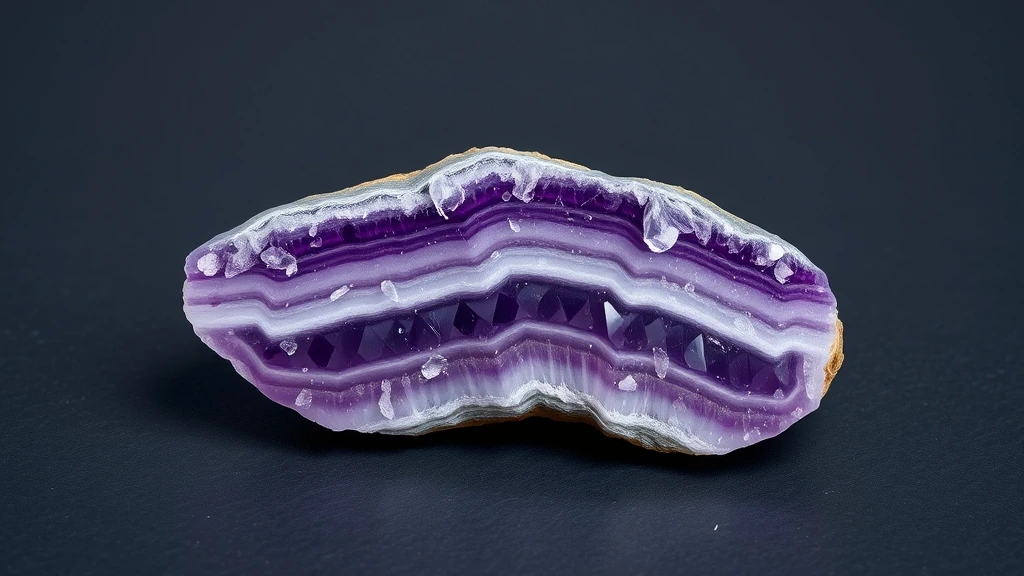
Chevron amethyst belongs to the extensive silicate mineral family, specifically classified within the tectosilicate subclass. This geological grouping places it firmly within the quartz group, sharing fundamental structural and chemical traits with other silica-based minerals. Its formation involves complex hydrothermal processes that deposit silica in distinct, alternating layers. These layered deposits create the unique visual characteristics that distinguish chevron specimens from standard amethyst varieties. Understanding this parentage is essential for accurate mineralogical identification and valuation.
What is Chevron Amethyst (band Amethyst)? Geological Overview & Definition
Chevron amethyst is defined by its distinctive V-shaped or chevron banding patterns, formed by alternating growth zones. These bands result from fluctuating iron concentrations and radiation exposure during crystal formation. The stone typically displays a sharp contrast between deep violet and lighter purple or white sections. This unique morphology differentiates it from uniform amethyst varieties found in standard geodes. In comparative mineralogical collections, practitioners and geologists frequently study Blue Flower Agate alongside this crystal to appreciate their subtle energetic and structural differences.
Geologically, these specimens often form in hydrothermal cavities within volcanic or igneous rock hosts. The banded structure indicates episodic mineral deposition over significant geological timeframes. Each band represents a distinct period of crystal growth with varying environmental conditions. This layered history provides valuable insights into the specific geological environment where the mineral originated. In comparative mineralogical collections, practitioners and geologists frequently study Nevada Rose Purple Dumortierite alongside this crystal to appreciate their subtle energetic and structural differences.
Chevron Amethyst (band Amethyst) Chemical Composition & Crystallographic Properties
The mineral crystallizes in the trigonal crystal system, forming hexagonal prismatic crystals with rhombohedral terminations. Its lattice structure consists of a continuous framework of silicon-oxygen tetrahedra. This tectosilicate arrangement provides the stone with its characteristic Mohs hardness of 7.0. The structural integrity ensures durability suitable for various gemological applications.
Coloration arises from Fe³⁺ cation substitution within the silica lattice, followed by natural irradiation. This process creates color centers that absorb specific wavelengths of light, producing the violet hue. The stone exhibits acid sensitivity only under extreme conditions, as quartz is generally chemically inert. Standard laboratory acids do not affect its surface or internal structure.
Thermal behavior reveals that high temperatures can alter the chromophore color centers, potentially fading the violet coloration. Prolonged exposure to intense heat may cause the stone to turn yellow or brown. This thermal instability requires careful handling during cutting and polishing processes. Proper temperature control preserves the gemstone’s aesthetic and market value.
| Property | Specification |
|---|---|
| Mineral Group | Silicates (Tectosilicates / Quartz Group) |
| Chemical Formula | SiO₂ (Silicon Dioxide with Fe³⁺ traces) |
| Mohs Hardness | 7.0 |
| Crystal System | Trigonal (Hexagonal prismatic crystals) |
| Specific Gravity (Density) | 2.65 – 2.66 |
| Refractive Index | 1.544 – 1.553 |
| Color & Optical Properties | Natural Chevron Amethyst (band Amethyst) color spectrum and optical dispersion |
| Primary Mining Localities | Brazil (Rio Grande do Sul), Uruguay (Artigas), Madagascar, Russia, Turkey |
| Water & Chemical Resistance | High (Water resistant; avoid prolonged direct sunlight to prevent color fading) |
| Chakra Alignment (Traditional) | Crown Chakra and Third Eye Chakra |
| Zodiac Affinity (Traditional) | Pisces, Aquarius, Virgo |
| Symbolic Meaning (Traditional) | Spiritual clarity, inner peace, meditative focus, and negative energy dispelling |
Chevron Amethyst (band Amethyst) Varieties & Color Spectrum
Chevron amethyst is distinguished by its striking V-shaped banding patterns, which result from alternating growth phases of purple and white quartz. This unique morphology occurs when the crystal lattice incorporates iron impurities at different stages of cooling within geode cavities. The contrast between the saturated violet zones and the clear or milky white sections creates a visually dynamic aesthetic.
Deep Siberian Chevron
Originating from the Ural Mountains, this variety features intense indigo-purple bands set against a stark white background. The high saturation is attributed to specific radiation exposure levels during the crystal’s formation in metamorphic schist. These specimens often exhibit sharp, well-defined chevron angles that are highly prized by collectors.
Brazilian Banded Amethyst
Brazilian deposits produce chevron amethyst with softer, lavender-hued bands that transition smoothly into pale white zones. The pegmatite host rock in Minas Gerais allows for slower crystal growth, resulting in broader, less rigid banding patterns. This variety is abundant and widely available in the global gemstone market.
Uruguayan High-Contrast Chevron
Known for its vivid magenta-purple stripes, this variety displays exceptional color clarity and saturation. The bands are typically narrow and sharply defined, creating a high-contrast visual effect against the colorless quartz matrix. Uruguay’s geodes often contain large, intact crystals suitable for substantial cabochon cuts.
Siberian White-Purple Morph
This rare morph features milky white bands that dominate the stone, interspersed with thin lines of deep purple. The white areas contain microscopic fluid inclusions that scatter light, enhancing the stone’s opalescent quality. Such specimens are valued for their ethereal appearance and distinct textural contrast.
African Chevron Varieties
Found in South Africa and Zimbabwe, these stones display warm purple tones with subtle brownish undertones in the banded sections. The volcanic origin of these deposits contributes to the presence of minor mineral inclusions within the crystal structure. These varieties are less common in the trade but offer unique color nuances.
Smoky-Purple Transitional Chevron
This transitional form exhibits a gradient from smoky quartz to amethyst, with chevron patterns interrupting the color shift. The reduction state of iron fluctuates during growth, causing the alternating smoky and purple bands. Such stones are rare and highly sought after for their complex chromatic behavior.
Where is Chevron Amethyst (band Amethyst) Found? Geological Mining & Extraction
Chevron amethyst primarily forms within silica-rich geodes and cavities in volcanic and metamorphic rocks. The banded structure develops as fluid composition changes during successive crystal growth cycles in these enclosed spaces. Most commercial deposits are located in regions with significant volcanic activity or ancient tectonic shifts.
Major mining regions include Brazil, Uruguay, and the Ural Mountains of Russia, where large geodes are extracted using careful blasting techniques. In Brazil, the Minas Gerais state remains the dominant source, yielding high-quality banded crystals for the global market. Extraction methods focus on preserving the integrity of the chevron patterns to maximize gemological value.
Historical Significance & Cultural Lore of Chevron Amethyst
Ancient Greco-Roman civilizations revered amethyst for its perceived ability to prevent intoxication and promote clarity of mind. The banded varieties were often carved into intaglio seals and amulets, symbolizing the duality of spiritual insight and earthly wisdom. Historical texts reference the stone’s use in royal jewelry and religious ceremonies.
In Vedic traditions, amethyst was associated with the Ajna chakra, enhancing meditation and spiritual perception. Archaeological findings in Egypt reveal amethyst beads used in burial rites to guide the soul in the afterlife. These cross-cultural practices highlight the stone’s enduring significance in human history.
Modern Uses & Jewelry Applications of Chevron Amethyst (band Amethyst)
Chevron Amethyst is prized for its distinctive banded pattern, which lends itself to a variety of lapidary techniques. Skilled cutters often produce cabochon shapes that showcase the stone’s natural swirls, while faceted cuts accentuate its refractive brilliance. The mineral’s moderate hardness (7.0 on the Mohs scale) allows for precise carving into ornamental pieces such as pendants, rings, and decorative panels.
- Cabochon and faceted jewelry pieces highlight the banded texture.
- Carved pendants and brooches emphasize the stone’s natural swirls.
- Decorative panels and architectural accents showcase large, uncut specimens.
Metaphysical Properties & Traditional Meaning of Chevron Amethyst (band Amethyst)
According to historical traditions and metaphysical lore, Chevron Amethyst is revered for its capacity to foster spiritual clarity and inner peace. Across ancient Mediterranean and Vedic lapidary practices, the stone is believed to calm the mind, enhance meditation, and dispel negative energies. Its deep violet hue is thought to resonate with the Crown Chakra, encouraging higher consciousness, while the subtle banding is associated with the Third Eye Chakra, promoting intuition and insight.
Which Chakra and Zodiac Signs Align with Chevron Amethyst (band Amethyst)?
Chevron Amethyst is traditionally linked to the Crown Chakra (Sahasrara) and the Third Eye Chakra (Ajna), both centers of spiritual awareness and higher perception. The stone’s energetic influence is said to support the awakening of these chakras, facilitating a deeper connection to the divine and the inner self.
The gemstone aligns with the zodiac signs of Pisces, Aquarius, and Virgo. Those born under these signs are believed to benefit from Chevron Amethyst’s calming and clarifying properties, which enhance emotional balance and intellectual focus.
How to Identify Real vs. Fake Chevron Amethyst (band Amethyst)
Artificial imitations of Chevron Amethyst commonly include synthetic glass, dyed quartz, or low‑quality dyed amethyst. These replicas often lack the natural banding and may display uniform coloration or artificial sparkle. Genuine Chevron Amethyst retains its characteristic banded pattern and exhibits a natural, slightly uneven surface.
Practical At-Home Authenticity Tests
- Temperature Test (Thermal Feel): Hold the stone in your hand; real amethyst feels cool to the touch initially, cooling slowly due to its thermal conductivity, whereas synthetic glass warms quickly.
- Specific Gravity & Weight Test: Compare the stone’s weight to a known quartz sample of the same size; real amethyst should be slightly heavier (specific gravity ~2.65).
- Scratch & Hardness Test (Mohs Comparison): Use a reference mineral (e.g., quartz at 7.0) to test scratch resistance; real amethyst should resist scratching by materials softer than quartz.
- Microscopic & Loupe Inspection (Internal Inclusions): Examine the stone under a loupe; genuine Chevron Amethyst often shows natural inclusions or subtle color zoning, whereas synthetic versions appear uniformly clear or artificially patterned.
Chevron Amethyst (band Amethyst) Valuation Factors, Grading & Pricing
The market places the highest premium on color saturation, where a deep, uniform violet hue signals superior quality. Vibrancy that persists under varied lighting is prized, as it reflects the stone’s natural energetic luster and minimal zoning. Specimens that display a vivid, consistent tone without visible brown or gray undertones command the top price brackets.
Crystal size & weight (grams) drive the next tier of valuation, with larger, well‑proportioned pieces offering greater market appeal. Raw chevron amethyst that retains its natural banding can be more valuable than heavily tumbled stones, provided the polish is even and the surface free of scratches. Inclusions such as quartz matrix or minor fractures are tolerated when they enhance the banded pattern rather than obscure it, and they are reflected in the per‑gram pricing.
Collectors increasingly reward ethical sourcing & locality premium, especially when stones originate from historically significant mines in Brazil, Uruguay, or Zambia. Transparent supply chains that respect labor standards and environmental stewardship add a measurable surcharge in holistic and high‑end markets. Proven provenance, documented through reputable dealers, often justifies a higher price even when physical attributes are comparable to less‑traceable counterparts.
How to Clean and Care for Chevron Amethyst (band Amethyst)
Gentle cleaning with warm soapy water is safe for untreated chevron amethyst; use a mild detergent, lukewarm temperature, and a soft brush to remove surface dust. Rinse thoroughly with distilled water and pat dry with a lint‑free microfiber cloth, avoiding any abrasive motions that could dull the natural polish. Ultrasonic cleaning may be employed for stones without liquid inclusions, but the process should be brief and set to a low‑intensity cycle to prevent fracture of any internal voids. Store the gemstone in a low‑humidity pouch or box, away from direct sunlight, to preserve its vivid color over time.
Cleansing and Recharging Chevron Amethyst (band Amethyst) (Energetic Care)
A traditional method for energetic renewal involves passing the stone through gentle herbal smudging, using sage or cedar smoke without allowing the flame to touch the crystal surface. The smoke is waved across the amethyst for a few breaths, allowing the subtle aromatic particles to clear stagnant energies while maintaining the mineral’s structural integrity.
Another widely accepted practice is to place the chevron amethyst on a clean selenite charging slab or expose it to soft moonlight for several hours, preferably during a waning or full moon. This dry, ambient exposure re‑energizes the stone’s vibrational field without introducing heat or moisture, ensuring that its metaphysical properties remain vibrant and balanced.
Frequently Asked Questions About Chevron Amethyst (band Amethyst)
Chevron Amethyst (band Amethyst) displays distinct mineralogical characteristics across its geological varieties and structural habits. Gemologists evaluate these natural varieties based on crystal habit, trace chromophore concentrations, and visual luster.
Primary Natural Chevron Amethyst (band Amethyst)
The benchmark natural variety exhibiting diagnostic color saturation and classic crystallographic symmetry.
Distinct Geological Morphs of Chevron Amethyst (band Amethyst)
Secondary regional and structural varieties formed under localized geological temperature and pressure conditions.
Is Chevron Amethyst water‑resistant enough for everyday wear?
Yes, it is highly water‑resistant. The quartz variety tolerates routine exposure to rain, hand washing, and brief showering, but prolonged direct sunlight can cause the violet hue to fade. For long‑term durability, avoid extended UV exposure and store the stone in a dark pouch when not in use.
How should I clean my Chevron Amethyst safely?
Warm, mildly soapy water and a soft brush are recommended. Gently scrub the surface, rinse with lukewarm water, and pat dry with a lint‑free cloth. This method removes oils and dust without harming the crystal lattice, preserving the trigonal structure and its characteristic banding.
Can I use an ultrasonic cleaner on untreated Chevron Amethyst?
Ultrasonic cleaning is generally acceptable for untreated stones. The vibrations dislodge microscopic particles from crevices, but if the specimen contains liquid inclusions, the process may cause fracture. Always test a small, inconspicuous area first and limit cleaning cycles to a few seconds.
Which zodiac signs are traditionally linked to Chevron Amethyst?
Pisces, Aquarius, and Virgo are the aligned zodiac signs. In astrological tradition, these signs benefit from the stone’s calming energy, which is believed to enhance intuition for water‑signs like Pisces and Aquarius, and bring analytical focus to Virgo’s meticulous nature.
Which chakras does Chevron Amethyst activate?
It is associated with the Crown Chakra and the Third Eye Chakra. The stone’s high refractive index (1.544‑1.553) is thought to amplify spiritual insight, supporting meditation, inner clarity, and a sense of connection to higher consciousness.
Does Chevron Amethyst fade if left in sunlight?
Prolonged direct sunlight can cause color fading. The iron‑oxide impurities that give the stone its violet bands are photosensitive; UV radiation can gradually bleach the hue. Store the gemstone away from windows or use UV‑filtering display cases to maintain its vibrancy.
Is Chevron Amethyst suitable for setting in jewelry that receives frequent contact?
Its Mohs hardness of 7 makes it suitable for most jewelry. While resistant to scratches from everyday wear, it can be chipped by harder materials such as diamonds or corundum. Choose protective settings and avoid impact with metal tools to preserve the banded pattern.
What are the primary metaphysical benefits attributed to Chevron Amethyst?
It is said to promote spiritual clarity, inner peace, and meditative focus. Practitioners claim the stone helps dispel negative energy, aligning the mind with higher thought processes. These properties are linked to its Fe³⁺ trace elements, which are believed to influence subtle energy fields.