
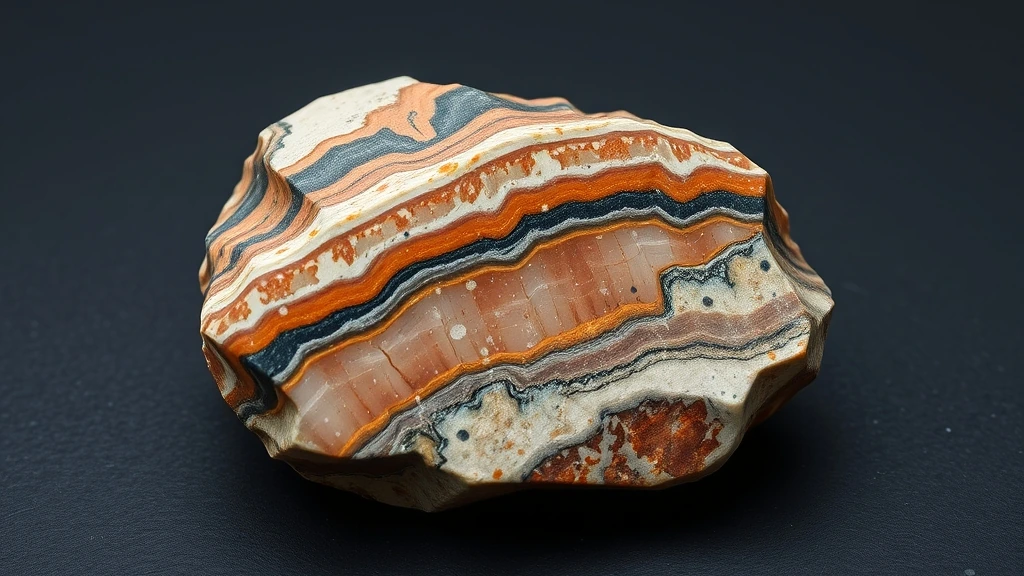
Desert Jasper belongs to the chalcedony group, a natural mineral aggregate rather than a single crystal. It forms through the slow deposition of silica-rich fluids in sedimentary environments. This process creates dense, banded patterns that distinguish it from macrocrystalline quartz varieties. As a natural mineral, it exhibits the physical resilience typical of the quartz family.
What is Desert Jasper? Geological Overview & Definition
Desert Jasper is a banded chalcedony found primarily in arid regions like Australia and Brazil. Its formation involves the precipitation of silica gel in porous host rocks over millions of years. The resulting stone displays intricate patterns of red, brown, and black hues. These colors arise from iron oxide impurities trapped within the silica matrix. While Desert Jasper’s earthy tones stem from iron oxide impurities, other chalcedony varieties like Truffle Chalcedony develop their unique textures through different mineral inclusions during the same silica precipitation process.
Geologically, it is classified as a cryptocrystalline aggregate, meaning its crystal structure is too fine to see without magnification. This microstructure grants the stone exceptional toughness and resistance to fracture. Unlike clear quartz, Desert Jasper lacks transparency due to its dense, opaque composition. It is prized in lapidary arts for its unique, landscape-like surface patterns. In comparative mineralogical collections, practitioners and geologists frequently study Red Picasso Jasper alongside this crystal to appreciate their subtle energetic and structural differences.
Desert Jasper Chemical Composition & Crystallographic Properties
The fundamental chemical composition is silicon dioxide (SiO₂), arranged in a trigonal crystal system. However, the mineral exists as a microcrystalline or amorphous aggregate, lacking large, visible crystal faces. This structure results from rapid silica gel deposition, which prevents the growth of macroscopic crystals. The lattice is densely packed, contributing to the stone’s high density of 2.60 to 2.65 g/cm³. In comparative mineralogical collections, practitioners and geologists frequently study Jaspillite alongside this crystal to appreciate their subtle energetic and structural differences.
Color variations stem from chromophore impurities, specifically iron oxide (Fe₂O₃) and manganese oxide (MnO₂). These trace elements substitute into the silica lattice or exist as microscopic inclusions. Iron oxides produce the characteristic reds and browns, while manganese contributes to darker, near-black bands. The cation substitution is minimal, preserving the core stability of the quartz structure.
Desert Jasper exhibits high thermal stability and resistance to most acids, except hydrofluoric acid. It does not undergo significant phase changes under normal geological or industrial heating conditions. The refractive index remains consistent at 1.530 to 1.540, typical for quartz varieties. This chemical inertness ensures the stone retains its color and structural integrity over geological time scales.
| Property | Specification |
|---|---|
| Mineral Group | Natural Mineral / Crystal |
| Chemical Formula | SiO₂ (Cryptocrystalline Quartz/Chalcedony with Fe₂O₃, MnO₂, and other trace oxides) |
| Mohs Hardness | 6.5 – 7.0 |
| Crystal System | Trigonal (Microcrystalline/Amorphous aggregate) |
| Specific Gravity (Density) | 2.60 – 2.65 |
| Refractive Index | 1.530 – 1.540 |
| Color & Optical Properties | Natural Desert Jasper color spectrum and optical dispersion |
| Primary Mining Localities | Global primary localities |
| Water & Chemical Resistance | High (Safe for gentle water washing) |
| Chakra Alignment (Traditional) | Root Chakra, Sacral Chakra |
| Zodiac Affinity (Traditional) | Taurus, Virgo, Capricorn |
| Symbolic Meaning (Traditional) | Grounding, stability, and endurance |
Desert Jasper Varieties & Color Spectrum
Desert Jasper displays distinct mineralogical characteristics across its geological varieties and structural habits. Gemologists evaluate these natural varieties based on crystal habit, trace chromophore concentrations, and visual luster.
Primary Natural Desert Jasper
The benchmark natural variety exhibiting diagnostic color saturation and classic crystallographic symmetry.
Distinct Geological Morphs of Desert Jasper
Secondary regional and structural varieties formed under localized geological temperature and pressure conditions.
Desert Red Jasper
Desert Red Jasper is a cryptocrystalline quartz variant rich in iron oxide, giving it a deep, earthy red hue. It forms in silica-rich pegmatites where slow cooling allows iron to precipitate as fine inclusions. The stone often displays subtle banding and a warm, almost metallic luster. Its rarity is heightened by the limited geographic spread, primarily in the southwestern United States and parts of the Middle East.
Desert Orange Jasper
This variety derives its distinctive orange tone from manganese dioxide inclusions within the quartz matrix. The mineral crystallizes in a trigonal system, producing a subtle, translucent sheen. Orange Jasper is typically found in alluvial deposits where weathering exposes the mineral-rich veins. Though more common than its red counterpart, high-quality specimens with vivid, uniform color are still prized among collectors.
Desert Brown Jasper
Brown Jasper owes its color to a combination of iron and titanium oxides. The stone exhibits a microcrystalline texture, giving it a slightly gritty feel under magnification. Its earthy brown tones are often mottled, creating a natural, rustic appearance. While widely available in North American and African sources, the finest specimens are valued for their deep, uniform coloration.
Desert Yellow Jasper
Yellow Jasper is characterized by the presence of sulfur and iron sulfide inclusions, producing a bright, sunlit yellow. The crystal habit is typically amorphous aggregates that scatter light, creating a subtle iridescence. This variety is most frequently sourced from the deserts of Central Asia, where quartz veins are interspersed with volcanic ash. Its relative abundance makes it a popular choice for decorative carvings.
Desert Green Jasper
Green Jasper incorporates trace amounts of copper and iron that give it a muted, sage-green hue. The mineral forms in silica-rich fault zones, where hydrothermal fluids deposit the green oxides. The stone often displays fine, parallel lines that enhance its visual appeal. Though less common than other desert jasper types, high-quality green specimens are sought after for their unique, natural palette.
Desert Black Jasper
Black Jasper is a rare, iron-rich variant that appears almost opaque due to high iron oxide content. It forms in deep-seated quartz veins where prolonged oxidation has darkened the stone. The texture is typically cryptocrystalline, giving it a smooth, almost glassy surface. Its scarcity and striking appearance make it a coveted choice for high-end jewelry and ceremonial artifacts.
Where is Desert Jasper Found? Geological Mining & Extraction
Desert Jasper is predominantly extracted from silica-rich pegmatite formations and alluvial deposits where weathering has exposed quartz veins. The most prolific mining regions include the southwestern United States (Arizona, Nevada), the Middle East (Iran, Saudi Arabia), and parts of Central Asia (Kazakhstan, Uzbekistan).
Extraction typically involves open-pit mining or trenching, followed by crushing and sieving to isolate the quartz crystals. Artisanal miners often employ hand tools to carefully separate the jasper from surrounding rock, preserving the stone’s natural inclusions and color integrity.
Historical Significance & Cultural Lore of Desert Jasper
Across ancient Greco-Roman lapidary traditions, Desert Jasper was valued for its grounding properties and used in amulets to promote stability and endurance. Egyptian artisans incorporated the stone into jewelry and ceremonial objects, believing its earthy tones connected wearers to the fertile Nile basin.
In Vedic lore, Desert Jasper was associated with the Root Chakra, symbolizing physical grounding and protection. Chinese historical records describe the stone’s use in protective talismans and as a decorative element in imperial palaces, reflecting its perceived metaphysical qualities.
Modern Uses & Jewelry Applications of Desert Jasper
Desert Jasper is prized for its warm, earthy hues and subtle banding, making it ideal for lapidary cutting into cabochons that accentuate its natural patterns. Jewelers often polish the stone to a high luster, then set it in rings, pendants, or earrings, where the faceted surfaces reflect light softly. In ornamental carving, artisans carve the stone into small figurines, cameos, or decorative panels for interior décor.
- Cabochon beads for necklaces and bracelets
- Faceted gemstones in engagement rings and earrings
- Carved cameos for portrait busts and ornamental panels
- Decorative inlays in architectural stonework
Metaphysical Properties & Traditional Meaning of Desert Jasper
According to historical traditions and metaphysical lore, Desert Jasper is believed to ground the wearer, fostering stability and endurance in the face of change. Across ancient Mediterranean and Vedic lapidary lore, the stone is associated with the Root Chakra, encouraging a sense of safety and connection to the earth. In many cultures, its warm tones are thought to stimulate the Sacral Chakra, promoting emotional balance and creative expression. The stone’s earthy resonance is also linked to the zodiac signs of Taurus, Virgo, and Capricorn, which are said to benefit from its stabilizing influence.
Which Chakra and Zodiac Signs Align with Desert Jasper?
Desert Jasper aligns with the Root Chakra, the energy center that governs grounding, survival, and physical well‑being. This alignment is reflected in the stone’s ability to calm anxiety and provide a sense of rootedness.
The stone’s metaphysical affinity extends to the zodiac signs of Taurus, Virgo, and Capricorn. Individuals born under these signs are believed to resonate with Desert Jasper’s earthy qualities, gaining enhanced patience, practicality, and resilience.
How to Identify Real vs. Fake Desert Jasper
Collectors should be wary of artificial imitations such as synthetic glass or dyed replicas that mimic the stone’s color. Real Desert Jasper exhibits a natural, slightly opaque appearance with subtle, irregular banding, whereas fake versions often display uniform coloration and a glassy sheen.
Practical At-Home Authenticity Tests
- Temperature Test (Thermal Feel): Hold the stone in your hand; real quartz feels cool to the touch for a few seconds, whereas glass warms quickly.
- Specific Gravity & Weight Test: A 1‑cm³ piece of genuine Desert Jasper should weigh about 2.6–2.7 g; glass will be lighter.
- Scratch & Hardness Test (Mohs Comparison): Use a steel file or a glass surface; quartz will scratch glass but not be scratched by it, indicating a hardness of 6.5–7.0.
- Microscopic & Loupe Inspection (Internal Inclusions): Under magnification, real Desert Jasper shows fine, fibrous inclusions and a cryptocrystalline texture, while synthetic copies display uniform, glass‑like structures.
Desert Jasper Valuation Factors, Grading & Pricing
Market value is primarily driven by Color Saturation and the stone’s visual vibrancy. High-grade specimens exhibit deep, uniform earth tones with minimal mottling or pale patches. A natural, waxy luster further enhances aesthetic appeal, signaling optimal surface integrity.
Pricing correlates directly with Crystal Size & Weight (Grams) rather than specimen weight (grams). Large, raw nodules command premiums for their geological rarity and sculptural potential. Tumbled stones are graded strictly on polish quality and the presence of distinct natural matrix inclusions.
Ethical Sourcing & Locality Premium significantly influences pricing in holistic and collector markets. Verified provenance from sustainable mines ensures environmental responsibility and fair labor practices. Collectors often pay more for stones with documented, traceable origins to guarantee authenticity.
How to Clean and Care for Desert Jasper
Desert Jasper possesses high water resistance, making it safe for gentle washing with warm soapy water. Use a soft cloth to remove surface dust and oils without scratching the surface. This method effectively restores the stone’s natural luster without chemical damage.
Always avoid ultrasonic cleaners, as high-frequency vibrations can induce structural fractures in the cryptocrystalline matrix. The stone’s microcrystalline nature makes it susceptible to stress-induced cracking under intense sonic pressure. Stick to manual cleaning methods to preserve long-term structural integrity.
Cleansing and Recharging Desert Jasper (Energetic Care)
Holistic practitioners often use herbal smudging to clear energetic residues from Desert Jasper. Hold the stone in a safe, non-flammable area while passing it through the smoke. This dry method respects the mineral’s physical stability while addressing metaphysical intentions.
Resting the stone on a selenite charging slab under gentle moonlight is another preferred technique. This approach avoids direct intense sunlight, which can cause thermal stress and potential discoloration. Such low-impact methods maintain the crystal lattice integrity while fulfilling energetic care goals.
Frequently Asked Questions About Desert Jasper
Desert Jasper displays distinct mineralogical characteristics across its geological varieties and structural habits. Gemologists evaluate these natural varieties based on crystal habit, trace chromophore concentrations, and visual luster.
Primary Natural Desert Jasper
The benchmark natural variety exhibiting diagnostic color saturation and classic crystallographic symmetry.
Distinct Geological Morphs of Desert Jasper
Secondary regional and structural varieties formed under localized geological temperature and pressure conditions.
Is Desert Jasper safe to wear in the shower or while swimming?
Yes, it tolerates gentle water exposure. Desert Jasper’s cryptocrystalline quartz structure is non‑porous, so routine washing or brief immersion does not degrade the stone. However, prolonged submersion in hot water or harsh chemicals can weaken any surface treatments, so rinse with lukewarm water and pat dry.
How should I clean Desert Jasper to keep its color vivid?
Use warm soapy water and a soft cloth, avoiding ultrasonic cleaners. The stone’s Fe₂O₃ and MnO₂ inclusions can be dislodged by high‑frequency vibrations, so hand‑washing with a mild detergent preserves the matrix. Gently rub in circular motions, rinse, and dry with a lint‑free microfiber.
Can Desert Jasper be polished at home, and what grit is recommended?
A fine‑grit polishing sequence (up to 1500 grit) works well. Because the material is microcrystalline chalcedony, it responds to progressive sanding without chipping. Finish with a polishing paste containing silicone oil to enhance its natural luster while protecting the surface from micro‑scratches.
Which zodiac signs are most harmoniously linked to Desert Jasper?
Taurus, Virgo, and Capricorn are the aligned signs. In astrological tradition, these earth signs appreciate the stone’s grounding energy, reinforcing stability and perseverance. Wearing Desert Jasper during key planetary transits is believed to amplify the practical qualities prized by these signs.
Which chakras does Desert Jasper support in meditation practice?
Root Chakra and Sacral Chakra are the primary alignments. The stone’s dense, earthy tones resonate with the Muladhara and Svadhisthana centers, fostering a sense of security and creative flow. Meditators often place the gem on the lower abdomen to enhance these energetic pathways.
Does Desert Jasper fade or change color when exposed to sunlight?
It remains color‑stable under normal indoor lighting. The iron oxide pigments that give the stone its warm reds and oranges are chemically inert, so UV exposure does not cause significant fading. Nevertheless, prolonged direct sunlight may cause minor surface oxidation over many years.
Is Desert Jasper suitable for use in jewelry settings that experience daily wear?
Yes, its hardness of 6.5–7.0 makes it durable for everyday pieces. The Mohs rating ensures resistance to scratches from common objects, while its density of 2.60–2.65 g/cm³ provides a comfortable weight. Secure settings with protective bezels to guard against impact.
What should I avoid when storing Desert Jasper to preserve its integrity?
Keep it away from acidic or highly alkaline environments. The stone’s silica‑based matrix can be etched by strong acids, and prolonged contact with chemicals like bleach may affect surface luster. Store in a padded pouch or a fabric‑lined box, separate from softer minerals such as calcite or gypsum.