
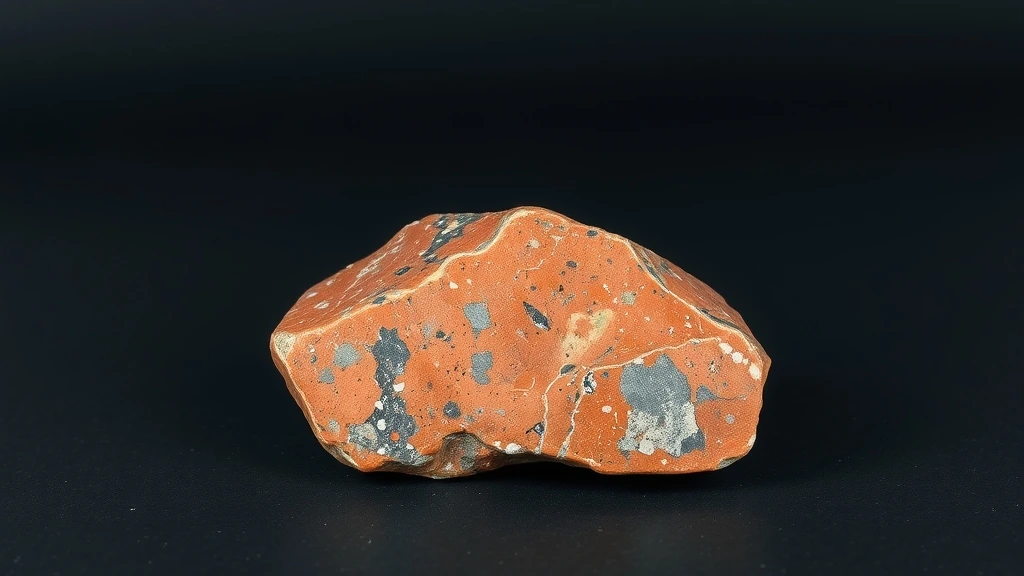
Red Picasso Jasper belongs to the chalcedony group, a microcrystalline form of quartz. It is classified as a natural mineral aggregate rather than a single crystal. This stone forms through the slow deposition of silica-rich solutions in volcanic or sedimentary environments. Its unique art-like patterns result from complex geological processes involving multiple mineral phases.
What is Red Picasso Jasper? Geological Overview & Definition
Red Picasso Jasper is a banded chalcedony known for its striking red, white, and black patterns. These designs resemble abstract paintings, earning the stone its distinctive name. The red hues stem from hematite and goethite inclusions within the silica matrix.
Geologically, this jasper forms in hydrothermal veins or as nodules in basaltic rocks. The intricate patterns develop as silica precipitates in layers over millions of years. Each specimen displays unique fractal geometry, making no two pieces identical. This natural variability enhances its appeal in lapidary arts and jewelry design. In comparative mineralogical collections, practitioners and geologists frequently study Orca Agate alongside this crystal to appreciate their subtle energetic and structural differences.
Red Picasso Jasper Chemical Composition & Crystallographic Properties
The primary constituent is silicon dioxide (SiO₂), arranged in a trigonal crystal system. Unlike macrocrystalline quartz, chalcedony consists of interlocking microcrystals too small to see. This cryptocrystalline structure provides exceptional toughness and durability. The lattice lacks large defects, contributing to its smooth polish.
Color variation arises from iron oxide impurities acting as chromophores. Red tones indicate ferric iron (Fe³⁺) substitutions within the silica lattice. White areas represent pure silica with minimal metallic contamination. These color centers remain stable under normal environmental conditions. In comparative mineralogical collections, practitioners and geologists frequently study Lattice Lace Agate alongside this crystal to appreciate their subtle energetic and structural differences.
Thermal behavior is stable up to moderate temperatures, suitable for jewelry use. The stone resists acid attack due to its silica-rich composition. However, prolonged exposure to strong alkalis may degrade the surface. Proper care ensures the preservation of its vibrant polychromatic patterns.
| Property | Specification |
|---|---|
| Mineral Group | Natural Mineral / Crystal |
| Chemical Formula | SiO₂ |
| Mohs Hardness | 6.5 – 7.0 |
| Crystal System | Trigonal |
| Color & Optical Properties | Natural Red Picasso Jasper color spectrum and optical dispersion |
| Primary Mining Localities | Global primary localities |
| Water & Chemical Resistance | High (Safe for gentle water washing) |
| Chakra Alignment (Traditional) | Third Eye Chakra (Ajna) |
| Zodiac Affinity (Traditional) | Leo, Sagittarius |
| Symbolic Meaning (Traditional) | Emotional balance, compassion and inner peace |
Red Picasso Jasper Varieties & Color Spectrum
Red Picasso Jasper displays distinct mineralogical characteristics across its geological varieties and structural habits. Gemologists evaluate these natural varieties based on crystal habit, trace chromophore concentrations, and visual luster.
Primary Natural Red Picasso Jasper
The benchmark natural variety exhibiting diagnostic color saturation and classic crystallographic symmetry.
Distinct Geological Morphs of Red Picasso Jasper
Secondary regional and structural varieties formed under localized geological temperature and pressure conditions.
Classic Red Picasso
Formed in silica-rich sedimentary layers of the Brazilian shield, Classic Red Picasso displays a vivid scarlet matrix intersected by white, black, and gray veining. The veining originates from iron oxide and manganese inclusions that crystallize during low‑grade metamorphism. Its striking contrast makes it a staple in high‑end lapidary, yet large flawless slabs remain relatively scarce.
Red‑Orange Picasso (Maranhão)
Extracted from the Maranhão region of Brazil, this variety exhibits a warm red‑orange hue punctuated by fine, cream‑colored banding. The coloration is driven by hematite micro‑inclusions aligned along fracture planes within the host quartzite. Because the deposits are shallow and subject to seasonal flooding, mining yields are limited, enhancing its market desirability.
Deep Crimson Picasso (Uruguay)
Deep Crimson Picasso originates in the Precambrian granitic terrains of Uruguay, where hydrothermal fluids percolate through fractured jasper beds. The resulting stone shows a saturated crimson background overlaid with delicate, spider‑web gray veins. Its rarity stems from the narrow vein zones and the difficulty of extracting intact pieces without fracturing the dense matrix.
Pink‑Red Picasso (Namibia)
Namibian Pink‑Red Picasso forms within ancient trigonal jasper nodules embedded in sandstone formations of the Namib Desert. The pinkish‑red tones arise from trace amounts of goethite, while thin, translucent quartz ribbons create a luminous overlay. Remote mining conditions and strict export regulations contribute to its limited availability on the global market.
Scarlet‑White Picasso (India)
Sourced from the Deccan Plateau, Scarlet‑White Picasso displays a bold scarlet field intersected by stark white bands that follow the stone’s natural fracture set. The white veining is composed of calcite cement filling micro‑fractures during diagenesis. Though more abundant than other varieties, high‑quality blocks with minimal weathering are prized by collectors.
Multicolored Red Picasso (Russia)
In the Ural Mountains, multicolored Red Picasso exhibits a complex palette of reds, oranges, and subtle blues, reflecting multiphase mineralization within metamorphosed volcanic ash layers. The blue specks are microscopic inclusions of tourmaline, while the reds derive from hematite. Extraction is labor‑intensive, and the intricate color play makes this variety exceptionally sought after for artistic cabochons.
Where is Red Picasso Jasper Found? Geological Mining & Extraction
Red Picasso Jasper chiefly occurs in trigonal silica formations that have undergone low‑temperature metamorphism within ancient sedimentary basins. In Brazil, the stone is hosted by quartzite and sandstone units of the Amazonian craton, where hydrothermal fluids introduce iron oxides that generate the characteristic veining. Mining is typically carried out by small‑scale open‑pit operations that employ hand‑sorting to preserve the delicate banding patterns.
Outside Brazil, significant deposits lie in the granitic terrains of Uruguay, the sandstone outcrops of Namibia’s Namib Desert, and the Precambrian shields of the Russian Urals. Extraction in these regions relies on a combination of manual labor and lightweight mechanical equipment to fracture the host rock without damaging the dense jasper nodules. Environmental regulations in Namibia and Russia now mandate reclamation plans, ensuring sustainable removal of the gemstone.
Historical Significance & Cultural Lore of Red Picasso Jasper
Across ancient lapidary traditions, Red Picasso Jasper was prized for its vibrant hue and perceived protective qualities. In Greco‑Roman mosaics, fragments of red jasper were set into floor designs to symbolize martial vigor and to ward off malevolent forces, a practice documented in the Villa Romana del Casale. Egyptian artisans incorporated red jasper beads into funerary necklaces, believing the stone facilitated safe passage to the afterlife through its inner‑peace resonance.
In Vedic texts, red jasper—referred to as “*Lal‑Manik*”—was associated with the Third Eye Chakra (Ajna), enhancing intuition and emotional balance. Chinese jade workshops of the Han dynasty occasionally blended red jasper with nephrite to create composite talismans intended to promote compassion. These cross‑cultural uses underscore the stone’s enduring role as a conduit for emotional equilibrium and spiritual insight.
Modern Uses & Jewelry Applications of Red Picasso Jasper
Red Picasso Jasper is prized for its vibrant, banded patterns, making it a favorite in contemporary lapidary work. Artisans cut the stone into smooth cabochons for earrings, pendants, and rings, or facet it for a subtle sparkle that highlights its internal swirls. The mineral’s moderate hardness (6.5–7.0 on the Mohs scale) allows for precise engraving, enabling intricate ornamental carvings used in decorative panels, figurines, and architectural accents.
- Cabochon and faceted jewelry pieces that showcase the stone’s natural bands
- Engraved ornamental carvings for decorative panels and figurines
- Architectural accents such as inlay in walls or flooring
- Decorative objects for collectors and display
Metaphysical Properties & Traditional Meaning of Red Picasso Jasper
According to historical traditions and metaphysical lore, Red Picasso Jasper is believed to foster emotional balance and encourage compassion. Across ancient Mediterranean and Vedic lapidary practices, the stone is associated with inner peace and the ability to transform negative energy into constructive growth. Its warm hues are thought to stimulate the Third Eye Chakra (Ajna), enhancing intuition and spiritual insight.
Which Chakra and Zodiac Signs Align with Red Picasso Jasper?
Red Picasso Jasper aligns with the Third Eye Chakra (Ajna), a center of intuition and perception. This energetic correspondence supports heightened awareness and clarity of thought.
The stone is also linked to the zodiac signs Leo and Sagittarius, both of which embody confidence, optimism, and a quest for truth. These astrological associations reinforce the gem’s role in encouraging boldness and philosophical exploration.
How to Identify Real vs. Fake Red Picasso Jasper
Artificial imitations of Red Picasso Jasper often appear as synthetic glass or dyed quartz, lacking the stone’s natural banding and internal texture. Genuine specimens exhibit a distinct, irregular pattern of red and brown bands, whereas replicas tend to display uniform coloration or artificial streaks.
Practical At-Home Authenticity Tests
- Temperature Test (Thermal Feel): Hold the stone in your palm; real jasper feels cool to the touch due to its silicate composition, while glass or dyed stones heat up quickly.
- Specific Gravity & Weight Test: Compare the stone’s weight to a known quartz sample of the same size; real jasper is denser and heavier.
- Scratch & Hardness Test (Mohs Comparison): Use a steel file or a glass plate; real jasper resists scratching at 6.5–7.0 hardness, whereas glass scratches more easily.
- Microscopic & Loupe Inspection (Internal Inclusions): Examine under a loupe for natural inclusions or microfractures; synthetic replicas often show smooth, flawless interiors.
Red Picasso Jasper Valuation Factors, Grading & Pricing
The most sought‑after attribute of Red Picasso Jasper is its Color Saturation. A specimen that displays a deep, vivid crimson interlaced with striking orange or gold veins commands a premium, as the visual vibrancy reflects the stone’s natural energetic luster.
Crystal Size & Weight (Grams) play a decisive role in market pricing. Larger, heavier pieces—especially those that retain a natural matrix or exhibit a raw, unpolished surface—are valued higher than smaller, tumbled specimens. The quality of the polish, whether a gentle hand‑tumble or a more refined machine finish, further differentiates pricing tiers.
Ethical sourcing and locality contribute a Locality Premium in both holistic and collector circles. Stones mined from reputable, traceable deposits with transparent labor practices attract collectors willing to pay a premium for provenance and sustainability.
How to Clean and Care for Red Picasso Jasper
Gentle cleaning of Red Picasso Jasper should be performed with warm soapy water and a soft cloth. After rinsing, dry the stone thoroughly with a clean, lint‑free towel. Avoid ultrasonic cleaners, as the vibration can induce microfractures in the crystal lattice, compromising structural integrity.
Cleansing and Recharging Red Picasso Jasper (Energetic Care)
To cleanse the stone’s energetic field, place it in a quiet space and smudge it with sage or palo santo, allowing the smoke to circulate for a few minutes. Alternatively, expose the jasper to gentle moonlight for several hours, which gently recharges its vibration without subjecting it to heat.
Resting the stone on a selenite charging slab can also facilitate energetic renewal. The selenite’s conductive properties help to clear and amplify the jasper’s natural energies, ensuring a balanced and harmonious aura.
Frequently Asked Questions About Red Picasso Jasper
Red Picasso Jasper displays distinct mineralogical characteristics across its geological varieties and structural habits. Gemologists evaluate these natural varieties based on crystal habit, trace chromophore concentrations, and visual luster.
Primary Natural Red Picasso Jasper
The benchmark natural variety exhibiting diagnostic color saturation and classic crystallographic symmetry.
Distinct Geological Morphs of Red Picasso Jasper
Secondary regional and structural varieties formed under localized geological temperature and pressure conditions.
What is the chemical composition of Red Picasso Jasper?
Red Picasso Jasper is a variety of quartz with the chemical formula SiO₂. This silica-based mineral crystallizes in the trigonal system, giving it a characteristic fibrous texture that is prized for its vibrant red bands and artistic patterns.
Is Red Picasso Jasper safe to wash in the shower?
Yes, Red Picasso Jasper is water‑resistant and can be gently washed in the shower. A mild soap solution and a soft cloth will clean its surface without damaging the stone; avoid harsh chemicals that could dull its natural luster.
How should I clean Red Picasso Jasper to avoid damage?
Use warm soapy water and a soft cloth, and never employ ultrasonic cleaners. Ultrasonic vibration can cause microfractures in the quartz matrix, compromising structural integrity and reducing the stone’s aesthetic appeal.
Can I wear Red Picasso Jasper in a humid environment?
Yes, Red Picasso Jasper tolerates humidity well. Its quartz composition resists moisture absorption, making it suitable for everyday wear in damp climates without risk of swelling or discoloration.
Which zodiac signs are associated with Red Picasso Jasper?
Red Picasso Jasper aligns with Leo and Sagittarius. These signs are believed to benefit from the stone’s energetic properties, fostering confidence and adventurous spirit in their wearers.
Which chakra does Red Picasso Jasper correspond to?
Red Picasso Jasper is linked to the Third Eye Chakra (Ajna). This chakra governs intuition and insight, and the stone’s vibrant hues are thought to stimulate mental clarity and perceptive depth.
Does Red Picasso Jasper have any special metaphysical properties?
It is reputed to promote emotional balance, compassion, and inner peace. Practitioners believe that the stone’s warm tones help soothe emotional turbulence and encourage a calm, centered mindset.
Is Red Picasso Jasper suitable for jewelry that is exposed to daily wear?
Yes, it is durable enough for everyday jewelry. With a Mohs hardness of 6.5–7.0, Red Picasso Jasper resists scratching and retains its striking appearance even under regular use.