
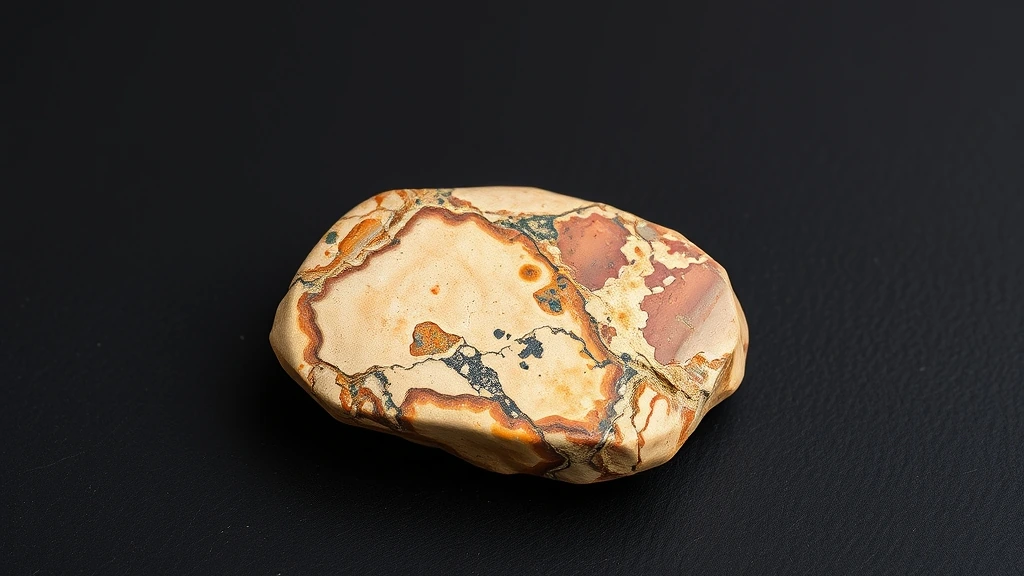
An aggregate of microcrystalline SiO₂, Picasso Jasper belongs to the chalcedony family within the broader quartz group. Though it is not a single mineral, its tightly intergrown fibrous crystals give it the appearance of a single stone, classifying it as a natural mineral/rock. The formation occurs in hydrothermal veins where silica‑rich fluids precipitate fine‑grained quartz, later infused with iron oxides and other trace elements that produce its vivid, painterly patterns. Its trigonal crystal symmetry underlies the orderly arrangement of the quartz fibers, even as the stone presents as a massive, opaque mass.
What is Picasso Jasper? Geological Overview & Definition
Picasso Jasper is an ornamental aggregate of microcrystalline quartz, distinguished by multicolored swirls that resemble abstract art. The stone forms in sedimentary or volcanic contexts where silica‑saturated solutions infiltrate fissures, solidifying into dense, banded masses.
Across ancient lapidary traditions, the stone has been prized for its striking visual complexity, often used in carvings, cabochons, and decorative objects. Its name reflects the modern artistic inspiration, yet the material itself is rooted in geological processes that have operated for millions of years. While Picasso Jasper captivates with its bold, abstract patterns, its quieter counterpart, Pink Chalcedony, offers a softer aesthetic often favored for delicate carvings and intimate jewelry pieces.
Picasso Jasper Chemical Composition & Crystallographic Properties
The primary constituent is silicon dioxide (SiO₂), organized as a trigonal framework of interlocking quartz crystals. Because the material is an aggregate, its overall composition includes minor iron oxides, manganese, and other transition‑metal ions that substitute into the silica lattice, creating the vivid chromatic zones. In comparative mineralogical collections, practitioners and geologists frequently study Hilutite alongside this crystal to appreciate their subtle energetic and structural differences.
These trace cations act as chromophore color centers, absorbing specific wavelengths and producing reds, blues, and yellows. The stone’s microstructure is highly resistant to dilute acids, yet prolonged exposure to strong acids can dissolve the quartz framework, revealing the underlying matrix.
Thermally, Picasso Jasper remains stable up to about 573 °C, the quartz α‑β transition temperature, after which the trigonal lattice reorients to a hexagonal form. This transformation is generally invisible in the finished gemstone because the aggregate’s opacity masks subtle crystallographic changes.
Overall, the stone’s trigonal crystal system governs its internal order, while the heterogeneous inclusion of metal oxides imparts the artistic coloration that defines Picasso Jasper.
| Property | Specification |
|---|---|
| Mineral Group | Natural Mineral / Crystal |
| Chemical Formula | SiO₂ |
| Mohs Hardness | 6.5 – 7.0 |
| Crystal System | Trigonal |
| Color & Optical Properties | Natural Picasso Jasper color spectrum and optical dispersion |
| Primary Mining Localities | Global primary localities |
| Water & Chemical Resistance | High (Safe for gentle water washing) |
| Chakra Alignment (Traditional) | Solar Plexus Chakra (Manipura) |
| Zodiac Affinity (Traditional) | Aquarius, Gemini |
| Symbolic Meaning (Traditional) | Creativity, motivation and self-confidence |
Picasso Jasper Varieties & Color Spectrum
Picasso Jasper displays distinct mineralogical characteristics across its geological varieties and structural habits. Gemologists evaluate these natural varieties based on crystal habit, trace chromophore concentrations, and visual luster.
Primary Natural Picasso Jasper
The benchmark natural variety exhibiting diagnostic color saturation and classic crystallographic symmetry.
Distinct Geological Morphs of Picasso Jasper
Secondary regional and structural varieties formed under localized geological temperature and pressure conditions.
Red‑Orange Picasso Jasper
Formed in silica‑rich volcanic tuffs, this variety displays a vivid red‑orange matrix intersected by white and black curvilinear veins. The striking patterns arise from micro‑fracture fillings of iron oxide and calcite, giving each slab a unique “painted” appearance. Found primarily in Brazil’s Minas Gerais region, it is moderately rare and prized for its high contrast.
Blue‑Green Picasso Jasper
Developed within hydrothermal quartz veins, the blue‑green type exhibits a deep teal background overlaid with swirling bands of milky white and charcoal. Manganese and copper impurities impart the cool hue, while fluid inclusions create a subtle sparkle. This morph is most common in Namibia’s Erongo Province and is valued for its soothing palette in meditation pieces.
Yellow‑Brown Picasso Jasper
Originating from sedimentary sandstone host rocks, the yellow‑brown variant shows a warm honey‑colored field intersected by dark, feather‑like inclusions of iron‑rich minerals. The banding pattern results from alternating periods of silica precipitation and iron oxidation during diagenesis. Primarily sourced from the United States’ Colorado Plateau, it is abundant yet sought after for its earthy elegance.
Black‑White Picasso Jasper
This high‑contrast form crystallizes in granite‑derived pegmatites, where silica fills fissures alongside abundant magnetite and albite crystals. The result is a dramatic black background pierced by stark white, often geometric, veins that resemble abstract art. Predominantly mined in Madagascar’s Antsirabe district, its rarity stems from limited pegmatite exposure and meticulous hand‑sorting.
Multicolor “Rainbow” Picasso Jasper
A rare hybrid, the rainbow variety forms in metamorphic schist where multiple trace elements—chromium, titanium, and manganese—co‑precipitate. Its kaleidoscopic surface features interlaced bands of red, green, blue, and gold, each hue defined by distinct mineral inclusions. Limited deposits in Pakistan’s Khyber Pakhtunkhwa make it one of the most collectible specimens for high‑end collectors.
Polished “Mosaic” Picasso Jasper
Extracted from dolomitic limestone, the mosaic type undergoes a unique polishing process that reveals a mosaic‑like pattern of translucent quartz and opaque chalcedony. The micro‑crystalline texture yields a smooth, glassy finish prized in cabochon jewelry. Though less colorful, its subtle elegance is sourced mainly from South Africa’s Limpopo province, where artisanal miners prioritize quality over quantity.
Where is Picasso Jasper Found? Geological Mining & Extraction
Picasso Jasper occurs chiefly within silica‑rich volcanic tuffs and hydrothermal quartz veins, where rapid cooling traps mineral inclusions that later weather into the characteristic patterned stone. In Brazil and Namibia, open‑pit mining extracts the material from weathered outcrops, while in Madagascar and Pakistan, underground shafts follow narrow pegmatite veins to retrieve the most vivid specimens.
Extraction techniques emphasize careful hand‑sorting to preserve the intricate banding and inclusions that define each variety. Miners employ low‑impact methods such as selective blasting and water‑washed sieving, ensuring that the delicate patterns remain intact for subsequent cutting and polishing by skilled lapidaries.
Historical Significance & Cultural Lore of Picasso Jasper
Across ancient lapidary traditions, Picasso Jasper’s bold patterns were likened to celestial maps, prompting its use in Greco‑Roman amulets intended to ward off misfortune. Egyptian tombs from the New Kingdom occasionally contain quartz fragments with similar banded textures, suggesting early appreciation for its aesthetic and symbolic resonance.
In Vedic and early Chinese metaphysical texts, the stone is associated with the Solar Plexus Chakra (Manipura), believed to stimulate creativity, motivation, and self‑confidence. Artisans in medieval Persia and Mughal India fashioned inlays for ceremonial vessels, embedding the stone’s vivid motifs into objects that signified status and spiritual vigor.
Modern Uses & Jewelry Applications of Picasso Jasper
Picasso Jasper is prized for its vivid, mottled patterns that echo the brushstrokes of a master painter. Skilled lapidaries cut the stone into smooth cabochons or intricately faceted pieces, allowing light to play across its swirling bands. The gemstone is also fashioned into ornamental carvings, from pendants and brooches to decorative tabletops, where its natural hues add a touch of artistic flair.
- Cabochon cuts highlight the stone’s color gradients.
- Faceted cuts enhance brilliance and reflectivity.
- Carved ornaments showcase the stone’s natural patterning.
Metaphysical Properties & Traditional Meaning of Picasso Jasper
According to historical traditions and metaphysical lore, Picasso Jasper is believed to stimulate creativity and foster self-confidence. Across ancient Mediterranean and Vedic lapidary lore, the stone is associated with the Solar Plexus Chakra (Manipura), a center of personal power and motivation. Its vibrant hues are thought to balance emotional energy, encouraging individuals to pursue their ambitions with clarity and enthusiasm.
Which Chakra and Zodiac Signs Align with Picasso Jasper?
Picasso Jasper is canonically aligned with the Solar Plexus Chakra (Manipura), the energetic hub of willpower and personal authority. This alignment is reflected in its reputed ability to enhance motivation and self‑confidence.
The gemstone’s astrological affinity is firmly rooted in the signs of Aquarius and Gemini. Those born under these signs are said to resonate with Picasso Jasper’s dynamic energy, fostering intellectual curiosity and innovative thinking.
How to Identify Real vs. Fake Picasso Jasper
Collectors must be vigilant against artificial imitations, such as synthetic glass or dyed replicas that mimic the stone’s characteristic bands. Real Picasso Jasper retains its natural texture and subtle variations, whereas imitations often exhibit uniformity or a glassy sheen.
Practical At-Home Authenticity Tests
- Temperature Test (Thermal Feel): Hold the stone in your palm; genuine quartz feels cool to the touch, whereas glass warms quickly.
- Specific Gravity & Weight Test: Compare the stone’s heft to a known quartz sample; real Jasper should feel noticeably heavier.
- Scratch & Hardness Test (Mohs Comparison): Use a steel file or a glass plate; genuine Jasper resists scratching, matching a hardness of 6.5–7.0.
- Microscopic & Loupe Inspection (Internal Inclusions): Examine under magnification for natural inclusions and subtle banding; synthetic versions often lack these fine details.
Picasso Jasper Valuation Factors, Grading & Pricing
Market value primarily hinges on Color Saturation and the distinct visual contrast of the stone’s patterns. Collectors seek specimens with vibrant, high-contrast imagery that mimics abstract art, often featuring deep browns against creamy whites. The natural energetic luster should be smooth and even, enhancing the artistic appeal without requiring excessive polishing.
Crystal Size & Weight (Grams) significantly influences pricing, with larger raw blocks commanding higher premiums than smaller pieces. Tumbled stones are graded by their polish quality, where a flawless, high-gloss finish increases desirability. Natural matrix inclusions that create unique, painterly designs are highly valued, as each stone offers a singular aesthetic profile.
Ethical Sourcing & Locality Premium plays a crucial role in the holistic and collector markets. Buyers increasingly prefer stones from verified, sustainable mines that ensure fair labor practices and environmental stewardship. Provenance documentation can elevate a piece’s status, adding a layer of historical and ethical significance to its physical beauty.
How to Clean and Care for Picasso Jasper
Maintain the stone’s integrity by using warm soapy water and a soft, lint-free cloth for gentle cleaning. This method effectively removes dust and oils without damaging the delicate surface patterns or internal structures. Always dry the specimen thoroughly with a separate soft cloth to prevent water spots or mineral residue buildup.
It is critical to avoid ultrasonic cleaners entirely, as the high-frequency vibrations can induce structural fractures within the jasper. These internal stresses may cause hairline cracks or shatter the stone, particularly if it contains natural fissures or inclusions. Stick to manual, low-impact cleaning methods to preserve the long-term durability and aesthetic value of your specimen.
Cleansing and Recharging Picasso Jasper (Energetic Care)
For holistic energetic maintenance, place the stone on a selenite charging slab overnight to absorb ambient energy. This passive method allows the crystal lattice to reset without exposing the material to physical stress or extreme temperatures. Selenite is a compatible mineral that gently amplifies positive vibrations while maintaining the jasper’s structural stability.
Alternatively, use herbal smudging with sage or palo santo to clear stagnant energy from the stone’s surface. Hold the smoke near the specimen for a few seconds, ensuring direct flame contact is strictly avoided to prevent thermal shock. This dry, non-invasive technique respects the mineral’s physical properties while addressing metaphysical cleansing goals.
Frequently Asked Questions About Picasso Jasper
Picasso Jasper displays distinct mineralogical characteristics across its geological varieties and structural habits. Gemologists evaluate these natural varieties based on crystal habit, trace chromophore concentrations, and visual luster.
Primary Natural Picasso Jasper
The benchmark natural variety exhibiting diagnostic color saturation and classic crystallographic symmetry.
Distinct Geological Morphs of Picasso Jasper
Secondary regional and structural varieties formed under localized geological temperature and pressure conditions.
What is Picasso Jasper and how does it differ from other jasper varieties?
Picasso Jasper is a form of quartz (SiO₂) that displays distinctive, swirling patterns resembling abstract paintings. Its trigonal crystal system and mohs hardness of 6.5–7.0 give it a durable, glassy luster that sets it apart from softer, more porous jasper types.
Is Picasso Jasper safe to wash in the shower or with rainwater?
Yes, Picasso Jasper is water‑resistant and can be gently washed with water. A mild, warm soapy solution and a soft cloth are recommended; the stone’s structure tolerates light moisture without risk of dissolution or damage.
How should I clean Picasso Jasper to avoid damaging its surface?
Use warm soapy water and a soft cloth, avoiding ultrasonic cleaners. Ultrasonic vibration can cause micro‑fractures in the quartz matrix, so gentle hand‑washing is the safest method for maintaining clarity and pattern integrity.
Can I use a dishwasher to clean my Picasso Jasper jewelry?
No, a dishwasher is not recommended for Picasso Jasper. The high temperature and harsh detergents can alter the stone’s surface and potentially introduce scratches or discoloration.
Which zodiac signs are associated with Picasso Jasper?
Picasso Jasper aligns with the zodiac signs Aquarius and Gemini. These signs are believed to resonate with the stone’s energetic qualities of creativity and intellectual curiosity.
Which chakra does Picasso Jasper correspond to and what benefits does it offer?
Picasso Jasper corresponds to the Solar Plexus Chakra (Manipura). It is thought to enhance personal power, confidence, and motivation, helping to balance the solar plexus energy center in the body.
Does Picasso Jasper contain any harmful elements or toxins?
Picasso Jasper is composed solely of silicon dioxide (SiO₂) and contains no toxic additives. Its purity ensures it is safe for everyday wear and handling, with no risk of chemical leaching or allergic reactions.
How should I store Picasso Jasper to preserve its appearance?
Store Picasso Jasper in a dry, soft‑lined pouch away from direct sunlight. Exposure to intense light can fade the stone’s vibrant patterns, while moisture can promote surface staining; a protective, breathable environment keeps the stone’s beauty intact.