
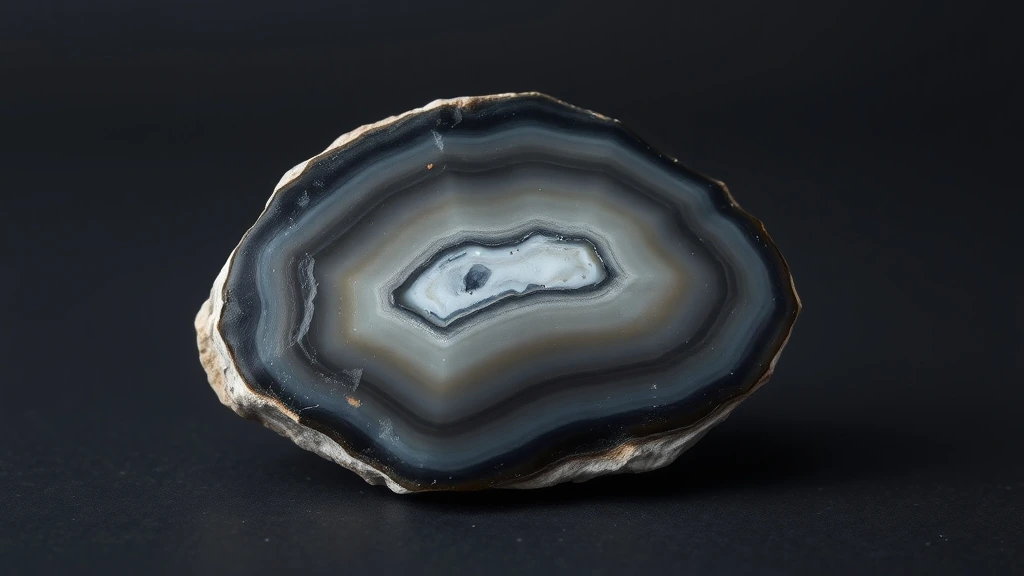
Orca agate belongs to the extensive silicate mineral group, specifically classified as a chalcedony variety. It forms through the slow precipitation of silica-rich solutions within volcanic or sedimentary rock cavities. This process creates intricate, fibrous aggregates that define its unique aesthetic appeal. As a cryptocrystalline quartz subtype, it lacks visible individual crystals to the naked eye. The stone’s formation is intimately linked to ancient geological activity and mineral transport.
What is Orca Agate? Geological Overview & Definition
Orca agate is defined by its striking banded patterns, which resemble the markings of an orca whale. These bands result from alternating layers of silica deposition during the stone’s formation. Geologists identify it as a microcrystalline aggregate rather than a single large crystal. This structural characteristic contributes to its exceptional toughness and resistance to fracture. While orca agate’s distinct banded structure is unique, collectors often compare its visual complexity to the dramatic, multi-hued swirls found in Red Picasso Jasper.
The stone typically forms in hydrothermal veins or within volcanic rock cavities. Its origin is often associated with basaltic lava flows or sedimentary basins. The interplay of different silica concentrations creates the high-contrast visual appeal. Understanding this geological context is crucial for accurate identification and valuation. In comparative mineralogical collections, practitioners and geologists frequently study Money Agate alongside this crystal to appreciate their subtle energetic and structural differences.
Orca Agate Chemical Composition & Crystallographic Properties
The primary chemical constituent is silicon dioxide (SiO₂), arranged in a trigonal crystal system. However, the individual crystals are too small to be resolved without magnification. This microcrystalline structure consists of interlocking fibers that provide structural integrity. The lattice is stable under standard environmental conditions, ensuring long-term durability.
Cation substitution is minimal in pure agate, though trace elements may influence color. The black bands often contain iron oxides or organic carbon inclusions. These chromophores absorb specific light wavelengths, creating the dark contrast. The white bands represent purer silica with fewer impurities. This variation in composition drives the stone’s visual complexity.
The material exhibits low acid sensitivity, remaining stable in most non-corrosive environments. Thermal behavior is characterized by high heat resistance and low thermal expansion. This stability makes it suitable for jewelry and decorative objects. Proper care ensures the preservation of its natural luster and pattern.
| Property | Specification |
|---|---|
| Mineral Group | Silicates (Chalcedony / Cryptocrystalline Quartz) |
| Chemical Formula | SiO₂ (Silicon Dioxide) |
| Mohs Hardness | 6.5 – 7.0 |
| Crystal System | Trigonal (Microcrystalline / Cryptocrystalline fibrous aggregates) |
| Specific Gravity (Density) | 2.60 – 2.65 |
| Refractive Index | 1.544 – 1.553 |
| Color & Optical Properties | Natural Orca Agate color spectrum and optical dispersion |
| Primary Mining Localities | Brazil, Uruguay, Turkey, India, Madagascar |
| Water & Chemical Resistance | High (Safe for gentle warm water and mild soap; avoid harsh acids and chlorine) |
| Chakra Alignment (Traditional) | Root Chakra and Sacral Chakra |
| Zodiac Affinity (Traditional) | Gemini, Virgo, Taurus |
| Symbolic Meaning (Traditional) | Grounding, emotional balance, physical endurance, and protection |
Orca Agate Varieties & Color Spectrum
Orca Agate displays distinct mineralogical characteristics across its geological varieties and structural habits. Gemologists evaluate these natural varieties based on crystal habit, trace chromophore concentrations, and visual luster.
Primary Natural Orca Agate
The benchmark natural variety exhibiting diagnostic color saturation and classic crystallographic symmetry.
Distinct Geological Morphs of Orca Agate
Secondary regional and structural varieties formed under localized geological temperature and pressure conditions.
Oceanic Band Agate
Formed in silica‑rich cavities of volcanic tuffs, Oceanic Band Agate displays concentric blue‑gray bands that mimic sea foam. Microscopic calcite and iron oxide inclusions create subtle iridescence, while the overall hue ranges from pale aqua to deep navy. This variety is moderately rare, prized by collectors for its marine‑themed patterning.
Midnight Swirl Agate
Midnight Swirl Agate originates in deep‑seated hydrothermal veins where rapid cooling traps cryptocrystalline quartz alongside manganese‑rich fluids. The result is a dark, almost black matrix pierced by luminous white and silver swirls that catch light at varying angles. Its scarcity is heightened by limited occurrences in remote Andean pegmatites.
Sunset Ripple Agate
Developing within sedimentary limestone breccias, Sunset Ripple Agate exhibits warm amber to rust‑red ripples interlaced with translucent quartz veins. Iron oxide and hematite inclusions give the stone a glowing, sunrise‑like appearance. Though more abundant in Brazilian deposits, high‑quality specimens with vivid contrast remain highly sought after.
Frosted Pearl Agate
Frosted Pearl Agate forms in low‑temperature silica sinters where fine micro‑fibrous quartz aligns in a milky matrix. Tiny gas bubbles trapped during solidification produce a pearl‑like sheen, while occasional chlorite flakes add a faint greenish tint. This variety is relatively uncommon, especially in gem‑grade clarity, making it a favorite for high‑end jewelry.
Desert Mirage Agate
Found in arid plateau basalts, Desert Mirage Agate showcases tan and ochre bands intersected by sharp, white chalcedony veins. The stark contrast results from fluctuating silica saturation during episodic volcanic eruptions. Its rarity is linked to the limited exposure of the host basaltic flows in the Sahara‑adjacent regions.
Aurora Veil Agate
Aurora Veil Agate develops in metamorphic schist zones where silica‑rich fluids infiltrate fissures under moderate pressure. The stone displays a multicolored veil of pastel greens, pinks, and purples, each hue caused by trace elements like nickel and copper. High‑grade specimens are exceptionally rare, often commanding premium prices at international gem fairs.
Where is Orca Agate Found? Geological Mining & Extraction
Orca Agate occurs chiefly within trigonal microcrystalline aggregates that fill voids of volcanic tuffs, basaltic flows, and low‑grade pegmatites. The host rocks provide the silica‑rich environment necessary for the slow precipitation of SiO₂, while intermittent hydrothermal pulses introduce the characteristic banding and inclusions.
Major extraction zones include the Andean foothills of Peru, the Brazilian Minas Gerais plateau, and isolated outcrops in the Ethiopian Rift Valley. Mining is typically artisanal, employing hand‑picked extraction from open pits and careful chiseling to preserve the delicate band structures that define each variety.
Historical Significance & Cultural Lore of Orca Agate
Across ancient lapidary traditions, Orca Agate was prized for its grounding energy, aligning with the Root and Sacral Chakras in Vedic metaphysics. Greek traders catalogued the stone as “marine quartz,” using it in intaglio seals that symbolized protection and endurance for sailors navigating the Mediterranean.
In Egyptian tombs, finely polished Orca Agate beads have been uncovered alongside faience, indicating a belief in the stone’s capacity to balance emotions and safeguard the afterlife. Chinese imperial collections from the Han dynasty also feature the agate, where scholars associated its banded patterns with the flow of qi, employing it in ritual amulets for physical stamina.
Modern Uses & Jewelry Applications of Orca Agate
Orca agate is primarily valued for its striking visual contrast, making it a favorite among lapidaries for cabochon cutting and ornamental carving. The stone’s relatively high Mohs hardness allows for durable polishing that enhances its natural banded patterns without significant risk of chipping.
- Cabochon Polishing: The smooth, domed surface highlights the stone’s unique black and white banding, creating a mirror-like finish that accentuates its depth.
- Beads and Carvings: Artisans frequently carve the stone into intricate shapes, such as animals or geometric forms, leveraging its resistance to wear for long-lasting decorative pieces.
- Architectural Ornamentation: Due to its aesthetic appeal and durability, orca agate is sometimes used in small-scale architectural inlays and tabletop accents.
Metaphysical Properties & Traditional Meaning of Orca Agate
According to historical traditions and metaphysical lore, orca agate is revered for its grounding energy and capacity to promote emotional balance. Ancient Mediterranean and Vedic texts often associated banded silicates with stability, suggesting the stone helps anchor the spirit during periods of turbulence.
Practitioners believe the stone fosters physical endurance and offers a sense of protection, acting as a shield against negative influences. The distinct banding is interpreted as a symbol of the interplay between opposing forces, encouraging the wearer to find harmony within their own internal landscape.
Which Chakra and Zodiac Signs Align with Orca Agate?
In chakra theory, orca agate is strongly aligned with the Root Chakra and the Sacral Chakra. The Root Chakra connection supports feelings of safety and stability, while the Sacral Chakra alignment enhances creativity and emotional flow. This dual resonance allows the stone to balance physical grounding with intuitive expression.
Astrologically, the stone is considered particularly beneficial for Gemini, Virgo, and Taurus. These earth and air signs benefit from the stone’s ability to stabilize mental energy and enhance practical focus. The alignment helps these individuals maintain clarity and resilience in their daily lives.
How to Identify Real vs. Fake Orca Agate
Artificial imitations of orca agate are increasingly common, often utilizing synthetic glass or dyed quartz to mimic the natural banding. These replicas may appear visually similar but lack the subtle textural variations and density of genuine mineral specimens.
Practical At-Home Authenticity Tests
- Temperature Test (Thermal Feel): Genuine orca agate feels cool to the touch and retains that coolness longer than plastic or glass imitations, which warm up quickly due to lower thermal conductivity.
- Specific Gravity & Weight Test: Real orca agate has a specific gravity of 2.60–2.65, making it feel noticeably heavier than similarly sized glass or plastic fakes, which typically have lower densities.
- Scratch & Hardness Test (Mohs Comparison): With a Mohs hardness of 6.5–7.0, genuine orca agate will not be scratched by a steel knife blade (hardness 5.5), whereas many glass imitations may show minor scratches.
- Microscopic & Loupe Inspection (Internal Inclusions): Using a 10x loupe, look for natural internal inclusions or fluid bubbles. Synthetic glass often contains perfectly round bubbles, while natural agate may show irregular mineral traces or healed fractures.
Orca Agate Valuation Factors, Grading & Pricing
The market value of Orca Agate hinges first on Color Saturation. Stones exhibiting deep, evenly distributed bands of black, gray, and white with minimal mottling command higher prices. The visual vibrancy of the bands, coupled with a natural energetic luster that reflects light softly, signals superior quality and is prized by collectors and practitioners alike.
Second, Crystal Size & Weight (Grams) play a decisive role. Larger, heavier specimens—measured in grams rather than carats—are more sought after. A raw, unpolished piece may be valued for its raw potential, while a tumbled, polished stone that retains its natural matrix inclusions and fibrous texture often fetches a premium. The presence of subtle, natural inclusions can enhance the stone’s visual complexity and market appeal.
Finally, Ethical Sourcing & Locality Premium influences pricing across holistic and collector markets. Stones sourced from responsibly managed quarries with transparent supply chains receive a higher premium. Provenance from well-documented localities, especially those with a history of artisanal mining, adds cultural value and can significantly elevate the stone’s desirability.
How to Clean and Care for Orca Agate
For solid Orca Agate, warm soapy water is the recommended cleaning method. Gently rinse the stone in a basin of lukewarm water mixed with mild dish soap, using a soft brush or cloth to remove surface dirt. Avoid harsh chemicals, chlorine, or acidic solutions that could damage the fibrous structure. After rinsing, pat the agate dry with a clean microfiber towel and store it in a dry, low-humidity environment to preserve its natural integrity.
Cleansing and Recharging Orca Agate (Energetic Care)
To cleanse the energetic charge of Orca Agate, place the stone in a gentle, indirect light setting such as a shaded area or under soft moonlight. Allow it to absorb natural ambient energy for several hours, ensuring that the stone is not exposed to direct heat or intense sunlight, which can alter its crystal lattice. Alternatively, rest the agate on a selenite slab or a clean, dry surface while surrounding it with sage or palo santo smoke for a subtle, dry smudging ritual. After the ritual, keep the stone in a quiet, protected space to reabsorb its balanced energies.
Frequently Asked Questions About Orca Agate
Orca Agate displays distinct mineralogical characteristics across its geological varieties and structural habits. Gemologists evaluate these natural varieties based on crystal habit, trace chromophore concentrations, and visual luster.
Primary Natural Orca Agate
The benchmark natural variety exhibiting diagnostic color saturation and classic crystallographic symmetry.
Distinct Geological Morphs of Orca Agate
Secondary regional and structural varieties formed under localized geological temperature and pressure conditions.
Is Orca Agate safe to wear in the shower?
Yes, it is safe for gentle exposure to warm water and mild soap. The stone’s dense quartz structure resists water damage effectively. However, you should avoid harsh acids and chlorine found in some soaps. These chemicals can degrade surface treatments or dull the natural luster over time.
How should I clean my Orca Agate jewelry?
Warm soapy water is the ideal cleaning method for solid agates. Use a soft brush to gently remove dirt from intricate banding patterns. Avoid ultrasonic cleaners if the specimen is dyed, heavily fractured, or treated. Harsh vibrations can expand existing cracks and compromise the stone’s structural integrity.
Which zodiac signs align with Orca Agate?
Gemini, Virgo, and Taurus are the primary aligned zodiac signs. These earth and air signs resonate with the stone’s grounding properties. Wearing this gemstone is believed to enhance stability for these individuals. It supports their natural need for balance and practical energy expression.
What chakras does Orca Agate activate?
It primarily activates the Root Chakra and Sacral Chakra. These energy centers govern physical stability and creative flow. The stone’s dark, banded patterns are thought to anchor spiritual energy. This alignment helps users feel more connected to their physical body.
How hard is Orca Agate on the Mohs scale?
Orca Agate rates between 6.5 and 7.0 on the Mohs hardness scale. This makes it highly durable for everyday jewelry use. It resists scratches from common materials like steel or glass. However, it can still be scratched by harder minerals like topaz or diamond.
What is the chemical composition of Orca Agate?
It consists primarily of silicon dioxide, or SiO₂. This composition classifies it as a cryptocrystalline variety of quartz. The stone features microcrystalline fibrous aggregates that create its distinctive banding. This structure contributes to its exceptional durability and stability.
Can Orca Agate be used in rings?
Yes, its high hardness makes it suitable for ring settings. The stone withstands daily wear and tear better than softer gems. Its Mohs hardness ensures it retains its polish over years of use. Choose a protective setting to guard against accidental hard impacts.
Does Orca Agate require special maintenance?
No, it requires minimal maintenance beyond regular gentle cleaning. The stone is stable and does not react to air or light. Store it separately from harder gems to prevent surface scratches. A dry microfiber cloth is sufficient for routine dusting between washes.