
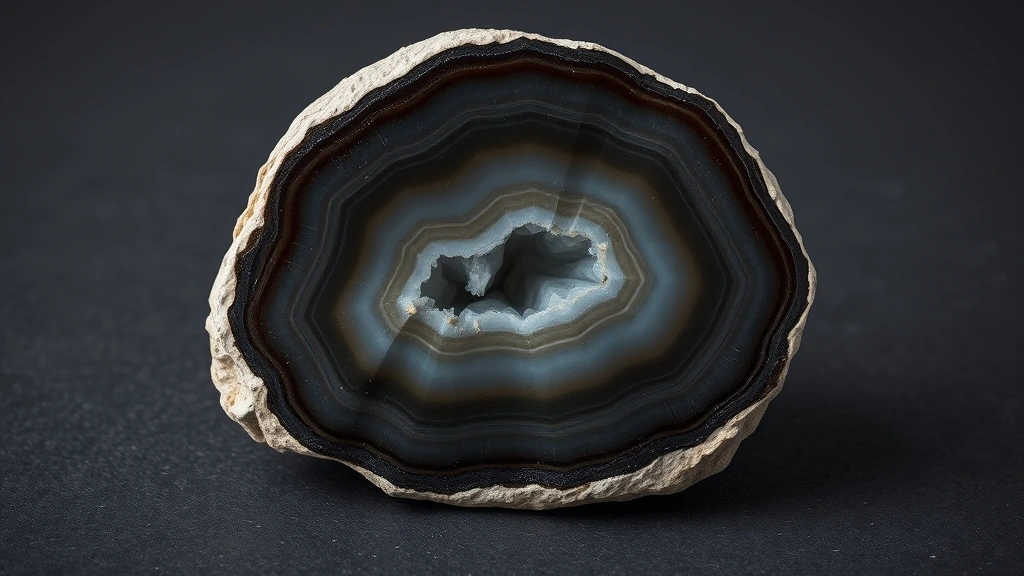
Money Agate belongs to the silicate family, specifically the chalcedony subgroup of cryptocrystalline quartz. Its formation results from the fibrous aggregation of microcrystals that align in a trigonal lattice, producing the characteristic banded pattern. These aggregates are typically deposited in volcanic tuff or sedimentary layers where silica‑rich fluids precipitate over time, yielding a dense, polished stone prized for both ornamental and metaphysical uses.
What is Money Agate? Geological Overview & Definition
Money Agate is a microcrystalline aggregate of silica that forms in thin, concentric bands of varying color, often resembling the patina of aged copper or gold. The banding arises from rhythmic changes in impurity concentrations during silica deposition, giving each specimen a unique, almost ledger‑like appearance.
Historically, the stone has been mined in regions such as Brazil, India, and the United States, where volcanic ash and hydrothermal activity provide the silica‑rich environments necessary for its growth. Across ancient lapidary traditions, these patterned stones were associated with wealth and prosperity, a belief that persists in modern metaphysical circles. While Money Agate is prized for its direct association with financial abundance, collectors often seek out Turritella Agate for its distinctive fossilized patterns that offer a unique aesthetic and energetic complement to traditional wealth stones.
Money Agate Chemical Composition & Crystallographic Properties
The primary constituent of Money Agate is SiO₂, organized as a trigonal (microcrystalline/cryptocrystalline fibrous aggregate). Unlike single crystals, the stone consists of countless interlocked quartz fibers whose collective symmetry defines its overall crystal system. This fibrous architecture imparts a modest density of 2.60–2.65 g/cm³ and contributes to its characteristic translucency. This fibrous architecture imparts a modest density of 2.60–2.65 g/cm³ and contributes to the stone’s characteristic banded appearance, a structural trait it shares with the more complex banded iron oxide formations found in Tiger Iron.
Coloration stems from trace iron, manganese, and copper ions substituting within the silica lattice, creating chromophore color centers that absorb specific wavelengths of light. These impurities are unevenly distributed, producing the distinctive green‑gold banding that resembles minted currency.
Money Agate is chemically stable but can be sensitive to strong acids, which may leach surface impurities and alter its hue. Thermal exposure above 600 °C can induce recrystallization, gradually transforming the cryptocrystalline fabric into coarser quartz and diminishing the banded pattern.
Overall, the stone’s trigonal microcrystalline framework, combined with its impurity‑driven chromophores, defines both its physical resilience and its striking aesthetic, making Money Agate a prized material in gem cutting and ornamental design.
| Property | Specification |
|---|---|
| Mineral Group | Silicates (Chalcedony / Cryptocrystalline Quartz) |
| Chemical Formula | SiO₂ (Silicon Dioxide) |
| Mohs Hardness | 6.5 – 7.0 |
| Crystal System | Trigonal (Microcrystalline / Cryptocrystalline fibrous aggregates) |
| Specific Gravity (Density) | 2.60 – 2.65 |
| Refractive Index | 1.544 – 1.553 |
| Color & Optical Properties | Natural Money Agate color spectrum and optical dispersion |
| Primary Mining Localities | Brazil, Uruguay, Turkey, India, Madagascar |
| Water & Chemical Resistance | High (Safe for gentle warm water and mild soap; avoid harsh acids and chlorine) |
| Chakra Alignment (Traditional) | Root Chakra and Sacral Chakra |
| Zodiac Affinity (Traditional) | Gemini, Virgo, Taurus |
| Symbolic Meaning (Traditional) | Grounding, emotional balance, physical endurance, and protection |
Money Agate Varieties & Color Spectrum
Money Agate displays distinct mineralogical characteristics across its geological varieties and structural habits. Gemologists evaluate these natural varieties based on crystal habit, trace chromophore concentrations, and visual luster.
Primary Natural Money Agate
The benchmark natural variety exhibiting diagnostic color saturation and classic crystallographic symmetry.
Distinct Geological Morphs of Money Agate
Secondary regional and structural varieties formed under localized geological temperature and pressure conditions.
Green Money Agate
Formed in silica‑rich volcanic tuffs, green Money Agate displays banded layers of chlorite and iron oxides that impart a deep forest hue. The cryptocrystalline texture creates a milky translucency, while occasional calcite veining adds sparkle. Found chiefly in Brazil’s Minas Gerais region, it is moderately rare and prized for its soothing visual depth.
Blue‑Gray Money Agate
Developed within basaltic lava flows, blue‑gray Money Agate acquires its muted tone from microscopic inclusions of manganese and titanium. Fine concentric bands produce a wave‑like pattern reminiscent of storm‑cloud skies. Primary sources include the United States’ Oregon Cascades, where the stone’s subtle chroma makes it a collector’s favorite despite limited deposits.
Red‑Brown Money Agate
The red‑brown Money Agate originates in sedimentary sandstones where iron oxidation yields rich rust‑colored bands. Hematite crystals often appear as speckled inclusions, enhancing the stone’s earthy vibrancy. Major localities span India’s Rajasthan and Namibia’s Otjozondjupa, where the variety’s robust coloration and relative abundance support a thriving trade market.
Yellow‑Gold Money Agade
Born in hydrothermal veins intersecting quartzite, yellow‑gold Money Agate exhibits bright citrine‑like bands interlaced with translucent chalcedony. The presence of goethite particles creates a warm, metallic sheen that has historically attracted merchants. Notable occurrences are reported from Mexico’s Zacatecas mines, where the variety’s luminous quality commands premium prices.
Black‑Band Money Agate
In high‑pressure metamorphic zones, black‑band Money Agate forms through the replacement of basaltic glass by silica, embedding carbonaceous soot and magnetite. The stark contrast of jet‑black bands against pale milky backgrounds yields a dramatic visual effect. This variety is chiefly sourced from the Czech Republic’s Bohemian Massif, where its rarity enhances its desirability among esoteric collectors.
Multi‑Color Money Agate (Mosaic)
The Mosaic Money Agate is a composite of several mineral layers, each reflecting different trace elements such as copper, nickel, and zinc. Its kaleidoscopic pattern emerges from alternating bands of green, blue, and amber, creating a natural “money‑tree” motif. Found in the Rift Valley’s Tanzanian deposits, the stone’s complex formation makes it one of the most sought‑after and scarce agate types.
Where is Money Agate Found? Geological Mining & Extraction
Money Agate typically occurs in cryptocrystalline silica that fills vesicular cavities of volcanic tuffs, basaltic lava flows, and hydrothermal quartz veins. The stone’s banded architecture results from successive silica precipitation, often accompanied by iron, manganese, or carbonaceous inclusions that dictate its color palette.
Commercial extraction concentrates in Brazil’s Minas Gerais, the United States’ Pacific Northwest, India’s Rajasthan, and the Czech Republic’s Bohemian Massif. Small‑scale open‑pit mining and selective hand‑picking preserve the delicate banding, while modern beneficiation plants employ gentle crushing and water‑based washing to separate agate nodules from host rock without damaging their surface luster.
Historical Significance & Cultural Lore of Money Agate
Across ancient lapidary traditions, Money Agate was valued for its perceived ability to attract wealth and stability. In Greco‑Roman texts, the stone was called “*money stone*” and set into amulets for merchants, while Egyptian tomb inventories list agate beads as symbols of prosperity and protection for the afterlife.
In Vedic astrology, Money Agate aligns with the planet Mercury and is recommended for Gemini, Virgo, and Taurus to enhance financial acumen. Chinese feng‑shui manuals describe the stone’s grounding energy as a safeguard against sudden loss, and medieval European alchemists cited its banded pattern as a visual metaphor for the flow of capital. Throughout these cultures, the gemstone’s enduring reputation for grounding, emotional balance, and physical endurance remains a testament to its timeless allure.
Modern Uses & Jewelry Applications of Money Agate
Money agate’s cryptocrystalline texture makes it ideal for cabochon cuts that showcase its banded swirls, while skilled lapidaries can also facet the stone for high‑gloss rings and pendants. Its sturdy Mohs hardness of 6.5–7 allows intricate ornamental carving for beads, brooches, and decorative inlays. Contemporary designers favor the stone for its earthy aesthetic and perceived prosperity symbolism.
- Cabochon settings for rings, earrings, and pendants
- Faceted cuts in high‑shine jewelry pieces
- Carved cameos, beads, and ornamental inlays for accessories
Metaphysical Properties & Traditional Meaning of Money Agate
According to historical traditions and metaphysical lore, Money agate is believed to ground the wearer, fostering emotional balance and physical endurance. Across ancient Mediterranean and Vedic lapidary practices, the stone was prized for attracting wealth and safeguarding against negative energies, resonating with the Root and Sacral Chakras. Its layered bands symbolize the flow of prosperity, encouraging confidence in financial decisions while promoting inner stability.
Which Chakra and Zodiac Signs Align with Money Agate?
Money agate is expressly linked to the Root Chakra, supporting foundational stability, and the Sacral Chakra, enhancing creativity and sensual confidence. Practitioners claim the stone’s energy helps anchor personal power and stimulate the flow of abundance in daily life.
In astrological alignment, the gemstone corresponds to Gemini, Virgo, and Taurus. These signs are associated with communication, analytical precision, and material security, respectively, echoing the stone’s reputed ability to balance intellect, practicality, and wealth attraction.
How to Identify Real vs. Fake Money Agate
Artificial imitations of Money agate include dyed quartz, synthetic glass, and resin composites that mimic its banded appearance but lack the stone’s natural density and refractive qualities. These substitutes often feel lighter, display uniform coloration, or exhibit a glassy surface rather than the subtle translucency of genuine agate. Careful observation and simple tests can reveal the true nature of the specimen.
Practical At-Home Authenticity Tests
- Temperature Test (Thermal Feel): Real agate absorbs heat slowly and feels cool to the touch, whereas glass or plastic warms quickly in the hand.
- Specific Gravity & Weight Test: Genuine Money agate has a density of 2.60–2.65 g/cm³; a simple water‑displacement test will show it feels heavier than glass imitations.
- Scratch & Hardness Test (Mohs Comparison): Using a steel needle (hardness ~5.5) should not leave a scratch on authentic agate, while softer substitutes will show visible marks.
- Microscopic & Loupe Inspection (Internal Inclusions): Under 10× magnification, natural agate reveals fine banding, chalcedony fibers, and occasional micro‑fractures, whereas synthetic glass appears uniformly smooth with no internal structure.
Money Agate Valuation Factors, Grading & Pricing
Market valuation primarily hinges on Color Saturation, where deep, uniform earth tones command higher premiums than pale or mottled specimens. Collectors seek stones exhibiting a natural energetic luster that reflects the inherent quality of the silica structure. Visual vibrancy is assessed under neutral lighting to ensure the hue remains consistent without artificial enhancement.
Crystal Size & Weight (Grams) serves as the fundamental metric for pricing raw and polished specimens. Larger, unfractured pieces with smooth, high-quality tumbled finishes typically fetch significantly higher prices than smaller or irregularly shaped stones. The presence of natural matrix inclusions can either enhance or diminish value, depending on the aesthetic appeal of the geological pattern.
Ethical Sourcing & Locality Premium increasingly influences pricing in both holistic and collector markets. Buyers often pay a premium for stones with verified provenance from reputable, environmentally responsible mines. Documentation of the origin supports transparency and ensures the specimen aligns with modern ethical standards for mineral acquisition.
How to Clean and Care for Money Agate
Due to its high water resistance, Money Agate can be safely cleaned using warm soapy water and a soft cloth. This gentle method effectively removes surface oils and dust without damaging the stone’s surface. Always rinse thoroughly with clean water and dry immediately to prevent any potential residue buildup.
Avoid using ultrasonic cleaners if the specimen is dyed, heavily fractured, or has undergone other treatments. These devices can exacerbate existing cracks or strip away artificial colorants, leading to permanent damage. For solid, untreated agates, ultrasonic cleaning is generally safe but should still be performed with caution.
Cleansing and Recharging Money Agate (Energetic Care)
Holistic practitioners often recommend herbal smudging to clear perceived energetic stagnation from the stone. Passing the agate through the smoke of sage or palo santo is a traditional method believed to reset its vibrational frequency. This dry process ensures the mineral remains physically intact while addressing metaphysical concerns.
Alternatively, placing the stone on a selenite charging slab allows for gentle recharging through ambient energy. Exposure to soft moonlight is another popular technique that avoids the thermal risks associated with direct sunlight. These methods respect the crystal lattice structure while aligning with traditional metaphysical practices.
Frequently Asked Questions About Money Agate
Money Agate displays distinct mineralogical characteristics across its geological varieties and structural habits. Gemologists evaluate these natural varieties based on crystal habit, trace chromophore concentrations, and visual luster.
Primary Natural Money Agate
The benchmark natural variety exhibiting diagnostic color saturation and classic crystallographic symmetry.
Distinct Geological Morphs of Money Agate
Secondary regional and structural varieties formed under localized geological temperature and pressure conditions.
What is Money Agate and how does it differ from other agates?
Money Agate is a type of cryptocrystalline quartz known for its distinctive banded patterns resembling coins or currency. These bands are formed by variations in silica deposition, giving the stone a unique visual appeal that has historically symbolized wealth and prosperity in many cultures.
Is Money Agate safe to wear in the shower or while swimming?
Yes, Money Agate is water‑resistant and can be safely worn in gentle warm water with mild soap. Avoid exposure to harsh acids, chlorine, or prolonged soaking, as these chemicals can damage the stone’s surface and alter its natural appearance.
How should I clean a Money Agate to keep it looking its best?
Use warm soapy water and a soft cloth for cleaning solid Money Agate specimens. Avoid ultrasonic cleaners if the stone is dyed, heavily fractured, or treated, as vibrations can cause damage or discoloration.
Can Money Agate be used in jewelry that is exposed to everyday wear?
Yes, Money Agate is durable enough for everyday jewelry, with a Mohs hardness of 6.5–7.0. Its resistance to scratches and moderate wear makes it suitable for rings, pendants, and bracelets, though it should be protected from harsh impacts.
Which zodiac signs are associated with Money Agate?
Money Agate is traditionally linked to Gemini, Virgo, and Taurus. These signs are believed to benefit from the stone’s grounding and protective energies, enhancing focus and financial intuition.
Which chakras does Money Agate influence?
Money Agate primarily influences the Root Chakra and the Sacral Chakra. These chakras are associated with grounding, stability, and emotional balance, supporting the stone’s reputation for fostering financial confidence.
Does Money Agate have any special metaphysical properties?
Money Agate is thought to promote grounding, emotional balance, physical endurance, and protection. Its symbolic connection to wealth and stability makes it a popular choice in metaphysical practices aimed at enhancing prosperity and resilience.
How should I store Money Agate when not wearing it?
Store Money Agate in a soft pouch or lined jewelry box away from direct sunlight and moisture. This protects the stone from environmental stressors that could fade its colors or cause surface wear, ensuring long‑term beauty and integrity.