
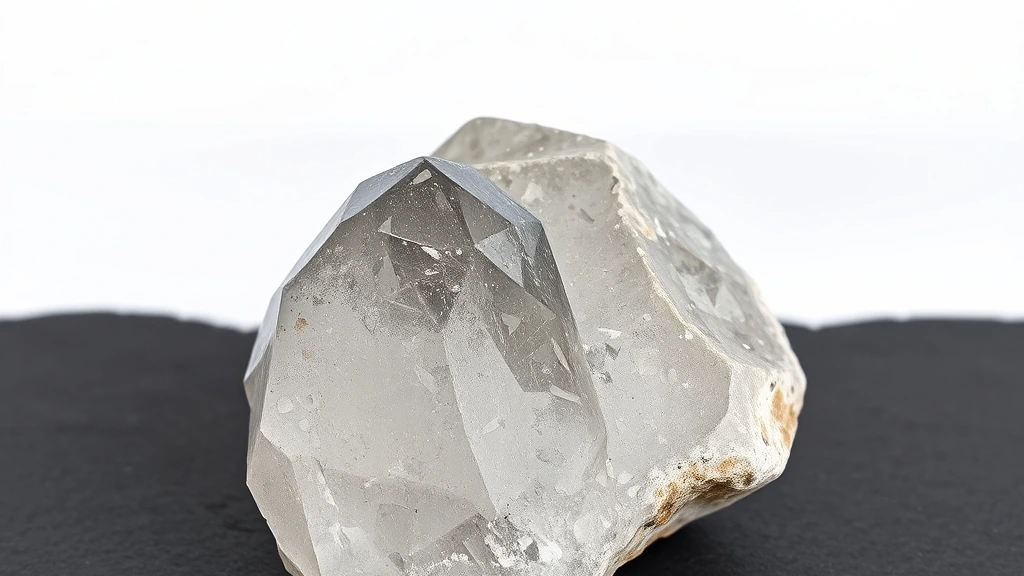
Faden Quartz belongs to the extensive Quartz Group within the silicate mineral family. Specifically, it is classified as a tectosilicate, a framework silicate where silicon and oxygen atoms form a continuous three-dimensional network. This structural arrangement provides the stone with its characteristic rigidity and chemical stability. The internal “faden,” or thread-like inclusions, typically consist of rutile or goethite crystals trapped during formation. These inclusions do not alter the primary SiO₂ lattice but significantly influence the stone’s optical properties.
What is Faden Quartz? Geological Overview & Definition
Faden Quartz is defined by its distinct internal rutile needles, which appear as parallel fibers within the crystal matrix. These inclusions form when titanium dioxide precipitates along the growth planes of the host quartz. The term “Faden” is German for thread, accurately describing this linear, fibrous appearance. This variety is often found in hydrothermal veins associated with granitic intrusions. In comparative mineralogical collections, practitioners and geologists frequently study Quartz Geode alongside this crystal to appreciate their subtle energetic and structural differences.
The geological formation process involves slow cooling of silica-rich fluids in crustal fractures. As the fluid cools, quartz crystals nucleate and grow around pre-existing mineral seeds. The alignment of these inclusions creates a striking visual effect, often resembling a bundle of hair. This unique morphology distinguishes Faden Quartz from other quartz varieties like amethyst or citrine.
Faden Quartz Chemical Composition & Crystallographic Properties
Faden Quartz crystallizes in the Trigonal (Rhombohedral / Trapezohedral) system, reflecting its underlying atomic symmetry. The unit cell is defined by equal edge lengths and non-90-degree angles, typical of the quartz group. This trigonal lattice allows for the characteristic piezoelectric properties observed in pure quartz specimens. The crystal structure consists of helical chains of silicon-oxygen tetrahedra linked by shared oxygen atoms. The same trigonal symmetry that gives Faden Quartz its piezoelectric charm is also found in the rare Oumi Yakuseki, making it a compelling companion for those exploring quartz’s energetic pathways.
The primary chemical composition remains SiO₂, with trace impurities responsible for the inclusions. Rutile (TiO₂) is the dominant chromophore in the fibrous inclusions, absorbing specific wavelengths of light. The host quartz may contain minor cation substitutions, such as aluminum replacing silicon, which can affect electrical conductivity. These substitutions are minimal and do not significantly alter the bulk density, which remains near 2.65 g/cm³.
Thermal behavior is stable up to high temperatures, making the stone resistant to standard jewelry cleaning methods. However, extreme heat can potentially alter the color of the rutile inclusions or cause fracturing. The refractive index ranges from 1.544 to 1.553, contributing to the stone’s moderate brilliance. Acid sensitivity is low, as quartz is highly resistant to most common acids, ensuring long-term preservation of the gemstone’s integrity.
| Property | Specification |
|---|---|
| Mineral Group | Silicates (Tectosilicates / Quartz Group) |
| Chemical Formula | SiO₂ (Silicon Dioxide) |
| Mohs Hardness | 7.0 |
| Crystal System | Trigonal (Rhombohedral / Trapezohedral) |
| Specific Gravity (Density) | 2.65 |
| Refractive Index | 1.544 – 1.553 |
| Color & Optical Properties | Natural Faden Quartz color spectrum and optical dispersion |
| Primary Mining Localities | Brazil, Madagascar, USA (Arkansas), Swiss Alps |
| Water & Chemical Resistance | High (Fully resistant to water and moisture) |
| Chakra Alignment (Traditional) | All Chakras (Universal Harmonizer) |
| Zodiac Affinity (Traditional) | All Zodiac Signs (Especially Leo and Aries) |
| Symbolic Meaning (Traditional) | Master energy amplifier, clarity, purification, and focus |
Faden Quartz Varieties & Color Spectrum
Faden Quartz displays distinct mineralogical characteristics across its geological varieties and structural habits. Gemologists evaluate these natural varieties based on crystal habit, trace chromophore concentrations, and visual luster.
Primary Natural Faden Quartz
The benchmark natural variety exhibiting diagnostic color saturation and classic crystallographic symmetry.
Distinct Geological Morphs of Faden Quartz
Secondary regional and structural varieties formed under localized geological temperature and pressure conditions.
Clear (Crystal) Faden Quartz
Formed in silica‑rich pegmatitic veins, this variety crystallizes as transparent, hexagonal prisms with a glassy luster. Minute fluid inclusions and occasional rutile needles create a subtle “star” effect when cut. Its clarity makes it the most common and widely traded, yet high‑grade stones are prized for their optical perfection.
Smoky Faden Quartz
Developed through natural irradiation of colorless quartz, smoky quartz displays a uniform gray to deep brown hue. The coloration is linked to trapped hydrogen‑related color centers within the crystal lattice. Found primarily in the Czech Republic and Brazil, its depth of tone varies with exposure time, making deep‑smoky stones relatively rare.
Rose Faden Quartz
Rose quartz forms in hydrothermal environments where trace manganese and titanium replace iron in the silica framework, imparting a delicate pink blush. Microscopic cryptocrystalline aggregates give it a milky translucency, often enhanced by surface polishing. High‑quality rose stones from Madagascar are especially sought after for their even coloration and minimal veining.
Amethyst Faden Quartz
Amethyst’s violet hue originates from Fe³⁺ ions in the crystal lattice, charge‑balanced by radiation‑induced color centers. It typically grows in cavities of volcanic rhyolitic and andesitic host rocks, producing well‑defined hexagonal crystals. Brazilian and Uruguayan amethyst with deep, saturated tones command premium prices, while lighter shades are more abundant.
Citrine Faden Quartz
Citrine results from the heat‑induced oxidation of amethyst, converting Fe³⁺ color centers to yellow‑orange Fe⁴⁺ complexes. Natural citrine is rarer than its heat‑treated counterpart, occurring in the arid zones of Spain and Brazil where slow cooling preserves the color. Its brilliance is enhanced by a high refractive index, making it a favored gemstone for jewelry.
Tourmalinated Faden Quartz
In this rare hybrid, tourmaline needles are embedded within a quartz matrix, creating striking black‑white striations. The inclusions form during late‑stage crystallization in granitic pegmatites, where both minerals precipitate simultaneously. Specimens from Madagascar and the United States are highly collectible, valued for their unique visual contrast and geological intrigue.
Where is Faden Quartz Found? Geological Mining & Extraction
Faden quartz predominates in silica‑rich pegmatites, often associated with feldspar, mica, and beryl. These coarse‑grained intrusions crystallize from late‑stage magmatic fluids, allowing quartz to grow to large, well‑formed crystals. The mineral’s hardness of 7 on the Mohs scale facilitates mechanical extraction without excessive breakage.
Major mining districts include the Ural Mountains of Russia, the Czech Bohemian Massif, Brazil’s Minas Gerais region, and the Sierra de Gredos in Spain. In each locale, open‑pit or underground methods expose quartz veins, followed by hand‑sorting and water‑based cleaning to preserve the stone’s optical clarity for the gemstone market.
Historical Significance & Cultural Lore of Faden Quartz
Across ancient lapidary traditions, clear quartz served as a “master healer” in Egyptian tombs, where amulets fashioned from the stone were placed in burial chambers for protection. Greco‑Roman writers such as Pliny the Elder described its ability to focus sunlight, linking it to the deity Apollo and the concept of divine clarity.
In Vedic texts, quartz—particularly the rose and smoky varieties—was revered as a purification conduit, used in meditation to balance all chakras and amplify mantra vibrations. Chinese imperial courts prized amethyst and citrine for their auspicious colors, incorporating them into dragon‑motif ornaments that symbolized imperial authority and celestial harmony.
Modern Uses & Jewelry Applications of Faden Quartz
Faden quartz is prized for its clarity and subtle internal striations, making it ideal for both cabochon and faceted settings. Lapidary artisans often employ precision saws to preserve the stone’s natural “thread‑like” inclusions, which add character to high‑end pendants and rings. Ornamental carving also showcases its translucency in decorative beads, inlays, and small sculpture pieces.
- Faceted gems for rings, earrings, and brooches
- Cabochon pendants highlighting the stone’s luminous depth
- Inlaid motifs in watch dials and luxury accessories
- Carved figurines and ornamental beads for interior décor
Metaphysical Properties & Traditional Meaning of Faden Quartz
According to historical traditions and metaphysical lore, faden quartz functions as a master energy amplifier, enhancing clarity of thought and purifying the aura. Across ancient Mediterranean and Vedic lapidary records, the stone is associated with emotional balance, encouraging focus during meditation and creative endeavors. Its subtle vibration is believed to support inner purification, fostering a sense of calm while amplifying intention.
Which Chakra and Zodiac Signs Align with Faden Quartz?
In universal chakra systems, faden quartz resonates with all chakras, acting as a universal harmonizer that aligns and balances each energy center. Practitioners report that its broad frequency spectrum facilitates seamless flow of chi, making it suitable for holistic healing practices that address the entire subtle body.
Astrologically, faden quartz is linked to all zodiac signs, with particular emphasis on Leo and Aries. The stone’s dynamic, amplifying qualities are said to complement the fire energy of these signs, encouraging confidence, leadership, and decisive action while supporting the broader traits of every sign.
How to Identify Real vs. Fake Faden Quartz
Artificial imitations of faden quartz include high‑index glass, synthetic quartz, and dyed quartz substitutes that mimic its characteristic striations. These replicas often lack the subtle internal growth patterns and the specific refractive index range of natural material. Careful visual and tactile examination can reveal discrepancies in weight, hardness, and internal clarity that distinguish genuine stones from fakes.
Practical At-Home Authenticity Tests
- Temperature Test (Thermal Feel): Natural quartz feels cool to the touch and retains that coolness longer than glass, which quickly warms to skin temperature.
- Specific Gravity & Weight Test: With a density of 2.65 g/cm³, genuine faden quartz feels noticeably heavier than glass of the same size; a simple water displacement test can confirm this.
- Scratch & Hardness Test (Mohs Comparison): Using a steel file (hardness ~5.5) will leave a mark on glass but not on quartz, which rates 7 on the Mohs scale.
- Microscopic & Loupe Inspection (Internal Inclusions): Under 10× magnification, natural faden quartz shows fine, thread‑like inclusions and growth lines, whereas synthetic glass appears uniformly clear or shows bubble patterns.
Faden Quartz Valuation Factors, Grading & Pricing
The market first gauges color saturation, noting how vivid the pale gray‑white to smoky hues appear under varied lighting. A deep, uniform tone signals natural energetic luster that collectors prize, while uneven or washed‑out coloration reduces perceived value. Visual vibrancy directly influences price brackets across wholesale and retail channels.
Next, crystal size & weight (grams) dominate pricing, with larger, well‑formed prisms commanding higher fees. Raw, unpolished specimens are priced per gram, whereas tumbled pieces receive a polish premium that reflects labor and surface smoothness. Natural matrix inclusions such as minute quartz veins may add character, but excessive fracture or clouding lowers the gram‑based valuation.
Finally, ethical sourcing & locality premium shapes demand among holistic practitioners and serious collectors. Stones harvested from responsibly managed mines in Brazil or Madagascar attract a premium, as provenance documentation assures minimal environmental impact. Markets also reward pieces linked to traditional lapidary regions, where cultural heritage and traceable supply chains enhance both spiritual and monetary worth.
How to Clean and Care for Faden Quartz
Gently rinse Faden Quartz in warm water mixed with a mild, pH‑neutral soap, using a soft brush or fingertip to dislodge surface dust. Rinse thoroughly with clean water and pat dry with a lint‑free microfiber cloth, avoiding abrasive pads that could mar the crystal surface. The mineral tolerates ultrasonic cleaning, provided it is not heavily fractured, allowing safe use of standard jewelry cleaners for deeper grime removal.
Cleansing and Recharging Faden Quartz (Energetic Care)
For holistic renewal, place the quartz on a clean selenite slab and allow ambient moonlight to bathe it for several hours, a method praised across ancient lapidary traditions for gentle energy amplification. Alternatively, pass the stone through a slow, steady stream of sage smoke, ensuring the herb is pure and the environment well‑ventilated, to clear lingering vibrations without exposing the crystal to heat.
A second recharge option involves burying the quartz in a shallow bowl of sea salt for a brief night, then removing and wiping it dry with a soft cloth; the salt draws out stagnant energy while the crystal remains physically unharmed. Concluding the ritual, store the stone in a dark, dry pouch to preserve both its physical clarity and its amplified metaphysical properties.
Frequently Asked Questions About Faden Quartz
Faden Quartz displays distinct mineralogical characteristics across its geological varieties and structural habits. Gemologists evaluate these natural varieties based on crystal habit, trace chromophore concentrations, and visual luster.
Primary Natural Faden Quartz
The benchmark natural variety exhibiting diagnostic color saturation and classic crystallographic symmetry.
Distinct Geological Morphs of Faden Quartz
Secondary regional and structural varieties formed under localized geological temperature and pressure conditions.
Is Faden Quartz safe to wear in the shower?
Yes, it is fully resistant to water and moisture. The mineral’s stable silicon dioxide structure prevents any chemical degradation when exposed to steam or liquid. You can confidently wear your jewelry during bathing without risking surface damage or structural integrity.
How should I clean my Faden Quartz jewelry?
Use warm water and mild soap for routine maintenance. Gently scrub the stone with a soft brush to remove oils and dirt. It is also suitable for ultrasonic cleaning, provided the specimen does not have heavy internal fractures that could worsen under vibration.
What is the Mohs hardness of Faden Quartz?
It rates a 7.0 on the Mohs scale. This makes it durable enough for daily wear in rings and bracelets. The trigonal crystal system provides structural strength, though sharp impacts can still cause chipping along cleavage planes.
Which zodiac signs are aligned with Faden Quartz?
It resonates with all zodiac signs, especially Leo and Aries. These fire signs benefit from its amplifying properties. The stone serves as a universal harmonizer, supporting confidence and clarity across the entire astrological spectrum without exclusion.
Which chakras does Faden Quartz activate?
It interacts with all chakras as a universal harmonizer. Rather than targeting a single energy center, it balances the entire system. This master energy amplifier property helps clear blockages and promotes holistic spiritual alignment for the wearer.
What is the chemical composition of Faden Quartz?
It consists primarily of silicon dioxide (SiO₂). The distinctive needle-like inclusions are often rutile or other minerals trapped during formation. This crystal lattice structure gives the stone its unique visual appeal and physical stability in various environments.
Can Faden Quartz be used in high-heat settings?
Yes, it withstands moderate heat without significant damage. However, extreme thermal shock may cause fracturing due to internal stress. For optimal longevity, avoid sudden temperature changes to preserve the integrity of the rhombohedral crystal structure.
How does Faden Quartz differ from regular clear quartz?
It contains visible needle-like inclusions within the matrix. While both share the same refractive index range, the inclusions create a fibrous appearance. This unique characteristic distinguishes it visually and enhances its reputation as a powerful energy amplifier in metaphysical practices.