
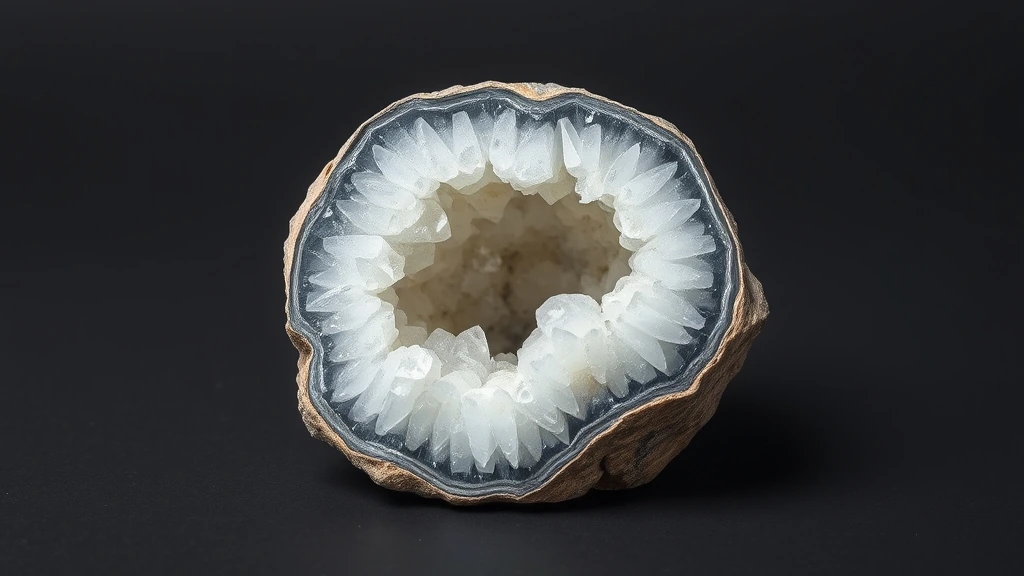
Quartz geodes belong to the silicate mineral family, specifically classified as tectosilicates within the quartz group. They form when silica-rich fluids precipitate within gas cavities of volcanic or sedimentary host rocks. This process creates intricate, three-dimensional crystal lattices that define their unique structural integrity. The parent mineral group dictates their fundamental chemical stability and optical properties. Consequently, geodes represent a significant geological record of fluid dynamics in Earth’s crust.
What is Quartz Geode? Geological Overview & Definition
A quartz geode is a secondary mineral formation characterized by a hollow cavity lined with inward-growing crystals. These structures typically develop within igneous or sedimentary rocks where gas bubbles were trapped during formation. The surrounding host rock provides the necessary confinement for silica saturation to occur. This environment allows for the slow, orderly precipitation of quartz over millions of years. In comparative mineralogical collections, practitioners and geologists frequently study Honey Comb Calcite alongside this crystal to appreciate their subtle energetic and structural differences.
The internal crystal faces often display a radial growth pattern, creating a striking visual contrast with the rough exterior. Geologists distinguish these formations from solid quartz masses by their distinct hollow geometry. The cavity size can range from small pockets to massive chambers. This structural uniqueness makes geodes valuable for both scientific study and lapidary art. In comparative mineralogical collections, practitioners and geologists frequently study Purple Chalcedony alongside this crystal to appreciate their subtle energetic and structural differences.
Quartz Geode Chemical Composition & Crystallographic Properties
Quartz crystallizes in the trigonal crystal system, specifically exhibiting rhombohedral or trapezohedral symmetry. The atomic lattice consists of a continuous framework of silicon-oxygen tetrahedra linked in a helical arrangement. This specific geometry dictates the mineral’s piezoelectric properties and optical behavior. The trigonal axis runs parallel to the c-axis, influencing the direction of crystal growth.
The primary chemical composition is silicon dioxide (SiO₂), with minimal cation substitution in pure specimens. Trace elements like aluminum or lithium may substitute for silicon, altering physical properties slightly. The mineral exhibits chemical inertness toward most acids, resisting weathering and dissolution. This stability ensures the preservation of crystal faces over geological timescales.
Color variations arise from chromophore impurities or lattice defects rather than structural changes. For instance, iron inclusions can produce amethyst or citrine hues. Thermal behavior remains stable, with quartz undergoing a phase transition near 573°C. This transition involves a slight change in crystal symmetry without breaking the lattice structure.
| Property | Specification |
|---|---|
| Mineral Group | Silicates (Tectosilicates / Quartz Group) |
| Chemical Formula | SiO₂ (Silicon Dioxide) |
| Mohs Hardness | 7.0 |
| Crystal System | Trigonal (Rhombohedral / Trapezohedral) |
| Specific Gravity (Density) | 2.65 |
| Refractive Index | 1.544 – 1.553 |
| Color & Optical Properties | Natural Quartz Geode color spectrum and optical dispersion |
| Primary Mining Localities | Brazil, Madagascar, USA (Arkansas), Swiss Alps |
| Water & Chemical Resistance | High (Fully resistant to water and moisture) |
| Chakra Alignment (Traditional) | All Chakras (Universal Harmonizer) |
| Zodiac Affinity (Traditional) | All Zodiac Signs (Especially Leo and Aries) |
| Symbolic Meaning (Traditional) | Master energy amplifier, clarity, purification, and focus |
Quartz Geode Varieties & Color Spectrum
Quartz Geode displays distinct mineralogical characteristics across its geological varieties and structural habits. Gemologists evaluate these natural varieties based on crystal habit, trace chromophore concentrations, and visual luster.
Primary Natural Quartz Geode
The benchmark natural variety exhibiting diagnostic color saturation and classic crystallographic symmetry.
Distinct Geological Morphs of Quartz Geode
Secondary regional and structural varieties formed under localized geological temperature and pressure conditions.
Amethyst‑lined Geode
Formed in silica‑rich volcanic ash beds, the amethyst‑lined geode displays deep violet crystals that grow outward from the cavity walls. Microscopic fluid inclusions of iron‑manganese complexes give the hue its characteristic saturation. Large, well‑preserved specimens from Brazil’s Minas Gerais are prized for their vivid color and relative rarity.
Citrine‑filled Geode
Citrine geodes develop when heat‑altered amethyst crystals recrystallize into golden‑yellow quartz within basaltic host rocks. The bright β‑Fe₂O₃ coloration is often zoned, producing a gradient from pale honey to rich amber. High‑quality examples from Uruguay’s Cerro de los Cristales command premium prices due to their uniform tone and clarity.
Smoky Quartz Geode
Smoky quartz forms in radiation‑damaged quartz within granitic pegmatites, yielding a translucent brown to deep black interior. The color intensity correlates with exposure to natural gamma radiation, and inclusions of minute mineral dust create a subtle, smoky veil. Notable deposits in the Czech Republic’s Bohemian region are celebrated for their deep, even coloration.
Rose Quartz Geode
Rose quartz geodes arise from micro‑inclusions of titanium and manganese that scatter light, imparting a delicate pink blush. The crystals often exhibit a milky translucency with a soft, velvety luster, especially in geodes from Madagascar’s Antsirabe area. Their gentle hue and frequent occurrence make them popular, though large, flawless specimens remain scarce.
Blue Chalcedony Geode
In rare instances, silica‑rich fluids deposit blue chalcedony layers within geodes, producing a striking azure interior. The hue originates from trace amounts of copper and fine‑grained microcrystalline quartz that diffract light. Notable occurrences in Namibia’s Otjozondjupa region are highly sought after for their vivid, uniform coloration.
Rutilated Quartz Geode
Rutilated quartz geodes contain needle‑like rutile (TiO₂) inclusions that intersect the crystal lattice, creating a dramatic metallic sparkle. These inclusions form during slow cooling of silica solutions in metamorphic host rocks, often yielding a golden‑silver network. Exceptional specimens from the United States’ Arkansas Ozarks are valued for their dense, well‑distributed rutile arrays.
Where is Quartz Geode Found? Geological Mining & Extraction
Quartz geodes commonly occur in silica‑saturated volcanic tuffs and granite pegmatites, where hydrothermal fluids precipitate quartz crystals along cavity walls. The cavities develop through gas‑bubble entrapment or dissolution of less stable minerals, providing the open space needed for crystal growth. Extraction typically involves careful manual removal of overlying breccia to preserve the delicate interior.
Major mining districts include Brazil’s Minas Gerais (amethyst and citrine), the Czech Republic’s Bohemian Massif (smoky quartz), and Madagascar’s Antsirabe region (rose quartz). In North America, the Arkansas Ozarks yield rutilated quartz, while Namibia’s Otjozondjupa province supplies blue chalcedony geodes. Sustainable practices emphasize low‑impact blasting and hand‑sorting to minimize damage to the fragile crystal linings.
Historical Significance & Cultural Lore of Quartz Geode
Across ancient lapidary traditions, quartz geodes were prized for their hidden brilliance, symbolizing inner truth and revelation. The Greeks and Romans carved geode fragments into intaglios, believing the inner crystal amplified divine messages, while Egyptian tombs occasionally contained small geode shards as protective amulets. In Vedic texts, quartz is described as “the eye of the universe,” a metaphor for its capacity to focus spiritual energy.
Chinese alchemists of the Han dynasty ground geode quartz into fine powders for elixirs of longevity, attributing its clarity to the purification of the body’s qi. Indigenous peoples of the American Southwest incorporated geode quartz into ceremonial masks, valuing its reflective interior as a conduit for ancestral spirits. Throughout these cultures, the geode’s concealed crystal core served as a powerful emblem of hidden knowledge and transformative potential.
Modern Uses & Jewelry Applications of Quartz Geode
Quartz geodes serve as versatile raw materials for both high-end jewelry and architectural ornamentation due to their durability and aesthetic variety. Lapidaries often split large geodes to reveal the internal crystal lining, which is then stabilized for display or cut into smaller components. The Mohs hardness of 7.0 ensures that quartz pieces resist scratching during daily wear, making them ideal for long-lasting jewelry settings.
- Cabochon Polishing: Smooth, domed stones are carved from the amethyst or citrine linings to showcase color saturation without faceting.
- Faceted Cutting: Transparent crystal points are cut into brilliant or step cuts to maximize light return and sparkle.
- Ornamental Carving: Large geode halves are used as decorative bowls, paperweights, or wall art in interior design.
- Bead Making: Smaller quartz fragments are drilled and strung into bracelets and necklaces for casual wear.
Metaphysical Properties & Traditional Meaning of Quartz Geode
According to historical traditions and metaphysical lore, quartz is revered as a master energy amplifier that enhances the power of other crystals and the wearer’s intent. Ancient Mediterranean and Vedic texts describe clear quartz as a conduit for universal life force, promoting mental clarity and spiritual purification. This stone is believed to transmute negative energies into positive vibrations, fostering a state of balanced awareness.
In contemporary spiritual practice, quartz geodes are valued for their ability to create harmonic resonance within the user’s energy field. The natural formation of the geode symbolizes the integration of chaos into order, representing clarity, purification, and focus. Practitioners often use these stones in meditation to align physical, emotional, and spiritual dimensions, ensuring a holistic state of well-being.
Which Chakra and Zodiac Signs Align with Quartz Geode?
Quartz geodes are universally recognized as a Universal Harmonizer, meaning they resonate effectively with all seven chakras rather than targeting a single energy center. This broad compatibility allows the stone to balance the entire energetic system, from the grounding root chakra to the transcendent crown chakra. Its neutral yet powerful frequency supports the flow of prana without imposing specific vibrational biases.
Astrologically, quartz aligns with All Zodiac Signs, making it a versatile talisman for any individual. However, it exhibits particularly strong resonance with Leo and Aries, two fire signs that benefit from quartz’s ability to stabilize intense energy. For these signs, the stone helps channel creative passion and assertive drive into focused, productive action.
How to Identify Real vs. Fake Quartz Geode
Artificial imitations of quartz geodes are increasingly common, often crafted from synthetic glass, resin, or dyed calcite to mimic natural crystal formations. These fakes may appear visually identical to the naked eye but lack the complex internal structures and mineralogical consistency of genuine quartz. Understanding the differences in physical properties is essential for distinguishing authentic specimens from commercial replicas.
Practical At-Home Authenticity Tests
- Temperature Test (Thermal Feel): Genuine quartz feels cool to the touch and retains that coolness longer than glass or resin, which warm up quickly due to lower thermal conductivity.
- Specific Gravity & Weight Test: Real quartz has a density of 2.65, making it noticeably heavier than similarly sized glass or plastic imitations when held in the hand.
- Scratch & Hardness Test (Mohs Comparison): With a Mohs hardness of 7.0, quartz can scratch glass and steel but will not be scratched by a steel knife (Mohs 5.5).
- Microscopic & Loupe Inspection (Internal Inclusions): Use a 10x loupe to look for natural inclusions like fluid bubbles or mineral traces; synthetic glass often contains perfect, spherical air bubbles or swirl marks.
Quartz Geode Valuation Factors, Grading & Pricing
The market value of a quartz geode is first and foremost driven by color saturation. A specimen that displays a vivid, saturated hue—whether the classic milky white, smoky gray, or rare rose‑tinted variant—commands a premium, as collectors prize visual vibrancy and the natural energetic luster that these colors suggest. The deeper the saturation, the more pronounced the perceived clarity and metaphysical appeal, which translates into higher demand and price.
Next, crystal size and weight (grams) play a decisive role. Larger geodes, measured by their overall dimensions and mass, are rarer and therefore more valuable. Whether the specimen is in its raw, unpolished state or has been gently tumbled to reveal a smooth, polished surface, the weight remains the primary metric for grading. Natural matrix inclusions, such as embedded quartz crystals or mineral veins, add character and can enhance value, but they are evaluated in the context of the specimen’s overall mass rather than tumbled polish and natural crystal geometry or specimen weight (grams).
Finally, ethical sourcing and locality premium influence pricing in both holistic and collector markets. Geodes sourced from well-documented, responsibly mined locations—such as the renowned quartz deposits of the American Southwest, the crystalline formations of the Himalayas, or the volcanic outcrops of the Caribbean—receive a premium. Provenance that aligns with sustainable mining practices and transparent supply chains boosts a specimen’s desirability among ethically conscious buyers, thereby elevating its market value.
How to Clean and Care for Quartz Geode
Quartz geodes are fully water‑resistant, allowing them to be safely cleaned with warm water and mild soap. A gentle rinse followed by drying with a soft, lint‑free cloth preserves the natural surface. Ultrasonic cleaning is also acceptable, provided the geode is not heavily fractured; the vibration helps remove embedded dust without compromising structural integrity. After cleaning, store the geode in a dry, low‑humidity environment to maintain its pristine condition.
Cleansing and Recharging Quartz Geode (Energetic Care)
To recharge the energetic properties of a quartz geode, place it in a quiet, moonlit setting during a waxing or full moon. The gentle lunar light revitalizes the crystal’s vibration without exposing it to heat or direct sunlight, which could alter its lattice structure. Alternatively, resting the geode on a selenite charging slab allows the selenite’s subtle electromagnetic field to cleanse and amplify the quartz’s natural energy, fostering clarity and focus. Herbal smudging with sage or palo santo can also be employed, but the geode should remain dry and free from any liquid residue, ensuring that the mineral’s integrity is preserved.
Frequently Asked Questions About Quartz Geode
Quartz Geode displays distinct mineralogical characteristics across its geological varieties and structural habits. Gemologists evaluate these natural varieties based on crystal habit, trace chromophore concentrations, and visual luster.
Primary Natural Quartz Geode
The benchmark natural variety exhibiting diagnostic color saturation and classic crystallographic symmetry.
Distinct Geological Morphs of Quartz Geode
Secondary regional and structural varieties formed under localized geological temperature and pressure conditions.
What is the chemical composition of a quartz geode?
Quartz geodes are composed of silicon dioxide (SiO₂). The mineral’s crystalline structure is trigonal, forming perfect hexagonal prisms that give quartz its characteristic hardness of 7 on the Mohs scale. This composition also accounts for its high refractive index range of 1.544–1.553, which creates the sparkling effect seen in polished specimens.
How durable is quartz geode when exposed to water or humidity?
Quartz geodes are fully resistant to water and moisture. Their dense, non-porous crystal lattice prevents absorption of liquids, making them ideal for use in damp environments. This durability also ensures that the internal crystals retain their clarity and color over time, even when exposed to daily household humidity.
Can quartz geodes be cleaned with an ultrasonic cleaner?
Yes, quartz geodes can be cleaned with an ultrasonic cleaner using warm water and mild soap. The ultrasonic waves gently dislodge dust and surface grime without damaging the crystal structure. However, avoid ultrasonic cleaning if the geode has significant fractures, as the vibrations could worsen existing cracks.
Are quartz geodes safe to wear in a shower or bath?
Quartz geodes are safe to wear in a shower or bath. Their water resistance means they will not absorb moisture or degrade when exposed to steam and water droplets. The mineral’s stable chemical composition ensures it remains unchanged, preserving both its aesthetic appeal and metaphysical properties.
Which zodiac signs are most associated with quartz geode?
Quartz geodes align with all zodiac signs, especially Leo and Aries. In astrological practice, the stone’s energetic amplification is believed to support leadership and courage, traits commonly linked to these fire signs. Nevertheless, its universal influence makes it a suitable companion for any birth chart.
Which chakras does quartz geode influence?
Quartz geodes influence all chakras as a universal harmonizer. The stone’s clear, amplifying energy is thought to balance the entire energy system, promoting clarity, purification, and focus across every chakra point. This makes it a versatile tool for meditation and energetic healing practices.
Does quartz geode require special care to maintain its luster?
Quartz geodes require minimal special care beyond regular cleaning. A soft microfiber cloth or gentle brush is sufficient for dust removal, while warm soapy water can be used for deeper cleaning. Avoid harsh chemicals or abrasive tools, as these can scratch the surface and diminish the stone’s natural brilliance.
Can quartz geodes be used for jewelry or decorative purposes in humid climates?
Yes, quartz geodes are suitable for jewelry and décor in humid climates. Their inherent water resistance protects against moisture-induced damage, while the crystal’s refractive properties enhance visual appeal. Whether set in a necklace or displayed in a glass case, quartz geodes maintain their integrity and sparkle in any environment.