
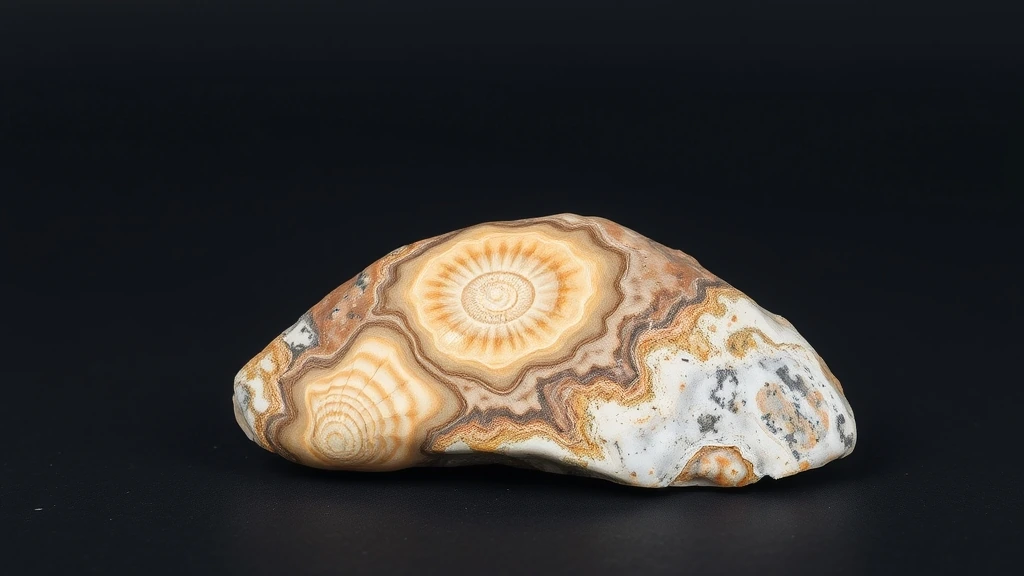
Fossil Shell Jasper belongs to the broader class of natural mineral crystals, specifically within the chalcedony family of quartz. Its formation occurs when silica-rich fluids permeate sedimentary basins, encapsulating marine shell fragments that later undergo diagenesis. The resulting material is a fine-grained, translucent rock that retains the structural integrity of both silica and fossilized calcium carbonate. This dual heritage gives it a unique combination of hardness and organic inclusions, setting it apart from pure quartz varieties.
What is Fossil Shell Jasper? Geological Overview & Definition
Fossil Shell Jasper is a cryptocrystalline form of quartz that incorporates fossilized shell fragments within its matrix. The inclusions are typically composed of calcium carbonate (CaCO₃) or secondary silica, creating a distinctive mottled appearance. This gemstone is classified under the chalcedony group, a subset of the quartz mineral family. Its geological occurrence is most common in sedimentary basins where ancient marine environments once thrived.
The stone’s name derives from the visible fossil shells, which are often preserved in their original shape and color. These inclusions provide a visual record of past marine life, linking the gem to the geological history of the region. Fossil Shell Jasper is prized not only for its aesthetic qualities but also for its cultural significance in ancient lapidary traditions, where it was believed to embody ancestral wisdom and grounding energy. In comparative mineralogical collections, practitioners and geologists frequently study Gilsonite alongside this crystal to appreciate their subtle energetic and structural differences.
Fossil Shell Jasper Chemical Composition & Crystallographic Properties
Fossil Shell Jasper is fundamentally composed of SiO₂ in a trigonal crystal system, characteristic of quartz and its cryptocrystalline variants. The lattice is a hexagonal close‑packed arrangement of silicon and oxygen atoms, with no long‑range order, giving the stone its fine-grained texture. Cation substitution is minimal; however, trace amounts of aluminum or iron can create color centers that influence the stone’s hue. Flint, another SiO₂ variety that shares this trigonal crystal system, often appears as a fossilized shell fragment within the same geological strata.
The presence of fossilized shell material introduces calcium carbonate or secondary silica, which does not alter the overall crystal system but contributes to the stone’s composite nature. Acid sensitivity is low, typical of quartz, but the fossil inclusions may react slightly with dilute acids, releasing calcium ions. Chromophore color centers arise from structural defects and trace metal ions, producing the characteristic amber or brown tones.
Thermal behavior of Fossil Shell Jasper is consistent with quartz: it withstands temperatures up to 573 °C before undergoing phase transformation to cristobalite. The fossil inclusions may decompose or alter at higher temperatures, potentially affecting the stone’s appearance. Overall, the material remains stable under normal environmental conditions, making it suitable for long‑term use in jewelry and ornamental objects.
| Property | Specification |
|---|---|
| Mineral Group | Natural Mineral / Crystal |
| Chemical Formula | SiO₂ (Chalcedony/Quartz) with fossil inclusions (CaCO₃ or SiO₂) |
| Mohs Hardness | 6.5 – 7.0 |
| Crystal System | Trigonal (Quartz/Chalcedony matrix) |
| Specific Gravity (Density) | 2.60 – 2.65 |
| Refractive Index | 1.530 – 1.544 |
| Color & Optical Properties | Natural Fossil Shell Jasper color spectrum and optical dispersion |
| Primary Mining Localities | Global primary localities |
| Water & Chemical Resistance | High (Safe for gentle water washing) |
| Chakra Alignment (Traditional) | Root Chakra, Sacral Chakra |
| Zodiac Affinity (Traditional) | Taurus, Cancer, Virgo, Capricorn |
| Symbolic Meaning (Traditional) | Grounding, ancestral wisdom, emotional stability, and connection to the earth |
Fossil Shell Jasper Varieties & Color Spectrum
Fossil Shell Jasper displays distinct mineralogical characteristics across its geological varieties and structural habits. Gemologists evaluate these natural varieties based on crystal habit, trace chromophore concentrations, and visual luster.
Primary Natural Fossil Shell Jasper
The benchmark natural variety exhibiting diagnostic color saturation and classic crystallographic symmetry.
Distinct Geological Morphs of Fossil Shell Jasper
Secondary regional and structural varieties formed under localized geological temperature and pressure conditions.
Oceanic Blue‑White Jasper
Formed in shallow marine limestone, this variety incorporates fossilized mollusk shells that have undergone silica replacement. The silica matrix preserves delicate shell outlines, giving a translucent blue‑white background with subtle iridescence. Its rarity stems from the precise diagenetic conditions required, making it prized among collectors.
Red‑Brown Fossil Jasper
Originating from volcanic ash deposits, this type contains calcite‑rich fossil fragments that impart a warm, earthy hue. The inclusions often display spiral or nodular patterns, creating a striking contrast against the quartz matrix. While more common than its blue counterpart, high‑clarity specimens remain scarce.
Green‑Moss Jasper
This variety forms in serpentine‑rich metamorphic terrains, where fossilized plant material is encased in green‑tinged quartz. The chlorite inclusions give a mossy appearance, and the stone’s subtle sheen enhances its visual appeal. Green‑Moss Jasper is moderately rare, prized for its unique botanical motifs.
Black‑Veined Fossil Jasper
Developing within basaltic flows, this type incorporates fossilized shells that have been darkened by iron oxidation. The resulting black veins contrast sharply with the lighter quartz background, creating a dramatic visual effect. Due to the limited exposure of suitable basaltic hosts, this variety is relatively uncommon.
Yellow‑Ochre Jasper
Found in sedimentary basins rich in iron oxides, this variety showcases fossil inclusions that have been stained a warm ochre. The iron‑oxide tint gives the stone a luminous quality, while the fossil outlines remain visible. Yellow‑Ochre Jasper is moderately abundant but prized for its vibrant color.
White‑Marble Fossil Jasper
This rare variety forms in marble quarries where fossilized shells have been partially replaced by calcite. The result is a translucent white stone with subtle shell patterns that glow under light. Its scarcity is due to the narrow window of marble formation that allows for fossil preservation.
Where is Fossil Shell Jasper Found? Geological Mining & Extraction
Fossil Shell Jasper typically occurs in silica‑rich pegmatites that intrude limestone or volcanic sequences, where fossil material is incorporated during diagenesis. The quartz matrix crystallizes around the fossils, preserving their shapes and textures.
Major mining regions include the Appalachian Basin in the United States, the Iberian Peninsula in Spain and Portugal, and the sedimentary basins of China and India. Extraction often involves open‑pit quarrying or underground mining, followed by careful sorting to isolate specimens with desirable fossil clarity.
Historical Significance & Cultural Lore of Fossil Shell Jasper
Across ancient Greco‑Roman lapidary traditions, Fossil Shell Jasper was valued for its earthy grounding qualities and used in amulets to promote stability and ancestral wisdom. Archaeological finds from Roman villas reveal polished shells embedded in decorative mosaics, suggesting symbolic reverence for the sea’s legacy.
In Egyptian culture, fossilized shells were incorporated into burial jewelry, believed to connect the deceased with the primordial waters of the Nile. Chinese artisans also prized the stone for its resemblance to jade, using it in ceremonial vessels to honor ancestral lineage. These traditions underscore the stone’s enduring role as a bridge between the living and the ancestral past.
Modern Uses & Jewelry Applications of Fossil Shell Jasper
Lapidaries primarily cut Fossil Shell Jasper into cabochons to showcase the intricate, three-dimensional fossil inclusions within the chalcedony matrix. The stone’s moderate Mohs hardness of 6.5 to 7.0 allows for durable polishing without the brittleness associated with higher-grade quartz varieties. This material is ideal for creating pendants, rings, and ornamental carvings that highlight natural history in wearable art.
- Cabochon Cutting: Smooth, domed surfaces are standard to protect delicate fossil structures from chipping during daily wear.
- Ornamental Carving: Skilled artisans sculpt the stone into figurines and decorative panels, emphasizing the contrast between the matrix and the embedded shells.
- Jewelry Settings: Bezel and prong settings are commonly used to secure the stone while maximizing the visibility of the pale fossil patterns.
Metaphysical Properties & Traditional Meaning of Fossil Shell Jasper
According to historical traditions and metaphysical lore, Fossil Shell Jasper is revered for its profound connection to ancestral wisdom and the passage of deep geological time. Practitioners believe the stone serves as a bridge between the present and the distant past, facilitating access to collective memory. This attribute encourages introspection and a respectful acknowledgment of the cycles that govern natural existence.
In spiritual contexts, the gemstone is associated with emotional stability and a strong sense of grounding. It is often utilized in meditation to anchor the mind and reduce anxiety related to rapid modern changes. The presence of ancient life forms within the stone symbolizes resilience, reminding the wearer of the enduring strength found in nature’s history.
Which Chakra and Zodiac Signs Align with Fossil Shell Jasper?
Fossil Shell Jasper is energetically aligned with the Root Chakra and the Sacral Chakra. The Root Chakra connection stems from the stone’s earthy composition and its role in promoting physical stability and security. Meanwhile, the Sacral Chakra alignment reflects the stone’s capacity to support creative flow and emotional balance, linking the body to deeper spiritual currents.
Astrologically, this gemstone resonates strongly with the earth and water signs of Taurus, Cancer, Virgo, and Capricorn. These zodiac signs share a fundamental need for stability, structure, and emotional depth that the stone’s energy is believed to amplify. Wearing this jasper can help these individuals maintain their center during periods of transition or uncertainty.
How to Identify Real vs. Fake Fossil Shell Jasper
Artificial imitations of Fossil Shell Jasper often involve synthetic glass or dyed chalcedony designed to mimic the appearance of fossil inclusions. These replicas may feature uniform, overly perfect patterns that lack the natural irregularity of genuine geological formations. Understanding the subtle differences in texture, weight, and internal structure is essential for discerning authentic specimens from manufactured fakes.
Practical At-Home Authenticity Tests
- Temperature Test (Thermal Feel): Genuine jasper feels cool to the touch initially and warms slowly, whereas plastic or resin imitations tend to feel neutral or warm immediately upon contact.
- Specific Gravity & Weight Test: Real Fossil Shell Jasper has a specific gravity of 2.60 to 2.65, making it feel noticeably heavier than glass or plastic replicas of the same size.
- Scratch & Hardness Test (Mohs Comparison): With a Mohs hardness of 6.5 to 7.0, authentic jasper will not be scratched by a steel knife blade, while softer imitations may show visible marks.
- Microscopic & Loupe Inspection (Internal Inclusions): Using a 10x loupe, look for natural fossil details and minor imperfections; fake stones often contain air bubbles or artificial dye lines within the matrix.
Fossil Shell Jasper Valuation Factors, Grading & Pricing
The market value of Fossil Shell Jasper hinges first on Color Saturation. Stones exhibiting deep, vivid hues—ranging from warm amber to rich ochre—command premium prices because they reflect a high degree of natural energetic luster and visual vibrancy. Collectors prize specimens that display a harmonious blend of warm tones with subtle, translucent shell inclusions, as these features suggest a well-preserved geological history.
Second, Crystal Size & Weight (Grams) plays a decisive role. Larger, heavier pieces—measured in grams rather than carats—are prized for their commanding presence and tactile heft. The distinction between raw and tumbled polish quality further influences pricing: a finely polished surface enhances clarity and accentuates the fossilized shell patterns, whereas a raw cut may appeal to those seeking an unaltered, rugged aesthetic. Natural matrix inclusions, such as fossilized shells or mineral veins, add unique character and can elevate a stone’s desirability.
Finally, Ethical Sourcing & Locality Premium shapes the stone’s market position. Fossil Shell Jasper sourced from responsibly managed quarries, with transparent supply chains, attracts both holistic practitioners and collectors who value sustainability. Provenance from renowned localities—such as the fossil-rich formations of the Appalachian Basin—can add a locality premium, reflecting the stone’s historical and geological significance.
How to Clean and Care for Fossil Shell Jasper
Gentle cleaning of Fossil Shell Jasper should be performed with warm soapy water and a soft cloth. Begin by rinsing the stone under lukewarm tap water to remove surface dust, then apply a mild, fragrance‑free liquid soap diluted in water. Using a soft microfiber cloth, gently wipe the stone’s surface, ensuring no abrasive particles remain. After cleaning, rinse with clean water and pat dry with a lint‑free towel. Avoid ultrasonic cleaners, as the vibration can induce microfractures in the quartz matrix, compromising structural integrity.
Cleansing and Recharging Fossil Shell Jasper (Energetic Care)
For energetic recharging, place the stone in a quiet, shaded area under gentle moonlight for several hours. The soft lunar illumination allows the crystal to absorb natural, low‑energy vibrations without exposing it to heat. Alternatively, resting the stone on a selenite charging slab can facilitate the transfer of purifying, high‑frequency energy, enhancing its grounding properties. Herbal smudging with sage or cedar can also cleanse residual energies, but the smudge should be kept at a safe distance to prevent direct contact with the stone. These dry, low‑heat methods preserve both the physical structure and the metaphysical qualities of Fossil Shell Jasper.
Frequently Asked Questions About Fossil Shell Jasper
Fossil Shell Jasper displays distinct mineralogical characteristics across its geological varieties and structural habits. Gemologists evaluate these natural varieties based on crystal habit, trace chromophore concentrations, and visual luster.
Primary Natural Fossil Shell Jasper
The benchmark natural variety exhibiting diagnostic color saturation and classic crystallographic symmetry.
Distinct Geological Morphs of Fossil Shell Jasper
Secondary regional and structural varieties formed under localized geological temperature and pressure conditions.
What is the primary mineral composition of fossil shell jasper?
It consists of chalcedony with fossilized shell inclusions. The stone features a SiO₂ matrix that has replaced ancient marine organisms over millions of years. This unique combination creates the distinctive patterns visible in polished specimens.
How hard is fossil shell jasper on the Mohs scale?
It rates between 6.5 and 7.0 on the Mohs hardness scale. This durability makes it suitable for everyday jewelry like rings and bracelets. The trigonal crystal system of the quartz matrix provides excellent resistance to scratching.
Is fossil shell jasper safe to wear in the shower?
Yes, it is safe for gentle water washing. The high water resistance allows it to withstand occasional exposure to rain or brief showers. However, prolonged soaking is unnecessary and should be avoided to maintain the stone’s luster.
Can I use an ultrasonic cleaner on this?
No, you should avoid ultrasonic cleaners entirely. The vibrations can cause structural fractures within the fossil inclusions or the matrix. Instead, use warm soapy water and a soft cloth for safe and effective cleaning.
Which zodiac signs are aligned with fossil shell jasper?
It resonates with Taurus, Cancer, Virgo, and Capricorn. These earth and water signs benefit from the stone’s stabilizing energy. Wearing it supports emotional balance and strengthens the connection to natural rhythms.
Which chakras does fossil shell jasper activate?
It primarily activates the Root and Sacral Chakras. These energy centers govern grounding and emotional stability. The stone helps anchor the wearer to the earth while fostering ancestral wisdom and inner peace.
What is the specific gravity of this?
The density ranges from 2.60 to 2.65. This specific gravity helps distinguish it from other jaspers or similar silicate stones. Gemologists use this measurement alongside refractive index values to verify authenticity.
How should I store fossil shell jasper jewelry?
Store it in a soft pouch or separate compartment. Although durable, the stone can scratch softer gems if stored loosely. Keeping it isolated prevents surface abrasions and preserves the intricate fossil details for long-term display.