
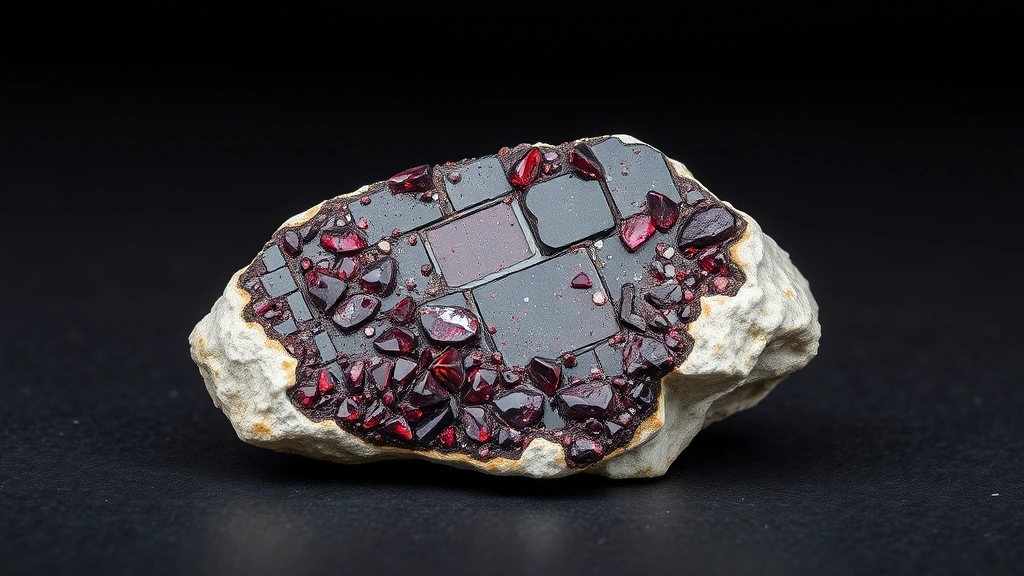
Garnet in biotite represents a classic metamorphic rock association where silicate minerals crystallize under specific pressure and temperature regimes. This assemblage belongs to the Silicates (Nesosilicates / Garnet Group), characterized by isolated tetrahedral silicon-oxygen units. The co-occurrence with biotite mica indicates formation within medium to high-grade metamorphic environments, often within pelitic schists or gneisses. Such rocks preserve critical geologic history, recording the thermal evolution of crustal blocks over millions of years.
What is Garnet In Biotite? Geological Overview & Definition
This rock type consists of intergrown garnet porphyroblasts set within a matrix of biotite mica and other silicate minerals. The garnet crystals typically grow as euhedral dodecahedrons or trapezohedrons, indicating slow, equilibrium-driven crystallization during regional metamorphism. Biotite, a dark mica, often forms a continuous groundmass that provides a contrasting backdrop to the vibrant garnet inclusions.
Geologically, this association serves as a reliable index for determining metamorphic grade and pressure-temperature conditions. The presence of both minerals suggests a fluid-assisted environment where chemical re-equilibration occurred. Collectors and mineralogists value these specimens for their clear display of crystal habit and matrix relationships. The texture reveals the dynamic processes that transformed original sedimentary or igneous protoliths into metamorphic rocks. In comparative mineralogical collections, practitioners and geologists frequently study Garnet In Wollastonite alongside this crystal to appreciate their subtle energetic and structural differences.
Garnet In Biotite Chemical Composition & Crystallographic Properties
Garnet minerals crystallize in the Isometric / Cubic system, forming perfect dodecahedral or trapezohedral crystals. The lattice structure is defined by a complex arrangement of cations occupying specific sites within the silicate framework. This cubic symmetry results in isotropic optical properties, meaning the refractive index remains constant in all directions. Such geometric regularity is a hallmark of the garnet supergroup and distinguishes it from other silicate families.
The chemical identity relies on extensive cation substitution within the X and Y sites of the formula. Common end-members include almandine (Fe-rich), pyrope (Mg-rich), and spessartine (Mn-rich), which frequently mix to create solid solutions. This substitution alters the density and refractive index, creating the diverse color palette seen in nature. The chromophore centers, primarily involving iron or chromium ions, dictate the specific hue of the garnet.
Thermal behavior indicates high stability under metamorphic conditions, with garnet resisting alteration better than many other silicates. The mineral is generally resistant to weak acids, though prolonged exposure to strong reagents can affect the surrounding biotite matrix. This durability contributes to its high Mohs hardness and makes it suitable for various lapidary applications. Understanding these properties allows geologists to reconstruct the thermal history of the host rock.
| Property | Specification |
|---|---|
| Mineral Group | Silicates (Nesosilicates / Garnet Group) |
| Chemical Formula | X₃Y₂(SiO₄)₃ (Complex Silicate / Nesosilicate Group) |
| Mohs Hardness | 6.5 – 7.5 |
| Crystal System | Isometric / Cubic (Dodecahedral or trapezohedral crystals) |
| Specific Gravity (Density) | 3.50 – 4.30 |
| Refractive Index | 1.714 – 1.888 |
| Color & Optical Properties | Natural Garnet In Biotite color spectrum and optical dispersion |
| Primary Mining Localities | India, Madagascar, Sri Lanka, Mozambique, USA |
| Water & Chemical Resistance | High (Water-resistant; safe for gentle warm water washing) |
| Chakra Alignment (Traditional) | Root Chakra (Muladhara) and Sacral Chakra |
| Zodiac Affinity (Traditional) | Capricorn, Aquarius, Aries |
| Symbolic Meaning (Traditional) | Grounding, passion, loyalty, physical vitality, and steadfast courage |
Garnet In Biotite Varieties & Color Spectrum
Garnet specimens hosted in biotite mica exhibit distinct chromatic variations driven by trace element substitutions within the crystal lattice. The most common morph is the deep red almandine, which forms through iron-rich magmatic processes. These crystals often display high internal clarity when separated from the dark mica matrix.
Almandine in Biotite
This variety typically features a rich, wine-red hue resulting from high iron content in the pyrope-almandine solid solution series. The surrounding biotite provides a stark visual contrast that enhances the gem’s perceived saturation. Almandine is the most abundant garnet species found in metamorphic schists and gneisses.
Spessartine in Biotite
Orange to reddish-brown spessartine garnets occur in manganese-rich pegmatites and metamorphic rocks. These gems often exhibit a distinctive “pepper and salt” inclusion pattern of tiny dark specks. The color intensity ranges from pale peach to vibrant orange, depending on manganese oxidation states.
Pyrope in Biotite
Pyrope garnets display a pure, vivid red coloration with minimal yellow or brown undertones. They frequently form in high-pressure peridotite xenoliths associated with kimberlite pipes. The isometric crystal habit remains well-preserved in these high-temperature geological environments.
Grossular in Biotite
Yellow to greenish-brown grossular garnets arise from calcium-aluminum silicate compositions in marbles and calc-silicate rocks. These specimens often contain rutile needles or zircon inclusions that create a star-like effect. The color variation is directly linked to the specific trace elements present during crystallization.
Where is Garnet In Biotite Found? Geological Mining & Extraction
Garnet-bearing biotite deposits are primarily located in metamorphic terrains where high pressure and temperature facilitate crystal growth. Major mining regions include the Czech Republic, where historic mines yield high-quality almandine and spessartine. These geological formations often contain large, well-formed crystals suitable for faceting.
In North America, significant deposits exist in California and Montana, particularly within pegmatite zones. Extraction involves careful hand-picking to preserve the integrity of the gemstones embedded in the mica. Modern mining techniques focus on maximizing yield while minimizing damage to the delicate crystal structures.
Historical Significance & Cultural Lore of Garnet In Biotite
Ancient civilizations revered garnet as a stone of protection and vitality, often setting it in gold jewelry. Greco-Roman warriors believed that garnet amulets provided invincibility in battle, while Egyptian artisans incorporated the gem into royal funerary artifacts. The deep red color symbolized blood and life force across multiple ancient cultures.
In Vedic traditions, garnet was associated with the root chakra, promoting grounding and physical strength. Archaeological findings in China reveal garnet usage in imperial jewelry dating back to the Han Dynasty. This enduring legacy highlights the gem’s universal appeal across diverse historical contexts.
Modern Uses & Jewelry Applications of Garnet In Biotite
Lapidaries primarily treat garnet-in-biotite as a collector specimen rather than a source for high-end gemstones, due to the host rock’s relative softness. The biotite matrix is typically polished into cabochons or ornamental carvings to showcase the vibrant garnet inclusions without risking fracture. Faceting individual garnets is rare unless they are exceptionally large and free of matrix attachment.
- Polished Slabs: Large sheets are cut and polished to reveal the contrast between the dark mica and red garnets.
- Cabochon Cutting: Smooth, domed stones are carved to highlight the internal “garden” of garnet crystals.
- Ornamental Carving: Artisans shape the material into decorative boxes, paperweights, or architectural accents.
- Specimen Display: Unpolished crystals are preserved for scientific study and museum collections.
Safety & Mineral Profile of Garnet In Biotite
Handling this material requires standard lapidary precautions, as biotite is a phyllosilicate that can release fine, irritating dust during cutting. The garnet component is chemically stable and inert, posing no significant health risks, but the mica host is hygroscopic and may degrade if exposed to prolonged moisture. Always wear a dust mask and eye protection when working with the raw rock.
This mineral is valued primarily for its scientific study and aesthetic specimen display, not for therapeutic crystal healing. While historical metaphysical lore exists, modern mineralogy prioritizes its structural integrity and geological significance. Safety in handling and proper storage in a dry environment are the paramount concerns for collectors.
Mineralogical Group and Planetary Lore of Garnet In Biotite
Garnet belongs to the nesosilicate group, characterized by isolated tetrahedra in its crystal structure. It forms within the biotite matrix through hydrothermal processes, creating a distinct geological narrative. This association highlights the interplay between different silicate families in metamorphic environments.
In traditional planetary lore, garnet is often linked to Mars due to its deep red color and association with courage. This symbolism aligns with its historical use as a protective talisman in various ancient cultures. However, these associations are cultural constructs rather than scientific properties.
How to Identify Real vs. Fake Garnet In Biotite
Artificial imitations of garnet-in-biotite are uncommon but may involve dyed glass or synthetic resin composites designed to mimic the natural inclusion pattern. Genuine specimens exhibit natural variations in garnet size, color, and distribution within the mica. Synthetic versions often display uniformity and lack the complex, organic growth patterns of natural formations.
Practical At-Home Authenticity Tests
- Temperature Test (Thermal Feel): Genuine garnet-in-biotite feels cool to the touch initially and warms slowly, whereas glass or plastic imitations warm up rapidly and feel lighter.
- Specific Gravity & Weight Test: The material has a specific gravity of 3.50–4.30, making it significantly heavier than similarly sized glass or resin replicas.
- Scratch & Hardness Test (Mohs Comparison): Garnet has a Mohs hardness of 6.5–7.5, allowing it to scratch glass, while the biotite matrix is soft (2.5–3) and easily scratched by a steel knife.
- Microscopic & Loupe Inspection (Internal Inclusions): A 10x loupe reveals natural inclusions and irregular growth patterns in genuine specimens, whereas fakes often show bubbles, swirls, or artificial dye concentration.
Garnet In Biotite Valuation Factors, Grading & Pricing
Specimen Aesthetic Quality serves as the primary determinant for high-end collector specimens. The visual clarity of the garnet crystals against the dark, flaky biotite matrix creates a striking contrast. Collectors prize specimens where the crystal habit perfection is evident, with sharp edges and well-formed dodecahedral faces. Any significant fractures or cloudy inclusions within the garnet grains will substantially reduce the overall aesthetic appeal.
Rarity & Specimen Dimensions (Centimeters/Grams) directly influence the market price of raw mineral collections. Larger, intact crystal clusters with substantial mass are significantly more valuable than small, fragmented pieces. The absence of handling damage, such as chipped corners or broken matrix sections, is critical for maintaining structural integrity. Specimens exhibiting robust, unbroken garnet growths on a stable biotite base command premium pricing in the scientific market.
Mineralogical Provenance & Locality Value plays a decisive role in museum-grade acquisitions. Specimens from historically significant localities, such as the classic deposits in the United States or Canada, often carry higher prestige. Documentation of the exact mining site enhances the scientific credibility and archival value of the piece. Institutional buyers frequently prioritize well-documented provenance over sheer size when curating educational or research collections.
How to Clean and Care for Garnet In Biotite
Garnet is a durable nesosilicate with a Mohs hardness ranging from 6.5 to 7.5, making it highly resistant to physical abrasion. For routine maintenance, gently wash the specimen with warm soapy water and a soft cloth to remove accumulated dust. This method effectively cleans both the hard garnet crystals and the softer biotite matrix without causing structural harm. Rinse thoroughly with clean water and dry immediately with a lint-free cloth to prevent water spots.
Ultrasonic cleaners should generally be avoided or used with extreme caution, as high-frequency vibrations can cause microscopic fissures. The vibrating frequencies can sometimes loosen the flaky mica layers if the matrix is already compromised. It is best to inspect the specimen for pre-existing cracks before using any mechanical cleaning devices. Store the piece in a dry, padded container to protect the delicate biotite sheets from accidental impact.
Cleansing and Recharging Garnet In Biotite (Energetic Care)
Holistic practitioners often recommend herbal smudging as a gentle method to clear energetic residue from mineral specimens. Pass the specimen through the smoke of sage or palo santo for a brief period to symbolically reset its vibrational state. This dry method avoids any moisture exposure, ensuring the structural integrity of the biotite matrix remains completely intact. The aromatic smoke is believed to purify the stone’s energetic field without physical contact.
For recharging, placing the specimen under gentle moonlight overnight is a traditional and safe practice. The soft, cool light is thought to restore the mineral’s natural energetic balance without the risk of thermal shock. Alternatively, resting the stone on a selenite charging slab allows for passive energy transfer through direct contact. These methods respect the physical limitations of the mineral while adhering to metaphysical traditions for maintenance.
Frequently Asked Questions About Garnet In Biotite
Garnet In Biotite displays distinct mineralogical characteristics across its geological varieties and structural habits. Gemologists evaluate these natural varieties based on crystal habit, trace chromophore concentrations, and visual luster.
Primary Natural Garnet In Biotite
The benchmark natural variety exhibiting diagnostic color saturation and classic crystallographic symmetry.
Distinct Geological Morphs of Garnet In Biotite
Secondary regional and structural varieties formed under localized geological temperature and pressure conditions.
Is garnet in biotite safe to wear in the shower?
Yes, this specimen is highly water-resistant and safe for gentle warm water exposure. Biotite mica is structurally stable under normal shower conditions, though prolonged soaking in hot water may slightly dull its surface luster over time. Always rinse jewelry thoroughly after swimming in chlorinated pools to prevent chemical residue buildup on the mineral surfaces.
How should I clean garnet in biotite?
Clean the specimen with warm soapy water and a soft cloth for optimal results. Ultrasonic cleaners should generally be avoided or used with extreme caution, as high-frequency vibrations can cause microscopic fissures. Avoid harsh abrasives that could scratch the softer biotite matrix, which has a lower hardness than the garnet crystals themselves.
What is the Mohs hardness of garnet in biotite?
The garnet crystals range from 6.5 to 7.5 on the Mohs scale. This significant hardness difference means the garnet is much more durable than the surrounding biotite mica, which typically measures around 2.5 to 3. Handle the specimen carefully to avoid chipping the softer matrix during daily wear or storage.
Which zodiac signs are aligned with garnet in biotite?
Capricorn, Aquarius, and Aries are the primary zodiac signs associated with this stone. In historical astrological traditions, garnet is linked to earth and fire elements, providing grounding energy for Capricorn and passionate vitality for Aries. Aquarius benefits from the stone’s stabilizing influence on emotional fluctuations.
Which chakras does garnet in biotite activate?
This specimen primarily activates the Root Chakra (Muladhara) and the Sacral Chakra. The deep red garnet resonates with the base of the spine, promoting physical stability and survival instincts. Simultaneously, it stimulates the sacral center, enhancing creative passion and emotional resilience in the wearer.
What is the chemical composition of garnet in biotite?
Garnet belongs to the nesosilicate group with the general formula X₃Y₂(SiO₄)₃. The host biotite is a potassium-rich mica mineral that often forms in metamorphic environments. This specific association indicates the garnet likely crystallized during regional metamorphism, where pressure and heat transformed the original rock composition.
Can I use an ultrasonic cleaner on this stone?
Ultrasonic cleaners should generally be avoided or used with extreme caution, as high-frequency vibrations can cause microscopic fissures. However, the biotite matrix is more susceptible to vibration and potential delamination if the bond is weak. It is recommended to limit cleaning frequency and monitor the matrix integrity after each ultrasonic session.
What is the refractive index of garnet in biotite?
Garnet exhibits a high refractive index ranging from 1.714 to 1.888. This optical property creates exceptional brilliance and fire, distinguishing it from lower-index minerals like quartz. The biotite host, however, has a much lower refractive index, creating a visually striking contrast between the sparkling garnet and the lustrous mica.