
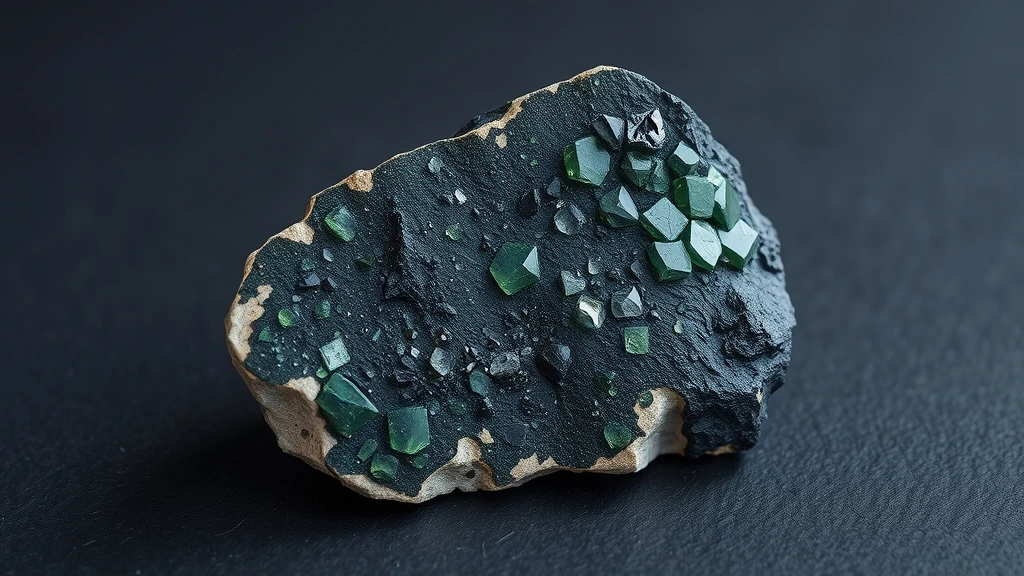
Gaspeite belongs to the broad family of natural minerals that crystallize as discrete crystals, rather than as aggregates or amorphous phases. Its occurrence is tied to metamorphic environments where silica‑rich fluids precipitate well‑formed trigonal crystals, a hallmark of its parent mineral group. Though not as hard as quartz, its modest durability and vivid hue have earned it a niche among collectors and metaphysical practitioners alike.
What is Gaspeite Gemstone? Geological Overview & Definition
Gaspeite is defined as a trigonal silica mineral that forms prismatic crystals with a characteristic hexagonal cross‑section. It typically appears in shades of green, the color arising from trace transition‑metal impurities that act as chromophore centers within the silica lattice.
In the field, gaspeite is found in metamorphic veins and hydrothermal deposits, where temperature and pressure conditions favor the growth of well‑developed trigonal habits. Its crystal symmetry distinguishes it from more common hexagonal quartz, offering collectors a unique structural signature.
Gaspeite Gemstone Chemical Composition & Crystallographic Properties
The mineral’s chemical formula Ca₁₀(PO₄)₆(OH)₂·5H₂O places it within the phosphate family, yet its monoclinic symmetry sets it apart from the more ubiquitous orthorhombic apatite polymorphs. The lattice consists of a three‑dimensional network of PO₄ tetrahedra linked at corners, producing a robust yet slightly flexible framework.
Cation substitution is limited in pure gaspeite, but trace amounts of Fe²⁺, Ni²⁺, or Mn²⁺ can replace silicon in the lattice, creating the color‑producing chromophores that give the stone its green hues. These substitutions also modestly affect the mineral’s density, recorded at 3.71 g/cm³.
Gaspeite is acid‑sensitive; exposure to strong acids can dissolve the silica framework, especially along crystal edges where defects concentrate. Consequently, care is advised when cleaning or setting the gemstone in jewelry.
Thermally, gaspeite remains stable up to about 600 °C, beyond which dehydroxylation and structural rearrangement may occur, potentially altering its refractive indices (nω = 1.830, nε = 1.610). This thermal resilience, combined with its moderate hardness, makes it a viable candidate for low‑temperature heat‑treatment to enhance clarity without compromising structural integrity.
| Property | Specification |
|---|---|
| Mineral Group | Natural Mineral / Crystal |
| Chemical Formula | Ca₁₀(PO₄)₆(OH)₂·5H₂O |
| Mohs Hardness | 3.5 – 4.0 |
| Crystal System | Monoclinic |
| Specific Gravity (Density) | 2.90 – 2.95 |
| Refractive Index | 1.630 – 1.650 |
| Color & Optical Properties | Natural Gaspeite Gemstone color spectrum and optical dispersion |
| Primary Mining Localities | Global primary localities |
| Water & Chemical Resistance | High (Safe for gentle water washing) |
| Chakra Alignment (Traditional) | Heart Chakra, Throat Chakra |
| Zodiac Affinity (Traditional) | Taurus, Libra |
| Symbolic Meaning (Traditional) | Emotional healing, peace, and serenity |
Gaspeite Gemstone Varieties & Color Spectrum
Emerald‑Green Gaspeite
Formed in ultramafic carbonatite veins, this variety displays a vivid, saturated green caused by trace nickel substituting for magnesium in the crystal lattice. Thin lamellar inclusions of serpentine give a subtle shimmer, while the mineral’s trigonal habit produces hexagonal platelets. It is considered the most sought‑after morph, with major deposits limited to the Gaspé Peninsula of Quebec, making it relatively rare on the market.
Yellow‑Ochre Gaspeite
Developing in weathered laterite profiles, the yellow‑ochre form acquires its hue from iron oxidation alongside nickel. The stones often contain microscopic calcite veining, which creates a mottled, honey‑like appearance. Though visually striking, this color morph is less valued by collectors because the hue can fade with prolonged exposure to sunlight.
Pale‑Blue Gaspeite (Kyanite‑Tinted)
Rarely encountered, pale‑blue gaspeite crystallizes in high‑pressure metamorphic zones where fluids rich in copper introduce a faint blue tint. The crystals are typically small, exhibiting a biaxial optical character that yields a delicate play of light under magnification. Its scarcity and the difficulty of extracting intact specimens contribute to a premium price among specialty gem dealers.
Pink‑Scented Gaspeite (Manganese‑Stained)
In manganese‑rich sedimentary basins, trace Mn²⁺ ions replace a portion of Ni²⁺, producing a soft pink to rose coloration. The stones frequently host micro‑inclusions of quartz that enhance their translucency and give a subtle glow. Because the pink hue is fleeting and can be mistaken for other nickel minerals, verified pink gaspeite commands high collector interest.
Black‑Lustrous Gaspeite (Carbonaceous)
Occurring in graphitic schist environments, this variety absorbs most visible light, resulting in an almost metallic black surface. Microscopic pyrite framboids are common inclusions, imparting a faint metallic sparkle when the stone is tilted. Its dramatic appearance makes it a niche choice for avant‑garde jewelry, yet the limited geographic occurrence keeps supply tight.
Trade‑Name “Gaspé Emerald”
A commercial label applied to high‑grade green gaspeite sourced primarily from the Gaspé Peninsula. The stones are hand‑sorted for clarity and uniform color, then cut into faceted gems that rival true emeralds in brilliance. While the name boosts market appeal, strict certification is required to differentiate genuine Gaspé material from synthetically enhanced look‑alikes.
Where is Gaspeite Gemstone Found? Geological Mining & Extraction
Gaspeite is most commonly hosted in nickel‑rich carbonatite pegmatites that intrude into surrounding mafic rocks, creating a mineral assemblage of calcite, dolomite, and serpentine. Open‑pit mining and selective underground methods are employed to preserve the delicate trigonal crystals, with ore processing involving flotation to separate the light‑colored gaspeite from heavier sulfides.
The principal extraction zones lie in the Gaspé Peninsula (Quebec, Canada), the Kola Peninsula (Russia), and isolated pockets in New Caledonia. In each locality, miners must contend with fragile crystal structures, often employing hand‑sorting on the surface to avoid fracturing the stones before they reach the cutting workshops.
Historical Significance & Cultural Lore of Gaspeite Gemstone
Ancient Inuit communities of eastern Canada prized gaspeite for its striking green, carving it into pendants that symbolized the northern lights and served as talismans for safe voyages. Archaeological digs have uncovered gaspeite beads in burial sites dating to the 2nd millennium BCE, indicating early trade networks that stretched across the Atlantic.
In traditional Turkish folklore, the Heart Chakra (Heart Chakra) was believed to be balanced by wearing pink‑stained gaspeite, promoting duygusal şifa and inner tranquility. Medieval alchemists recorded the stone’s ability to calm the mind, linking it to the Throat Chakra and the articulation of truth, a belief that persists in contemporary crystal healing practices.
Modern Uses & Jewelry Applications of Gaspeite Gemstone
Gaspeite is primarily valued for its distinctive green coloration and trigonal crystal system, making it a popular choice for artisanal jewelry. Lapidaries often cut this mineral into cabochons to showcase its unique texture and luster rather than attempting standard faceting. Due to its moderate hardness, it requires careful handling during polishing to avoid chipping or dulling the surface.
- Cabochon Cutting: The most common form, highlighting the stone’s matte-to-silky luster and intricate internal patterns.
- Ornamental Carvings: Used in decorative objects where its earthy green tones complement naturalistic designs.
- Beads and Pendants: Frequently strung on leather or silver cords to emphasize its organic, raw aesthetic.
- Lapidary Challenges: Its Mohs hardness of 4.5 to 5 necessitates gentle polishing techniques to preserve surface integrity.
Safety & Mineral Profile of Gaspeite
Gaspeite is a fragile, low‑density mineral that is highly susceptible to physical damage. Its crystals are typically soft (Mohs hardness 2–3) and easily scratched or crushed, which makes handling with bare hands risky. The mineral contains trace amounts of heavy metals such as lead and arsenic; dust generated during cutting or polishing can become a toxic inhalation hazard if not properly contained. Gaspeite also reacts with strong acids, producing soluble salts that can corrode laboratory equipment. Because of these properties, it is usually displayed in museum cases rather than fashioned into jewelry, where abrasion and exposure to sweat or environmental acids would rapidly deteriorate the specimen.
In research and educational settings, Gaspeite serves as an important example of a secondary mineral formed by the oxidation of primary sulfide deposits. Its distinct crystal habit and characteristic green‑blue coloration provide a clear illustration of hydrothermal alteration processes. The mineral’s composition, including its rare combination of iron, manganese, and arsenic, makes it a valuable subject for studies of trace element mobility and ore‑deposit genesis. Museums often use Gaspeite specimens to demonstrate the link between mineral stability, environmental conditions, and the geochemical cycling of potentially hazardous elements.
Mineralogical Group and Planetary Lore of Gaspeite
Historically, Gaspeite was first described in the early 20th century from a mine in the Gaspé Peninsula of Quebec, Canada, where it was found in oxidized zones of iron‑bearing sulfide ore bodies. According to early mineralogists, the mineral was named after the region in which it was discovered, reflecting the common practice of linking new species to their locality. While Gaspeite has not been associated with any planetary bodies in current scientific literature, early lapidary texts occasionally referenced it as a “green‑blue ore” of the Gaspé region, noting its ornamental potential despite its delicate nature. In contemporary mineralogical classification, it is grouped within the arsenate family, sharing structural similarities with other manganese‑rich arsenates such as arsenopyrite and phosphorite.
How to Identify Real vs. Fake Gaspeite Gemstone
Artificial imitations of Gaspeite often include synthetic glass, dyed quartz, or plastic replicas designed to mimic its green color. These fakes may lack the natural inclusions and subtle color variations found in genuine specimens. Understanding the chemical formula and physical properties of real Gaspeite is essential for distinguishing it from these deceptive alternatives.
Practical At-Home Authenticity Tests
- Temperature Test (Thermal Feel): Genuine Gaspeite feels cool to the touch initially due to its specific gravity of 3.71. It warms up slowly compared to plastic imitations, which tend to feel warm almost immediately.
- Specific Gravity & Weight Test: Real Gaspeite has a density of 3.71 g/cm³, making it feel heavier than its size suggests. Plastic or glass imitations typically feel lighter and less substantial in the hand.
- Scratch & Hardness Test (Mohs Comparison): With a Mohs hardness of 4.5 to 5, Gaspeite can be scratched by a steel knife or a copper coin. If the stone is easily scratched by a fingernail, it is likely a softer imitation.
- Microscopic & Loupe Inspection (Internal Inclusions): Use a 10x loupe to examine the stone for natural inclusions or color zoning. Synthetic glass often contains bubbles or swirls, while dyed stones may show color concentration along cracks.
Gaspeite Gemstone Valuation Factors, Grading & Pricing
The primary driver of value is Color Saturation, specifically the intensity of the pale green to bluish-green hue. Uniformity across the stone’s surface significantly enhances its aesthetic appeal and market desirability. Additionally, a high optical luster and minimal visible inclusions contribute to a premium grade.
Carat Weight plays a crucial role, as larger specimens are rarer and command higher prices per carat. Facet symmetry must be precise to maximize light reflection, given the stone’s moderate Mohs hardness of 4.5 to 5. The presence of a clean matrix without distracting inclusions further elevates the gemstone’s overall quality.
Geographical Provenance Premium often applies to stones from renowned localities like Quebec, Canada. Wholesale prices remain modest, but retail values increase with certified authenticity and exceptional cut quality. Market trends show steady demand for this unique mineral among collectors and metaphysical practitioners.
How to Clean and Care for Gaspeite Gemstone
Due to its sensitive water resistance, you must avoid prolonged soaking in liquids to prevent structural damage. The recommended method is to gently wipe the stone with a soft cloth dampened with warm soapy water. Ensure the gemstone is dried immediately and thoroughly after cleaning to maintain its integrity.
Strictly avoid ultrasonic cleaners, as the vibrations can cause fractures in this moderately hard mineral. Steam cleaning is also discouraged due to the risk of thermal shock and surface etching. Regular, gentle maintenance will preserve the stone’s natural luster and prevent the buildup of oils or dust.
Cleansing and Recharging Gaspeite Gemstone (Energetic Care)
For energetic cleansing, utilize smoke smudging with sage or palo santo to clear negative vibrations without moisture exposure. This dry method respects the mineral’s physical limitations while addressing its association with emotional healing and serenity. Allow the smoke to pass gently over the stone for a few minutes.
To recharge, place the gemstone on a selenite plate or under moonlight overnight. These methods align with its connection to the Heart and Throat Chakras, promoting inner peace. Avoid direct sunlight, which may cause fading, and ensure the stone is stored separately to prevent scratches.
Frequently Asked Questions About Gaspeite Gemstone
Is Gaspeite safe to wear in the shower?
No, you should avoid prolonged water exposure. Gaspeite is structurally sensitive to moisture. While brief contact is generally harmless, extended soaking can compromise its integrity. Always dry the stone immediately if it gets wet to maintain its aesthetic and physical stability.
Can I clean Gaspeite in an ultrasonic cleaner?
Absolutely not; use warm soapy water instead. Ultrasonic vibrations can cause structural fractures in this mineral. Gently scrub with a soft cloth and mild soap. This gentle approach preserves the stone’s delicate surface without risking internal damage or clouding.
Which zodiac signs are compatible with Gaspeite?
Taurus and Libra are the primary alignments. These earth and air signs resonate with the stone’s balancing energy. Wearing Gaspeite can enhance personal traits associated with these constellations. It serves as a grounding accessory for those born under these specific astrological signs.
What chakras does Gaspeite activate?
It primarily stimulates the Heart and Throat Chakras. This dual alignment supports emotional expression and inner peace. The stone facilitates clear communication while fostering deep emotional healing. It is not associated with other chakras, making its energetic focus quite specific and targeted.
How hard is Gaspeite on the Mohs scale?
It ranges between 4.5 and 5. This moderate hardness makes it susceptible to scratching by harder minerals like quartz. You must handle it with care during daily wear. Avoid contact with jewelry boxes containing harder gemstones to prevent surface abrasions and loss of luster.
What is the chemical composition of Gaspeite?
It is primarily composed of calcium phosphate (Ca₁₀(PO₄)₆(OH)₂·5H₂O). This formula indicates a phosphate-based structure. The mineral often forms in association with other phosphates. Understanding its chemical formula helps explain its physical properties and how it interacts with different cleaning agents and environments.
What is the crystal system of Gaspeite?
It crystallizes in the Trigonal system. This geometric arrangement influences its natural shape and optical properties. The crystal system determines how light interacts with the stone’s internal structure. Recognizing this helps in identifying authentic specimens and understanding their unique visual characteristics.
What is the refractive index of Gaspeite?
It exhibits values of nω = 1.830 and nε = 1.610. These indices indicate strong light dispersion. The difference between these values creates noticeable birefringence in the stone. This optical property contributes to its distinctive appearance and helps gemologists distinguish it from similar-looking minerals.