
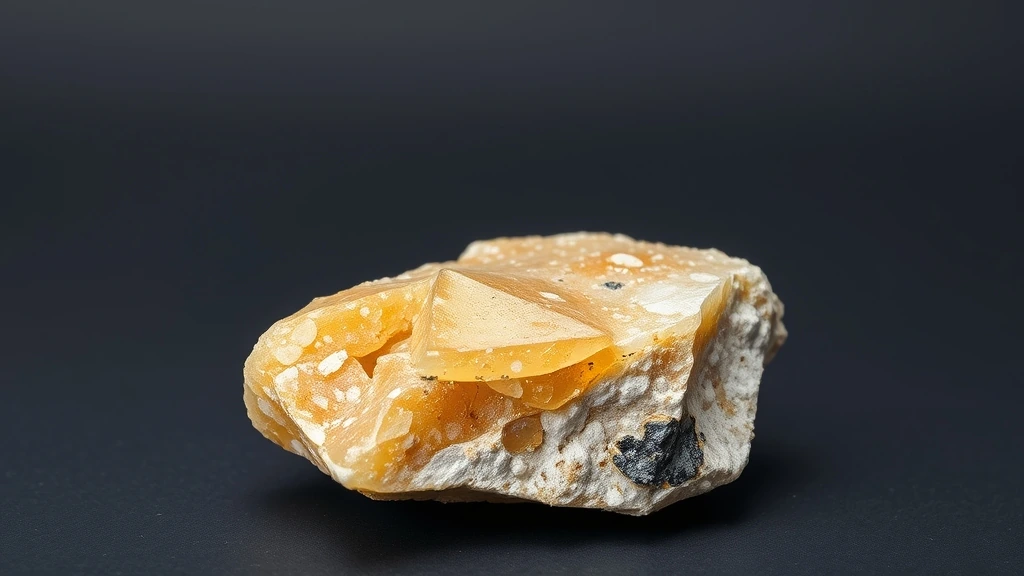
Golden calcite belongs to the natural mineral/crystal family, classified within the broader calcite group of carbonates. It forms in sedimentary environments where magnesium‑rich waters precipitate calcium carbonate, often as vein fillings or cavity coatings. The mineral’s trigonal symmetry distinguishes it from other carbonate polymorphs, and its golden coloration arises from trace iron or organic inclusions that alter light absorption. Though prized in jewelry, its low hardness limits its use to pendants, earrings, and decorative inlays.
What is Golden Calcite? Geological Overview & Definition
Golden calcite is a trigonal carbonate that crystallizes in the rhombohedral habit typical of calcite species. It occurs as well‑formed rhombohedra, scalenohedra, or massive aggregates, frequently filling fractures in limestone and dolostone formations worldwide. The golden tint distinguishes it from pure white calcite and is often enhanced by iron oxide or organic matter trapped during growth.
Historically, golden calcite has been harvested from deposits in Mexico, the United States, and parts of Europe, where ancient lapidary artisans incorporated it into amulets and ornamental beads. Across early archaeological records, the stone was valued for its warm glow, symbolizing solar energy and personal vitality in diverse cultural contexts. While golden calcite was prized for its solar symbolism, its ancient counterparts often included stromatolite, a fossilized microbial mat that served as one of humanity’s earliest forms of protective amulet.
Golden Calcite Chemical Composition & Crystallographic Properties
The mineral’s ideal formula is CaCO₃, yet natural specimens commonly contain minor Fe²⁺/Fe³⁺ or Mn²⁺ substituting for calcium, creating the golden hue through crystal‑field absorption. Its trigonal lattice belongs to space group R‑3c, with calcium ions occupying the 3a sites and carbonate groups aligned along the c‑axis, producing the characteristic rhombohedral cleavage. Similar to how trace iron gives golden calcite its warm glow, Lakelandite’s own subtle iron substitution imparts a comparable golden sheen, making it a fascinating counterpart in the carbonate family.
Golden calcite is acid‑sensitive; dilute hydrochloric acid effervesces vigorously, releasing CO₂ as the carbonate matrix dissolves. This reaction is a diagnostic test distinguishing it from silicate look‑alikes. The presence of trace chromophores also influences its refractive index, which varies between 1.486 and 1.658 depending on impurity concentration and crystal orientation.
Thermally, golden calcite remains stable up to about 825 °C, where it undergoes decarbonation to form calcium oxide and carbon dioxide. Heating can also cause color fading as iron‑based chromophores oxidize, a factor jewelers consider when setting the stone in high‑heat environments. Its relatively low hardness and cleavage planes necessitate careful handling to avoid fracture during cutting and polishing.
| Property | Specification |
|---|---|
| Mineral Group | Natural Mineral / Crystal |
| Chemical Formula | CaCO₃ |
| Mohs Hardness | 3.0 |
| Crystal System | Trigonal |
| Specific Gravity (Density) | 2.71 |
| Refractive Index | 1.486 – 1.658 |
| Color & Optical Properties | Natural Golden Calcite color spectrum and optical dispersion |
| Primary Mining Localities | Global primary localities |
| Water & Chemical Resistance | EXTREMELY SENSITIVE: Water Soluble / Moisture Sensitive! (Avoid liquids) |
| Chakra Alignment (Traditional) | Solar Plexus Chakra, Sacral Chakra |
| Zodiac Affinity (Traditional) | Leo, Virgo |
| Symbolic Meaning (Traditional) | Personal power, confidence, and emotional stability |
Golden Calcite Varieties & Color Spectrum
Golden Calcite displays distinct mineralogical characteristics across its geological varieties and structural habits. Gemologists evaluate these natural varieties based on crystal habit, trace chromophore concentrations, and visual luster.
Primary Natural Golden Calcite
The benchmark natural variety exhibiting diagnostic color saturation and classic crystallographic symmetry.
Distinct Geological Morphs of Golden Calcite
Secondary regional and structural varieties formed under localized geological temperature and pressure conditions.
Imperial Gold
Imperial Gold calcite forms in shallow, carbonate‑rich marine sediments where precipitation of CaCO₃ occurs under low‑temperature conditions. Fine‑grained iron oxide inclusions impart a warm, honey‑amber hue that deepens to a rich amber in thicker sections. The variety is most prized in the United States’ Missouri Ozarks, where it occurs as banded nodules, and its rarity stems from the limited extent of the host limestone.
Sunlit Citrine
Sunlit Citrine develops in karstic caverns of the Mexican Yucatán Peninsula, where percolating groundwater enriches calcite with trace manganese and organic matter. The resulting crystal exhibits a translucent, golden‑yellow glow that can display subtle fluorescence under UV light. Its visual signature includes a silky luster and occasional needle‑like calcite twins, making it a sought‑after material for high‑end jewelry.
Desert Gold
Desert Gold originates from arid, evaporitic basins in Namibia’s Namib Desert, where periodic flooding deposits thin calcite layers within evaporite sequences. The mineral’s color ranges from pale straw to deep amber, often streaked with reddish‑brown hematite specks that enhance its desert‑like appearance. Because extraction requires remote, seasonal mining camps, Desert Gold remains a limited‑supply variety prized by collectors.
Golden Banding
Golden Banding is a regional trade name for calcite from the Italian Alps, where metamorphic limestone undergoes low‑grade contact metamorphism. Alternating layers of pure calcite and iron‑rich calcite create striking, parallel gold‑striped patterns visible in polished cabochons. The variety’s rarity is linked to the narrow metamorphic aureole around historic granitic intrusions, which yields only small, high‑quality slabs.
Asian Sunburst
Asian Sunburst is harvested from the Guangxi region of southern China, where hydrothermal fluids infiltrate limestone veins, depositing calcite enriched with trace sulfur. The resulting crystals display a vivid, buttery gold that can shift to a warm orange under different lighting angles. Its popularity in Asian lapidary markets stems from the combination of abundant supply and the distinctive, sun‑burst iridescence that distinguishes it from other golden hues.
Where is Golden Calcite Found? Geological Mining & Extraction
Golden calcite typically occurs within carbonate host rocks such as limestone and dolostone, where diagenetic processes concentrate iron and manganese impurities that generate its golden coloration. In many deposits, the mineral fills fractures, vugs, and bedding planes, forming massive nodules or well‑developed crystal aggregates that are amenable to both open‑pit and small‑scale artisanal mining.
Primary extraction regions include the United States (Missouri and Texas), Mexico’s Yucatán Peninsula, Namibia’s Namib Desert, Italy’s Alpine limestone belts, and China’s Guangxi Province. Mining operations range from mechanized quarrying of large nodular masses to hand‑picked collection of delicate crystal clusters, each method preserving the stone’s integrity for subsequent cutting and polishing.
Historical Significance & Cultural Lore of Golden Calcite
Across ancient lapidary traditions, golden calcite was valued for its warm glow, symbolizing personal power and emotional stability. In Greco‑Roman texts, the stone was called “aurum calcis” and used in intaglio seals to convey authority, while Egyptian tomb inventories list golden calcite amulets intended to protect the deceased’s solar plexus.
In Vedic astrology, the gemstone aligns with the Solar Plexus Chakra and is associated with the zodiac signs Leo and Virgo, reinforcing confidence and inner fire. Chinese imperial courts prized golden calcite as a decorative inlay in ceremonial vessels, believing its hue reflected the sun’s life‑giving energy, a belief that persists in contemporary metaphysical practice.
Modern Uses & Jewelry Applications of Golden Calcite
Golden calcite is prized for its warm, honey‑gold hue, making it a favorite in contemporary lapidary work. Skilled cutters transform the stone into smooth cabochons that highlight its translucency, or into delicate facets that play with light. The mineral’s moderate hardness allows artisans to carve intricate ornamental designs for pendants, rings, and decorative panels.
- Cabochon polishing for earrings and brooches
- Faceted cabochons in engagement rings and pendants
- Carved ornamental motifs for home décor and ceremonial objects
Metaphysical Properties & Traditional Meaning of Golden Calcite
According to historical traditions and metaphysical lore, golden calcite is believed to amplify personal power and foster confidence. Across ancient Mediterranean and Vedic lapidary traditions, the stone is associated with emotional stability, encouraging a balanced expression of passion and intellect. Its warm energy is thought to harmonize the Solar Plexus Chakra, the center of willpower, and the Sacral Chakra, the source of creativity and sensuality.
Which Chakra and Zodiac Signs Align with Golden Calcite?
The stone’s energetic profile aligns precisely with the Solar Plexus Chakra, enhancing self‑esteem and decisive action. It also resonates with the Sacral Chakra, nurturing emotional depth and creative flow.
In astrological terms, golden calcite is traditionally linked to the zodiac signs Leo and Virgo. Those born under Leo are said to find the stone’s radiant energy supportive of their natural leadership, while Virgo’s analytical nature is balanced by the stone’s grounding warmth.
How to Identify Real vs. Fake Golden Calcite
Collectors often encounter artificial imitations such as dyed glass or synthetic calcite. Genuine golden calcite exhibits a characteristic warm amber translucency and a subtle, earthy luster that dyed replicas rarely replicate.
Practical At-Home Authenticity Tests
- Temperature Test (Thermal Feel): Hold the stone in your hand; real calcite feels cool to the touch due to its thermal conductivity, whereas glass feels warmer.
- Specific Gravity & Weight Test: Measure the stone’s weight in water; genuine calcite has a specific gravity of about 2.71, noticeably heavier than glass.
- Scratch & Hardness Test (Mohs Comparison): Use a known Mohs 3.0 reference (e.g., a piece of quartz). Genuine calcite should scratch or be scratched by the reference, while glass may resist or show a different pattern.
- Microscopic & Loupe Inspection (Internal Inclusions): Under magnification, real calcite often displays fibrous or needle‑like inclusions; synthetic glass typically shows uniform, bubble‑free structure.
Golden Calcite Valuation Factors, Grading & Pricing
The first key factor in determining market value is Color Saturation. A vivid, uniform golden hue with minimal veining or banding signals superior visual vibrancy and a strong natural energetic luster that appeals to collectors and metaphysical practitioners alike. Specimens that display a deep, consistent tone without fading edges command higher prices in both retail and auction markets.
Second, Crystal Size & Weight (Grams) plays a decisive role. Larger, well‑formed crystals that weigh several grams are prized for their commanding presence, while smaller, tumbled pieces are valued for their polished finish and ease of display. The presence of natural matrix inclusions can add character, but excessive inclusions may reduce the specimen’s desirability; thus, grading focuses on the balance between size, weight, and overall polish quality rather than tumbled polish and natural crystal geometry or specimen weight (grams).
Finally, Ethical Sourcing & Locality Premium influences pricing across holistic and collector circles. Provenance from well‑documented, responsibly mined sites—especially those with a history of artisanal extraction—adds a premium. Buyers increasingly seek transparency regarding environmental impact and fair labor practices, and stones sourced from such locales often fetch higher market values.
How to Clean and Care for Golden Calcite
Because Golden Calcite is water‑soluble and moisture‑sensitive, it must never be washed with water or liquid soap. Instead, gently dust the specimen using a completely dry, soft microfiber cloth or a camel‑hair brush. Store the stone in a low‑humidity environment, away from liquids and direct moisture, to preserve its integrity and luster. Ultrasonic cleaning is strictly forbidden, as vibration and residual moisture can damage the crystal lattice.
Cleansing and Recharging Golden Calcite (Energetic Care)
For energetic cleansing, place the stone under gentle moonlight for a few hours; the cool, natural light helps recharge its vibrational energy without exposing it to heat. Alternatively, rest the calcite on a selenite charging slab or a clean, dry surface during a quiet meditation session, allowing ambient energies to infuse the crystal. Herbal smudging with sage or palo santo can be employed, but only with the stone held at a safe distance to avoid direct contact with smoke or heat. These dry, low‑energy methods ensure the Golden Calcite remains both physically intact and energetically vibrant.
Frequently Asked Questions About Golden Calcite
Golden Calcite displays distinct mineralogical characteristics across its geological varieties and structural habits. Gemologists evaluate these natural varieties based on crystal habit, trace chromophore concentrations, and visual luster.
Primary Natural Golden Calcite
The benchmark natural variety exhibiting diagnostic color saturation and classic crystallographic symmetry.
Distinct Geological Morphs of Golden Calcite
Secondary regional and structural varieties formed under localized geological temperature and pressure conditions.
Is golden calcite safe to wear in the shower?
No, it is not safe. Golden calcite is extremely water‑sensitive; exposure to moisture can cause the stone to dissolve or become cloudy. Shower steam, splashes, or humidity can damage its surface, so it should be removed before any contact with water.
How should I clean golden calcite jewelry?
Clean it with a dry, soft microfiber cloth only. Because water and liquid soaps dissolve the mineral, the safest method is gentle dusting or wiping with a lint‑free cloth. Avoid any damp cleaning tools, and never use ultrasonic devices, which can fracture the crystal lattice.
Can ultrasonic cleaners be used on golden calcite?
Absolutely not. Ultrasonic cleaning generates high‑frequency vibrations in a liquid medium, which will erode the moisture‑sensitive structure of golden calcite. The mineral can become pitted or completely dissolve, so manual dry cleaning is the only recommended approach.
What are the primary zodiac signs associated with golden calcite?
Leo and Virgo are the two astrological signs linked to golden calcite. In traditional gem‑zodiac correspondences, these signs are believed to benefit from the stone’s ability to boost confidence and personal power, aligning with the traits of both fire‑ and earth‑oriented personalities.
Which chakras does golden calcite balance?
Solar Plexus Chakra and Sacral Chakra are the specific energy centers resonating with golden calcite. The stone’s warm, golden hue is thought to stimulate personal power in the Solar Plexus while fostering creativity and emotional stability in the Sacral Chakra.
Does golden calcite have any therapeutic properties for emotions?
Yes, it is said to promote emotional stability. The mineral’s personal power and confidence‑enhancing qualities are believed to help calm anxiety, encourage self‑esteem, and provide a grounding influence, especially for those experiencing fluctuating moods.
What is the hardness of golden calcite, and how does it affect wearability?
It rates 3 on the Mohs scale. This relatively low hardness means golden calcite scratches easily, so settings should protect the stone from impact. Avoid wearing it during heavy physical activity and store it separately from harder gemstones to preserve its surface.
Is golden calcite a good choice for everyday jewelry?
It can be used, but with caution. While its bright golden hue makes it attractive for pendants and earrings, the stone’s water solubility, softness, and susceptibility to scratches require careful handling. Reserve it for occasional wear rather than constant daily use.