
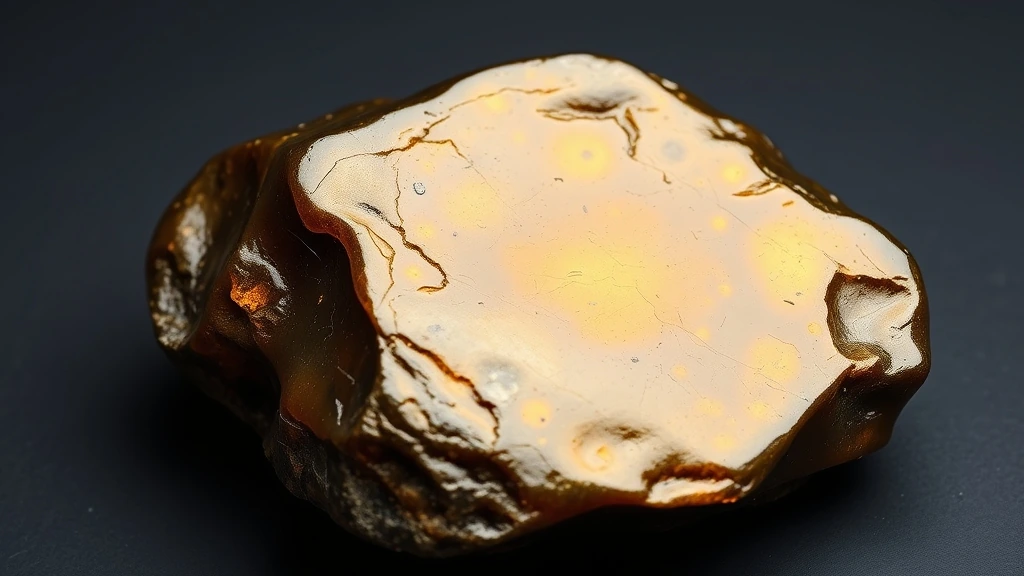
Obsidian is fundamentally classified as a mineraloid, distinguishing it from true crystalline minerals due to its rapid cooling history. It belongs to the extrusive volcanic glass family, forming when felsic lava cools too quickly for atomic lattices to organize. This geological process traps volatile gases and creates a homogeneous, glassy texture without any internal crystalline structure. Consequently, it lacks the periodic atomic arrangement that defines standard mineral species in geological taxonomy.
What is Golden Sheen Obsidian? Geological Overview & Definition
Golden Sheen Obsidian is a rare variety of volcanic glass characterized by a shimmering, metallic gold reflection. This unique optical phenomenon results from microscopic inclusions of iron and magnesium silicates suspended within the silica matrix. These tiny particles scatter light, creating a brilliant sheen that contrasts sharply with the stone’s deep black base. In comparative mineralogical collections, practitioners and geologists frequently study Flower Obsidian alongside this crystal to appreciate their subtle energetic and structural differences.
Geologically, this material forms during explosive volcanic eruptions where lava fragments cool rapidly in the air. The sudden temperature drop prevents crystal growth, resulting in an amorphous structure that retains the fluid dynamics of the original melt. Unlike standard obsidian, the golden variety requires specific volatile compositions to generate its signature luster. This makes it a prized specimen for collectors seeking unique optical properties in volcanic glass. While the golden flecks in obsidian are naturally occurring metallic inclusions, they share a striking visual kinship with the copper-infused glass of Blue Goldstone, which is artificially created to mimic these celestial sparks.
Golden Sheen Obsidian Chemical Composition & Crystallographic Properties
As an amorphous material, Golden Sheen Obsidian lacks a defined crystal lattice or repeating unit cell. Its atomic structure is disordered, resembling a frozen liquid rather than a rigid solid framework. This non-crystalline nature means it does not exhibit cleavage or distinct crystal faces under magnification. Instead, it fractures conchoidally, producing smooth, curved surfaces typical of glassy materials.
The primary chemical component is silicon dioxide (SiO₂), which constitutes over 70% of the composition. Minor cations such as iron and magnesium substitute into the silica network, influencing both color and density. These substitutions create localized charge imbalances that contribute to the stone’s overall stability. The absence of a stoichiometric formula reflects its heterogeneous, glassy origin rather than a pure mineral compound.
The chromophore responsible for the golden sheen is not a single element but a complex of metallic inclusions. These microscopic particles interact with light to produce interference colors and metallic reflections. The base black color arises from trace amounts of carbon and iron oxides dispersed throughout the glass. This combination of optical effects creates the stone’s distinctive and highly sought-after appearance.
Thermally, obsidian exhibits low thermal conductivity, making it prone to shock if heated unevenly. Rapid temperature changes can induce internal stress, leading to conchoidal fracture or shattering. The amorphous structure provides no crystal planes to absorb energy, increasing its vulnerability to thermal shock. Therefore, handling and storage must account for its sensitivity to sudden environmental temperature fluctuations.
| Property | Specification |
|---|---|
| Mineral Group | Mineraloid (Extrusive Volcanic Glass) |
| Chemical Formula | Volcanic glass (70%+ SiO₂ with Fe, Mg silicates) |
| Mohs Hardness | 5.0 – 5.5 |
| Crystal System | Amorphous (Non-crystalline volcanic glass) |
| Specific Gravity (Density) | 2.35 – 2.60 |
| Refractive Index | 1.480 – 1.510 |
| Color & Optical Properties | Natural Golden Sheen Obsidian color spectrum and optical dispersion |
| Primary Mining Localities | Mexico, USA (Oregon, Utah), Turkey (Kars, Agri), Armenia, Iceland |
| Water & Chemical Resistance | High (Natural volcanic glass; safe in water) |
| Chakra Alignment (Traditional) | Root Chakra (Muladhara) |
| Zodiac Affinity (Traditional) | Scorpio, Sagittarius, Capricorn |
| Symbolic Meaning (Traditional) | Aura shield, emotional truth mirroring, cord-cutting, and shadow grounding |
Golden Sheen Obsidian Varieties & Color Spectrum
Golden Sheen Obsidian displays distinct mineralogical characteristics across its geological varieties and structural habits. Gemologists evaluate these natural varieties based on crystal habit, trace chromophore concentrations, and visual luster.
Primary Natural Golden Sheen Obsidian
The benchmark natural variety exhibiting diagnostic color saturation and classic crystallographic symmetry.
Distinct Geological Morphs of Golden Sheen Obsidian
Secondary regional and structural varieties formed under localized geological temperature and pressure conditions.
Golden Veined Obsidian
This variety forms when iron‑rich basaltic magma cools rapidly, trapping iron‑oxide inclusions that create delicate golden veins. The veins appear as fine, almost translucent ribbons against a dark basaltic background, giving the stone a subtle, metallic sheen. It is prized for its rarity, occurring only in isolated volcanic fields such as the Hawaiian Islands and the Canary Islands.
Amber‑Tinted Obsidian
Amber‑tinted obsidian results from the presence of organic matter and trace amounts of manganese during crystallization, yielding a warm, amber hue. The color is uniform but may display faint, honey‑colored streaks. This variety is most commonly sourced from the volcanic regions of the Pacific Northwest, where it is considered a mid‑range commodity in the gemstone market.
Golden‑Shimmer Obsidian (Golden Sheen)
The eponymous Golden‑Shimmer variety exhibits a lustrous, golden sheen due to a high concentration of iron silicate nanocrystals aligned during rapid cooling. Its surface reflects a warm glow that intensifies under direct light. This type is highly sought after by collectors and is predominantly mined in the volcanic provinces of the Philippines and Indonesia.
Dark‑Gold Obsidian
Dark‑Gold obsidian contains a higher proportion of iron‑oxide inclusions, producing a deep gold‑brown tone with occasional black specks. The inclusions create a speckled, almost meteorite‑like appearance. It is relatively uncommon, with notable deposits in the volcanic arcs of New Zealand and the Andes.
Golden‑Banded Obsidian
Golden‑Banded obsidian displays concentric, golden bands formed by periodic fluctuations in magma composition during solidification. The bands are often subtle yet distinct, giving the stone a layered visual effect. This variety is rare, with significant finds in the volcanic regions of Iceland and the Cascades.
Golden‑Glaze Obsidian
Golden‑Glaze obsidian is characterized by a thin, glassy glaze that imparts a golden luster across the entire surface. The glaze results from a late‑stage silica enrichment that creates a smooth, almost metallic finish. It is most frequently sourced from the volcanic fields of the western United States, where it is considered a premium ornamental stone.
Where is Golden Sheen Obsidian Found? Geological Mining & Extraction
Golden Sheen Obsidian is typically hosted in volcanic lava flows and basaltic fissure vents, where rapid quenching of silica‑rich magma creates the amorphous glass. The stone is extracted through open‑pit mining or surface quarrying, with careful hand‑cutting to preserve its delicate sheen.
Primary extraction regions include the Philippines, particularly the island of Luzon, and Indonesia, where extensive basaltic lava fields provide abundant deposits. Secondary sources are found in the Pacific Northwest of the United States and the Cascades of Oregon and Washington, where volcanic activity has produced smaller, yet commercially viable, quarries.
Historical Significance & Cultural Lore of Golden Sheen Obsidian
Across ancient lapidary traditions, Golden Sheen Obsidian was prized for its reflective quality, which ancient Egyptians associated with the sun’s brilliance and used in ceremonial headdresses and amulets. In Vedic lore, the stone was believed to shield the wearer from negative energies, a belief echoed in Chinese talismans that employed obsidian for protective purposes. Archaeological excavations in the Mesoamerican region have uncovered obsidian blades and ornamental pieces that suggest a symbolic link between the stone’s golden sheen and the divine, reinforcing its status as a material of both utility and spiritual significance.
Modern Uses & Jewelry Applications of Golden Sheen Obsidian
Lapidaries primarily cut this volcanic glass into smooth cabochons to accentuate its iridescent surface luster, as faceting often obscures the delicate sheen. The material’s moderate Mohs hardness of 5.0 to 5.5 allows for precise polishing without excessive wear during the cutting process.
- Cabochon Cutting: The standard method for preserving the golden flash, typically resulting in domed or flat-backed stones.
- Ornamental Carving: Skilled artisans shape larger pieces into pendants, beads, and decorative inlays for luxury accessories.
- Polishing Techniques: Fine abrasive compounds are used to enhance the refractive index effects, maximizing the visual depth of the sheen.
Metaphysical Uses & Origins of Golden Sheen Obsidian
Across ancient lapidary traditions, obsidian has long served as a tool for emotional truth mirroring, helping practitioners confront hidden psychological patterns. The golden sheen variant is specifically valued for its perceived ability to facilitate aura shielding and energetic protection during deep meditation.
In modern holistic practices, this stone is utilized for shadow grounding, assisting individuals in releasing negative attachments. Its amorphous structure is believed to absorb stagnant energy, promoting a state of psychic clarity and emotional stability.
Which Chakra and Zodiac Signs Align with Golden Sheen Obsidian?
This stone is canonically aligned with the Root Chakra (Muladhara), which governs fundamental survival instincts and physical security. By anchoring energy to the earth, it supports the stabilization of one’s foundational beliefs and physical presence.
Astrologically, Golden Sheen Obsidian resonates strongly with Scorpio, Sagittarius, and Capricorn. These earth and water signs benefit from the stone’s capacity to transform intense emotional energy into grounded, actionable power.
How to Identify Real vs. Fake Golden Sheen Obsidian
Artificial imitations often utilize synthetic glass or dyed obsidian to mimic the natural iridescence, which can be deceiving to the untrained eye. Genuine volcanic glass forms rapidly from cooling lava, creating unique internal structures that synthetic replicas struggle to replicate authentically.
Practical At-Home Authenticity Tests
- Temperature Test (Thermal Feel): Real obsidian feels distinctly cool to the touch initially due to its low thermal conductivity, whereas plastic or resin imitations warm up quickly.
- Specific Gravity & Weight Test: Genuine obsidian has a density of 2.35 to 2.60, making it feel significantly heavier than similarly sized glass or plastic fakes.
- Scratch & Hardness Test (Mohs Comparison): With a Mohs hardness of 5.0 to 5.5, real obsidian will scratch glass but can be scratched by quartz or steel, distinguishing it from softer imitations.
- Microscopic & Loupe Inspection (Internal Inclusions): A 10x loupe reveals natural amorphous flow lines or tiny bubbles in real obsidian, while synthetic glass often shows perfect clarity or artificial swirls.
Golden Sheen Obsidian Valuation Factors, Grading & Pricing
Golden Sheen Obsidian displays a spectrum of color variations ranging from deep mahogany to golden iridescence, often accentuated by natural banding or veining that forms a striking visual contrast. The presence of metallic‑gold sheen is a result of microscopic iron‑oxide inclusions that catch light at specific angles. Collectors prize stones with uniform hue transitions and minimal surface chatter, as these features signal a high‑quality volcanic glass.
The specimen mass and size are decisive in market pricing, with larger, intact blocks commanding premium rates due to their rarity and the difficulty of extracting them without fracture. Weight measured in grams or kilograms directly influences handling costs, while artisans who carve intricate shapes must preserve structural integrity to avoid chipping. Light diffusion through the glass enhances the golden sheen, adding aesthetic value that is reflected in wholesale and retail offers.
Geographical origin and authenticity are critical provenance markers; Golden Sheen Obsidian sourced from historic volcanic fields in Mexico, the United States, or Iceland carries a recognized pedigree that boosts desirability. Certified origin statements deter counterfeit glass and assure buyers of natural formation rather than synthetic enhancement. Current market trends show a surge in demand from ornamental and wellness sectors, where authentic pieces are marketed for both decorative appeal and metaphysical uses.
How to Clean and Care for Golden Sheen Obsidian
Golden Sheen Obsidian tolerates gentle immersion in warm water, allowing dust and surface grime to be rinsed away without damaging the glass matrix. Use lukewarm tap water and a soft, lint‑free cloth to wipe the stone, avoiding vigorous scrubbing that could induce micro‑fractures. After cleaning, pat the specimen dry with a dry microfiber cloth and store it in a stable, low‑humidity environment to prevent any moisture‑related stress.
Ultrasonic cleaning devices must be avoided, as the high‑frequency vibrations can cause brittle volcanic glass to chip or fracture along existing micro‑flaws. Instead, rely on manual cleaning methods and handle the stone with care, especially when moving larger blocks or carved pieces.
Cleansing and Recharging Golden Sheen Obsidian (Energetic Care)
For energetic maintenance, a brief exposure to gentle moonlight can revitalize the stone’s natural glow without introducing thermal stress. Place the specimen on a windowsill during a clear night, allowing lunar photons to interact with the glass surface for a few hours, then retrieve it before sunrise.
Alternatively, a short session of herbal smudging with sage or cedar, performed at a safe distance, can clear lingering energetic residues while respecting the mineral’s physical stability. Rest the stone on a clean selenite slab afterward to harmonize its vibrational field, ensuring the process remains dry and free of heat.
Frequently Asked Questions About Golden Sheen Obsidian
Golden Sheen Obsidian displays distinct mineralogical characteristics across its geological varieties and structural habits. Gemologists evaluate these natural varieties based on crystal habit, trace chromophore concentrations, and visual luster.
Primary Natural Golden Sheen Obsidian
The benchmark natural variety exhibiting diagnostic color saturation and classic crystallographic symmetry.
Distinct Geological Morphs of Golden Sheen Obsidian
Secondary regional and structural varieties formed under localized geological temperature and pressure conditions.
Is Golden Sheen Obsidian safe to wear in the shower?
Yes, it can be worn in the shower. The volcanic glass is highly water‑resistant, so routine exposure to water or steam will not degrade its surface. However, prolonged soaking may attract mineral deposits; gently wiping with a soft, dry cloth after use helps maintain its characteristic golden sheen.
How should I clean Golden Sheen Obsidian without damaging it?
Clean with warm water and a soft brush, avoiding ultrasonic vibration. Because the glass is brittle, ultrasonic cleaners can cause micro‑chips. Use lukewarm water and a soft‑bristled brush to dislodge dirt, then pat dry with a lint‑free microfiber cloth to preserve the reflective golden luster.
Can Golden Sheen Obsidian be used in jewelry that is exposed to perfume or cosmetics?
Yes, it tolerates most cosmetic products. The amorphous silica matrix is chemically inert to typical fragrance oils and makeup residues. Still, wipe the stone after contact to prevent film buildup, which can dull the metallic sheen that defines this variety of obsidian.
What is the typical hardness of Golden Sheen Obsidian, and how does it affect everyday wear?
Its Mohs hardness ranges from 5.0 to 5.5. This places it on par with window glass, making it suitable for pendants and earrings but vulnerable to scratches from harder materials. Regular polishing with a ceramic polishing pad can restore surface brilliance after minor abrasion.
Which zodiac signs are traditionally associated with Golden Sheen Obsidian?
Scorpio, Sagittarius, and Capricorn are the aligned signs. In astrological lore, the stone is believed to amplify the intensity of these fire‑ and earth‑sign energies, supporting personal transformation and grounding. Collectors often choose it as a talisman for these specific zodiac periods.
Which chakra does Golden Sheen Obsidian resonate with most strongly?
It is linked to the Root Chakra (Muladhara). The grounding properties of the stone are said to anchor emotional turbulence, fostering stability and a sense of safety. Practitioners place the stone on the base of the spine during meditation to reinforce earth‑element balance.
Is Golden Sheen Obsidian prone to breaking if dropped?
Yes, it can fracture upon impact. As an amorphous volcanic glass, it lacks a crystalline lattice and therefore exhibits brittleness similar to regular obsidian. To minimize risk, store the gems in padded compartments and avoid contact with hard surfaces that could cause micro‑fractures.
What is the typical specific gravity of Golden Sheen Obsidian, and why does it matter for setting choices?
Its density falls between 2.35 and 2.60 g/cm³. This relatively low specific gravity means the stone is lightweight, allowing designers to create larger pieces without excessive weight. However, the modest mass also requires secure prong or bezel settings to prevent the gem from dislodging during active wear.