
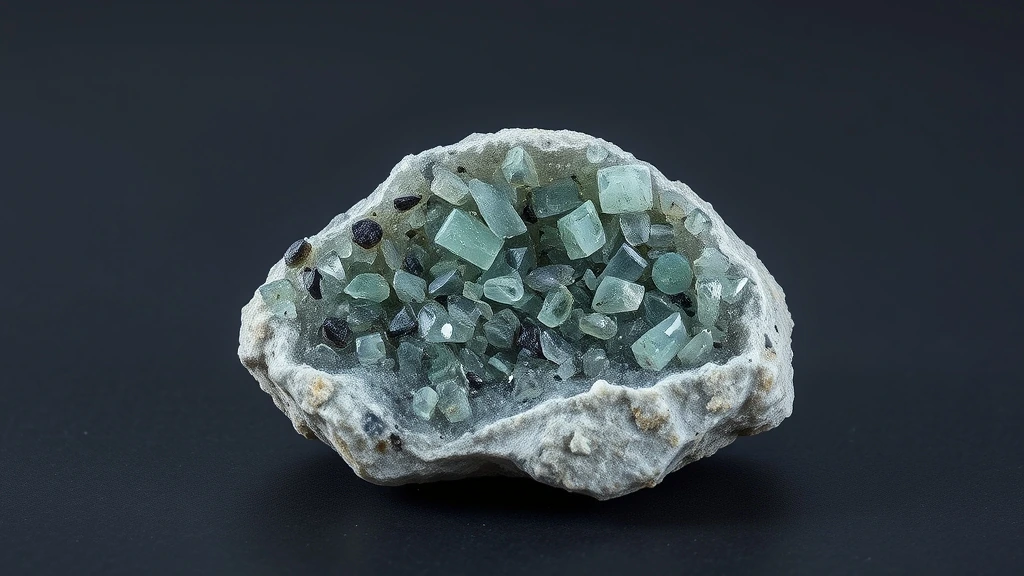
Quartz belonging to the tectosilicate family forms the backbone of this mineral aggregate, crystallizing in the trigonal (rhombohedral / trapezohedral) system. The host crystal provides a transparent to translucent matrix, while microscopic hollandite needles create a striking, iridescent play of color. Across ancient lapidary traditions, such specimens have been prized for both aesthetic brilliance and reputed metaphysical properties, linking the earth’s structural order with universal harmonic symbolism.
What is Hollandite In Quartz? Geological Overview & Definition
Hollandite‑in‑quartz refers to a natural quartz crystal that encapsulates fine, elongated inclusions of the manganese‑rich mineral hollandite. These inclusions form during late‑stage hydrothermal processes, where hollandite precipitates from manganese‑bearing fluids within the growing quartz lattice. The result is a composite gemstone where the silicate framework of quartz hosts oxide‑based hollandite filaments, producing a unique visual contrast. While the deep purple manganese inclusions of Hollandite create a striking visual contrast against the clear quartz, collectors often juxtapose this specimen with the vibrant blue-green hues found in Turquoise On Quartz to explore the diverse aesthetic possibilities of mineral-in-quartz formations.
Historically, such specimens have been documented in mining districts of the United States, Brazil, and Madagascar, where manganese‑rich zones intersect quartz veins. Across early archaeological records, artisans incorporated these stones into ornamental beads and amulets, valuing the interplay of quartz’s clarity with the metallic luster of hollandite as a symbol of balance between light and earth. Collectors often compare the metallic sheen of Hollandite with the intricate, multi-mineral aesthetic of Triplite Wagnerite And Pyrite In Quartz, which similarly showcases the striking contrast between crystalline structures and sulfide inclusions.
Hollandite In Quartz Chemical Composition & Crystallographic Properties
The primary host, quartz, is composed of silicon dioxide (SiO₂) and crystallizes in the trigonal (rhombohedral / trapezohedral) system, characterized by a three‑fold rotational axis and a hexagonal lattice metric. Hollandite, the secondary phase, is a complex manganese oxide with a general formula (Ba,H₂O)₂(Mn⁴⁺,Mn³⁺)₈O₁₆, adopting a tunnel‑type structure that fits within the quartz matrix as microscopic needles. The vibrant energy of Hollandite in quartz is complemented by the fiery passion of Ruby Fuchsite, which amplifies the stone’s protective and transformative qualities.
Cation substitution within hollandite’s tunnels—often involving Ba²⁺, K⁺, or Na⁺—modulates its chromophore color centers, shifting the inclusion hue from amber to deep brown. The quartz host remains chemically inert, but the aggregate shows limited acid sensitivity; dilute hydrofluoric acid can etch quartz surfaces while leaving hollandite inclusions relatively resistant due to their oxide composition.
Thermally, quartz retains its trigonal symmetry up to 573 °C, where it undergoes the α‑β quartz transition, while hollandite remains stable up to ~600 °C before decomposing to manganese oxides. Heating can enhance the visibility of hollandite inclusions by inducing slight refractive index changes in quartz, a technique sometimes employed by gem cutters to accentuate the stone’s internal contrast.
| Property | Specification |
|---|---|
| Mineral Group | Silicates (Tectosilicates / Quartz Group) |
| Chemical Formula | SiO₂ (Silicon Dioxide) |
| Mohs Hardness | 7.0 |
| Crystal System | Trigonal (Rhombohedral / Trapezohedral) |
| Specific Gravity (Density) | 2.65 |
| Refractive Index | 1.544 – 1.553 |
| Color & Optical Properties | Natural Hollandite In Quartz color spectrum and optical dispersion |
| Primary Mining Localities | Brazil, Madagascar, USA (Arkansas), Swiss Alps |
| Water & Chemical Resistance | High (Fully resistant to water and moisture) |
| Chakra Alignment (Traditional) | All Chakras (Universal Harmonizer) |
| Zodiac Affinity (Traditional) | All Zodiac Signs (Especially Leo and Aries) |
| Symbolic Meaning (Traditional) | Master energy amplifier, clarity, purification, and focus |
Hollandite In Quartz Varieties & Color Spectrum
Hollandite in quartz presents a complex visual landscape defined by the interplay between the host crystal and the manganese silicate inclusion. The most common form features colorless to white quartz matrices hosting distinct, dark purple to black hollandite crystals. These inclusions often appear as sharp, angular shards or fine needle-like structures suspended within the transparent host. This specific variety is highly sought after for its stark contrast and geometric clarity.
Purple Needle Hollandite
This variety is characterized by delicate, violet-purple needles of hollandite radiating through clear quartz. The coloration stems from manganese ions substituting within the hollandite crystal lattice structure. Geologically, these needles form during the late-stage cooling of granitic pegmatites, where volatile fluids facilitate rapid crystal growth. Specimens with dense, well-defined needle clusters are considered rare and command premium market prices.
Black Shard Hollandite
Distinguished by opaque black fragments of hollandite embedded in milky or clear quartz, this morph offers a dramatic visual impact. The shards typically exhibit a sub-metallic luster and sharp, fractured edges that catch light uniquely. Formation occurs when high-pressure conditions cause the hollandite to fracture and disperse within the growing quartz matrix. Collectors value these pieces for their bold, abstract aesthetic and distinct textural contrast.
Manganese-Rich Deep Violet
In rarer occurrences, the hollandite inclusions display a deep, saturated violet hue rather than standard purple or black. This intense coloration indicates a higher concentration of manganese dioxide within the silicate structure. Such specimens are often found in specific pegmatite zones where chemical conditions favored manganese enrichment. The visual depth of these inclusions creates a mesmerizing, almost ethereal appearance under natural light.
Matrix-Embedded Hollandite
This variety features hollandite crystals growing directly on the surface of the quartz rather than fully enclosed within it. The exposed mineral faces allow for detailed observation of the hollandite’s trigonal crystal habit. These specimens are prized by mineralogists for their educational value and clear display of crystal morphology. The boundary between the host quartz and the inclusion is sharply defined and visually striking.
Where is Hollandite In Quartz Found? Geological Mining & Extraction
Hollandite in quartz primarily occurs in granitic pegmatites, which are coarse-grained igneous rocks formed from the last stages of magma crystallization. These deposits are typically located in regions with significant Precambrian or Paleozoic geological activity, where volatile-rich fluids facilitated the formation of complex mineral assemblages. The quartz hosts the hollandite inclusions as the pegmatite cooled and solidified over millions of years.
Primary extraction regions include specific pegmatite fields in Brazil, particularly the state of Minas Gerais, and certain locations in Canada and the United States. Mining operations in these areas focus on hand-picking high-quality specimens from open-pit or underground workings. The extraction process requires careful handling to preserve the integrity of the delicate inclusions and the clarity of the quartz matrix.
Historical Significance & Cultural Lore of Hollandite In Quartz
While hollandite itself was not widely recognized as a distinct gemstone in ancient times, its host mineral, quartz, held profound significance across ancient Egyptian and Greco-Roman civilizations. Egyptians used clear quartz for amulets and scarabs, believing it possessed the power to purify the spirit and enhance spiritual clarity. In Vedic traditions, quartz was revered as a Sphatika, a sacred stone associated with the divine and used in ritualistic practices for meditation and healing.
Archaeological records reveal that quartz crystals were frequently embedded in jewelry and ceremonial objects, serving as symbols of purity and strength. The inclusion of manganese-rich minerals like hollandite would have added a unique visual element, potentially enhancing the stone’s perceived mystical properties. Throughout early archaeological records, such composite stones were valued for their natural beauty and the enigmatic energy they were believed to carry.
Modern Uses & Jewelry Applications of Hollandite In Quartz
Hollandite in quartz is prized for its subtle banding and translucent clarity, making it ideal for lapidary artisans. Skilled cutters produce smooth cabochons that highlight the stone’s natural veining, while faceted pieces accentuate its refractive index. The material is also favored for ornamental carvings, such as pendants, brooches, and decorative panels that showcase its unique texture.
- Cabochon polishing to enhance translucency
- Faceting to exploit the 1.544–1.553 refractive index
- Carving into intricate motifs for ornamental jewelry
Metaphysical Properties & Traditional Meaning of Hollandite In Quartz
According to historical traditions and metaphysical lore, Hollandite in quartz is viewed as a master energy amplifier that fosters clarity and purification. Across ancient Mediterranean and Vedic lapidary lore, the stone is believed to harmonize the mind, encouraging focus and emotional balance. Its universal appeal is reflected in its association with all chakras, serving as a conduit for spiritual alignment and energetic flow.
Which Chakra and Zodiac Signs Align with Hollandite In Quartz?
The stone is said to resonate with all chakras, acting as a universal harmonizer that balances the subtle energy centers from root to crown. This holistic alignment supports both physical and metaphysical well-being, allowing wearers to experience a unified sense of inner equilibrium.
The canonical zodiac association for Hollandite in quartz encompasses all zodiac signs, with particular emphasis on Leo and Aries. These signs are believed to benefit from the stone’s energetic amplification, fostering courage, leadership, and dynamic vitality.
How to Identify Real vs. Fake Hollandite In Quartz
Collectors must be vigilant against artificial imitations, such as synthetic glass or dyed replicas that mimic the stone’s appearance. Real Hollandite in quartz exhibits natural banding, a specific density of 2.65, and a distinct refractive index range that cannot be replicated by most synthetic substitutes.
Practical At-Home Authenticity Tests
- Temperature Test (Thermal Feel): Hold the stone near a warm surface; genuine quartz feels noticeably cooler due to its thermal conductivity.
- Specific Gravity & Weight Test: Compare the stone’s weight to a known quartz sample of the same size; a true specimen will match the expected 2.65 specific gravity.
- Scratch & Hardness Test (Mohs Comparison): Use a 7.0 hardness reference (e.g., a steel file); real quartz should resist scratching, whereas lower‑grade imitations may show marks.
- Microscopic & Loupe Inspection (Internal Inclusions): Examine under magnification for natural inclusions or growth patterns typical of quartz; synthetic versions often display uniformity or artificial striations.
Hollandite In Quartz Valuation Factors, Grading & Pricing
Market value is primarily driven by Color Saturation, which determines the visual appeal of the specimen. High-grade stones exhibit deep, uniform hues that enhance their natural energetic luster under ambient lighting. Collectors prioritize vibrant, unclouded tones that reflect the mineral’s inherent purity and structural integrity.
Pricing also depends heavily on Crystal Size & Weight (Grams), with larger specimens commanding higher premiums due to rarity. Raw specimens are valued for their natural matrix inclusions, while tumbled pieces require flawless polish quality. Dimensional accuracy and surface smoothness directly influence the final retail price in the collector market.
Ethical Sourcing & Locality Premium significantly impacts demand in holistic and collector circles. Verified provenance from responsible mines ensures environmental sustainability and fair labor practices. Specific localities with historical significance often carry a price premium, appealing to discerning buyers seeking authentic geological heritage.
How to Clean and Care for Hollandite In Quartz
This mineral is fully resistant to water and moisture, allowing for easy maintenance with warm water and mild soap. Gently wash the specimen to remove surface dust and oils without damaging the crystal structure. Rinse thoroughly and dry with a soft, lint-free cloth to prevent water spots.
Ultrasonic cleaning is suitable for most pieces, provided the stone is not heavily fractured or internally stressed. Avoid using harsh chemicals or abrasive materials that could scratch the surface or degrade the quartz matrix. Regular gentle cleaning preserves the stone’s luster and ensures long-term aesthetic and structural integrity.
Cleansing and Recharging Hollandite In Quartz (Energetic Care)
For holistic maintenance, place the stone on a selenite charging slab to naturally restore its energetic balance. This dry method avoids moisture exposure and allows the crystal lattice to reset without physical stress. Leave the specimen in this position for several hours or overnight for optimal results.
Alternatively, use gentle moonlight exposure to cleanse the stone, positioning it near a window during a full moon. This traditional practice aligns with lunar cycles and avoids the risks associated with heat or intense sunlight. Ensure the environment is dry and stable to protect the mineral’s physical and energetic properties.
Frequently Asked Questions About Hollandite In Quartz
Hollandite In Quartz displays distinct mineralogical characteristics across its geological varieties and structural habits. Gemologists evaluate these natural varieties based on crystal habit, trace chromophore concentrations, and visual luster.
Primary Natural Hollandite In Quartz
The benchmark natural variety exhibiting diagnostic color saturation and classic crystallographic symmetry.
Distinct Geological Morphs of Hollandite In Quartz
Secondary regional and structural varieties formed under localized geological temperature and pressure conditions.
Is Hollandite in quartz safe to wear in the shower?
Yes, it is fully water‑resistant. Quartz’s silica framework and the hollandite inclusions do not dissolve or degrade in moisture, so the stone can be worn during bathing, swimming, or rain without loss of brilliance or structural integrity.
How should I clean Hollandite‑in‑quartz jewelry?
Clean it with warm water and a mild soap, then rinse and pat dry. This gentle method removes oils and residues while preserving the crystal lattice; the stone also tolerates ultrasonic cleaning cycles provided it is not cracked or heavily fractured.
Can I use an ultrasonic cleaner on Hollandite‑in‑quartz?
Yes, ultrasonic cleaning is safe unless the piece is significantly fractured. The high‑frequency vibrations dislodge microscopic particles without harming the quartz matrix, but avoid ultrasonic treatment for pieces with visible cracks to prevent propagation.
Does Hollandite in quartz have any zodiac associations?
It aligns with all zodiac signs, especially Leo and Aries. Across astrological traditions, the stone is believed to amplify the bold, dynamic energies of fire signs while still resonating universally with every sign’s planetary influences.
Which chakras does Hollandile‑in‑quartz balance?
It is regarded as a universal harmonizer for all chakras. The stone’s clarity‑enhancing vibration is said to support energetic flow from the root to the crown, making it a versatile tool for meditation and energy work.
What is the hardness of Hollandile‑in‑quartz, and will it scratch easily?
It rates 7 on the Mohs scale, making it relatively scratch‑resistant. While quartz can withstand everyday wear, it may be scratched by harder minerals such as topaz or corundum, so store it separately from jewelry containing those stones.
Is Hollandite in quartz suitable for daily wear?
Yes, its durability and water resistance make it ideal for everyday use. The combination of a trigonal crystal system and a stable silica composition ensures the stone retains its luster and structural integrity under normal occupational and recreational conditions.
Does Hollandite in quartz have any known metaphysical properties?
It is described as a master energy amplifier that promotes clarity, purification, and focus. Practitioners claim the stone enhances mental acuity and spiritual insight, supporting meditation practices and intention‑setting across diverse cultural traditions.