
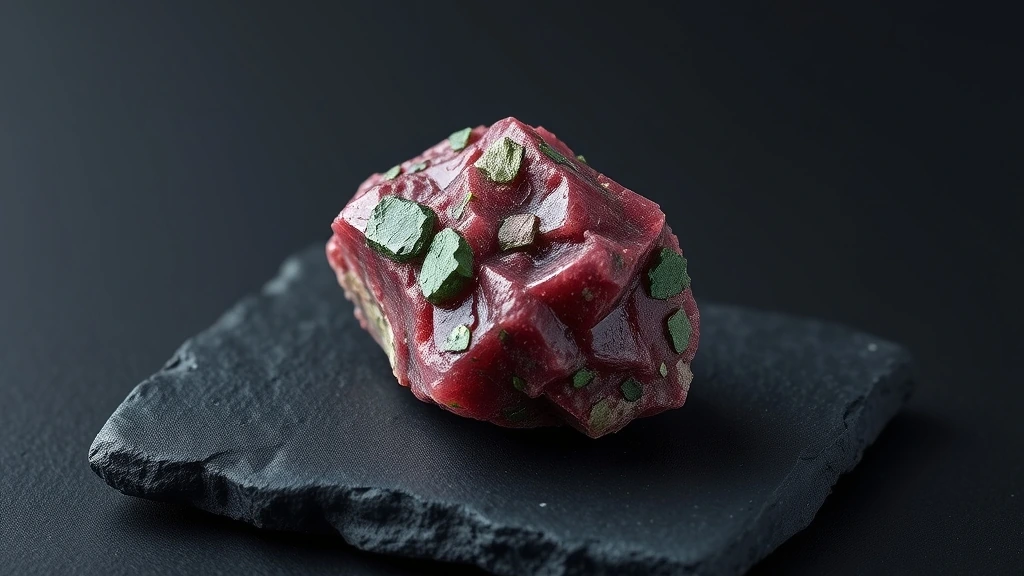
Ruby Fuchsite belongs to the Oxides mineral group, specifically the Corundum subgroup. This unique formation results from the intimate intergrowth of corundum and muscovite during regional metamorphism. The stone represents a complex geological assemblage rather than a single crystalline phase. Its rarity stems from the precise pressure and temperature conditions required for simultaneous growth.
What is Ruby Fuchsite? Geological Overview & Definition
Ruby Fuchsite is a metamorphic rock formed under high-pressure conditions. It features a distinctive intergrowth of red corundum and green muscovite. This combination creates a striking visual contrast in lapidary specimens. The material is typically found in gneissic or schistose terrains.
The term “fuchsite” refers to the green variety of muscovite mica. When combined with ruby, it forms a composite gemstone of significant aesthetic value. Geologists classify this as a paragenetic association. The stone’s value depends on the clarity and distribution of the red and green components. The same paragenetic principles that govern Ruby Fuchsite also apply to **Ruby In Kyanite**, where the striking contrast between ruby and kyanite creates a similarly compelling visual narrative.
Ruby Fuchsite Chemical Composition & Crystallographic Properties
The ruby component crystallizes in the Trigonal system. It forms hexagonal prismatic or tabular corundum structures. The lattice is defined by a close-packed oxygen array. Aluminum cations occupy the octahedral sites within this framework.
The primary chromophore is chromium substitution for aluminum. This cation substitution generates the characteristic red color. The refractive index ranges from 1.762 to 1.778. The specific gravity measures between 3.97 and 4.05.
The fuchsite component is a muscovite mica with iron impurities. It exhibits a perfect basal cleavage and lower hardness. The aggregate structure complicates lapidary cutting and polishing. Thermal stability is high, but differential expansion may cause stress.
Chemical resistance is excellent for the corundum phase. The mica component is more susceptible to acid sensitivity. No single stoichiometric formula applies to the entire rock. Instead, it is a physical mixture of distinct mineral phases.
| Property | Specification |
|---|---|
| Mineral Group | Oxides (Corundum Group) |
| Chemical Formula | Al₂O₃:Cr (Aluminum Oxide with Chromium traces) |
| Mohs Hardness | 9.0 |
| Crystal System | Trigonal (Hexagonal prismatic or tabular corundum) |
| Specific Gravity (Density) | 3.97 – 4.05 |
| Refractive Index | 1.762 – 1.778 |
| Color & Optical Properties | Natural Ruby Fuchsite color spectrum and optical dispersion |
| Primary Mining Localities | Myanmar (Mogok), Mozambique, Madagascar, Thailand, Sri Lanka |
| Water & Chemical Resistance | Very High (Durable corundum matrix is highly resistant to water and detergents) |
| Chakra Alignment (Traditional) | Root Chakra (Muladhara) and Heart Chakra |
| Zodiac Affinity (Traditional) | Aries, Leo, Scorpio |
| Symbolic Meaning (Traditional) | Passion, vitality, courage, leadership, and noble devotion |
Ruby Fuchsite Varieties & Color Spectrum
Ruby Fuchsite displays distinct mineralogical characteristics across its geological varieties and structural habits. Gemologists evaluate these natural varieties based on crystal habit, trace chromophore concentrations, and visual luster.
Primary Natural Ruby Fuchsite
The benchmark natural variety exhibiting diagnostic color saturation and classic crystallographic symmetry.
Distinct Geological Morphs of Ruby Fuchsite
Secondary regional and structural varieties formed under localized geological temperature and pressure conditions.
Imperial Red Fuchsite
Formed in high‑temperature metamorphic zones where chromium‑rich fluids infiltrate corundum, Imperial Red displays a saturated scarlet hue with a faint pleochroic sheen. Minute inclusions of rutile needles create a subtle asterism, enhancing its fire. This variety is exceptionally rare, sourced mainly from Sri Lankan alluvial deposits and prized by collectors for its vivid intensity.
Pinkish‑Lavender Fuchsite
Developing in low‑grade pegmatitic veins, Pinkish‑Lavender exhibits a delicate rose‑to‑lavender gradient caused by trace amounts of manganese alongside chromium. The stone often contains microscopic fluid inclusions that scatter light, giving a soft glow. Found chiefly in the Ural Mountains, its limited occurrence makes it a sought‑after specimen for high‑end jewelry.
Green‑Tinted Ruby Fuchsite
A unique chromatic anomaly, Green‑Tinted Ruby forms where vanadium substitutes partially for chromium in the corundum lattice, producing a faint emerald cast over the classic red base. Thin growth zoning bands are visible under magnification, indicating fluctuating geochemical conditions during crystallization. This morph is localized to Madagascar’s southern kimberlite pipes and is considered a collector’s rarity.
Brown‑Spotted Fuchsite
Occurring in basaltic host rocks, Brown‑Spotted Fuchsite features irregular brown speckles of iron oxide that interrupt the red matrix. The speckles are the result of hydrothermal alteration after the crystal’s formation, adding a distinctive mottled appearance. Primary localities include Brazil’s Minas Gerais region, where the stones are extracted from secondary alluvial deposits.
Golden‑Sheen Fuchsite
Developed in volcanic ash layers, Golden‑Sheen displays a subtle metallic luster due to fine‑grained magnetite inclusions aligned along crystal planes. The sheen intensifies under angled lighting, creating a dynamic visual effect. This variety is predominantly mined in Tanzania’s Lake Victoria basin and is valued for both its aesthetic and rarity.
Oceanic Blue‑Red Fuchsite
Rarely encountered, Oceanic Blue‑Red forms in deep‑sea sedimentary basins where high pressure stabilizes trace amounts of titanium, imparting a faint blue overtone to the dominant ruby red. The stone often contains fluid‑filled micro‑fractures that produce a mesmerizing play of color. Found only in the Pacific Ocean’s Mariana trench outcrops, it commands premium prices in the gem market.
Where is Ruby Fuchsite Found? Geological Mining & Extraction
Ruby Fuchsite crystallizes within trigonal corundum host rocks, most commonly in metamorphosed limestone and granitic pegmatites enriched with chromium. The mineral’s high density (≈4 g/cm³) causes it to settle in alluvial gravels, where miners employ gravity separation and hand‑sorting to isolate the gem‑quality crystals.
Major extraction zones include Sri Lanka’s Ratnapura district, Brazil’s Minas Gerais, Madagascar’s southern kimberlite fields, and Tanzania’s Lake Victoria basin. In each locale, artisanal mining techniques coexist with small‑scale mechanized operations, emphasizing careful removal of the stone from surrounding matrix to preserve its delicate inclusions and color integrity.
Historical Significance & Cultural Lore of Ruby Fuchsite
Across ancient lapidary traditions, ruby fuchsite was revered for its vibrant red that symbolized life force and protection. Egyptian amulets fashioned from the stone have been uncovered in New Kingdom tombs, where they were believed to safeguard the wearer against malevolent spirits and to energize the heart chakra.
In Greco‑Roman texts, the gem was associated with Mars, the god of war, and was set into signet rings to convey courage and noble authority. Vedic scriptures describe a similar red stone, linking it to the fire element and recommending it for warriors seeking vitality and leadership, a belief that endures in contemporary esoteric practice.
Modern Uses & Jewelry Applications of Ruby Fuchsite
Ruby Fuchsite is prized for its vivid pink‑to‑red hue combined with a subtle green matrix, making it a favorite for both cabochon and faceted settings. Artisans often cut the stone in a classic oval or cushion shape to showcase its pleochroism, while high‑clarity pieces are set in rings, pendants, and earrings. Ornamental carving—such as miniature figurines or decorative inlays—leverages the mineral’s hardness (Mohs 9) for durable, intricate designs.
- Faceted gemstones for high‑impact sparkle in fine jewelry
- Polished cabochons for pendants and brooches emphasizing color depth
- Inlay work in luxury watch dials and decorative boxes
- Carved miniatures for collector displays and museum pieces
Safety & Mineral Profile of Ruby Fuchsite
Handling Ruby Fuchsite poses no toxicological risk; the mineral is chemically stable as Al₂O₃:Cr, resisting acids and most solvents. When cutting or polishing, use standard eye protection and dust masks to avoid inhaling fine silica particles, a precaution common to all corundum varieties. Though historic lapidary lore occasionally links the stone to vitality and courage, modern gemologists stress that its primary value lies in scientific study and specimen exhibition, not in crystal‑healing practices.
Mineralogical Group and Planetary Lore of Ruby Fuchsite
Ruby Fuchsite belongs to the corundum group, a trigonal silicate where trace chromium imparts the characteristic ruby red. Its crystal habit ranges from hexagonal prismatic to tabular forms, and its density (3.97–4.05 g/cm³) aids identification alongside its high refractive index (1.762–1.778).
In planetary symbolism, ruby has long been associated with the Sun and the fire element, echoing its alignment with the Root Chakra and Heart Chakra in contemporary esoteric systems. Across ancient lapidary traditions, ruby‑colored stones were regarded as talismans of courage and leadership, yet these cultural attributions remain symbolic rather than scientifically substantiated.
How to Identify Real vs. Fake Ruby Fuchsite
Imitations of Ruby Fuchsite include dyed quartz, synthetic glass, and laboratory‑grown corundum that mimic its pink‑red coloration but lack the distinctive green inclusions and high hardness. Synthetic ruby may appear flawless, while glass replicas often feel lighter and exhibit bubbles under magnification. Distinguishing genuine material requires a combination of visual, tactile, and physical tests.
Practical At-Home Authenticity Tests
- Temperature Test (Thermal Feel): Natural ruby‑fuchsite feels cool to the touch and retains that coolness longer than glass or plastic, which quickly equilibrate to ambient temperature.
- Specific Gravity & Weight Test: Weigh the stone and compare its specific gravity (≈ 4.0) to that of glass (~2.5); a genuine specimen will feel noticeably heavier for its size.
- Scratch & Hardness Test (Mohs Comparison): Use a steel file (Mohs 5.5) or a quartz crystal (Mohs 7); ruby fuchsite will resist scratching, whereas glass or dyed quartz will show visible marks.
- Microscopic & Loupe Inspection (Internal Inclusions): Under 10× magnification, authentic ruby fuchsite reveals fine green mineral inclusions and characteristic growth striations, while synthetic or glass imitations appear uniformly clear or contain air bubbles.
Ruby Fuchsite Valuation Factors, Grading & Pricing
Specimen aesthetic quality dominates market value; collectors prize a vivid emerald‑green hue that overlays the ruby’s deep red base without clouding. Perfect crystal habit—whether hexagonal prismatic or tabular—enhances visual impact, while an undamaged corundum matrix signals superior preservation. Even minor surface blemishes can depress price dramatically.
Rarity and specimen dimensions are the next decisive metrics. Large, intact clusters measured in centimeters and weighing several grams command premium prices, especially when the crystal retains its natural growth pattern. Absence of handling damage, such as chips or fractures, further validates rarity, distinguishing museum‑grade pieces from bulk mineral stock.
Mineralogical provenance and locality value complete the valuation equation. Specimens sourced from historically documented mines—particularly those with documented geochemical signatures—attract higher bids in scientific and museum circles. Provenance documentation, including original field notes and GPS coordinates, adds credibility and can double the price in competitive auctions.
How to Clean and Care for Ruby Fuchsite
Cleaning ruby fuchsite is straightforward because the corundum matrix resists water and detergents. Gently rinse the specimen in warm soapy water, using a soft brush to dislodge any loose debris, then pat dry with a lint‑free microfiber cloth. Ultrasonic cleaning is safe for solid crystals, but avoid this method if the ruby contains fracture‑filled inclusions, as vibrations may exacerbate internal cracks.
Cleansing and Recharging Ruby Fuchsite (Energetic Care)
For holistic maintenance, place the specimen in a clean area and allow gentle moonlight exposure for a few hours, preferably during a waning phase to clear residual energies. Alternatively, a brief session of herbal smudging—using sage or cedar—can refresh the stone’s vibrational field without introducing moisture or heat.
Another safe method is to rest the ruby fuchsite on a selenite charging slab for several minutes, allowing the neutral selenite to absorb and rebalance any energetic imbalances. Ensure the slab is dry and free of dust, and avoid any direct flame or intense sunlight, which could damage the crystal lattice.
Frequently Asked Questions About Ruby Fuchsite
Ruby Fuchsite displays distinct mineralogical characteristics across its geological varieties and structural habits. Gemologists evaluate these natural varieties based on crystal habit, trace chromophore concentrations, and visual luster.
Primary Natural Ruby Fuchsite
The benchmark natural variety exhibiting diagnostic color saturation and classic crystallographic symmetry.
Distinct Geological Morphs of Ruby Fuchsite
Secondary regional and structural varieties formed under localized geological temperature and pressure conditions.
What is the chemical composition of Ruby Fuchsite?
Ruby Fuchsite is a chromium‑doped corundum with the formula Al₂O₃:Cr. The trace chromium gives the gemstone its characteristic deep red hue, while the corundum matrix provides exceptional hardness and durability. This composition places it firmly within the corundum family, alongside sapphires and other color variants.
How hard is Ruby Fuchsite and can it scratch other stones?
Ruby Fuchsite scores a 9 on the Mohs hardness scale. Its hardness rivals that of top‑grade diamonds, meaning it can scratch most other gemstones and common materials. This makes it ideal for everyday wear, but it should still be handled with care to avoid chipping or accidental fractures.
Is Ruby Fuchsite safe to wear in the shower or while swimming?
Ruby Fuchsite is very high water resistant. The durable corundum matrix protects it from water, detergents, and everyday moisture exposure, so it can be worn in showers or while swimming without risk of damage or discoloration.
Can I clean my Ruby Fuchsite with an ultrasonic cleaner?
Yes, it can be cleaned with an ultrasonic cleaner, but avoid use on fracture‑filled rubies. Warm soapy water is also effective for routine cleaning. The ultrasonic vibration removes surface grime without compromising the stone’s integrity, provided it is free of internal fractures.
What are the recommended care instructions for maintaining a Ruby Fuchsite’s brilliance?
Use a soft microfiber cloth and warm soapy water for routine cleaning. Gently wipe the surface to remove oils and dirt; avoid harsh chemicals or abrasive materials that could scratch the polished face. Periodic professional cleaning can help preserve its luster over time.
Which zodiac signs are traditionally associated with Ruby Fuchsite?
Aries, Leo, and Scorpio are the zodiac signs linked to Ruby Fuchsite. In astrological lore, these signs are believed to resonate with the gemstone’s vibrant energy, enhancing traits such as courage, leadership, and passion.
Which chakras does Ruby Fuchsite correspond to in metaphysical practice?
Ruby Fuchsite aligns with the Root Chakra (Muladhara) and the Heart Chakra. These energy centers are thought to benefit from the stone’s grounding and love‑affirming properties, fostering stability and emotional balance.
Does Ruby Fuchsite have any special metaphysical or esoteric properties?
Ruby Fuchsite is associated with passion, vitality, courage, leadership, and noble devotion. In esoteric traditions, the gemstone is believed to amplify personal power and inspire confident, compassionate action, making it a favored talisman for those seeking to strengthen their inner drive.