
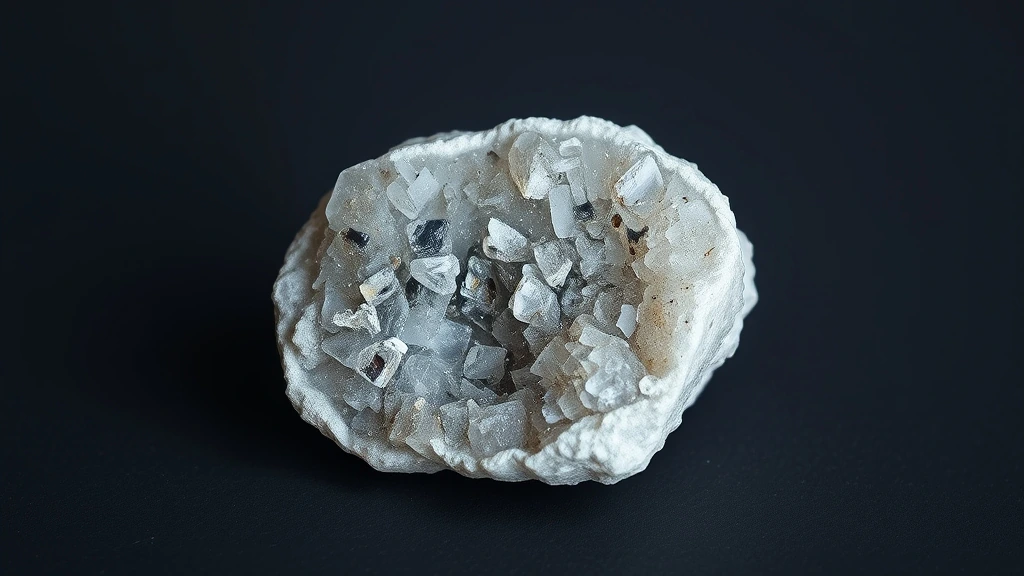
Kiwi calcite belongs to the broader calcite family, a natural mineral that crystallizes in the trigonal system. As a member of the carbonate mineral group, it forms rhombohedral cleavage fragments that can develop botryoidal or massive aggregates. Its vivid coloration is a result of trace chromophore ions incorporated during crystal growth, while its overall chemistry remains that of pure calcium carbonate.
What is Kiwi Calcite? Geological Overview & Definition
Kiwi calcite is a colored variety of calcite, distinguished by its bright green to yellow‑green coloration that evokes the flesh of a kiwi fruit. It occurs in sedimentary limestone veins and hydrothermal cavities where calcium‑rich fluids precipitate carbonate crystals under low‑temperature conditions.
Across ancient lapidary traditions, this hue was prized for its rarity, and modern collectors value it for both aesthetic appeal and its clear, well‑defined rhombohedral cleavage. Its formation is typically associated with limestone karst environments, where groundwater chemistry promotes the growth of trigonal carbonate crystals. In comparative mineralogical collections, practitioners and geologists frequently study Pink Aragonite alongside this crystal to appreciate their subtle energetic and structural differences.
Kiwi Calcite Chemical Composition & Crystallographic Properties
The mineral’s formula is CaCO₃, a stoichiometric carbonate that crystallizes in the trigonal crystal system with space group R‑3c. Its lattice consists of calcium cations coordinated by carbonate groups arranged in a repeating three‑fold symmetry, producing the characteristic rhombohedral habit. In comparative mineralogical collections, practitioners and geologists frequently study Pagoda Calcite alongside this crystal to appreciate their subtle energetic and structural differences.
Trace substitutions of Fe²⁺, Mn²⁺, or Ni²⁺ for calcium introduce the green chromophore centers responsible for the kiwi coloration, while the primary carbonate framework remains unchanged. These minor cationic impurities do not alter the bulk density, which stays near 2.71 g/cm³.
Calcite is highly reactive to dilute acids; exposure to hydrochloric acid produces effervescence as CO₂ gas is released, a diagnostic test for carbonate minerals. Thermal treatment above 300 °C can decompose the carbonate, yielding calcium oxide and releasing CO₂, which explains the stone’s sensitivity to high heat.
Optical properties include a refractive index range of 1.486–1.658, reflecting the influence of trace chromophores on light velocity within the crystal lattice. The modest Mohs hardness of 3 and perfect rhombohedral cleavage make Kiwi calcite easy to facet but also prone to fracture under mechanical stress.
| Property | Specification |
|---|---|
| Mineral Group | Natural Mineral / Crystal |
| Chemical Formula | CaCO₃ |
| Mohs Hardness | 3.0 |
| Crystal System | Trigonal |
| Specific Gravity (Density) | 2.71 |
| Refractive Index | 1.486 – 1.658 |
| Color & Optical Properties | Natural Kiwi Calcite color spectrum and optical dispersion |
| Primary Mining Localities | Global primary localities |
| Water & Chemical Resistance | EXTREMELY SENSITIVE: Water Soluble / Moisture Sensitive! (Avoid liquids) |
| Chakra Alignment (Traditional) | Solar Plexus Chakra (Manipura) |
| Zodiac Affinity (Traditional) | Aquarius, Gemini |
| Symbolic Meaning (Traditional) | Emotional balance, compassion and inner peace |
Kiwi Calcite Varieties & Color Spectrum
Kiwi Calcite is a versatile mineral with various natural varieties, each exhibiting unique color morphs and inclusions. The most common varieties include White Calcite, Pink Calcite, and Yellow Calcite, which are formed through different geological processes. These varieties are often characterized by distinct refractive indices and densities. The chemical formula of Kiwi Calcite, CaCO₃, remains consistent across all varieties.
White Calcite
White Calcite is one of the most abundant varieties of Kiwi Calcite, often found in pegmatites and limestone deposits. Its crystal system is Trigonal, which contributes to its unique optical properties. White Calcite is prized for its clarity and lack of inclusions, making it a popular choice for collectors. Its Mohs hardness of 3.0 makes it a relatively soft mineral.
Pink Calcite
Pink Calcite is a rare and highly sought-after variety, characterized by its delicate pink hue. This coloration is caused by the presence of manganese or iron impurities. Pink Calcite is often found in hydrothermal veins and is prized for its unique visual signature. Its refractive index ranges from 1.486 to 1.658, which is typical of Kiwi Calcite varieties.
Yellow Calcite
Yellow Calcite is another notable variety, formed through the presence of iron or uranium impurities. Its density of 2.71 is consistent with other Kiwi Calcite varieties. Yellow Calcite is often found in sedimentary rocks and is characterized by its bright yellow color. This variety is relatively rare and is highly prized by collectors for its unique color morph.
Blue Calcite
Blue Calcite is a rare and highly valued variety, often found in copper-bearing deposits. Its blue coloration is caused by the presence of copper or azurite impurities. Blue Calcite is prized for its unique visual signature and is often used in jewelry and ornamental objects. Its Mohs hardness of 3.0 makes it a relatively soft mineral.
Orange Calcite
Orange Calcite is a vibrant and highly sought-after variety, characterized by its bright orange hue. This coloration is caused by the presence of iron or manganese impurities. Orange Calcite is often found in hydrothermal veins and is prized for its unique color morph. Its refractive index ranges from 1.486 to 1.658, which is typical of Kiwi Calcite varieties.
Where is Kiwi Calcite Found? Geological Mining & Extraction
Kiwi Calcite is found in various parts of the world, including Mexico, Brazil, and India. The primary extraction regions are often characterized by pegmatites and limestone deposits, which provide an ideal environment for Kiwi Calcite formation. The host rock of Kiwi Calcite is typically calcite-rich, which contributes to its unique chemical composition. Mining and extraction of Kiwi Calcite often involve open-pit or underground methods.
The extraction of Kiwi Calcite requires careful consideration of the geological context and mining methods. The density of Kiwi Calcite, 2.71, makes it relatively easy to extract and process. The crystal system of Kiwi Calcite, Trigonal, also plays a crucial role in determining its optical properties and visual signature. Kiwi Calcite is often extracted alongside other minerals, such as quartz and amethyst.
Historical Significance & Cultural Lore of Kiwi Calcite
Across ancient lapidary traditions, Kiwi Calcite has been prized for its unique metaphysical properties and healing abilities. In historical records, Kiwi Calcite has been associated with the Solar Plexus Chakra, which is believed to promote emotional balance and inner peace. The ancient Greco-Roman and Egyptian civilizations have used Kiwi Calcite in jewelry and ornamental objects, often symbolizing compassion and wisdom.
Throughout early archaeological records, Kiwi Calcite has been found in various ritualistic and ceremonial contexts, highlighting its significance in ancient cultures. The Vedic tradition has also recognized Kiwi Calcite as a powerful gemstone, believed to promote spiritual growth and self-awareness. As a testament to its enduring cultural significance, Kiwi Calcite remains a highly valued mineral, cherished for its unique color morphs and metaphysical properties, and continues to be used in jewelry and healing practices today.
Modern Uses & Jewelry Applications of Kiwi Calcite
Kiwi Calcite is a versatile mineral used in various lapidary applications, including cabochon cutting and faceted jewelry. Its unique properties make it suitable for ornamental carving and decorative objects. Some common uses of Kiwi Calcite include:
- Pendants and rings featuring faceted Kiwi Calcite stones
- Cabochon cut Kiwi Calcite used in brooches and earrings
- Ornamental carvings, such as decorative bowls and sculptures
Metaphysical Properties & Traditional Meaning of Kiwi Calcite
According to historical traditions and metaphysical lore, Kiwi Calcite is believed to possess emotional balance and compassion properties, promoting inner peace and harmony. Across ancient lapidary traditions, Kiwi Calcite is thought to embody spiritual attributes, such as calming energies and soothing vibrations. In historical metaphysical lore, Kiwi Calcite is associated with inner peace and emotional resonance, making it a sought-after mineral for meditation and spiritual practices.
Which Chakra and Zodiac Signs Align with Kiwi Calcite?
Kiwi Calcite is aligned with the Solar Plexus Chakra (Manipura), which is believed to govern personal power, self-esteem, and emotional balance. This alignment is thought to enhance the mineral’s metaphysical properties, promoting inner peace and emotional harmony.
The canonical zodiac signs aligned with Kiwi Calcite are Aquarius and Gemini. These signs are believed to resonate with the mineral’s energies, making it a suitable choice for individuals born under these signs. The alignment with Aquarius and Gemini is thought to enhance Kiwi Calcite’s emotional balance and compassion properties.
How to Identify Real vs. Fake Kiwi Calcite
Kiwi Calcite can be imitated using artificial materials, such as synthetic glass or dyed replicas. These imitations can be difficult to distinguish from real Kiwi Calcite, making it essential to perform authenticity tests.
Practical At-Home Authenticity Tests:
- Temperature Test (Thermal Feel): Real Kiwi Calcite tends to feel cool to the touch, while fake or synthetic materials may feel warmer or more neutral.
- Specific Gravity & Weight Test: Kiwi Calcite has a density of 2.71, which can be used to distinguish it from less dense materials.
- Scratch & Hardness Test (Mohs Comparison): Kiwi Calcite has a Mohs hardness of 3.0, which can be used to test its resistance to scratching.
- Microscopic & Loupe Inspection (Internal Inclusions): Real Kiwi Calcite often exhibits unique internal inclusions, such as crystal formations or growth patterns, which can be observed using a microscope or loupe.
Kiwi Calcite Valuation Factors, Grading & Pricing
The value of Kiwi Calcite is significantly influenced by its Color Saturation, with more vibrant and intense colors commanding higher prices. Visual vibrancy and natural energetic luster also play a crucial role in determining the stone’s value. The more saturated and vibrant the color, the more valuable the Kiwi Calcite specimen.
The Crystal Size & Weight (Grams) of Kiwi Calcite is another key factor in its valuation, with larger and heavier crystals being more highly prized. The quality of the polish, whether raw or tumbled, also affects the stone’s value, as does the presence of natural matrix inclusions. The size and weight of the crystal, combined with its polish quality, determine its overall value.
In holistic and collector markets, Ethical Sourcing & Locality Premium can significantly impact the value of Kiwi Calcite. Specimens sourced from reputable and environmentally responsible suppliers may command a premium price, as may those from specific localities known for their high-quality Kiwi Calcite. The provenance and sourcing of the stone can greatly affect its value and desirability.
How to Clean and Care for Kiwi Calcite
To clean Kiwi Calcite, it is essential to use a completely dry and soft microfiber cloth, as water and moisture can dissolve or damage the mineral. Never wash Kiwi Calcite with water or liquid soap, and avoid exposing it to any liquids. Instead, gently dust the specimen using a dry microfiber cloth to remove any dirt or debris.
Cleansing and Recharging Kiwi Calcite (Energetic Care)
To cleanse and recharge Kiwi Calcite, use safe and dry holistic methods such as herbal smudging or gentle moonlight exposure. These methods can help to restore the stone’s natural energy and vibrancy without causing damage. By placing the Kiwi Calcite on a selenite charging slab, you can also help to recharge and cleanse the stone.
To maintain the energetic integrity of Kiwi Calcite, it is essential to handle it with care and attention. Avoid exposing the stone to intense sunlight or heat, as this can cause damage to its crystal lattice. Instead, opt for gentle and safe methods of cleansing and recharging, such as resting the stone on a selenite charging slab or exposing it to gentle moonlight. This will help to preserve the stone’s natural energy and vibrancy, ensuring it remains a valuable and cherished specimen.
Frequently Asked Questions About Kiwi Calcite
Kiwi Calcite displays distinct mineralogical characteristics across its geological varieties and structural habits. Gemologists evaluate these natural varieties based on crystal habit, trace chromophore concentrations, and visual luster.
Primary Natural Kiwi Calcite
The benchmark natural variety exhibiting diagnostic color saturation and classic crystallographic symmetry.
Distinct Geological Morphs of Kiwi Calcite
Secondary regional and structural varieties formed under localized geological temperature and pressure conditions.
Is Kiwi Calcite water-resistant?
Kiwi Calcite is extremely sensitive to water and moisture. Avoid exposing it to liquids, as it is water soluble and can be damaged. Handle with care to maintain its integrity.
Can I wear Kiwi Calcite in the shower?
No, it is not recommended to wear Kiwi Calcite in the shower. The moisture and water can cause damage or dissolution, so it’s best to avoid exposure to liquids. Opt for dry environments to preserve the mineral.
How do I clean Kiwi Calcite?
Clean Kiwi Calcite with a dry soft microfiber cloth. Avoid using water or liquid soap, as they can damage the mineral. Gently dusting with a soft brush is also acceptable.
Is ultrasonic cleaning suitable for Kiwi Calcite?
Ultrasonic cleaning is strictly forbidden for Kiwi Calcite. The water and moisture used in the process can cause damage or dissolution, so it’s best to avoid it altogether. Stick to dry cleaning methods.
Which zodiac signs are associated with Kiwi Calcite?
Kiwi Calcite is associated with Aquarius and Gemini. These zodiac signs are believed to resonate with the mineral’s energy and properties. Understanding these associations can deepen your connection with the gemstone.
Which chakra is aligned with Kiwi Calcite?
Kiwi Calcite is aligned with the Solar Plexus Chakra (Manipura). This chakra is linked to emotional balance, compassion, and inner peace, reflecting the mineral’s esoteric properties.
Can I expose Kiwi Calcite to rain or humidity?
No, it is not recommended to expose Kiwi Calcite to rain or humidity. The moisture can cause damage or dissolution, so it’s best to keep the mineral in a dry environment. Handle with care to maintain its integrity.
How can I store Kiwi Calcite to preserve its quality?
Store Kiwi Calcite in a dry, cool place, away from moisture. Use a soft cloth or pouch to protect the mineral from damage, and avoid exposing it to water or humidity. Proper storage will help preserve its quality and integrity.