
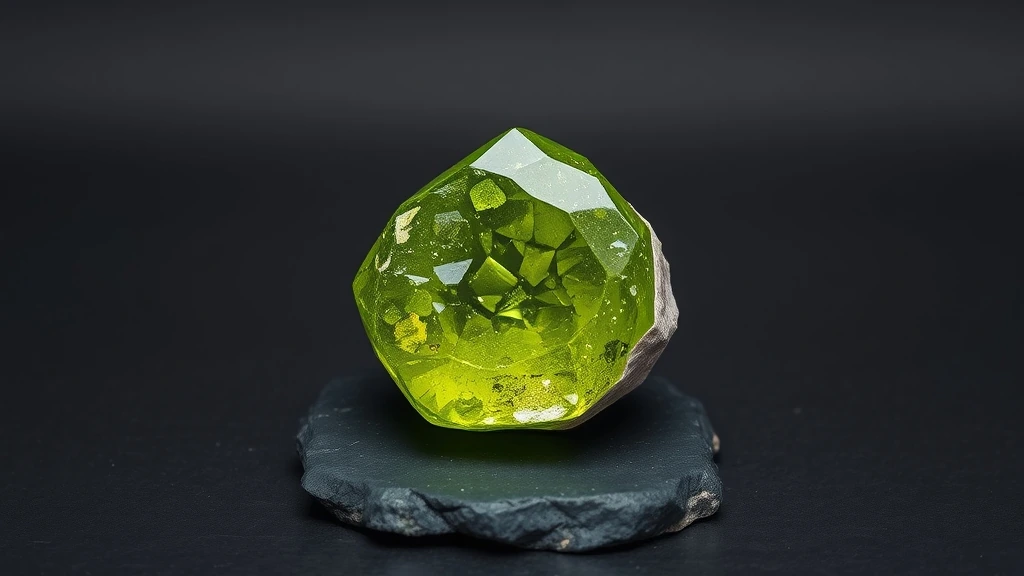
Peridot belongs to the nesosilicate subclass of the olivine group, a major component of the Earth’s upper mantle and of mafic to ultramafic igneous rocks. Its orthorhombic, prismatic crystals form in volcanic and metamorphic settings, often as well‑developed grains in basaltic lavas or as xenocrysts in kimberlites. The gemstone’s characteristic hue arises from trace iron substituting for magnesium within the crystal lattice, while its transparency and high refractive index enhance its brilliance.
What is Peridot (chrysolite)? Geological Overview & Definition
Peridot is the transparent, gem‑quality form of the mineral chrysolite, a member of the olivine group within the nesosilicate family. It occurs as isolated crystals in volcanic rocks, mantle‑derived xenoliths, and alluvial deposits where erosion liberates the durable grains.
The stone’s name derives from the Greek “chrysolithos,” meaning “golden stone,” reflecting its historic association with golden‑yellow hues, though today the most valued colors are vivid greens ranging from lime to olive. Its occurrence is worldwide, with notable sources in Egypt’s Zabargad Island, the United States’ Arizona, and recent discoveries in Pakistan’s Skardu region.
Peridot (chrysolite) Chemical Composition & Crystallographic Properties
Peridot’s ideal chemical formula is (Mg,Fe)₂SiO₄, indicating that magnesium and iron occupy the same octahedral sites in the crystal lattice. The proportion of Fe²⁺ to Mg²⁺ controls the depth of color: higher iron content deepens the green, while iron‑poor specimens appear more yellow‑green.
The mineral crystallizes in the orthorhombic (prismatic) crystal system, producing elongated, tabular habits that often exhibit distinct striations on well‑formed faces. Its unit cell contains four formula units, with SiO₄ tetrahedra isolated from each other and linked by divalent cations, a hallmark of nesosilicates.
Peridot is chemically stable in neutral environments but reacts to strong acids, which can leach iron and alter surface luster. The primary chromophore is Fe²⁺ occupying octahedral sites, absorbing light in the red‑yellow region and transmitting the complementary green.
Thermally, peridot exhibits a modest expansion coefficient; heating above ~800 °C can induce phase transitions to high‑temperature polymorphs, though such conditions are rare in natural settings. Its relatively low cleavage and high hardness make it resistant to weathering, allowing it to persist as durable gemstones after long geological transport.
| Property | Specification |
|---|---|
| Mineral Group | Silicates (Nesosilicates / Olivine Group) |
| Chemical Formula | (Mg,Fe)₂SiO₄ (Magnesium Iron Silicate) |
| Mohs Hardness | 6.5 – 7.0 |
| Crystal System | Orthorhombic (Prismatic crystals) |
| Specific Gravity (Density) | 3.27 – 3.37 |
| Refractive Index | 1.654 – 1.690 |
| Color & Optical Properties | Natural Peridot (chrysolite) color spectrum and optical dispersion |
| Primary Mining Localities | Egypt (Zabargad), USA (Arizona), Pakistan, Myanmar, China |
| Water & Chemical Resistance | Moderate (Safe in gentle warm soapy water; sensitive to acids and thermal shock) |
| Chakra Alignment (Traditional) | Heart Chakra (Anahata) and Solar Plexus Chakra |
| Zodiac Affinity (Traditional) | Leo, Virgo, Scorpio |
| Symbolic Meaning (Traditional) | Abundance, joy, heart renewal, emotional release, and vibrant vitality |
Peridot (chrysolite) Varieties & Color Spectrum
Egyptian Peridot
Formed in basaltic lava flows of the Eastern Desert, Egyptian peridot crystallizes within olivine‑rich mantle xenoliths. The stones display a vivid apple‑green hue, often with a subtle yellowish undertone caused by trace iron. Inclusions of chromite and spinel are common, and the variety is prized for its historic provenance, making it moderately rare on the market.
Pakistani Peridot
Pakistani peridot originates from the high‑altitude metamorphic belts of the Kohistan region, where tectonic shearing concentrates magnesium‑rich fluids. These gems exhibit a deep, forest‑green color with occasional brownish zones from microscopic inclusions of magnetite. Their clarity is typically high, and the mines yield limited quantities, contributing to their status as a collector’s favorite.
American (Arizona) Peridot
The San Carlos mine in Arizona produces peridot within granite‑bound pegmatites that cooled slowly, allowing large, well‑formed crystals. The stones are renowned for a bright, lime‑green shade and a characteristic “rainbow” play when viewed under angled light, a result of internal strain patterns. While abundant compared to other sources, top‑grade stones with minimal inclusions command premium prices.
Chinese (Hunan) Peridot
In Hunan Province, peridot forms in metasomatic veins intersecting dolomitic limestone, imparting a slightly yellow‑green tint unique to the region. The gems often contain microscopic rutile needles that create a faint asterism, enhancing their visual appeal. Production is relatively low, and the distinct hue makes Chinese peridot a sought‑after specialty in Asian markets.
Tanzanian Peridot (Merelani)
The Merelani Hills of Tanzania host peridot within kimberlite pipes, where rapid ascent preserves crystal integrity. These stones are distinguished by a vivid, emerald‑like green and a high degree of transparency, occasionally showing tiny gas bubbles as natural inclusions. Their rarity and the geopolitical challenges of mining render Tanzanian peridot among the most valuable in the global trade.
Australian Peridot (Coober Pedy)
Australian peridot is extracted from sandstone-hosted alluvial deposits near Coober Pedy, where weathering concentrates the mineral in placer streams. The gems display a soft, pastel green, often with a milky sheen due to fine‑grained silica inclusions. Though the deposits are extensive, gem‑quality stones are scarce, positioning Australian peridot as a niche but reliable source for jewelers.
Where is Peridot (chrysolite) Found? Geological Mining & Extraction
Peridot typically occurs in mantle‑derived ultramafic rocks, especially within olivine‑rich peridotite and kimberlite bodies. In these settings, the mineral crystallizes under high pressure and temperature, later being uplifted by volcanic activity or tectonic forces. The resulting deposits are often associated with spinel, chromite, and magnetite, which serve as diagnostic indicators during exploration.
Major extraction zones include the San Carlos mine (Arizona, USA), the Merelani kimberlite corridor (Tanzania), the Kohistan metamorphic belt (Pakistan), and the Eastern Desert of Egypt. Each region employs a combination of open‑pit, underground, and alluvial mining techniques, with careful processing to separate peridot from host rock using gravity separation and hand‑sorting under magnification.
Historical Significance & Cultural Lore of Peridot (chrysolite)
Ancient Egyptians called the stone “the gem of the sun,” embedding it in pharaonic jewelry and burial masks as a symbol of eternal life. Roman writers described peridot as a protective talisman against poison, and medieval European alchemists believed it could ward off evil spirits, leading to its frequent inclusion in ecclesiastical ornaments.
In Persian and Ottoman traditions, peridot was associated with the Heart Chakra, thought to promote emotional balance and vitality; it adorned royal crowns and diplomatic gifts. Asian folklore linked the gem to the zodiac signs Leo, Virgo, and Scorpio, attributing to it the power of abundance, joy, and heart renewal.** renewal, fostering a sense of inner harmony that resonated across cultures. This enduring legacy cements peridot’s status not only as a prized gemstone but also as a timeless emblem of human aspiration and spiritual vitality.
Modern Uses & Jewelry Applications of Peridot (chrysolite)
Peridot’s vivid lime‑green hue and relatively high refractive index (1.654‑1.690) make it a favorite for both classic and contemporary designs. Lapidary artisans often cut the stone into brilliant or step‑cut facets to maximize sparkle, while cabochon shapes highlight its natural fire. Ornamental carving—into beads, intaglios, and decorative plaques—exploits its orthorhombic crystal habit, allowing intricate detailing without compromising structural integrity.
- Brilliant, step, and mixed cuts for rings and pendants
- Cabochon settings for earrings and brooches
- Carved beads, intaglios, and ornamental inlays
Carat, Quality Grades & Value Factors of Peridot (chrysolite)
The market value of peridot hinges on the 4Cs: vivid, evenly distributed color; high clarity with minimal inclusions; precise cut that enhances brilliance; and carat weight, typically ranging from 0.5 ct to over 5 ct for fine specimens. Stones with a saturated, slightly yellow‑green tone command premium prices, while pale or brownish hues are graded lower.
Durability also influences pricing; with a Mohs hardness of 6.5‑7.0, peridot resists everyday wear but requires protective settings to avoid scratches. Grading labs apply the GIA‑style rubric, assessing color saturation, clarity grade (eye‑clean to included), cut quality, and weight, then assign a combined grade that guides both collectors and jewellers.
Zodiac and Astrological Lore of Peridot (chrysolite)
In Western astrology, peridot is the talisman of Leo, Virgo, and Scorpio, believed to amplify the Sun’s vitality for Leo, sharpen Virgo’s analytical mind, and deepen Scorpio’s transformative power. Historically, ancient Egyptians associated the stone with the sun god Ra, using it to ward off evil and promote longevity.
Ancient Mediterranean and Islamic lapidary traditions revered peridot as a gemstone of the sun, aligning it with both the Heart Chakra (Anahata) and Solar Plexus Chakra to stimulate abundance, joy, and emotional renewal. Its enduring cultural legacy underscores a cross‑civilizational belief in the stone’s ability to harmonize body and spirit.
How to Identify Real vs. Fake Peridot (chrysolite)
Artificial imitations of peridot include glass, synthetic spinel, and dyed quartz, all crafted to mimic its signature green hue. These substitutes often lack the stone’s characteristic specific gravity and display a uniform, glassy luster rather than the subtle internal reflections of natural peridot. Recognizing these differences is essential for buyers and appraisers alike.
Practical At-Home Authenticity Tests
- Temperature Test (Thermal Feel): Natural peridot feels cool to the touch and retains that coolness longer than glass or plastic, which quickly equilibrate to ambient temperature.
- Specific Gravity & Weight Test: Weigh the stone on a precise scale; genuine peridot (SG ≈ 3.30) feels noticeably heavier than glass (SG ≈ 2.5) of the same size.
- Scratch & Hardness Test (Mohs Comparison): Gently scratch an inconspicuous area with a steel file (hardness ≈ 5.5); peridot should resist scratching, whereas glass will show a faint mark.
- Microscopic & Loupe Inspection (Internal Inclusions): Under 10×–30× magnification, authentic peridot reveals minute, needle‑like inclusions (often termed “growth lines”), while synthetic or dyed stones appear uniformly clear or contain bubbles.
Peridot (chrysolite) Valuation Factors, Grading & Pricing
Color saturation drives the highest premiums for peridot, with vivid emerald‑green to yellow‑green hues commanding top prices. Uniform hue across the stone and a bright, oily luster enhance perceived value, while any brownish overtones or zoning reduce market appeal. Clarity is also critical; eye‑clean stones free of inclusions fetch a noticeable premium.
Carat weight remains a cornerstone of pricing, yet peridot’s value does not rise linearly with size. Larger stones above 2 carats are rare and therefore more valuable, provided they retain excellent facet symmetry and meet the 4Cs lapidary standards for cut, polish, and proportion. A well‑cut gem can amplify brilliance, offsetting minor inclusions that might otherwise lower the price.
Geographical provenance adds a distinct premium, with peridot from historic mines such as Zabargad (Egypt) or San Carlos (Arizona) often fetching higher bids due to their recognized heritage. Certified gems bearing reputable laboratory reports command confidence in the market, and recent trends show a steady increase in demand for ethically sourced, traceable stones, further elevating their resale value.
How to Clean and Care for Peridot (chrysolite)
Peridot tolerates gentle warm, soapy water, but it is sensitive to acids and thermal shock; therefore, clean the stone with lukewarm water and a mild, pH‑neutral soap, using a soft, lint‑free cloth to wipe the surface. Rinse quickly with distilled water and pat dry with a dry microfiber cloth, avoiding any sudden temperature changes that could fracture the crystal. Never place peridot in an ultrasonic or steam cleaner, as the vibrations and heat can induce internal stress cracks.
Cleansing and Recharging Peridot (chrysolite) (Energetic Care)
For holistic maintenance, gently smudge the stone with white sage or cedar smoke, allowing the fragrant vapor to pass over all faces for a few breaths; this clears stagnant energy without exposing the gem to heat. After smudging, place the peridot on a clean selenite slab or a wooden tray under the soft glow of moonlight for several hours, letting lunar energy renew its vibrancy.
Alternatively, rest the stone in a small cloth pouch filled with dried lavender or rose petals, positioning it near a window where indirect daylight filters through. This method offers a subtle energetic uplift while keeping the mineral safe from direct sunlight, which can cause fading or micro‑fractures over time.
Frequently Asked Questions About Peridot (chrysolite)
Is peridot safe to wear in the shower?
Peridot has moderate water resistance, making it safe for brief exposure to gentle, warm soapy water. However, prolonged submersion or contact with harsh chemicals should be avoided to prevent surface dulling. The stone is sensitive to thermal shock and acidic substances found in many commercial shampoos. Always remove jewelry before using strong detergents or hot water.
Can I clean peridot in an ultrasonic cleaner?
No, you must strictly avoid ultrasonic and steam cleaning for peridot. The stone is susceptible to internal stress fractures caused by high-frequency vibrations and rapid temperature changes. These methods can permanently damage the crystal structure and reduce its value. Instead, use a soft brush and mild soap for safe maintenance.
What is the chemical composition of peridot?
Peridot is an orthorhombic silicate mineral with the chemical formula (Mg,Fe)₂SiO₄. It belongs to the olivine group, where magnesium and iron atoms substitute for one another in the lattice. This specific magnesium-iron silicate composition dictates its characteristic green color and physical properties. The ratio of these elements influences the final hue intensity.
Which zodiac signs are aligned with peridot?
Peridot is traditionally associated with Leo, Virgo, and Scorpio. In astrological gemology, these signs benefit from the stone’s vibrant energy and protective qualities. Wearing peridot is believed to enhance vibrant vitality and emotional balance for these individuals. It serves as a powerful talisman for personal growth and confidence.
Which chakras does peridot activate?
Peridot primarily activates the Heart Chakra (Anahata) and the Solar Plexus Chakra. This dual alignment supports emotional renewal and personal power simultaneously. The stone facilitates emotional release while strengthening the core center of the body. It promotes a harmonious connection between the heart and mind.
What is the Mohs hardness of peridot?
Peridot measures between 6.5 and 7.0 on the Mohs hardness scale. This makes it durable enough for most jewelry settings, including rings and bracelets. However, it is less hard than sapphire or diamond, so it requires careful handling. Avoid exposing the stone to abrasive materials that could cause scratches or chips.
Why does peridot have a green color?
The green coloration results from iron impurities within the olivine crystal structure. Specifically, the presence of ferrous iron (Fe²⁺) absorbs certain wavelengths of light, reflecting green hues. The intensity varies based on the concentration of iron versus magnesium. This natural chromophore gives peridot its distinctive olive to lime-green appearance.
How should I store peridot jewelry?
Store peridot in a soft pouch or separate compartment to prevent scratches. Although moderately hard, it can still be damaged by contact with harder gemstones like quartz or topaz. Keep the stone away from extreme heat and direct sunlight to maintain its refractive index and luster. Proper storage ensures long-term preservation of its aesthetic qualities.