
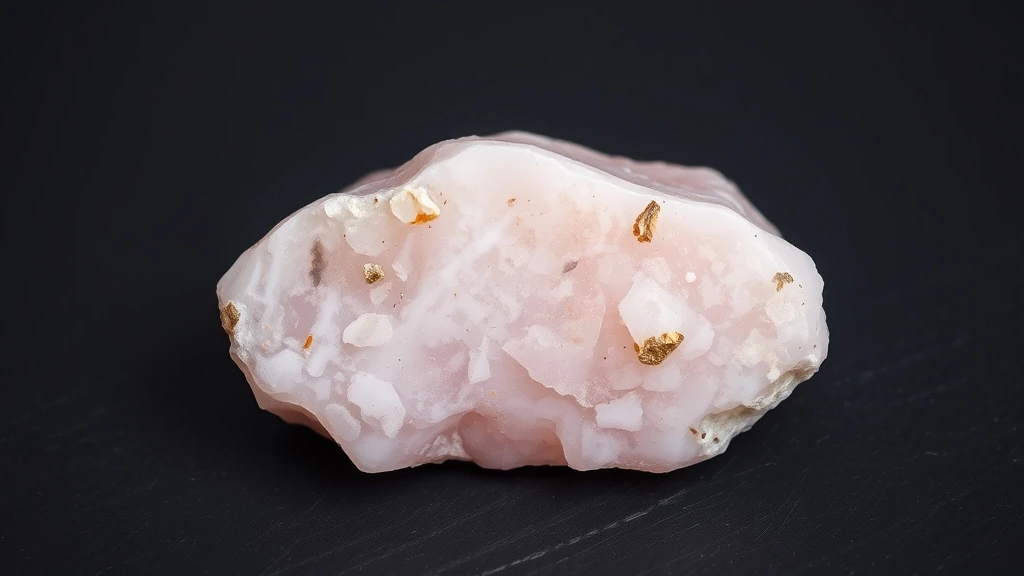
Pink Lace Chalcedony belongs to the extensive quartz mineral group, specifically classified as a chalcedony. It forms through the slow precipitation of silica-rich solutions in volcanic or sedimentary environments. This natural mineral crystallizes in a dense, fibrous aggregate rather than distinct macroscopic crystals. Its delicate lacing pattern results from the intergrowth of fine quartz fibers.
What is Pink Lace Chalcedony? Geological Overview & Definition
Pink Lace Chalcedony is defined as a microcrystalline chalcedony with a distinctive web-like or lace-like inclusion pattern. These inclusions typically consist of fine, hair-like quartz fibers or secondary mineral deposits. The stone forms in cavities within volcanic rocks or sedimentary basins over millions of years.
The “lace” appearance is created by the directional growth of silica gel layers. This process traps minute impurities that create the intricate, net-like visual texture. Geologically, it is an opaque to translucent aggregate of cryptocrystalline quartz. Its formation requires stable pressure and temperature conditions to allow for such delicate structural development. While the delicate, net-like patterns of Pink Lace Chalcedony result from directional silica gel growth, other jasper varieties like Desert Jasper form through similar cryptocrystalline quartz processes but typically exhibit more chaotic, earthy inclusions rather than structured lacing.
Pink Lace Chalcedony Chemical Composition & Crystallographic Properties
The fundamental chemical composition is pure silicon dioxide (SiO₂), with trace impurities responsible for coloration. Crystallographically, it adheres to the trigonal crystal system, sharing the lattice structure of alpha-quartz. The individual microcrystals are too small to be resolved without high-magnification microscopy. This aggregate structure gives the stone its characteristic waxy to vitreous luster. In comparative mineralogical collections, practitioners and geologists frequently study Crazy Lace Amethyst alongside this crystal to appreciate their subtle energetic and structural differences.
The pink hue is attributed to chromophore color centers or trace manganese inclusions. These color centers arise from lattice defects or minor cation substitutions within the silica framework. The material is chemically inert to most acids, showing high resistance to weathering and corrosion. Thermal behavior is stable, though rapid temperature changes may cause fracturing due to internal stress.
| Property | Specification |
|---|---|
| Mineral Group | Natural Mineral / Crystal |
| Chemical Formula | SiO₂ |
| Mohs Hardness | 6.5 – 7.0 |
| Crystal System | Trigonal |
| Color & Optical Properties | Natural Pink Lace Chalcedony color spectrum and optical dispersion |
| Primary Mining Localities | Global primary localities |
| Water & Chemical Resistance | High (Safe for gentle water washing) |
| Chakra Alignment (Traditional) | Throat Chakra (Vishuddha) |
| Zodiac Affinity (Traditional) | Cancer, Pisces |
| Symbolic Meaning (Traditional) | Emotional balance, compassion and inner peace |
Pink Lace Chalcedony Varieties & Color Spectrum
Pink Lace Chalcedony exhibits a delicate array of natural color morphs, ranging from pale rose to deeper salmon hues. These variations arise from trace impurities within the silica matrix, specifically iron oxides and manganese compounds. The intricate lacing patterns are formed by alternating bands of translucent chalcedony and opaque quartzite.
Rose Quartz Chalcedony
This variety features a soft, uniform pink tint often mistaken for pure rose quartz. The translucent body allows light to penetrate, highlighting the fine-grained crystalline structure. It typically forms in hydrothermal veins where silica-rich fluids cooled slowly.
Salmon Lace Agate
Characterized by distinct, ribbon-like bands of orange-pink and white, this morph is highly sought after. The banded structure results from periodic changes in mineral precipitation during formation. Inclusions of fine quartz crystals often create a subtle sparkle within the lace.
Blush Lace Chalcedony
A rarer form, Blush Lace displays a muted, dusty pink color with high clarity. The low saturation gives it an ethereal, almost pastel appearance under natural light. These specimens frequently contain micro-fossils or dendritic inclusions that add complexity.
Coral Pink Chalcedony
This vibrant morph mimics the hue of living coral, offering a saturated pink tone. The intense coloration is attributed to higher concentrations of iron impurities in the silica. It is often found in proximity to volcanic activity zones.
Lavender-Pink Transition Stone
A unique transitional variety, this stone blends pale lavender with soft pink tones. The dual-color zoning occurs where different chemical environments intersect during crystallization. Such specimens are prized for their rare chromatic diversity and aesthetic appeal.
Where is Pink Lace Chalcedony Found? Geological Mining & Extraction
Pink Lace Chalcedony primarily forms in hydrothermal veins and cavities within basaltic or andesitic volcanic rocks. These deposits develop when silica-rich fluids cool and precipitate in fractures, creating the characteristic banded structures. The geological setting often involves ancient volcanic arcs or intrusive igneous bodies.
Major extraction regions include Brazil, Madagascar, and the United States, particularly in California and Oregon. Open-pit mining and underground shafts are common methods for accessing these deep-seated deposits. Artisanal mining in developing regions also yields significant quantities of rough material.
Historical Significance & Cultural Lore of Pink Lace Chalcedony
Ancient Greco-Roman civilizations revered chalcedony for its protective properties, often carving it into intaglio seals and amulets. The stone was believed to calm the mind and enhance eloquence, aligning with its association with the throat chakra. Archaeological finds in Pompeii and Rome confirm its widespread use in jewelry and ritual objects.
In Vedic traditions, pink-hued silicas were linked to compassion and emotional healing, often worn during meditation. Egyptian artisans incorporated similar banded stones into scarabs and pendants, symbolizing rebirth and spiritual clarity. These cross-cultural practices highlight the enduring human connection to this gentle, laced mineral.
Modern Uses & Jewelry Applications of Pink Lace Chalcedony
Pink Lace Chalcedony is prized for its delicate, translucent pink‑white lace pattern, making it a favorite for cabochon settings that showcase its soft glow. Lapidary artisans often employ gentle sawing and polishing to preserve the lace‑like inclusions, while faceted cuts are reserved for high‑clarity stones to add sparkle. Ornamental carving—such as cameos, beads, and small figurines—exploits the stone’s fine grain and workability, allowing intricate designs without fracturing the material.
- Cabochon pendants and earrings emphasize the stone’s milky translucency.
- Faceted rings highlight high‑clarity specimens with subtle fire.
- Cameo and relief carvings draw on the lace pattern for decorative motifs.
- Beaded necklaces and bracelets benefit from the stone’s moderate hardness (6.5‑7 on Mohs).
Metaphysical Properties & Traditional Meaning of Pink Lace Chalcedony
According to historical traditions and metaphysical lore, Pink Lace Chalcedony is associated with emotional balance and the gentle opening of the heart. Across ancient Mediterranean lapidary records, the stone was believed to soothe grief and foster compassion, while Vedic texts link its pink hue to nurturing energies that calm turbulent thoughts. In broader esoteric practice, the stone is thought to promote inner peace, encouraging honest communication and the expression of true feelings.
Which Chakra and Zodiac Signs Align with Pink Lace Chalcedony?
The stone is aligned with the Throat Chakra (Vishuddha), supporting clear speech and authentic self‑expression. Practitioners claim that wearing Pink Lace Chalcedony can help release suppressed emotions, allowing the wearer to articulate compassion with confidence.
In astrology, Pink Lace Chalcedony resonates specifically with the water signs Cancer and Pisces. These signs, known for their sensitivity and intuitive nature, are said to benefit from the stone’s calming influence, which reinforces emotional stability and nurtures empathetic connections.
How to Identify Real vs. Fake Pink Lace Chalcedony
Artificial imitations of Pink Lace Chalcedony include dyed quartz, synthetic glass, and resin composites that mimic the lace pattern but lack the stone’s natural silica structure. Synthetic versions often display uniform coloration and lack the subtle internal veining characteristic of genuine chalcedony. Awareness of these differences helps collectors avoid costly misidentifications.
Practical At-Home Authenticity Tests
- Temperature Test (Thermal Feel): Natural chalcedony feels cool to the touch and retains that coolness longer than glass or plastic, which quickly warm to skin temperature.
- Specific Gravity & Weight Test: Genuine chalcedony has a specific gravity around 2.60; a simple water‑displacement test will reveal a slightly heavier feel compared with lighter glass replicas.
- Scratch & Hardness Test (Mohs Comparison): Using a steel file (hardness ~5.5) will leave no mark on authentic chalcedony, while softer imitations may show scratches; a quartz point (hardness 7) can scratch glass but not chalcedony.
- Microscopic & Loupe Inspection (Internal Inclusions): Under 10× magnification, real chalcedony shows fine, lace‑like micro‑inclusions and a milky matrix, whereas synthetic glass appears uniformly clear or shows bubble patterns inconsistent with natural growth.
Pink Lace Chalcedony Valuation Factors, Grading & Pricing
The color saturation of pink lace chalcedony dominates market value, with deep, uniform pink hues prized over pale or uneven tones. Buyers assess visual vibrancy under natural light, noting the subtle lace‑like translucency that enhances perceived depth. A stone that displays a consistent, rich pink without brown or gray undertones commands premium prices.
Crystal size & weight (grams) is the second key metric; larger, heavier pieces are rarer and fetch higher bids, especially when the specimen retains its natural lace pattern. Raw blocks may be valued for carving potential, while tumbled pieces are judged on polish quality and the absence of surface scratches. Natural matrix inclusions that accentuate the lace design can increase desirability, provided they do not compromise structural integrity.
Ethical sourcing & locality premium influences both holistic and collector markets, as provenance from reputable mines assures conflict‑free extraction and environmental stewardship. Stones sourced from regions with documented mining standards often carry a locality label that adds a modest surcharge. Collectors also value pieces that have been responsibly handled, linking the mineral’s metaphysical reputation to transparent supply chains.
How to Clean and Care for Pink Lace Chalcedony
Gentle cleaning of pink lace chalcedony is best performed with warm soapy water and a soft cloth, taking care to avoid abrasive motions that could mar the delicate lace pattern. Rinse the cloth in lukewarm water, add a mild, pH‑neutral soap, and lightly wipe the surface, then dry immediately with a clean microfiber towel. Ultrasonic cleaners should be avoided, as the vibrations may cause micro‑fractures in the fine crystal lattice. Store the stone in a padded pouch away from hard surfaces to preserve its polished finish.
Cleansing and Recharging Pink Lace Chalcedony (Energetic Care)
For energetic maintenance, a brief smudging with white sage or sweetgrass can clear stagnant vibrations without exposing the stone to moisture. Hold the chalcedony a few inches above the smoke, allowing the gentle aromatic mist to pass over the surface for one to two minutes, then set the stone aside to air‑dry.
Alternatively, place the chalcedony on a selenite charging slab or under soft moonlight for several hours, allowing lunar energy to replenish its inner balance. Avoid direct sunlight or any intense heat source, as prolonged exposure can degrade the crystal’s lattice and diminish its visual luster.
Frequently Asked Questions About Pink Lace Chalcedony
Pink Lace Chalcedony displays distinct mineralogical characteristics across its geological varieties and structural habits. Gemologists evaluate these natural varieties based on crystal habit, trace chromophore concentrations, and visual luster.
Primary Natural Pink Lace Chalcedony
The benchmark natural variety exhibiting diagnostic color saturation and classic crystallographic symmetry.
Distinct Geological Morphs of Pink Lace Chalcedony
Secondary regional and structural varieties formed under localized geological temperature and pressure conditions.
What is the chemical composition of Pink Lace Chalcedony?
Pink Lace Chalcedony is composed entirely of silicon dioxide (SiO₂). This mineral belongs to the quartz family, specifically the cryptocrystalline variety known as chalcedony. Its distinctive pink hue arises from trace impurities within the silica structure, creating a delicate, lace-like pattern that distinguishes it from other agates.
How hard is Pink Lace Chalcedony on the Mohs scale?
It registers between 6.5 and 7.0 on the Mohs hardness scale. This places it firmly in the mid-range of durable gemstones, making it suitable for daily wear in rings or pendants. However, its trigonal crystal system means it can still fracture along cleavage planes if subjected to sharp, direct impacts.
Is Pink Lace Chalcedony safe to wear in the shower?
Yes, it is safe for gentle water washing and exposure. As a silica-based mineral, it possesses high water resistance and will not dissolve or degrade in liquid. You may wear it during showers, though prolonged exposure to harsh soaps or extreme temperature shifts should be avoided to maintain its surface luster.
Can I use an ultrasonic cleaner on this?
No, you must avoid ultrasonic cleaners for this stone. The high-frequency vibrations can cause internal stress, leading to structural fractures within the delicate lace patterns. Instead, clean it using warm soapy water and a soft cloth to preserve its integrity and prevent microscopic damage to the crystal matrix.
Which zodiac signs are aligned with Pink Lace Chalcedony?
Cancer and Pisces are the primary aligned zodiac signs. These water signs resonate with the stone’s gentle, nurturing energy and emotional depth. Wearing this gemstone is believed to enhance emotional balance and compassion, supporting the sensitive nature associated with these astrological profiles.
Which chakra does Pink Lace Chalcedony correspond to?
It is exclusively aligned with the Throat Chakra (Vishuddha). This energy center governs communication, self-expression, and truth. The stone’s soft pink tones are thought to facilitate clear and compassionate expression, helping users articulate their feelings without fear or hesitation in daily interactions.
What is the crystal system of this mineral?
Pink Lace Chalcedony crystallizes in the trigonal system. Although it appears amorphous to the naked eye, its internal atomic structure follows this specific geometric arrangement. This trigonal symmetry contributes to its physical properties, including its refractive behavior and the way light interacts with its fine-grained texture.
How should I store Pink Lace Chalcedony safely?
Store it in a soft pouch or separate jewelry box. While durable, the stone can scratch softer gems and may be scratched by harder materials like diamonds. Keeping it isolated prevents surface abrasions and maintains the delicate, translucent quality of its lace-like inclusions over time.