
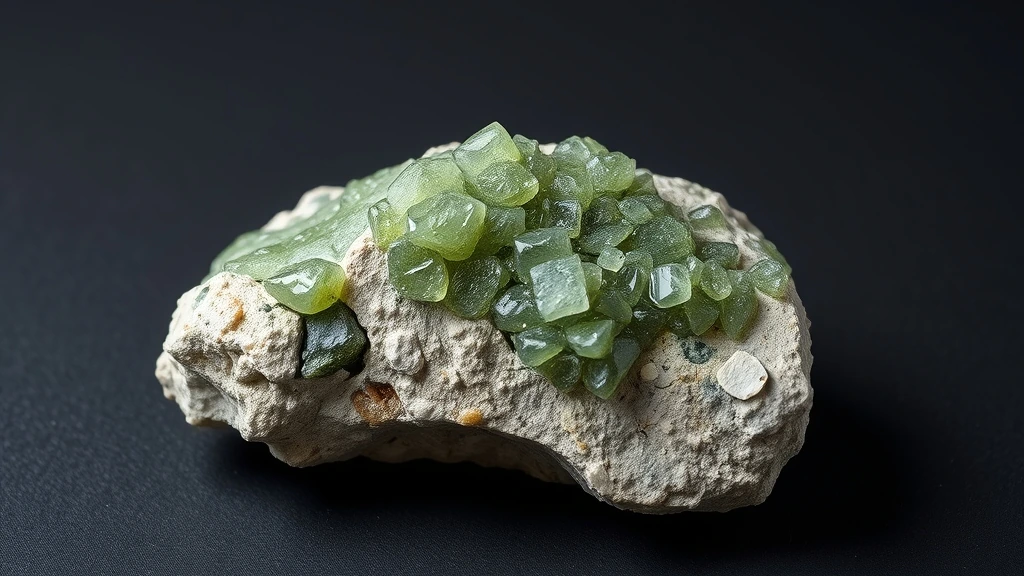
Prehnite belongs to the natural mineral class, specifically classified as a tectosilicate within the prehnite-pumpellyite group. It forms as a secondary mineral in low-temperature hydrothermal veins and cavities. These geological settings often involve the alteration of volcanic rocks or basic igneous formations. The mineral frequently occurs alongside calcite, zeolites, and other hydrothermal species. Its formation is strictly linked to specific fluid-rock interactions during cooling.
What is Prehnite? Geological Overview & Definition
Prehnite is a secondary hydrothermal mineral that crystallizes in orthorhombic prisms or tabular habits. It commonly forms in cavities of basaltic and andesitic volcanic rocks. The mineral is a key indicator of low-temperature alteration processes. Its presence signals specific geochemical conditions during the final stages of rock cooling.
The stone is geologically significant as a member of the prehnite-pumpellyite series. This group represents a solid solution between prehnite and pumpellyite. Prehnite typically contains more calcium and less iron than its counterpart. It is found in diverse locations including Germany, South Africa, and Australia. These deposits often feature well-formed crystals suitable for collection and gem use.
Prehnite Chemical Composition & Crystallographic Properties
Prehnite crystallizes in the orthorhombic system, characterized by three mutually perpendicular axes of unequal length. The unit cell parameters define its specific lattice geometry and symmetry. This structure allows for distinct cleavage planes and characteristic crystal habits. The space group is typically C2221, influencing its optical and mechanical properties.
The chemical structure features a framework of silicon and aluminum tetrahedra. Calcium cations occupy interstitial sites, stabilizing the overall lattice. Cation substitution can occur, where iron or magnesium replaces calcium in trace amounts. This substitution does not significantly alter the primary orthorhombic symmetry of the crystal.
The characteristic green color arises from chromophore centers, primarily involving iron impurities. These trace elements absorb specific wavelengths of visible light. The mineral is generally stable under ambient conditions but may undergo minor changes with heat. Thermal behavior indicates that prehnite remains stable up to moderate temperatures before dehydrating.
Prehnite exhibits moderate resistance to acids, though prolonged exposure may cause surface etching. The refractive index ranges from 1.611 to 1.665, indicating high brilliance. Its specific gravity of 2.8 to 2.95 aids in identification. These physical properties are consistent with its dense silicate framework composition.
| Property | Specification |
|---|---|
| Mineral Group | Natural Mineral / Crystal |
| Chemical Formula | Ca₂ Al(AlSi₃ O₁₀ )(OH)₂ |
| Mohs Hardness | 6–6.5 |
| Crystal System | Orthorhombic |
| Specific Gravity (Density) | 2.8–2.95 |
| Refractive Index | nα = 1.611 – 1.632 nβ = 1.615 – 1.642 nγ = 1.632 – 1.665 |
| Color & Optical Properties | Natural Prehnite color spectrum and optical dispersion |
| Primary Mining Localities | Global primary localities |
| Water & Chemical Resistance | High (Safe for gentle water washing) |
| Chakra Alignment (Traditional) | Heart Chakra, Throat Chakra |
| Zodiac Affinity (Traditional) | Taurus, Libra |
| Symbolic Meaning (Traditional) | Emotional healing, inner peace, and serenity |
Prehnite Varieties & Color Spectrum
Classic Green Prehnite
Formed in low‑grade metamorphic zones, classic green prehnite crystallizes from hydrothermal fluids percolating through basaltic host rocks. Its translucent to semi‑opaque habit often displays fine, needle‑like inclusions of quartz or calcite that catch light. The vivid apple‑green hue, ranging from pale to deep, makes it the most common and commercially sought variety, though high‑clarity stones remain relatively scarce.
Yellow‑Orange Prehnite (Citrine‑Tinted)
Yellow‑orange prehnite originates in oxidizing environments where iron substitutes for trace manganese, imparting a warm citrine tint. Typically found in weathered volcanic tuffs, it exhibits a buttery translucence with occasional specks of iron‑oxide inclusions. Because the coloration is subtle and the deposits are limited to a few South African localities, gem‑quality specimens command premium prices.
Blue‑Green Prehnite (Aquamarine)
The rare blue‑green, or “aquamarine,” variety develops in silica‑rich pegmatites where trace copper yields a delicate teal shade. Its crystal faces often display a pleochroic shift from blue‑green to pale green when rotated under polarized light. Inclusions of minute feldspar crystals give it a distinctive sparkle, and the scarcity of such deposits in Brazil makes it a collector’s favorite.
White (Milky) Prehnite
Milky prehnite forms in sedimentary limestone settings where abundant calcite micro‑inclusions scatter light, producing an opaque white‑milky appearance. Though less vibrant, its smooth, waxy luster is prized for ornamental carvings and beadwork. The variety is abundant in the United States, especially in Arizona, yet high‑clarity milky stones suitable for faceting are uncommon.
Pink Prehnite (Rosy)
Pink prehnite is a localized morph found primarily in the volcanic regions of the Dominican Republic, where trace chromium imparts a soft rose hue. The stones often exhibit a silky translucency with fine, hair‑like growths of secondary minerals such as epidote. Because the pink coloration is exceptionally rare, even small specimens are highly valued by niche markets.
Regional Trade Varieties – “Australian Desert” Prehnite
Australian desert prehnite, sourced from the Nullarbor Plain, displays a distinctive banded pattern of green and amber layers caused by alternating mineral precipitation during arid cycles. The material is typically massive rather than well‑formed crystals, making it popular for cabochon work. Its unique banding and limited extraction quotas contribute to a moderate rarity on the global market.
Where is Prehnite Found? Geological Mining & Extraction
Prehnite commonly occurs in the vesicles of basaltic lava flows and in the cavities of silica‑rich pegmatites, where low‑temperature hydrothermal fluids deposit the mineral alongside zeolites and calcite. The crystal habit is often botryoidal or stalactitic, filling fractures and voids that later become accessible through open‑pit mining or small‑scale quarrying.
Major production centers include the United States (Arizona, California), South Africa’s Namaqualand, Brazil’s Minas Gerais, and the Dominican Republic’s Cordillera Central. In each region, miners employ careful hand‑sorting to preserve the delicate crystal structures, followed by washing and grading processes that separate gem‑quality material from the abundant matrix.
Historical Significance & Cultural Lore of Prehnite
Ancient Egyptians prized prehnite for its soothing green hue, using it in amulets and burial ornaments to invoke eternal renewal. Archaeological digs in the Valley of the Kings have uncovered prehnite inlays within gold jewelry, indicating its high status among the elite.
In Greek and Roman texts, prehnite was associated with the goddess Aphrodite, believed to promote emotional harmony and protect sailors from storms. Medieval European alchemists classified it as “the stone of the heart,” attributing to it the power to heal emotional wounds and foster inner peace.
Modern Uses & Jewelry Applications of Prehnite
Prehnite’s moderate Mohs hardness of 6–6.5 makes it suitable for durable jewelry, though it requires careful handling to prevent chipping. Lapidaries often cut this mineral into cabochons to showcase its distinctive chatoyancy or honeycomb-like internal structure. Faceted cuts are also popular, particularly for larger specimens where the stone’s unique optical properties can be fully displayed.
- Cabochon Cutting: Ideal for highlighting the stone’s silky luster and internal “honeycomb” patterns without risking fracture.
- Faceted Jewelry: Commonly used in rings, pendants, and earrings, where the orthorhombic crystal system allows for precise geometric facets.
- Ornamental Carving: Larger blocks are occasionally carved into decorative objects, leveraging the mineral’s pleasant apple-green to yellowish-green hue.
- Collector Specimens: Raw crystals are highly prized by mineral collectors for their well-formed prismatic shapes and clarity.
Metaphysical Properties & Traditional Meaning of Prehnite
According to historical traditions and metaphysical lore, prehnite is revered as a stone of emotional healing and inner peace. Practitioners believe it helps dissolve negative energy, promoting a sense of serenity and calm during stressful periods. This mineral is often associated with the heart, symbolizing love, compassion, and emotional balance.
In spiritual contexts, prehnite is thought to enhance communication and self-expression, aligning with the throat chakra. It is frequently used in meditation to foster a deeper connection with one’s intuition and inner wisdom. The stone’s gentle energy is said to encourage forgiveness and release past grievances, facilitating personal growth.
Which Chakra and Zodiac Signs Align with Prehnite?
Prehnite is traditionally aligned with the Heart Chakra and the Throat Chakra. The Heart Chakra connection supports emotional healing, compassion, and the ability to give and receive love. Meanwhile, the Throat Chakra alignment enhances clear communication, self-expression, and the truthful articulation of one’s feelings and thoughts.
In astrological practice, prehnite is considered particularly beneficial for individuals born under the signs of Taurus and Libra. Taurus, an earth sign, may find stability and emotional grounding through this stone, while Libra, an air sign, can benefit from its support in harmonious communication and balanced relationships. These alignments are believed to amplify the stone’s calming and harmonizing properties.
How to Identify Real vs. Fake Prehnite
Artificial imitations of prehnite are relatively rare but can include synthetic glass, dyed chalcedony, or other green minerals. Synthetic glass often lacks the natural inclusions and specific gravity of genuine prehnite. Dyed replicas may show uneven color distribution or color bleeding in fractures, which can be detected with careful inspection.
Practical At-Home Authenticity Tests
- Temperature Test (Thermal Feel): Genuine prehnite feels cool to the touch initially and warms slowly, whereas glass imitations may warm up more quickly.
- Specific Gravity & Weight Test: Prehnite has a density of 2.8–2.95, making it feel slightly heavier than similarly sized glass or lighter minerals.
- Scratch & Hardness Test (Mohs Comparison): With a Mohs hardness of 6–6.5, prehnite can scratch glass (hardness 5.5) but will be scratched by quartz (hardness 7).
- Microscopic & Loupe Inspection (Internal Inclusions): Use a 10x loupe to look for natural inclusions or the characteristic “honeycomb” structure, which are absent in synthetic glass.
Prehnite Valuation Factors, Grading & Pricing
Market value is primarily driven by Color Saturation, where deep apple-green to pale yellowish-green hues command the highest premiums. Stones exhibiting a vibrant, uniform tone with natural energetic luster are significantly more desirable to collectors. Muted or overly pale specimens typically fetch lower prices due to reduced visual impact.
Pricing also depends heavily on Crystal Size & Weight (Grams), as larger, well-formed orthorhombic crystals are rarer and more valuable. Raw specimens are evaluated by their dimensional integrity, while tumbled stones are graded on polish quality. Natural matrix inclusions can enhance aesthetic appeal, provided they do not compromise structural stability.
Ethical Sourcing & Locality Premium plays a critical role in holistic and collector markets. Provenance from reputable mines, such as those in South Africa or Canada, often increases the stone’s desirability. Buyers increasingly prioritize transparency in supply chains, favoring stones with documented ethical extraction practices.
How to Clean and Care for Prehnite
To maintain the stone’s integrity, use warm soapy water and a soft cloth for gentle cleaning. This method effectively removes surface oils and dust without damaging the mineral surface. Ensure the stone is dried thoroughly with a lint-free cloth after washing.
It is essential to avoid ultrasonic cleaners to prevent structural fractures within the crystal lattice. The orthorhombic structure of prehnite can be susceptible to stress from high-frequency vibrations. Always handle the gemstone with care to preserve its natural luster and clarity.
Cleansing and Recharging Prehnite (Energetic Care)
For holistic maintenance, rest the stone on a selenite charging slab to restore its energetic balance. This dry method allows the prehnite to absorb positive vibrations without exposure to moisture or heat. Selenite is a compatible mineral that supports the gentle recharging of softer gemstones.
Alternatively, expose the stone to gentle moonlight overnight for a subtle energetic reset. This approach avoids the risk of thermal shock or lattice degradation associated with direct sunlight. Ensure the stone is placed in a secure, dry location to prevent accidental damage.
Frequently Asked Questions About Prehnite
Is prehnite safe to wear in the shower or while swimming?
Yes, prehnite tolerates gentle water exposure. Its orthorhombic structure and modest hardness of 6–6.5 allow safe cleaning with lukewarm water, but prolonged immersion or harsh detergents can dull the surface. A soft cloth after washing preserves its luminous green‑yellow hue.
How should I clean prehnite jewelry at home?
Use warm, mildly soapy water and a soft cloth. Gently rub the stone to remove oils, then rinse with distilled water and pat dry. Avoid abrasive pads; the hydroxyl‑bearing lattice can develop micro‑fractures if scrubbed aggressively.
Can I use an ultrasonic cleaner on prehnite?
No, ultrasonic cleaning is not recommended. The high‑frequency vibrations may cause internal stress, leading to structural fractures in this relatively brittle mineral. Stick to manual cleaning methods to maintain its optical clarity and avoid hidden damage.
What is the typical hardness of prehnite, and will it scratch glass?
Prehnite ranks 6–6.5 on the Mohs scale. This hardness is sufficient to resist minor scratches from most everyday objects but will be scratched by harder minerals like quartz or topaz. Its orthorhombic crystal habit contributes to a moderate resistance to abrasion.
Which zodiac signs are most associated with prehnite?
Taurus and Libra are the primary astrological correspondences. Those born under these signs are said to benefit from prehnite’s calming energy, which aligns with their desire for balance and stability. The stone’s soothing color reinforces these planetary influences.
Which chakras does prehnite activate?
Heart Chakra and Throat Chakra are the key energy centers. Prehnite is believed to open the heart’s emotional pathways while facilitating clear communication through the throat. This dual activation supports inner peace and expressive honesty.
Does prehnite have any notable optical properties?
Its refractive indices range from nα = 1.611–1.632 to nγ = 1.632–1.665. This modest birefringence gives prehnite a gentle luminous glow when cut as a cabochon. The stone’s density of 2.8–2.95 g/cm³ also contributes to a pleasant heft in hand‑held pieces.
Is prehnite suitable for everyday wear in rings or bracelets?
Yes, prehnite is durable enough for regular use. While its hardness is lower than that of many traditional gemstones, careful handling and the recommended cleaning routine keep it resilient against daily wear. Avoid exposing it to harsh chemicals or high‑impact activities.