
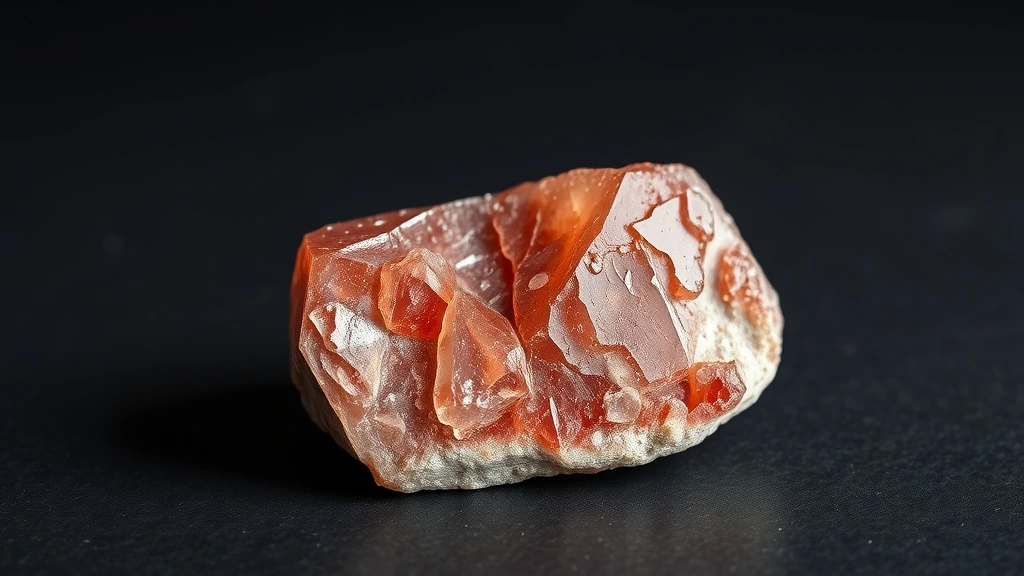
Red quartz belongs to the vast silicate mineral family, specifically classified under the Tectosilicates subgroup. It is a direct variant of the Quartz Group, sharing the same fundamental atomic framework as its more common colorless or purple counterparts. Geologically, it forms through the slow crystallization of silica-rich fluids within hydrothermal veins. These environments allow for the precise incorporation of trace elements that define its unique optical properties.
What is Red Quartz? Geological Overview & Definition
Red quartz is a naturally occurring silica mineral that crystallizes in the trigonal system. Its formation typically occurs in hydrothermal veins where silica-saturated fluids cool and deposit within host rocks. The stone’s rarity stems from the specific chemical conditions required to produce its characteristic red coloration. In comparative mineralogical collections, practitioners and geologists frequently study Hollandite In Quartz alongside this crystal to appreciate their subtle energetic and structural differences.
Unlike common rock crystal, red quartz often exhibits subtle inclusions or color zoning. These features provide critical clues about its geological provenance and formation history. Mineralogists distinguish it from red jasper, which is an opaque, microcrystalline aggregate rather than a transparent single crystal.
Red Quartz Chemical Composition & Crystallographic Properties
The fundamental building block of red quartz is the SiO₂ tetrahedron, linked in a continuous three-dimensional framework. This structure results in a Trigonal (Rhombohedral / Trapezohedral) crystal system, which dictates its geometric habit. The lattice is highly stable, contributing to the mineral’s exceptional durability and resistance to weathering. In comparative mineralogical collections, practitioners and geologists frequently study Preseli Bluestone alongside this crystal to appreciate their subtle energetic and structural differences.
Color in red quartz is primarily attributed to chromophore color centers or trace impurities like iron. These atomic defects absorb specific wavelengths of light, reflecting the visible red spectrum. The cation substitution of silicon by other elements can slightly alter the lattice parameters, though the core structure remains intact.
Thermal behavior reveals that red quartz is sensitive to extreme heat, which can cause color fading or fracturing. It is also resistant to most common acids, a hallmark of its tectosilicate composition. This chemical inertness makes it suitable for long-term preservation and display in gemological collections.
| Property | Specification |
|---|---|
| Mineral Group | Silicates (Tectosilicates / Quartz Group) |
| Chemical Formula | SiO₂ (Silicon Dioxide) |
| Mohs Hardness | 7.0 |
| Crystal System | Trigonal (Rhombohedral / Trapezohedral) |
| Specific Gravity (Density) | 2.65 |
| Refractive Index | 1.544 – 1.553 |
| Color & Optical Properties | Natural Red Quartz color spectrum and optical dispersion |
| Primary Mining Localities | Brazil, Madagascar, USA (Arkansas), Swiss Alps |
| Water & Chemical Resistance | High (Fully resistant to water and moisture) |
| Chakra Alignment (Traditional) | All Chakras (Universal Harmonizer) |
| Zodiac Affinity (Traditional) | All Zodiac Signs (Especially Leo and Aries) |
| Symbolic Meaning (Traditional) | Master energy amplifier, clarity, purification, and focus |
Red Quartz Varieties & Color Spectrum
Red Quartz displays distinct mineralogical characteristics across its geological varieties and structural habits. Gemologists evaluate these natural varieties based on crystal habit, trace chromophore concentrations, and visual luster.
Primary Natural Red Quartz
The benchmark natural variety exhibiting diagnostic color saturation and classic crystallographic symmetry.
Distinct Geological Morphs of Red Quartz
Secondary regional and structural varieties formed under localized geological temperature and pressure conditions.
Carnelian‑Tinted Quartz
Formed in silica‑rich hydrothermal veins, this variety acquires its deep orange‑red hue from microscopic iron oxide inclusions. The coloration is often uneven, creating a sunrise‑like gradient that intensifies with light exposure. Found chiefly in Brazil’s Minas Gerais region, it is moderately rare and prized for its vivid warmth.
Hematoid Quartz
Hematoid quartz develops when fine particles of hematite become trapped during crystal growth, imparting a metallic‑shimmering ruby tone. The mineral exhibits a glassy luster and may display subtle iridescence along fracture surfaces. Primary localities include the United States (Colorado) and Madagascar, where the blend of quartz and iron oxide is exceptionally scarce.
Ruby‑Spear Quartz
This variety emerges in high‑temperature pegmatitic environments where trace chromium substitutes into the silica lattice, producing a saturated ruby red. Its crystal habit is typically elongated, resembling spears or prismatic rods, and it often contains minute rutile needles that enhance its brilliance. Ruby‑spear quartz is most abundant in the Ural Mountains of Russia, yet remains a collector’s specialty due to its limited deposits.
Red Tourmaline‑Stained Quartz
In regions where tourmaline fragments infiltrate growing quartz, the resulting stone exhibits a striking crimson overlay. The inclusions create a speckled pattern that can range from translucent pink to opaque scarlet, depending on tourmaline concentration. Notable sources are the Zambezi Valley of Zambia, where tectonic activity promotes this unique intergrowth, making the stone both visually complex and relatively uncommon.
Crimson Agate‑Like Quartz
Although technically quartz, this form mimics agate’s banded appearance through alternating layers of iron‑rich hematite and pure silica. The bands produce a rhythmic red‑white pattern reminiscent of ancient cameo work. Major occurrences are reported in the volcanic tuffs of Mexico’s Sierra Madre, where rapid cooling traps iron oxides in concentric shells, yielding a highly sought‑after ornamental material.
Where is Red Quartz Found? Geological Mining & Extraction
Red quartz typically crystallizes within silica‑saturated pegmatites that intrude granitic host rocks, where slow cooling permits large, well‑formed crystals to develop. The mineral’s iron or chromium coloration is introduced by hydrothermal fluids rich in transition metals, which infiltrate the growing quartz lattice and create the characteristic red tones.
Key mining districts include Brazil’s Minas Gerais, the Ural Mountains of Russia, and the Colorado Front Range in the United States, each offering distinct red quartz varieties. Extraction relies on careful hand‑sorting and low‑impact blasting to preserve the delicate crystal habit, followed by washing and hand‑picking to separate the gem‑quality material from quartz matrix and associated gangue.
Historical Significance & Cultural Lore of Red Quartz
Across ancient lapidary traditions, red quartz was treasured for its vibrant energy and perceived protective qualities. In Egyptian tombs, scarlet quartz beads adorned the necks of elite officials, symbolizing vitality and the sun’s life‑giving force, while Greco‑Roman writers described the stone as a talisman against illness and misfortune.
In Vedic texts, red quartz—referred to as “Manikya”—was employed in ritual fire offerings to invoke clarity and purification, believed to amplify the wearer’s spiritual focus. Chinese imperial courts prized the stone for its ability to harmonize the five elements, integrating it into ceremonial seals that signified authority and balanced governance.
Modern Uses & Jewelry Applications of Red Quartz
Lapidaries value red quartz for its durability and vibrant hue, making it ideal for both faceted gemstones and polished cabochons. Its Mohs hardness of 7.0 ensures resistance to scratching, allowing for intricate cutting styles that maximize brilliance. In ornamental applications, carvers utilize the stone’s translucency for decorative objects and architectural accents.
- Ring Stones: Faceted cuts highlight the stone’s internal fire and color saturation.
- Pendants & Earrings: Cabochon cuts offer a smooth, domed aesthetic for everyday wear.
- Carvings: Larger specimens are sculpted into figurines or ornamental plates.
- Inlays: Used in high-end watch faces and luxury accessory detailing.
Metaphysical Properties & Traditional Meaning of Red Quartz
According to historical traditions and metaphysical lore, red quartz is revered as a master energy amplifier that promotes mental clarity. Ancient Mediterranean and Vedic texts often associated red stones with vitality and protective power. Practitioners believe this mineral aids in purification and sharpens focus during meditative practices.
In esoteric circles, the stone is thought to resonate with the body’s energetic field, encouraging emotional balance. It is frequently used to ground intentions and enhance spiritual awareness. This universal symbolism transcends specific cultural boundaries, reflecting a broad appreciation for its perceived clarity and stabilizing nature.
Which Chakra and Zodiac Signs Align with Red Quartz?
Red quartz is recognized as a Universal Harmonizer, aligning with all chakras to support overall energetic balance. Its broad resonance allows it to clear blockages across the entire chakra system. This versatility makes it a popular choice for holistic practitioners seeking comprehensive energetic support.
Astrologically, the stone resonates with all zodiac signs, particularly Leo and Aries. These fire signs benefit from the stone’s association with vitality, courage, and dynamic energy. The alignment reinforces the innate confidence and leadership qualities attributed to these fiery constellations.
How to Identify Real vs. Fake Red Quartz
Distinguishing genuine red quartz from artificial imitations requires careful observation of physical properties. Common fakes include synthetic glass, dyed clear quartz, and plastic replicas. Glass often lacks the natural inclusions found in mineral specimens. Understanding these differences is crucial for buyers seeking authentic gemological value.
Practical At-Home Authenticity Tests
- Temperature Test (Thermal Feel): Genuine quartz feels cool to the touch initially, while plastic or glass warms up quickly due to lower thermal conductivity.
- Specific Gravity & Weight Test: Real quartz has a density of 2.65 g/cm³, making it feel heavier than similarly sized glass or plastic imitations.
- Scratch & Hardness Test (Mohs Comparison): With a Mohs hardness of 7.0, red quartz can scratch glass but will not be scratched by a steel knife blade.
- Microscopic & Loupe Inspection (Internal Inclusions): Use a 10x loupe to look for natural fluid inclusions or fractures; glass often contains perfect, spherical bubbles.
Red Quartz Valuation Factors, Grading & Pricing
Color saturation drives the premium for red quartz, as collectors prize a deep, uniform hue that radiates natural energetic luster. Stones displaying vivid, unblemished red tones command higher prices, while pale or unevenly colored pieces are priced modestly. Market reports show that a clear, saturated color can increase value by up to 30 % over comparable lower‑intensity specimens.
Crystal size and weight, expressed in grams, are the primary quantitative metrics for pricing red quartz. Larger, heavier pieces that retain a smooth, tumbled polish fetch a premium, whereas rough or partially polished stones are assessed at a lower rate. Natural matrix inclusions, when subtle and aesthetically pleasing, may add intrigue, but prominent fractures or heavy inclusions reduce the gram‑based valuation.
Ethical sourcing and locality premium have become decisive factors in both holistic and collector markets. Specimens mined under transparent, fair‑trade conditions and documented provenance from renowned quartz belts receive a market uplift, reflecting buyer confidence in responsible practices. Additionally, stones originating from historically significant regions may attract a cultural premium, further enhancing their overall price.
How to Clean and Care for Red Quartz
Red quartz tolerates moisture well, allowing safe cleaning with warm water and a mild soap solution. Gently immerse the stone or run it under a lukewarm stream, using a soft brush to dislodge surface debris, then rinse thoroughly and pat dry with a lint‑free cloth. The mineral’s robust crystal lattice endures ultrasonic cleaning, provided the piece is not heavily fractured or cracked.
Cleansing and Recharging Red Quartz (Energetic Care)
For holistic maintenance, place the stone in a quiet space and pass a bundle of dried sage or sweetgrass over its surface, allowing the aromatic smoke to drift across without saturating the crystal. This dry smudging method respects the quartz’s physical integrity while clearing residual energetic fields.
Alternatively, expose the quartz to gentle moonlight for several hours or rest it on a clean selenite slab overnight, permitting natural lunar energy or the selenite’s subtle charge to revitalize the stone. Both practices avoid heat and direct sunlight, ensuring the crystal lattice remains intact while restoring its metaphysical clarity.
Frequently Asked Questions About Red Quartz
Red Quartz displays distinct mineralogical characteristics across its geological varieties and structural habits. Gemologists evaluate these natural varieties based on crystal habit, trace chromophore concentrations, and visual luster.
Primary Natural Red Quartz
The benchmark natural variety exhibiting diagnostic color saturation and classic crystallographic symmetry.
Distinct Geological Morphs of Red Quartz
Secondary regional and structural varieties formed under localized geological temperature and pressure conditions.
Is red quartz safe to wear in the shower?
Yes, red quartz is fully water-resistant and safe for shower use. The mineral’s stable silicon dioxide structure prevents any chemical reaction with moisture or steam. You can keep your jewelry on during daily hygiene routines without fear of degradation. This durability makes it an ideal choice for active lifestyles and frequent water exposure.
How should I clean my red quartz jewelry?
Use warm water and mild soap for routine maintenance. Gently scrub the stone with a soft toothbrush to remove oils and dirt. Ultrasonic cleaning is also suitable for most pieces, provided the quartz is not heavily fractured. Avoid harsh chemicals that might damage any accompanying metal settings or organic inclusions.
What is the Mohs hardness of red quartz?
Red quartz scores a 7.0 on the Mohs hardness scale. This makes it significantly harder than most common gemstones, offering excellent resistance to everyday scratches. It is durable enough for rings and bracelets that undergo frequent physical contact. This robustness ensures the stone maintains its polish and structural integrity over time.
Which zodiac signs are compatible with red quartz?
It resonates with all zodiac signs, particularly Leo and Aries. These fire signs benefit from the stone’s amplifying properties for passion and courage. However, anyone can wear it to enhance personal energy and focus. The universal appeal stems from its balanced vibrational frequency and adaptable metaphysical nature.
What chakras does red quartz activate?
It acts as a universal harmonizer for all chakras. Unlike stones tied to specific energy centers, red quartz balances the entire energetic system. It promotes clarity and purification across the body’s subtle energy pathways. This broad compatibility makes it a versatile tool for holistic healing and meditation practices.
How can I tell if red quartz is real?
Check for a refractive index between 1.544 and 1.553. Genuine quartz exhibits a specific luster and density of 2.65. Look for natural inclusions or slight color variations that synthetic stones often lack. Professional gemological testing remains the most reliable method for definitive identification and valuation.
Does red quartz require special storage conditions?
Store it separately to prevent scratches from harder materials. While durable, quartz can still be scratched by diamonds or sapphires. Keep it in a soft pouch or lined jewelry box to protect the surface. Avoid extreme temperature fluctuations that might stress any internal fractures or inclusions within the crystal.
What is the crystal system of red quartz?
It crystallizes in the trigonal system, often forming hexagonal prisms. This structure is characteristic of the quartz mineral family, including clear and smoky varieties. The rhombohedral or trapezohedral habits define its geometric beauty and optical properties. Understanding this lattice helps in identifying natural formations versus lab-grown alternatives.