
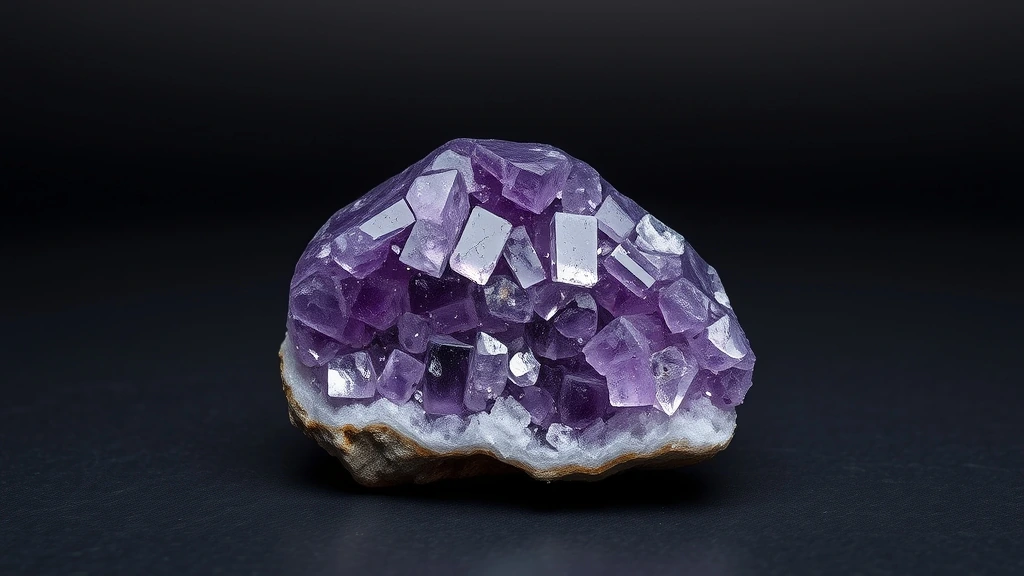
Rwanda amethyst belongs to the silicate family, specifically the tectosilicate subgroup of the quartz mineral group. Its crystals develop in the trigonal system, forming hexagonal prismatic habits that often terminate in sharp points. The stone’s characteristic purple hue arises from iron‑related color centers, and its physical properties mirror those of pure quartz, including a density near 2.65 g/cm³ and a refractive index between 1.544 and 1.553.
What is Rwanda Amethyst? Geological Overview & Definition
Rwanda amethyst is a gem‑quality quartz found in the high‑grade pegmatites of the East African Rift. Across ancient lapidary traditions, its deep violet tones have been prized for both decorative and ritual purposes. The mineral occurs as well‑formed, hexagonal prismatic crystals that can reach several centimeters in length. While Rwanda amethyst shares its crystalline structure with other quartz varieties, it stands in stark contrast to the rare, translucent blue Tugtupite, a mineral that is equally prized for its unique aesthetic appeal in the collector’s market.
In the geological record, amethyst forms during the late stages of magmatic cooling, when silica‑rich fluids infiltrate fractures and precipitate quartz. The presence of trace ferric iron (Fe³⁺) within the crystal lattice creates the distinctive purple coloration, a phenomenon documented in early African trade networks.
Rwanda Amethyst Chemical Composition & Crystallographic Properties
The fundamental composition of Rwanda amethyst is SiO₂, with minute Fe³⁺ ions substituting for silicon in the crystal framework. This substitution does not alter the overall stoichiometry but introduces color‑producing chromophore centers that absorb specific wavelengths of light. The mineral’s trigonal (hexagonal prismatic) crystal system yields a three‑fold rotational symmetry around the c‑axis. While the trigonal (hexagonal prismatic) crystal system of Rwanda amethyst dictates its geometric form, collectors often seek out composite specimens like Triplite Wagnerite And Pyrite In Quartz to appreciate the contrasting mineralogical aesthetics found within the same geological formations.
Its lattice consists of a continuous network of SiO₄ tetrahedra linked at each oxygen, a hallmark of the quartz group’s tectosilicate structure. The robust Si–O bonds confer resistance to most acids, yet prolonged exposure to hydrofluoric acid can dissolve the framework. Thermal treatment above 400 °C can decolorize the stone by altering the Fe³⁺ charge‑transfer complexes, a process exploited in gemstone enhancement.
Rwanda amethyst displays anisotropic optical behavior, with a birefringence that contributes to its vivid pleochroism under polarized light. The crystal’s hardness of 7 on the Mohs scale reflects the strength of its covalent bonding, ensuring durability for jewelry settings. Its specific gravity of 2.65–2.66 aligns with that of pure quartz, confirming its mineralogical purity despite trace impurity levels.
| Property | Specification |
|---|---|
| Mineral Group | Silicates (Tectosilicates / Quartz Group) |
| Chemical Formula | SiO₂ (Silicon Dioxide with Fe³⁺ traces) |
| Mohs Hardness | 7.0 |
| Crystal System | Trigonal (Hexagonal prismatic crystals) |
| Specific Gravity (Density) | 2.65 – 2.66 |
| Refractive Index | 1.544 – 1.553 |
| Color & Optical Properties | Natural Rwanda Amethyst color spectrum and optical dispersion |
| Primary Mining Localities | Brazil (Rio Grande do Sul), Uruguay (Artigas), Madagascar, Russia, Turkey |
| Water & Chemical Resistance | High (Water resistant; avoid prolonged direct sunlight to prevent color fading) |
| Chakra Alignment (Traditional) | Crown Chakra and Third Eye Chakra |
| Zodiac Affinity (Traditional) | Pisces, Aquarius, Virgo |
| Symbolic Meaning (Traditional) | Spiritual clarity, inner peace, meditative focus, and negative energy dispelling |
Rwanda Amethyst Varieties & Color Spectrum
Rwanda Amethyst displays distinct mineralogical characteristics across its geological varieties and structural habits. Gemologists evaluate these natural varieties based on crystal habit, trace chromophore concentrations, and visual luster.
Primary Natural Rwanda Amethyst
The benchmark natural variety exhibiting diagnostic color saturation and classic crystallographic symmetry.
Distinct Geological Morphs of Rwanda Amethyst
Secondary regional and structural varieties formed under localized geological temperature and pressure conditions.
Deep Royal Amethyst
Formed in late‑stage hydrothermal fluids that infiltrate trigonal quartz veins, this variety exhibits a saturated violet that deepens toward the crystal core. Microscopic Fe³⁺ chromophores create a uniform hue, while occasional rutile needles produce a subtle asterism. It is the most sought after for high‑end jewelry, reflecting both rarity and depth of color.
Lavender‑Sheen Amethyst
Developing within fine‑grained granite pegmatites, lavender‑sheen amethyst displays a pale, pastel violet that lightens near the surface. Thin layers of muscovite mica cause a silky sheen, distinguishing it from the deeper royal tones. Though abundant in Rwanda’s northern districts, its delicate coloration makes it prized for artisanal cabochons.
Smoky‑Veined Amethyst
This morph arises where iron oxide inclusions intersect growing quartz crystals, producing dark, smoky veins that contrast sharply with the surrounding purple. The veining results from localized oxidation of Fe²⁺ to Fe³⁺ during cooling. Collectors value the dramatic pattern, and the stone is frequently cut into faceted beads for spiritual jewelry.
Citrine‑Stained Amethyst
Occasionally, secondary heating alters trace iron, yielding citrine‑stained zones that appear as golden‑yellow patches within the violet matrix. The process mimics natural annealing in volcanic settings, creating a bi‑color effect prized in contemporary design. While less common than pure amethyst, these stones command premium prices in the global market.
Light‑Band Amethyst
Characterized by alternating thin color bands of violet and near‑colorless quartz, this variety forms in slowly cooling pegmatitic sheets where fluid composition fluctuates. The banding is visible to the naked eye and enhances the stone’s visual intrigue. Light‑band amethyst is often used in high‑visibility pendants, emphasizing its natural rhythm.
Trade‑Grade “Rwanda Violet”
Exported under the commercial name “Rwanda Violet,” this grade combines medium‑depth amethyst with minimal inclusions for mass‑market appeal. It originates from the same trigonal quartz deposits but is selectively sorted for uniformity rather than rarity. The trade name has become synonymous with affordable yet vibrant amethyst worldwide.
Where is Rwanda Amethyst Found? Geological Mining & Extraction
Rwanda’s amethyst occurs chiefly in the Kigali‑Kibuye pegmatite belt, where late‑stage granitic intrusions host quartz crystals enriched with Fe³⁺. These pegmatites intersect metamorphic schists, providing the necessary pressure‑temperature regime for large, well‑formed prisms. Mining is conducted through small‑scale open pits and artisanal shafts, with hand‑sorting to preserve crystal integrity.
The primary extraction zones lie in the Northern Province’s Gakenke and Rulindo districts, where surface outcrops reveal veins up to several meters long. Workers employ manual drilling and hydraulic splitting, followed by gentle crushing to separate amethyst from host rock. Environmental guidelines now require reclamation of mined terraces to protect Rwanda’s highland ecosystems.
Historical Significance & Cultural Lore of Rwanda Amethyst
Across ancient lapidary traditions, amethyst was revered for its purported ability to prevent intoxication, a belief recorded by Greek writers such as Pliny the Elder. Egyptian amulets fashioned from violet quartz have been uncovered in burial chambers at Saqqara, indicating early trade routes that likely carried Rwandan specimens to the Nile Valley.
In Vedic astrology, amethyst aligns with the Crown Chakra, symbolizing spiritual clarity and inner peace; medieval Chinese texts also cite the stone for its meditative focus. Contemporary Rwandan artisans echo these esoteric attributes, embedding the gem in ceremonial regalia that honors both heritage and universal metaphysical lore.
Modern Uses & Jewelry Applications of Rwanda Amethyst
Rwanda amethyst is prized for its vibrant violet hue and durable silicon dioxide matrix, making it suitable for a range of lapidary treatments. Skilled artisans cut the stone into cabochons that showcase its natural luster, or facet it into brilliant round or cushion cuts that enhance its refractive properties. The gemstone is also carved into ornamental motifs for decorative panels, pendants, and ceremonial objects.
- Cabochon polishing for smooth, reflective surfaces
- Faceted cuts (round, cushion, emerald) to maximize brilliance
- Ornamental carving for jewelry settings and architectural accents
Metaphysical Properties & Traditional Meaning of Rwanda Amethyst
According to historical traditions and metaphysical lore, Rwanda amethyst is believed to calibrate the Crown and Third Eye Chakras, fostering spiritual clarity and heightened intuition. Across ancient Mediterranean and Vedic lapidary lore, the stone is associated with inner peace and the dispelling of negative energies, serving as a conduit for meditative focus. Its violet coloration is thought to resonate with the emotional spectrum of Pisces, Aquarius, and Virgo, aligning the wearer with compassion, innovation, and analytical insight.
Which Chakra and Zodiac Signs Align with Rwanda Amethyst?
The Crown Chakra (Sahasrara) and the Third Eye Chakra (Ajna) are the primary energetic centers linked to Rwanda amethyst, according to universal metaphysical teachings. These chakras are said to enhance spiritual awareness, intuition, and the ability to perceive higher truths.
The gemstone’s alignment with the zodiac signs Pisces, Aquarius, and Virgo reflects its capacity to support emotional depth, visionary thinking, and meticulous attention to detail. Practitioners often incorporate Rwanda amethyst into rituals that honor these astrological influences, believing it amplifies the natural qualities of each sign.
How to Identify Real vs. Fake Rwanda Amethyst
Artificial imitations of Rwanda amethyst commonly appear as synthetic glass or dyed quartz, often lacking the characteristic internal inclusions and refractive index of natural stone. Synthetic variants may also display a uniform, glassy texture that betrays their manufactured origin.
Practical At-Home Authenticity Tests
- Temperature Test (Thermal Feel): Hold the stone in your hand; natural amethyst feels cool to the touch due to its thermal conductivity, whereas glass feels warmer.
- Specific Gravity & Weight Test: Weigh the stone against a known quartz sample of the same size; natural amethyst will be slightly heavier, reflecting its higher density of 2.65–2.66 g/cm³.
- Scratch & Hardness Test (Mohs Comparison): Use a standard Mohs hardness kit; amethyst should resist scratching by a steel file (7.0 on the scale) but be scratched by a quartz sample (6.0).
- Microscopic & Loupe Inspection (Internal Inclusions): Examine the stone under a loupe; natural amethyst often shows fine, fibrous inclusions or “tree rings,” whereas synthetic glass typically appears inclusion‑free.
Rwanda Amethyst Valuation Factors, Grading & Pricing
Market value is primarily driven by Color Saturation, where deep, uniform violet hues command the highest premiums. Stones exhibiting intense, even coloration without zoning or pale patches are highly sought after by collectors. The natural energetic luster of the quartz surface also enhances its visual appeal and perceived quality.
Pricing further depends on Crystal Size & Weight (Grams), with larger, intact specimens fetching higher prices per unit. Raw crystals are valued for their natural geometry, while tumbled stones are graded on the quality of their polish and smoothness. Natural matrix inclusions, such as rutile or hematite, can add unique character and increase desirability for specific collector niches.
Ethical Sourcing & Locality Premium significantly influences pricing in holistic and collector markets. Buyers increasingly prefer stones with verified provenance from responsible Rwandan mining operations. This transparency ensures fair labor practices and supports sustainable geological tourism in the region.
How to Clean and Care for Rwanda Amethyst
Rwanda Amethyst is water-resistant, making it safe to clean with warm soapy water and a soft brush. This method effectively removes surface oils and dust without damaging the mineral structure. Avoid prolonged direct sunlight exposure, as intense UV radiation can cause the purple color to fade over time.
Ultrasonic cleaning is generally acceptable for untreated specimens, providing a deep clean for intricate settings. However, you must avoid ultrasonic baths if the stone contains liquid inclusions, as the vibrations may cause them to shift or shatter. Store the amethyst in a dry, low-humidity environment to maintain its long-term integrity.
Cleansing and Recharging Rwanda Amethyst (Energetic Care)
For energetic maintenance, practitioners often use herbal smudging with sage or palo santo to clear perceived stagnant energy. This dry method avoids moisture exposure while aligning with traditional holistic practices for quartz varieties. The gentle smoke is believed to purify the stone’s vibrational field without physical abrasion.
Alternatively, resting the amethyst on a selenite charging slab allows for passive energetic renewal. This method leverages the selenite’s natural properties to amplify and stabilize the amethyst’s frequency. Ensure the stones are placed in a safe, stable location to prevent accidental drops or damage.
Frequently Asked Questions About Rwanda Amethyst
Rwanda Amethyst displays distinct mineralogical characteristics across its geological varieties and structural habits. Gemologists evaluate these natural varieties based on crystal habit, trace chromophore concentrations, and visual luster.
Primary Natural Rwanda Amethyst
The benchmark natural variety exhibiting diagnostic color saturation and classic crystallographic symmetry.
Distinct Geological Morphs of Rwanda Amethyst
Secondary regional and structural varieties formed under localized geological temperature and pressure conditions.
Is Rwanda Amethyst safe to wear in the shower?
Yes, it is highly water-resistant and safe for brief exposure to water. As a variety of quartz, it does not dissolve or degrade in moisture. However, you should avoid prolonged direct sunlight, which can cause the purple hue to fade over time.
How should I clean my Rwanda Amethyst jewelry?
Use warm soapy water and a soft brush for routine maintenance. This gentle method effectively removes oils and dirt without damaging the stone. For ultrasonic cleaning, ensure the specimen is untreated and free from liquid inclusions to prevent structural damage.
Which zodiac signs are aligned with Rwanda Amethyst?
Pisces, Aquarius, and Virgo are the primary zodiac associations for this gemstone. These signs resonate with the stone’s energy of mental clarity and spiritual insight. Wearing this quartz can support the introspective and analytical traits inherent in these astrological profiles.
What chakras does Rwanda Amethyst activate?
It primarily activates the Crown Chakra and the Third Eye Chakra. These energy centers govern higher consciousness, intuition, and spiritual connection. The stone’s violet tones are traditionally linked to enhancing meditative focus and dispelling negative mental patterns.
What is the Mohs hardness of Rwanda Amethyst?
Rwanda Amethyst has a Mohs hardness of 7.0, making it quite durable. This rating indicates it can resist scratches from most common minerals and everyday wear. It is suitable for rings and bracelets, though it remains susceptible to damage from harder materials like diamond.
What is the chemical composition of this?
The primary chemical formula is SiO₂, or silicon dioxide, with trace iron impurities. These Fe³⁺ traces are responsible for the characteristic purple coloration. The crystal structure belongs to the trigonal system, forming hexagonal prismatic shapes under natural geological conditions.
Can I use ultrasonic cleaners on my amethyst?
Ultrasonic cleaning is generally acceptable for untreated specimens without liquid inclusions. Always inspect the stone carefully before submersion to avoid stressing internal fractures. If you are unsure about the presence of inclusions, stick to manual cleaning with warm soapy water.
Does Rwanda Amethyst fade in direct sunlight?
Prolonged exposure to direct sunlight can cause the purple color to fade. While the stone is water-resistant, UV radiation poses a greater risk to its vibrancy. Store your jewelry in a dark, cool place when not in use to preserve its aesthetic value.