
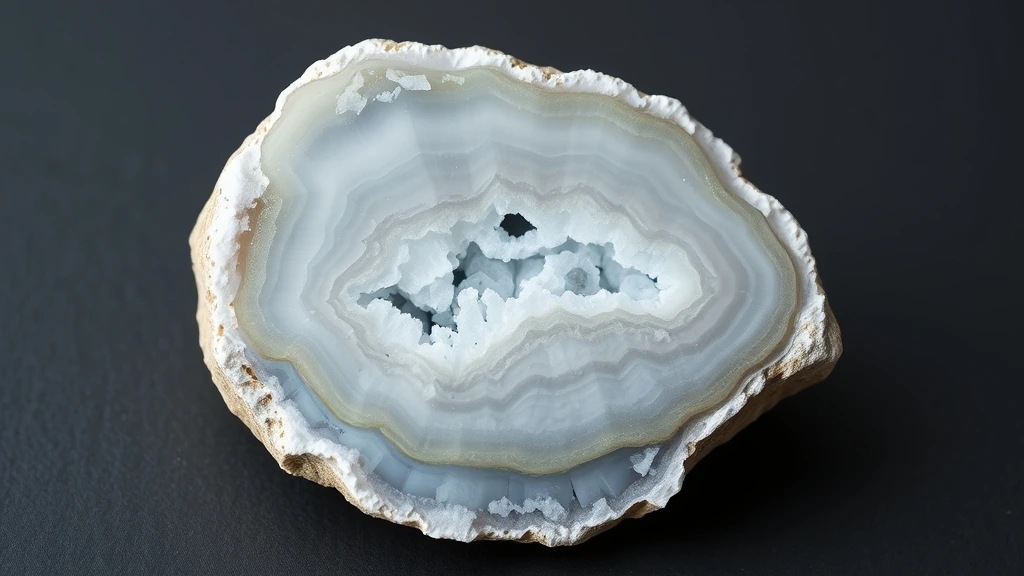
Silver Lace Agate belongs to the broader class of silicates, specifically the chalcedony subgroup of cryptocrystalline quartz. Formed through the slow precipitation of silica from hydrothermal fluids, this gemstone crystallizes as fine, fibrous aggregates that give it a characteristic lace pattern. The mineral’s fibrous texture is a hallmark of the trigonal crystal system, distinguishing it from other agates that may form in different symmetry classes.
What is Silver Lace Agate? Geological Overview & Definition
Silver Lace Agate is a type of chalcedony, a cryptocrystalline form of quartz that lacks visible crystals due to its micro‑ or cryptocrystalline structure. Its defining feature is the translucent, silver‑colored lace‑like bands that weave through a milky background, a pattern produced by variations in silica deposition and trace element inclusion. This gemstone is typically found in volcanic or sedimentary host rocks, where silica‑rich fluids have seeped into cavities and slowly crystallized. Across the globe, it has been prized for its understated elegance and subtle play of light. In comparative mineralogical collections, practitioners and geologists frequently study Cotton Candy Agate alongside this crystal to appreciate their subtle energetic and structural differences.
Silver Lace Agate Chemical Composition & Crystallographic Properties
The mineral’s chemical identity is SiO₂, with no significant cation substitution; however, trace amounts of Al³⁺ or Fe³⁺ can be incorporated into the silica framework, subtly altering its optical properties. Its crystal system is trigonal, specifically the microcrystalline or cryptocrystalline fibrous aggregate form, which means the quartz lattice repeats in a three‑fold symmetrical pattern but remains too fine to resolve individual crystals. Acid sensitivity is low; dilute hydrochloric acid shows minimal reaction, reflecting the chemical stability of pure silica. Chromophore color centers arise from structural defects and trace metal ions, giving the silver lace its characteristic sheen. Thermal behavior is typical of quartz: it remains stable up to 573 °C before undergoing a phase transition to cristobalite, after which it can fracture or devitrify if heated too rapidly.
| Property | Specification |
|---|---|
| Mineral Group | Silicates (Chalcedony / Cryptocrystalline Quartz) |
| Chemical Formula | SiO₂ (Silicon Dioxide) |
| Mohs Hardness | 6.5 – 7.0 |
| Crystal System | Trigonal (Microcrystalline / Cryptocrystalline fibrous aggregates) |
| Specific Gravity (Density) | 2.60 – 2.65 |
| Refractive Index | 1.544 – 1.553 |
| Color & Optical Properties | Natural Silver Lace Agate color spectrum and optical dispersion |
| Primary Mining Localities | Brazil, Uruguay, Turkey, India, Madagascar |
| Water & Chemical Resistance | High (Safe for gentle warm water and mild soap; avoid harsh acids and chlorine) |
| Chakra Alignment (Traditional) | Root Chakra and Sacral Chakra |
| Zodiac Affinity (Traditional) | Gemini, Virgo, Taurus |
| Symbolic Meaning (Traditional) | Grounding, emotional balance, physical endurance, and protection |
Silver Lace Agate Varieties & Color Spectrum
Silver Lace Agate exhibits a distinct palette ranging from pale gray to deep charcoal, defined by its unique fibrous structure. The primary visual characteristic is the lace-like pattern formed by interlocking bands of chalcedony. These patterns arise from the slow, rhythmic deposition of silica within volcanic cavities. The resulting aesthetic is highly prized for its organic, web-like complexity.
Classic Brazilian Silver Lace
This variety originates primarily from the Minas Gerais region of Brazil, where it forms in basaltic lava tubes. The stone typically displays a soft, silvery-gray background with delicate, darker gray lace patterns. Microcrystalline silica deposits create the intricate, thread-like inclusions that define this type. It remains the most commercially available and affordable form of silver lace agate.
Deep Charcoal Lace Agate
Found in limited deposits, this morph features a significantly darker base tone approaching black. The contrast between the dark matrix and the lighter lace patterns is stark and dramatic. High-contrast banding results from varying concentrations of iron and manganese impurities during formation. This variety is rarer and commands a higher market premium due to its visual intensity.
White Lace Agate
This lighter variant presents a creamy white or very pale gray background with subtle, faint lacing. The low-contrast fibrous structure gives the stone a soft, ethereal appearance suitable for delicate jewelry. It often contains fewer dark impurities, resulting in a cleaner, more uniform surface. Collectors value this type for its ability to enhance the clarity of the lace pattern.
Banded Silver Lace Agate
Distinct from the web-like lace, this variety features more linear, parallel bands of gray and white. The concentric banding indicates a different flow dynamic in the original volcanic vent. These bands are often thicker and more defined than the fine lace of classic types. It is frequently mistaken for standard gray agate but retains the fibrous texture.
Mottled Silver Lace Agate
This irregular morph displays a patchy, cloud-like distribution of gray tones rather than distinct lines. The amorphous silica inclusions create a speckled or mottled visual effect across the surface. Formation in turbulent volcanic environments leads to this chaotic, non-linear patterning. It is less common in high-grade gem cuts but popular for tumbled stones.
Where is Silver Lace Agate Found? Geological Mining & Extraction
Silver Lace Agate primarily forms in volcanic basalt deposits, specifically within gas bubbles or vesicles left by ancient lava flows. The silica-rich groundwater infiltrates these cavities, precipitating the cryptocrystalline quartz over millions of years. This process creates the dense, hard agate nodules characteristic of the stone. The host rock is typically fine-grained basalt, which provides the necessary structural integrity for the agate to form.
The most significant commercial sources are located in Brazil, particularly the states of Minas Gerais and Bahia. Smaller, less consistent deposits have been identified in Mexico, Madagascar, and the United States. Mining operations usually involve open-pit extraction of basalt blocks, which are then split to reveal the agate geodes. The Brazilian supply dominates the global market due to consistent quality and volume.
Historical Significance & Cultural Lore of Silver Lace Agate
Ancient Greco-Roman civilizations valued agate for its protective properties, often carving it into amulets and signet rings. Pliny the Elder documented the use of agate in talismans believed to ward off evil spirits. The stone’s durability made it ideal for intricate intaglio carving, a practice that continued through the medieval period. Its association with stability and endurance was central to its lapidary significance.
In Vedic traditions, agate was linked to the earth element, promoting grounding and physical resilience. Archaeological findings in Egypt reveal agate beads used in elaborate jewelry for both genders. The stone’s neutral tone made it a versatile medium for symbolic representation in various cultures. Its enduring popularity stems from this deep-rooted historical connection to protection and balance.
Modern Uses & Jewelry Applications of Silver Lace Agate
Silver Lace Agate is prized for its silky, banded translucency, which lends itself to both classic and contemporary designs. Lapidary artisans often cut the stone into smooth cabochons that showcase the delicate lace‑like patterns, while skilled faceting can highlight its subtle play of light. Ornamental carving also thrives, producing pendants, beads, and decorative inlays for high‑end accessories.
- Cabochon pendants that emphasize the stone’s milky lacing
- Faceted rings that exploit its modest refractive index (1.544‑1.553)
- Beaded necklaces for layered, boho‑chic looks
- Inlaid watch faces and decorative boxes for a refined, earthy accent
Metaphysical Properties & Traditional Meaning of Silver Lace Agate
According to historical traditions and metaphysical lore, Silver Lace Agate is associated with grounding and emotional balance, helping wearers stay centered amid stress. Across ancient Mediterranean lapidary records, the stone was believed to fortify physical endurance and act as a subtle shield against negative energies. In Vedic contexts, its cool hue symbolized calm rationality, encouraging clear communication and inner stability.
Which Chakra and Zodiac Signs Align with Silver Lace Agate?
The stone resonates strongly with the Root Chakra, supporting foundational stability and a sense of safety in the material world. It also harmonizes with the Sacral Chakra, fostering creative flow and emotional fluidity, making it a versatile aid for both personal security and expressive vitality.
Gemini, Virgo, and Taurus are the zodiac signs traditionally linked to Silver Lace Agate. Gemini benefits from the stone’s mental clarity, Virgo finds reinforcement for practical organization, and Taurus enjoys enhanced grounding that deepens its connection to the earth and sensual pleasures.
How to Identify Real vs. Fake Silver Lace Agate
Artificial imitations of Silver Lace Agate often include dyed quartz, colored glass, or resin composites that mimic its lace‑like bands but lack the authentic microcrystalline texture. Synthetic glass replicas may display a uniform sheen and feel colder to the touch, while dyed natural agate can be identified by uneven coloration and surface bubbles.
Practical At-Home Authenticity Tests
- Temperature Test (Thermal Feel): Genuine Silver Lace Agate warms slowly in the hand, whereas glass or plastic stays noticeably cooler.
- Specific Gravity & Weight Test: The stone’s density (2.60‑2.65 g/cm³) makes it feel heavier than glass of similar size; a simple water displacement test can confirm this range.
- Scratch & Hardness Test (Mohs Comparison): With a hardness of 6.5‑7, the stone resists scratches from a steel nail but will be marked by a quartz tip; glass typically scratches more easily.
- Microscopic & Loupe Inspection (Internal Inclusions): Under 10× magnification, authentic Silver Lace Agate shows fine, parallel banding and occasional micro‑fractures, while synthetic versions reveal bubbles, uniform coloration, or a lack of natural growth patterns.
Silver Lace Agate Valuation Factors, Grading & Pricing
The market prize of Silver Lace Agate hinges first on Color Saturation. Stones displaying deep, uniform bands of silvery‑gray lace against a translucent milky background command higher prices, as collectors prize visual vibrancy and the natural energetic luster that mimics moonlit water. Subtle variations in hue can shift a piece from modest to premium within a single lot.
Next, Crystal Size & Weight (Grams) drives valuation. Larger aggregates measured in grams and exhibiting a smooth, polished finish fetch better offers than smaller, rough‑cut fragments, because they provide more surface area for display and handling. Natural matrix inclusions, when present in a balanced pattern, can enhance appeal, while excessive fractures or heavy dyeing diminish price.
Finally, Ethical Sourcing & Locality Premium influences both holistic and collector markets. Specimens sourced from reputable mines with transparent labor practices attract buyers seeking responsible acquisitions, and those originating from historically noted locales may carry an added cultural premium. Provenance documentation often justifies a price uplift, reinforcing trust in the stone’s authenticity and ethical pedigree.
How to Clean and Care for Silver Lace Agate
Cleaning solid Silver Lace Agate is safest with warm soapy water; a few drops of mild liquid soap in lukewarm water gently removes surface dust without harming the cryptocrystalline structure. Use a soft, lint‑free cloth to wipe the stone, then rinse briefly with clean water and pat dry with another soft cloth. Avoid ultrasonic cleaners unless the piece is confirmed untreated and free of dyes, as vibration can loosen fragile internal layers.
Cleansing and Recharging Silver Lace Agate (Energetic Care)
For holistic upkeep, place the agate on a clean selenite slab overnight, allowing the neutral selenite to absorb lingering negative energies while the stone retains its grounding properties. This dry method respects the mineral’s lattice and avoids any moisture that could affect surface polish.
Alternatively, a brief exposure to gentle moonlight, preferably during a waning phase, can refresh the stone’s subtle luminescence without introducing heat. Lightly smudge the agate with aromatic sage or cedar, ensuring the herb is cool and the smoke passes over, not through, the surface, thereby preserving both physical integrity and energetic clarity.
Frequently Asked Questions About Silver Lace Agate
Silver Lace Agate displays distinct mineralogical characteristics across its geological varieties and structural habits. Gemologists evaluate these natural varieties based on crystal habit, trace chromophore concentrations, and visual luster.
Primary Natural Silver Lace Agate
The benchmark natural variety exhibiting diagnostic color saturation and classic crystallographic symmetry.
Distinct Geological Morphs of Silver Lace Agate
Secondary regional and structural varieties formed under localized geological temperature and pressure conditions.
What is the chemical composition of Silver Lace Agate?
It is a variety of quartz composed of silicon dioxide (SiO₂). This cryptocrystalline form displays fine, parallel bands of milky white and silvery gray that give the stone its lace‑like appearance. The mineral belongs to the trigonal crystal system and shares quartz’s typical hardness of 6.5‑7 on the Mohs scale.
Is Silver Lace Agate safe to wear in the shower?
Yes, it tolerates gentle warm water and mild soap. The stone’s high water resistance means routine exposure to shower steam or brief rinses will not damage it, provided harsh acids, chlorine, or abrasive cleaners are avoided. After washing, pat it dry with a soft cloth.
How should I clean a Silver Lace Agate that has been dyed?
Warm, mildly soapy water is the preferred cleaning method for solid, untreated agates. If the piece is dyed, heavily fractured, or has undergone surface treatments, avoid ultrasonic cleaners, as the vibrations can lift pigments or exacerbate cracks. Gently wipe with a soft cloth and rinse lightly.
Can I use an ultrasonic cleaner on Silver Lace Agate jewelry?
Ultrasonic cleaning is not recommended for dyed or treated specimens. While solid, untreated agate can withstand warm soapy water, the high‑frequency vibrations of an ultrasonic bath may cause color loss or fracture in fragile pieces. Hand‑cleaning remains the safest approach.
Which zodiac signs are associated with Silver Lace Agate?
Gemini, Virgo, and Taurus are the aligned zodiac signs. In astrological tradition, these earth and air signs are thought to benefit from the stone’s grounding energy, enhancing mental clarity for Gemini, practical organization for Virgo, and steady determination for Taurus. The gemstone is often set in talismans for these signs.
Which chakras does Silver Lace Agate influence?
It is linked to the Root Chakra and the Sacral Chakra. Activation of the Root Chakra promotes stability and a sense of security, while the Sacral Chakra supports emotional balance and creative flow. Wearing the stone near the lower abdomen is believed to amplify these effects.
How durable is Silver Lace Agate for everyday wear?
With a Mohs hardness of 6.5‑7, it is suitable for regular jewelry use. Its density of 2.60‑2.65 g/cm³ gives it a pleasant weight without being overly heavy. However, to prevent chipping, avoid hard impacts and store it separately from harder gemstones like diamonds or sapphires.
Does Silver Lace Agate have any known metaphysical properties?
It is reputed to aid grounding, emotional balance, physical endurance, and protection. Practitioners cite its ability to anchor energy to the Earth, helping the wearer stay centered during stressful situations. Historically, similar agates were carved into amulets for protective purposes across many cultures.