
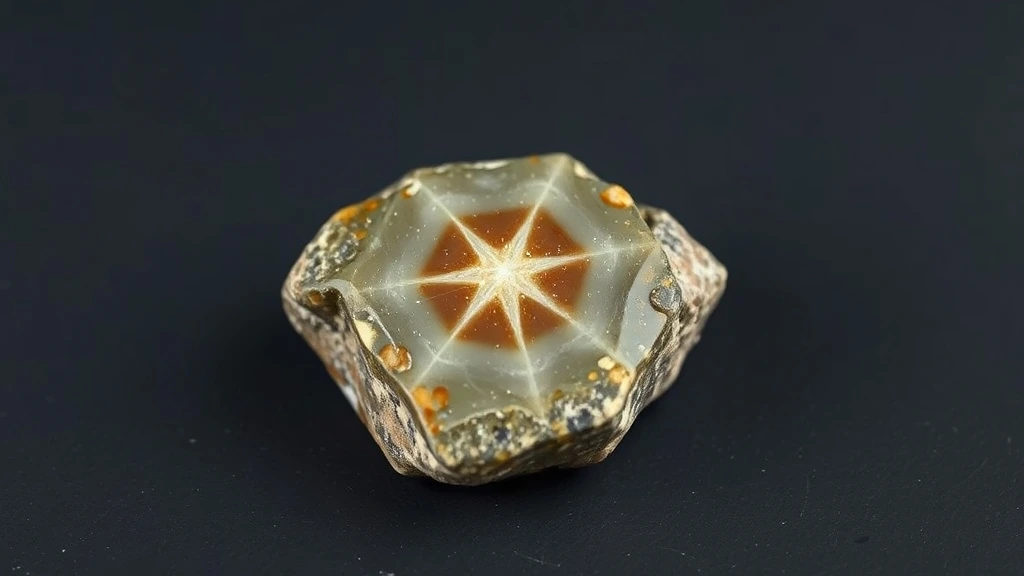
Star Jasper belongs to the natural mineral / crystal group and is classified as a variety of jasper, itself a cryptocrystalline aggregate of quartz. Formed in sedimentary or volcanic environments, the stone records mineral-rich fluids that precipitate fine‑grained silica. Its distinctive asterism arises from oriented hematite or goethite platelets that reflect light in a star pattern. The aggregate retains the trigonal crystal system of quartz, even though the rock‑like texture obscures individual crystal faces.
What is Star Jasper? Geological Overview & Definition
Star Jasper is a cryptocrystalline quartz variety, meaning its quartz crystals are too small to be seen without magnification. The stone’s opaque, earthy tones range from deep brown to black, punctuated by silvery‑white star‑shaped reflections that appear when light strikes the oriented inclusions. While Star Jasper’s cryptocrystalline structure hides its quartz composition, other opaque varieties like Wood Jasper reveal distinct, fibrous patterns that mimic the grain of natural timber.
In geological terms, Star Jasper forms as an epigenetic deposit within fissures, cavities, or sedimentary layers where silica‑rich solutions precipitate rapidly. The asterism is a result of light diffraction by parallel hematite or goethite platelets aligned along the quartz’s crystallographic axes, a phenomenon shared with other star‑bearing minerals such as star‑tourmaline.
Star Jasper Chemical Composition & Crystallographic Properties
Although often marketed as a single gemstone, Star Jasper is an aggregate of micro‑quartz crystals whose overall composition is SiO₂. The lack of a uniform lattice makes it impossible to assign a single stoichiometric formula beyond that of its quartz constituents.
The underlying quartz framework conforms to the trigonal crystal system, characterized by a three‑fold rotational axis and a hexagonal lattice that repeats every 4.9 Å along the c‑axis. This symmetry governs the orientation of the metallic inclusions that produce the star effect.
Cation substitution is minimal in pure quartz, but trace amounts of Fe³⁺ and Mn²⁺ can replace Si⁴⁺ in the lattice, creating color centers that influence the stone’s overall hue. These transition‑metal ions also contribute to the formation of the reflective platelets responsible for asterism.
Star Jasper is acid‑sensitive; prolonged exposure to strong acids can dissolve the silica matrix, eroding the surface and diminishing the star’s brilliance. Thermally, the stone is stable up to about 573 °C, the quartz α‑β transition temperature, beyond which the crystal structure reorganizes and the asterism may be lost.
| Property | Specification |
|---|---|
| Mineral Group | Natural Mineral / Crystal |
| Chemical Formula | SiO₂ |
| Mohs Hardness | 6.5 – 7.0 |
| Crystal System | Trigonal |
| Color & Optical Properties | Natural Star Jasper color spectrum and optical dispersion |
| Primary Mining Localities | Global primary localities |
| Water & Chemical Resistance | High (Safe for gentle water washing) |
| Chakra Alignment (Traditional) | Crown Chakra (Sahasrara) |
| Zodiac Affinity (Traditional) | Sagittarius, Pisces |
| Symbolic Meaning (Traditional) | Clear communication, truth and serenity |
Star Jasper Varieties & Color Spectrum
Star Jasper displays distinct mineralogical characteristics across its geological varieties and structural habits. Gemologists evaluate these natural varieties based on crystal habit, trace chromophore concentrations, and visual luster.
Primary Natural Star Jasper
The benchmark natural variety exhibiting diagnostic color saturation and classic crystallographic symmetry.
Distinct Geological Morphs of Star Jasper
Secondary regional and structural varieties formed under localized geological temperature and pressure conditions.
Blue Star Jasper
Formed in silica‑rich volcanic tuffs, Blue Star Jasper displays a deep indigo matrix intersected by bright white or silver star‑like asterisms. The stars arise from rutile needle inclusions that reflect light at specific angles, creating a “star” effect. This variety is most abundant in Brazil’s Minas Gerais region, yet high‑quality specimens are considered rare due to the precise growth conditions required.
Red‑Orange Star Jasper
Red‑Orange Star Jasper originates in sedimentary iron‑oxide layers of the United States’ Colorado Plateau, where hematite crystals embed within a quartz‑dominant host. The resulting asterism appears as vivid orange‑red points against a darker background, a visual signature prized by collectors. Its rarity stems from the limited extent of iron‑rich horizons that can produce the distinct star pattern.
Green Star Jasper
Found primarily in the volcanic flows of Madagascar, Green Star Jasper incorporates chlorite and epidote inclusions that lend a jade‑like hue. The star effect is produced by microscopic goethite fibers aligned during slow cooling, giving a subtle, emerald‑tinted sparkle. Although the deposit is relatively extensive, gem‑grade material with clear asterism remains scarce.
Black Star Jasper (Mookaite)
Black Star Jasper, often marketed as “Mookaite,” occurs in the arid basins of Western Australia where silica‑rich sandstones host abundant magnetite and hematite needles. The dark matrix accentuates the bright, white stars that emerge under direct illumination. Its commercial popularity has increased, yet pristine stones with uniform asterism are limited, preserving its collector value.
Pink Star Jasper
Pink Star Jasper is sourced from the granitic pegmatites of Brazil’s Rio Grande do Sul state, where trace manganese oxides impart a delicate rose tint. The asterism manifests as soft pink stars that seem to float within a translucent quartz base. Because the manganese concentration must be finely balanced, high‑quality pink specimens are among the most coveted.
Multi‑Color Star Jasper
Multi‑Color Star Jasper emerges from the complex interlayering of volcanic ash and sedimentary deposits in the United States’ Utah region. Its polychromatic matrix—ranging from amber to deep brown—hosts a network of rutile and goethite inclusions that produce a kaleidoscopic star pattern. While the deposit is abundant, stones displaying a balanced spectrum of colors with sharp asterism are relatively uncommon.
Where is Star Jasper Found? Geological Mining & Extraction
Star Jasper typically occurs within trigonal silica (SiO₂) veins that intersect volcanic tuffs, rhyolites, or sedimentary iron‑rich layers. The asterism forms when rutile or goethite needles align during slow cooling, a process facilitated by hydrothermal fluids that permeate the host rock. Mining operations employ careful hand‑sorting to preserve the delicate star patterns, as mechanical crushing can destroy the inclusions.
Major extraction zones include Brazil’s Minas Gerais and Rio Grande do Sul states, Madagascar’s eastern volcanic provinces, Western Australia’s Mookaite fields, and the United States’ Colorado Plateau and Utah desert deposits. In each region, small‑scale artisanal miners often collaborate with cooperatives that certify gem quality, ensuring that only stones with distinct asterism reach the global market.
Historical Significance & Cultural Lore of Star Jasper
Across ancient lapidary traditions, Star Jasper was prized for its purported ability to focus clear communication and truth. In Greco‑Roman texts, the stone was linked to the goddess Minerva, symbolizing wisdom and strategic insight, while Egyptian amulets fashioned from star‑patterned jasper were buried with pharaohs to guide them through the afterlife.
In Vedic astrology, Star Jasper aligns with the Crown Chakra (Sahasrara), believed to elevate spiritual awareness and serenity; early Chinese records describe the stone as a talisman for scholars seeking intellectual clarity. Throughout these cultures, the gemstone’s unique asterism reinforced its reputation as a conduit for inner truth, making it a revered element in both ceremonial and personal adornment.
Modern Uses & Jewelry Applications of Star Jasper
Star Jasper is primarily valued for its distinctive asterism, which requires precise optical alignment during the cutting process. Lapidaries typically cut this stone into cabochons to maximize the visibility of the star effect, ensuring the optical axis is perpendicular to the table. Faceted cuts are less common but possible for pieces where the star pattern is not the primary aesthetic focus.
- Cabochon Cutting: The standard method to display the asterism clearly, requiring a domed shape with a polished surface.
- Ornamental Carving: Used in intaglio work for seals and decorative inlays due to its durability and earthy tones.
- Jewelry Settings: Commonly set in rings, pendants, and earrings, often paired with silver or gold to complement its natural hues.
- Architectural Elements: Occasionally used in small-scale decorative paneling or mosaic art for its unique visual texture.
Metaphysical Properties & Traditional Meaning of Star Jasper
According to historical traditions and metaphysical lore, Star Jasper is revered for its capacity to foster inner serenity and mental clarity. Ancient Mediterranean and Vedic texts often associated jasper varieties with protection and grounding, viewing them as talismans against negative influences. The stone is believed to encourage truthful communication, helping the wearer express themselves with integrity and calm.
In esoteric practices, this gemstone is linked to the Crown Chakra, symbolizing a bridge between the physical and spiritual realms. Practitioners suggest that wearing Star Jasper can enhance intuition and promote a state of meditative stillness. It is often used in meditation to quiet the mind and facilitate a deeper connection to universal consciousness.
Which Chakra and Zodiac Signs Align with Star Jasper?
Star Jasper is canonically aligned with the Crown Chakra (Sahasrara), the energy center associated with spiritual connection and higher consciousness. This alignment suggests the stone supports mental clarity and the expansion of awareness beyond the physical self. The chakra’s focus on unity and enlightenment complements the stone’s reputed ability to promote spiritual insight.
In astrological correspondences, Star Jasper is specifically linked to the zodiac signs Sagittarius and Pisces. Sagittarius, a fire sign, may find the stone’s grounding qualities helpful for balancing their adventurous nature. Pisces, a water sign, might resonate with the gem’s capacity to enhance intuitive perception and emotional depth.
How to Identify Real vs. Fake Star Jasper
Artificial imitations of Star Jasper are increasingly common, often involving dyed chalcedony or synthetic glass designed to mimic the star effect. These fakes may lack the natural inclusion patterns and subtle color variations found in genuine specimens. Synthetic versions often appear too perfect, with uniform colors and artificially induced asterisms that do not respond to light changes as naturally.
Practical At-Home Authenticity Tests
- Temperature Test (Thermal Feel): Genuine jasper feels cool to the touch initially and warms slowly, while glass imitations may warm up more quickly or feel different due to lower thermal conductivity.
- Specific Gravity & Weight Test: Real Star Jasper has a density of approximately 2.6 g/cm³, making it feel heavier than glass or plastic replicas of the same size.
- Scratch & Hardness Test (Mohs Comparison): With a Mohs hardness of 6.5 to 7.0, genuine jasper will scratch glass but may not scratch steel, helping distinguish it from softer fakes.
- Microscopic & Loupe Inspection (Internal Inclusions): Using a 10x loupe, look for natural inclusions and irregularities; synthetic glass often contains bubbles or swirls, while dyed stones may show color concentrated in fractures.
Star Jasper Valuation Factors, Grading & Pricing
The foremost determinant of market value is color saturation. Deep, uniform reds, oranges, and browns that highlight the star‑ray pattern command premium prices, while muted or uneven hues reduce desirability. Collectors also prize a natural, luminous sheen that reflects light without artificial enhancement, as it signals an authentic, energetic luster.
Next, crystal size & weight (grams) play a pivotal role. Larger specimens measured in grams, especially those retaining a natural matrix, are priced higher than smaller, uniformly tumbled pieces. The presence of genuine inclusions—such as quartz or calcite veins—adds character, but excessive fracturing can diminish both aesthetic appeal and market price.
Finally, ethical sourcing & locality premium influences both holistic and collector markets. Stones extracted from responsibly managed mines in Brazil or the United States attract higher bids, reflecting consumer demand for traceable provenance. Regional lore, such as traditional use in Andean jewelry, can further elevate a piece’s cultural cachet and price point.
How to Clean and Care for Star Jasper
Gently wash Star Jasper with warm soapy water, using a soft cloth to remove surface dust while preserving the stone’s integrity. Rinse briefly with clean water and pat dry with a lint‑free microfiber towel, avoiding any prolonged immersion. Ultrasonic cleaners should be avoided, as the vibrational forces can cause micro‑fractures in the trigonal quartz lattice.
Cleansing and Recharging Star Jasper (Energetic Care)
Across ancient lapidary traditions, dry energetic cleansing is preferred for Star Jasper; a brief smudge with sage or cedar releases accumulated static without introducing moisture. After smudging, the stone may be placed on a polished selenite slab for several hours, allowing the neutral selenite to absorb and reset its vibrational field.
Moonlight exposure offers a gentle, natural recharge; positioning the stone on a windowsill during a clear night lets lunar photons harmonize the crystal’s Crown Chakra alignment. This method respects the stone’s physical stability while enhancing its reputed qualities of clear communication, truth, and serenity.
Frequently Asked Questions About Star Jasper
Star Jasper displays distinct mineralogical characteristics across its geological varieties and structural habits. Gemologists evaluate these natural varieties based on crystal habit, trace chromophore concentrations, and visual luster.
Primary Natural Star Jasper
The benchmark natural variety exhibiting diagnostic color saturation and classic crystallographic symmetry.
Distinct Geological Morphs of Star Jasper
Secondary regional and structural varieties formed under localized geological temperature and pressure conditions.
Is Star Jasper safe to wear in the shower?
Yes, Star Jasper is water-resistant and can be gently washed in the shower. The quartz composition gives it high resistance to water, but prolonged exposure to harsh chemicals or high temperatures may dull its surface. Use a mild soap and a soft cloth to maintain its natural luster.
Can I clean Star Jasper with an ultrasonic cleaner?
No, avoid ultrasonic cleaners for Star Jasper. The vibrations can cause microfractures in the quartz matrix. Instead, clean with warm soapy water and a soft cloth, then dry with a lint‑free towel to preserve its structural integrity.
What zodiac signs are associated with Star Jasper?
Star Jasper is linked to Sagittarius and Pisces. These signs are drawn from ancient astrological traditions that associate the stone’s star‑shaped inclusions with the celestial themes of these zodiac constellations.
Which chakra does Star Jasper correspond to?
Star Jasper aligns with the Crown Chakra (Sahasrara). This chakra governs higher consciousness and spiritual insight, and the stone’s clear, star‑like patterns are believed to enhance clarity and communication.
Does Star Jasper contain any toxic elements?
No, Star Jasper is composed solely of SiO₂ and contains no toxic impurities. Its pure quartz structure ensures it is safe for everyday wear and handling, making it suitable for jewelry and decorative pieces.
How should I store Star Jasper to avoid damage?
Store Star Jasper in a soft pouch or lined jewelry box away from sharp objects. The quartz crystal is relatively hard (6.5–7.0 on the Mohs scale), but surface scratches can still occur if it rubs against harder materials.
Can Star Jasper be used in a sauna or hot tub?
Yes, Star Jasper can tolerate moderate heat, but avoid extreme temperatures. The quartz core is heat‑resistant, yet prolonged exposure to high heat may cause surface crazing or color changes over time.
Is Star Jasper suitable for children’s jewelry?
Yes, Star Jasper is safe for children’s jewelry. Its durable quartz composition and lack of toxic elements make it an ideal choice for everyday wear by all ages, though supervision is advised to prevent accidental ingestion of small fragments.