
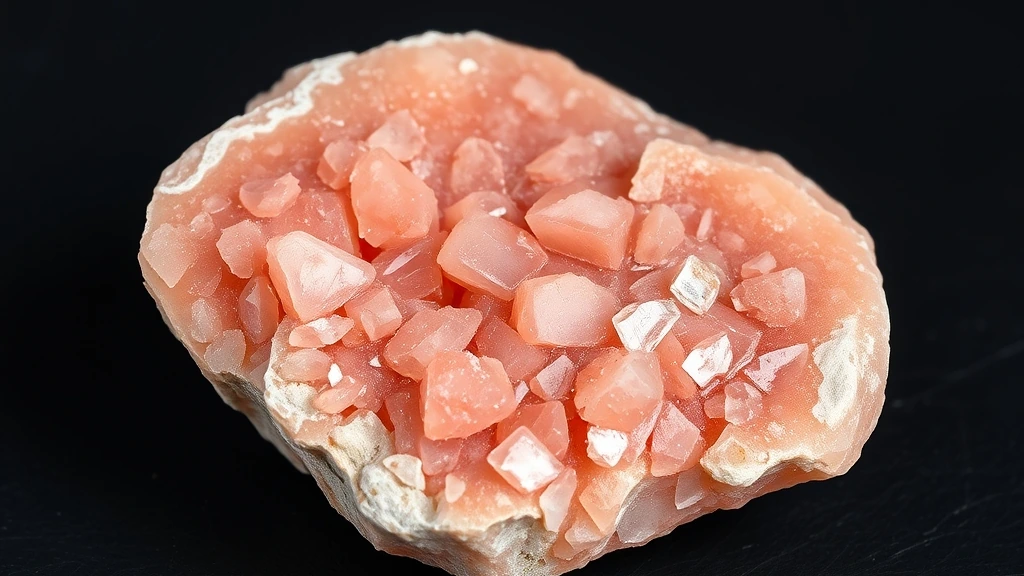
Strawberry calcite belongs to the broader carbonate mineral group, specifically within the natural mineral and crystal classification. It forms through the precipitation of calcium carbonate in specific geological environments. The stone’s unique appearance results from trace impurities rather than fundamental structural changes. Its identity is firmly rooted in standard mineralogical taxonomy.
What is Strawberry Calcite? Geological Overview & Definition
Strawberry calcite is defined by its intense pink to red coloration, which distinguishes it from common white or clear calcite varieties. This hue arises from manganese oxide inclusions or trace elements within the crystal lattice. Geologists classify it as a secondary mineral formation, often found in hydrothermal veins. The name derives from its resemblance to strawberry seeds or flesh. If you’re drawn to the vivid pink of strawberry calcite, you may also appreciate the luminous, sky‑blue hues of Stellar Beam Calcite, which share a similar calcite structure while offering a complementary energetic resonance.
The mineral typically occurs in trigonal crystal habits, displaying rhombohedral or scalenohedral shapes. Its Mohs hardness of 6.5 to 7.0 indicates a relatively durable structure compared to softer carbonates. Formation occurs in limestone or dolomite deposits where fluid chemistry shifts. This process allows for the incorporation of chromophoric elements during crystal growth.
Strawberry Calcite Chemical Composition & Crystallographic Properties
The primary chemical composition is calcium carbonate (CaCO₃), forming a stable trigonal crystal system. The lattice structure features a rhombohedral arrangement of calcium and carbonate ions. This specific symmetry dictates the mineral’s cleavage and fracture patterns. No distinct stoichiometric formula exists for the colored variety beyond the parent compound. While the base mineral structure remains consistent across the calcite family, the distinct green hues of Pistachio Calcite arise from trace impurities that subtly alter the optical properties of this same trigonal lattice.
Coloration stems from chromophore color centers, primarily involving manganese or iron impurities. These trace elements substitute for calcium ions within the lattice structure. The resulting optical properties create the characteristic strawberry-like appearance. Cation substitution is the key mechanism driving this visual variation.
The mineral exhibits moderate acid sensitivity, reacting with dilute hydrochloric acid to release carbon dioxide. This reaction confirms its carbonate identity and aids in field identification. Thermal behavior remains stable under standard geological conditions. However, extreme heat may alter surface luster without changing the core structure.
Crystallographic analysis reveals a trigonal lattice with distinct axial ratios. The refractive index varies slightly based on impurity concentration. This structural consistency ensures reliable identification under polarized light. Understanding these properties is essential for accurate gemological assessment.
| Property | Specification |
|---|---|
| Mineral Group | Natural Mineral / Crystal |
| Chemical Formula | CaCO₃ |
| Mohs Hardness | 6.5 – 7.0 |
| Crystal System | Trigonal |
| Specific Gravity (Density) | 2.71 |
| Refractive Index | 1.486 – 1.658 |
| Color & Optical Properties | Natural Strawberry Calcite color spectrum and optical dispersion |
| Primary Mining Localities | Global primary localities |
| Water & Chemical Resistance | EXTREMELY SENSITIVE: Water Soluble / Moisture Sensitive! (Avoid liquids) |
| Chakra Alignment (Traditional) | Heart Chakra (Anahata) |
| Zodiac Affinity (Traditional) | Capricorn, Taurus |
| Symbolic Meaning (Traditional) | Grounding, vitality and protection |
Strawberry Calcite Varieties & Color Spectrum
Strawberry Calcite displays distinct mineralogical characteristics across its geological varieties and structural habits. Gemologists evaluate these natural varieties based on crystal habit, trace chromophore concentrations, and visual luster.
Primary Natural Strawberry Calcite
The benchmark natural variety exhibiting diagnostic color saturation and classic crystallographic symmetry.
Distinct Geological Morphs of Strawberry Calcite
Secondary regional and structural varieties formed under localized geological temperature and pressure conditions.
Strawberry Red Calcite
Formed in low‑temperature hydrothermal veins, Strawberry Red Calcite displays a vivid pink‑to‑scarlet hue caused by trace manganese and iron oxides. Thin, parallel growth bands give the stone a marbled appearance, while occasional calcite‑in‑calcite inclusions create a subtle translucency. This variety is most abundant in the Mendoza Province of Argentina, yet remains moderately rare due to its limited vein development.
Pink‑Orange Calcite (Mango)
The Pink‑Orange, often called “Mango” calcite, originates in the weathered zones of carbonate-rich limestone where oxidizing conditions introduce nickel and copper chromophores. Its surface exhibits a buttery glow with occasional microscopic vesicles that scatter light, enhancing the warm tone. Primary localities include the Mendoza and San Luis regions of Argentina, and smaller deposits in Namibia, where the mineral is prized for its vivid coloration.
Light Pink Calcite (Rose)
Light Pink or Rose Calcite crystallizes in the trigonal system as rhombohedral aggregates within dolomitic marble. The delicate pink shade results from minimal iron substitution, producing a uniform, almost translucent body with faint growth striations. This variety is widely traded from Argentina’s San Juan Province and is comparatively abundant, making it a staple in ornamental lapidary work.
White‑Streaked Strawberry Calcite
A rarer morph, White‑Streaked Strawberry Calcite, exhibits a dominant scarlet matrix intersected by white calcite veins that create a striking striped pattern. The veins form during late‑stage recrystallization when silica‑rich fluids infiltrate the host rock, leaving behind micro‑fracture fillings. Notable occurrences are reported from Mendoza’s La Rioja district, where the mineral commands premium prices among collectors.
Deep Crimson Calcite (Bloodstone)
Deep Crimson, sometimes dubbed “Bloodstone” calcite, attains its intense color through higher concentrations of chromium and hematite inclusions, imparting a near‑opaque, blood‑red body. The stone often contains minute metallic flecks that catch light, giving a shimmering effect. This variety is exceptionally scarce, sourced from isolated pockets in Argentina’s Andes foothills, and is sought after for high‑end jewelry.
Pale Salmon Calcite (Blush)
Pale Salmon or Blush Calcite forms in evaporitic basins where fluctuating pH levels promote the precipitation of fine‑grained calcite with subtle sulfur traces. The resulting color is a soft salmon pink with a smooth, waxy luster and occasional microscopic bubbles that add depth. Small but consistent deposits are found in Namibia’s Otjozondjupa region, where the stone is exported for decorative carving.
Where is Strawberry Calcite Found? Geological Mining & Extraction
Strawberry Calcite primarily occurs in trigonal calcite crystals embedded within siliceous limestone and dolomitic marble host rocks. Hydrothermal fluids rich in CO₂ and trace metals infiltrate fissures, precipitating the colored calcite in vein and cavity fillings; the resulting deposits are often zoned, displaying vivid color gradients from core to rim.
Commercial extraction concentrates in the Mendoza and San Juan provinces of Argentina, where open‑pit and small‑scale underground mines exploit the mineral’s near‑surface veins. Additional, albeit limited, production comes from Namibia’s Otjozondjupa and Erongo regions, where artisanal miners employ hand‑tool methods to preserve the stone’s delicate crystal habit.
Historical Significance & Cultural Lore of Strawberry Calcite
Across ancient lapidary traditions, Strawberry Calcate was prized for its heart‑warming hue, appearing in Greco‑Roman amulets intended to promote love and emotional balance. Egyptian tomb inventories list pink calcite beads among grave goods, suggesting a belief in the stone’s protective qualities for the afterlife.
In early Vedic texts, red‑tinged calcite is associated with the Anahata (Heart) Chakra, symbolizing grounding, vitality, and protection; artisans fashioned it into prayer beads and talismans. Chinese mineralogists of the Han dynasty documented the stone’s “strawberry” coloration, noting its use in decorative inlays for ceremonial vessels.
Modern Uses & Jewelry Applications of Strawberry Calcite
Strawberry calcite is prized for its distinctive pink‑red hue and subtle translucency, making it a favorite in contemporary lapidary work. Skilled cutters fashion it into smooth cabochons that showcase its natural luster, while faceted pieces highlight its crystalline facets for more dramatic sparkle. The stone is also carved into ornamental motifs for decorative panels, garden ornaments, and architectural accents.
- Cabochon: Polished, dome‑shaped surfaces ideal for rings, pendants, and earrings.
- Faceted: Sharp, angular cuts that enhance brilliance for engagement settings.
- Carving: Intricate designs for wall art, vases, and garden sculptures.
Metaphysical Properties & Traditional Meaning of Strawberry Calcite
According to historical traditions and metaphysical lore, strawberry calcite is believed to ground the wearer while encouraging emotional healing. Across ancient Mediterranean and Vedic lapidary practices, the stone is associated with the Heart Chakra (Anahata), fostering compassion and emotional balance. Its gentle pink tones are thought to soothe anxiety, promote vitality, and protect against negative energies. In general metaphysical circles, the stone is revered for enhancing courage and fostering a sense of inner stability.
Which Chakra and Zodiac Signs Align with Strawberry Calcite?
The Heart Chakra (Anahata) is the primary energetic center linked to strawberry calcite, resonating with love, compassion, and emotional equilibrium. This alignment supports the stone’s use in healing rituals and emotional therapy.
The canonical zodiac signs that harmonize with strawberry calcite are Capricorn and Taurus. These earth signs reflect the stone’s grounding qualities and its capacity to reinforce determination and resilience.
How to Identify Real vs. Fake Strawberry Calcite
Artificial imitations of strawberry calcite often appear as dyed glass or synthetic crystals, lacking the natural internal structure and subtle color variations of genuine specimens. These replicas may exhibit a uniform, overly saturated hue and a smooth, glassy surface that betrays their non‑natural origin.
Practical At-Home Authenticity Tests
- Temperature Test (Thermal Feel): Hold the stone in your hand; real calcite feels cool to the touch for a few seconds, whereas glass warms quickly.
- Specific Gravity & Weight Test: Compare the stone’s weight to a known calcite sample of similar size; genuine calcite will be slightly heavier due to its mineral density.
- Scratch & Hardness Test (Mohs Comparison): Use a steel nail or a quartz crystal (Mohs 7) to test resistance; strawberry calcite should resist scratching, confirming a hardness between 6.5 and 7.0.
- Microscopic & Loupe Inspection (Internal Inclusions): Under magnification, real calcite displays fine, fibrous inclusions or subtle color zoning, while synthetic glass appears uniformly clear or shows artificial layering.
Strawberry Calcite Valuation Factors, Grading & Pricing
Market value is primarily driven by Color Saturation, where deep, uniform crimson hues command higher premiums than pale or mottled specimens. The stone’s natural energetic luster must appear vibrant and unclouded, indicating a well-preserved surface free from etching or weathering. Collectors seek intense red tones that reflect the iron-oxide impurities responsible for the distinctive strawberry appearance.
Pricing is determined by Crystal Size & Weight (Grams), with larger, intact specimens commanding significant premiums over smaller fragments. Raw crystals are valued for their natural matrix inclusions and geometric integrity, while tumbled stones are graded strictly by polish quality and surface smoothness. Dimensional consistency and the absence of major fractures or cleavage planes directly influence the final market appraisal.
Ethical Sourcing & Locality Premium plays a critical role in holistic and collector markets, where provenance transparency enhances perceived value. Stones from historically significant or geologically rare localities often fetch higher prices due to their archival and metaphysical appeal. Verified documentation of origin ensures authenticity, protecting buyers from synthetic imitations or misidentified calcite varieties in the secondary market.
How to Clean and Care for Strawberry Calcite
Strawberry Calcite is extremely sensitive to water and moisture, as liquid exposure can dissolve the mineral structure or cause severe surface damage. You must never wash the stone with water, liquid soap, or damp cloths, as these methods compromise its structural integrity. Ultrasonic cleaning is strictly forbidden because the vibrations and liquid medium accelerate degradation and can shatter delicate crystal formations.
To maintain the specimen’s clarity, gently dust the surface using a completely dry, soft microfiber cloth or a fine camel-hair brush. Store the stone in a low-humidity environment away from direct liquids, condensation, or high-moisture areas like bathrooms. Regular, gentle dry dusting preserves the natural luster without risking chemical or physical erosion of the calcite lattice.
Cleansing and Recharging Strawberry Calcite (Energetic Care)
For energetic maintenance, use herbal smudging with sage or palo santo to clear stagnant energy without exposing the stone to moisture. Hold the stone near the smoke for a few minutes, allowing the aromatic vapors to interact with the surface safely. This dry method respects the mineral’s water-soluble nature while fulfilling traditional holistic cleansing practices.
Alternatively, place the stone on a selenite charging slab or expose it to gentle moonlight for several hours to restore its vibrational balance. Avoid direct, intense sunlight or any form of domestic heating, as thermal stress can fracture the trigonal crystal lattice. These passive, dry recharging techniques ensure the stone remains structurally sound while revitalizing its metaphysical properties.
Frequently Asked Questions About Strawberry Calcite
Strawberry Calcite displays distinct mineralogical characteristics across its geological varieties and structural habits. Gemologists evaluate these natural varieties based on crystal habit, trace chromophore concentrations, and visual luster.
Primary Natural Strawberry Calcite
The benchmark natural variety exhibiting diagnostic color saturation and classic crystallographic symmetry.
Distinct Geological Morphs of Strawberry Calcite
Secondary regional and structural varieties formed under localized geological temperature and pressure conditions.
Is Strawberry Calcite safe to wear in the shower?
No, it is not water‑resistant.
Strawberry Calcite is extremely sensitive to moisture; even brief exposure can cause it to dissolve or become cloudy. Keep it away from showers, pools, or humid environments to preserve its color and structural integrity.
How should I clean Strawberry Calcite to avoid damage?
Use a dry soft microfiber cloth or a gentle brush.
Because water and moisture can dissolve the mineral, cleaning should be performed with a dry cloth or a soft brush to remove dust. Avoid any liquid cleaners or soap solutions.
Can I use an ultrasonic cleaner on Strawberry Calcite?
No, ultrasonic cleaning is strictly forbidden.
The vibrations and water used in ultrasonic cleaners can cause the mineral to dissolve or develop surface damage. Stick to dry cleaning methods only.
Does Strawberry Calcite have any special care instructions for storage?
Store it in a dry, cool place away from direct sunlight.
Humidity and heat accelerate the dissolution of calcite. Keep the stone in a sealed, moisture‑free container or a dry jewelry box to maintain its vivid hue.
Which zodiac signs are associated with Strawberry Calcite?
Capricorn and Taurus.
In astrological traditions, Strawberry Calcite is linked to the earth‑signs Capricorn and Taurus, symbolizing stability and grounded energy.
Which chakra does Strawberry Calcite correspond to?
Heart Chakra (Anahata).
This gemstone is believed to activate the Heart Chakra, promoting emotional balance, compassion, and love.
Can Strawberry Calcite be used in jewelry that is exposed to sweat?
It is not recommended.
Sweat contains moisture that can slowly erode the mineral. If worn, remove the piece before prolonged exposure to sweat and dry it immediately with a soft cloth.
Does Strawberry Calcite have any known health benefits or metaphysical properties?
It is thought to support grounding, vitality, and protection.
Many practitioners associate Strawberry Calcite with grounding energy, helping to stabilize emotions and enhance personal strength, though these effects are anecdotal and not scientifically proven.