
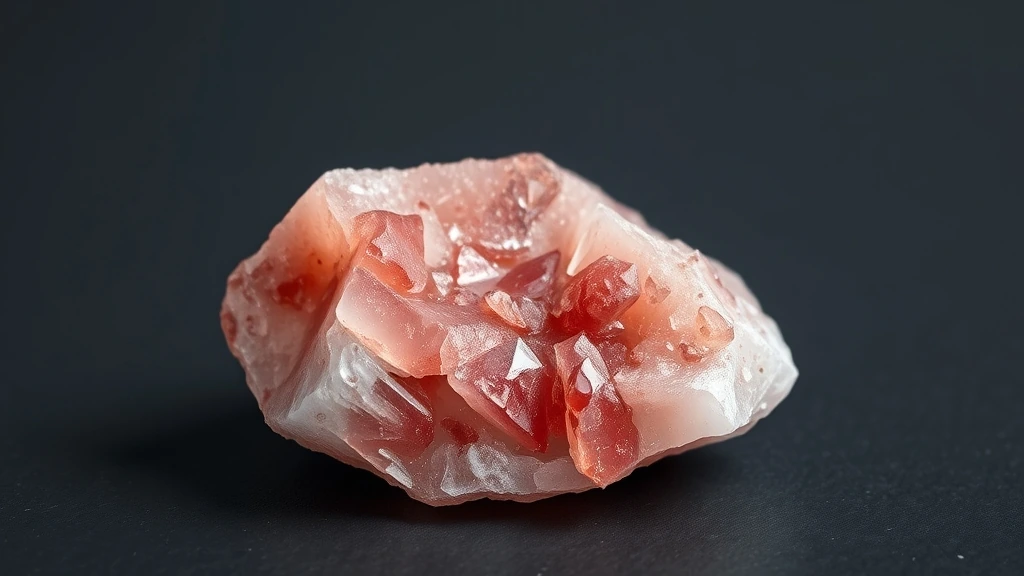
Strawberry quartz belongs to the extensive silicate mineral family, specifically classified within the tectosilicate subclass. As a member of the quartz group, it shares fundamental structural properties with other silica-based minerals. Its geological formation involves the slow crystallization of silica-rich hydrothermal fluids within igneous or metamorphic host rocks. These conditions allow for the incorporation of trace elements and mineral inclusions that define its unique aesthetic and physical characteristics.
What is Strawberry Quartz? Geological Overview & Definition
Strawberry quartz is a variety of clear quartz distinguished by its internal inclusions of hematite or lepidocrocite. These microscopic iron oxide particles create the stone’s characteristic pink to deep red coloration. The inclusions often form distinct, flower-like patterns within the transparent silica matrix.
Geologically, this mineral forms in hydrothermal veins associated with granite or rhyolite intrusions. The silica-rich fluids cool slowly, allowing large crystals to develop over millions of years. The presence of iron-bearing minerals during this process is critical for the final gemstone appearance. This natural inclusion pattern differentiates it from dyed or synthetic imitations.
Strawberry Quartz Chemical Composition & Crystallographic Properties
Strawberry quartz crystallizes in the trigonal crystal system, specifically exhibiting rhombohedral or trapezohedral habits. Its lattice structure consists of a continuous three-dimensional framework of silicon-oxygen tetrahedra. This tectosilicate arrangement provides high structural stability and isotropic optical properties. The unit cell parameters reflect the symmetry inherent to the alpha-quartz polymorph. In comparative mineralogical collections, practitioners and geologists frequently study Chinese Writing Stone alongside this crystal to appreciate their subtle energetic and structural differences.
The primary chemical composition is pure silicon dioxide (SiO₂), with no significant cation substitution in the host lattice. The coloration arises from chromophore centers created by iron oxide inclusions, not lattice defects. These inclusions remain chemically distinct from the surrounding silica matrix. The mineral is chemically inert to most weak acids, though strong alkalis can etch the surface. In comparative mineralogical collections, practitioners and geologists frequently study Caribbean Blue Calcite alongside this crystal to appreciate their subtle energetic and structural differences.
Thermal behavior remains stable under standard jewelry conditions, with no significant phase transitions below 573°C. The refractive index ranges from 1.544 to 1.553, contributing to its glassy luster. Density measurements consistently average 2.65 g/cm³, aligning with pure quartz standards. This thermal and optical consistency confirms its identity as a natural silica mineral.
| Property | Specification |
|---|---|
| Mineral Group | Silicates (Tectosilicates / Quartz Group) |
| Chemical Formula | SiO₂ (Silicon Dioxide) |
| Mohs Hardness | 7.0 |
| Crystal System | Trigonal (Rhombohedral / Trapezohedral) |
| Specific Gravity (Density) | 2.65 |
| Refractive Index | 1.544 – 1.553 |
| Color & Optical Properties | Natural Strawberry Quartz color spectrum and optical dispersion |
| Primary Mining Localities | Brazil, Madagascar, USA (Arkansas), Swiss Alps |
| Water & Chemical Resistance | High (Fully resistant to water and moisture) |
| Chakra Alignment (Traditional) | All Chakras (Universal Harmonizer) |
| Zodiac Affinity (Traditional) | All Zodiac Signs (Especially Leo and Aries) |
| Symbolic Meaning (Traditional) | Master energy amplifier, clarity, purification, and focus |
Strawberry Quartz Varieties & Color Spectrum
Strawberry Quartz displays distinct mineralogical characteristics across its geological varieties and structural habits. Gemologists evaluate these natural varieties based on crystal habit, trace chromophore concentrations, and visual luster.
Primary Natural Strawberry Quartz
The benchmark natural variety exhibiting diagnostic color saturation and classic crystallographic symmetry.
Distinct Geological Morphs of Strawberry Quartz
Secondary regional and structural varieties formed under localized geological temperature and pressure conditions.
Strawberry Quartz (Natural Red‑Pale Quartz)
Strawberry quartz is a silicon dioxide variant that displays a subtle pink to salmon hue due to trace amounts of chromium or iron. It forms in rhombohedral crystal systems within granite pegmatites, where slow cooling allows color‑bearing impurities to diffuse. The stone is prized for its gentle, translucent appearance and is commonly used in jewelry as a subtle accent. While not extremely rare, high‑quality specimens with vivid pinks are sought after by collectors.
Strawberry Quartz with Black Inclusions (Black‑Strawberry Quartz)
This variety incorporates minute black mica or graphite inclusions that create a striking contrast against the pink matrix. The inclusions are typically lamellar mica or graphite flakes, giving the stone a “strawberry‑with‑black‑berries” look. It forms in the same pegmatitic environments but often near fault zones where graphite can be introduced. The rarity lies in the precise balance of pink matrix and black inclusions, making it a favorite for statement pieces.
Strawberry Quartz with White Inclusions (White‑Strawberry Quartz)
White inclusions, usually quartz or feldspar fragments, give this variety a speckled, “strawberry‑with‑white‑berries” appearance. The inclusions are often quartz micro‑fractures that scatter light, enhancing the stone’s translucency. These stones are typically found in granite or pegmatite bodies where quartz crystals grow in close proximity. Rarity depends on the density of white specks; highly speckled specimens are prized for their visual complexity.
Strawberry Quartz with Green Inclusions (Green‑Strawberry Quartz)
Green inclusions, often from chlorite or serpentine, produce a vibrant contrast against the pink background. The green fragments are usually thin, leaf‑like plates that reflect light, giving the stone a subtle iridescence. These inclusions form when the quartz crystallizes in environments rich in phyllosilicate minerals. The combination of pink matrix and green specks is uncommon, making this variety a collector’s gem.
Strawberry Quartz from the Kola Peninsula (Kola‑Strawberry Quartz)
The Kola Peninsula in Russia yields strawberry quartz with a distinct deep salmon hue and occasional black mica inclusions. The region’s granite pegmatites are rich in trace elements that impart the characteristic color. These stones are valued for their consistency and the rarity of large, well‑formed crystals. They are often marketed under the regional name “Kola‑Strawberry Quartz” to emphasize provenance.
Strawberry Quartz from the United States (American Strawberry Quartz)
American strawberry quartz, particularly from the Baker Creek region of Arkansas, shows a light pink to peach tone with occasional white quartz inclusions. The local pegmatites contain high silica content, allowing for the formation of large, transparent crystals. These stones are relatively abundant but high‑quality specimens with vivid color and minimal inclusions are sought after by jewelers.
Where is Strawberry Quartz Found? Geological Mining & Extraction
Strawberry quartz typically occurs in granite pegmatites where slow crystallization allows trace elements such as chromium or iron to diffuse into the quartz lattice. The mineral is often found in association with feldspar and mica, and can be extracted through standard open‑pit or underground mining techniques that target these coarse‑grained bodies.
Major production centers include the Kola Peninsula in Russia, the Baker Creek area of Arkansas in the United States, and scattered deposits in China and India. Extraction involves careful crushing and screening to isolate the larger, color‑rich crystals, followed by sorting by color intensity and inclusion content for market grading.
Historical Significance & Cultural Lore of Strawberry Quartz
Across ancient lapidary traditions, strawberry quartz was valued for its subtle beauty and symbolic associations with love and passion. In Greco‑Roman jewelry, the stone was often set in cameo or filigree to accentuate feminine adornments, while Egyptian artisans occasionally used it in amulets believed to protect against envy.
Chinese alchemists recorded strawberry quartz as a “rose‑colored stone” that could enhance clarity of thought and was incorporated into ceremonial vessels. Vedic texts mention a similar pink quartz as a “heart stone,” used in rituals to balance emotional energy. These diverse cultural references underscore the stone’s enduring appeal across civilizations.
Modern Uses & Jewelry Applications of Strawberry Quartz
Lapidaries primarily cut strawberry quartz into cabochons to showcase its soft, internal color zoning and delicate inclusions. The stone’s moderate hardness allows for intricate faceted designs that maximize brilliance without risking excessive chipping during polishing. Because the pink hues often appear in distinct bands or clouds, skilled cutters orient the rough material carefully to enhance visual depth and saturation.
- Cabochon Settings: Dominant in rings and pendants, this smooth dome shape highlights the stone’s internal “strawberry” speckles and soft glow.
- Faceted Cuts: Oval, round, and pear shapes are popular for earrings and studs, where light refraction enhances the refractive index of 1.544–1.553.
- Ornamental Carvings: Larger pieces are sometimes carved into beads, spheres, or small figurines for collectors and decorative displays.
- Mixed Media Jewelry: Often paired with white quartz or clear rock crystal to create contrast and emphasize the stone’s subtle pink tones.
Metaphysical Properties & Traditional Meaning of Strawberry Quartz
According to historical traditions and metaphysical lore, strawberry quartz is revered as a master energy amplifier that promotes clarity and purification. Ancient Mediterranean and Vedic texts often associate pink-hued quartz varieties with the heart’s emotional resilience and the ability to transmute negative feelings. Practitioners believe the stone’s gentle vibration encourages focus and mental stillness, making it a favored tool for meditation and introspection.
The gemstone’s symbolic meaning centers on emotional resonance and spiritual balance, serving as a bridge between physical and energetic states. In universal lapidary lore, it is viewed as a stone of compassion that helps the wearer navigate complex interpersonal dynamics with grace. Its subtle aesthetic appeal reinforces its reputation as a calming influence, fostering a sense of inner peace and harmonious connection to the surrounding environment.
Which Chakra and Zodiac Signs Align with Strawberry Quartz?
Strawberry quartz is traditionally aligned with All Chakras, functioning as a Universal Harmonizer that balances the entire energy system. Rather than targeting a single center, it is believed to smooth energetic blockages across the root, sacral, solar plexus, heart, throat, third eye, and crown chakras. This holistic approach supports overall well-being and ensures that no single energy center becomes overactive or depleted during spiritual practice.
In astrological contexts, the stone resonates with All Zodiac Signs, offering broad compatibility for diverse personality types. However, it is considered particularly potent for Leo and Aries, whose fiery natures benefit from the quartz’s cooling and clarifying properties. For these signs, the gemstone is thought to temper impulsivity and enhance leadership qualities through improved emotional stability and focused intent.
How to Identify Real vs. Fake Strawberry Quartz
Distinguishing genuine strawberry quartz from artificial imitations requires attention to subtle visual and physical cues, as synthetic glass and dyed replicas are common in the market. Synthetic glass often lacks the natural inclusions found in real quartz and may display uniform coloration without the characteristic cloudiness. Dyed replicas, frequently made from clear quartz or other low-value stones, may show color concentration along cracks or surface pores, indicating artificial enhancement.
Practical At-Home Authenticity Tests
- Temperature Test (Thermal Feel): Genuine quartz feels cool to the touch initially and warms slowly, whereas plastic or glass imitations often reach room temperature more quickly.
- Specific Gravity & Weight Test: Real strawberry quartz has a density of 2.65 g/cm³, making it feel heavier than similarly sized glass or plastic substitutes.
- Scratch & Hardness Test (Mohs Comparison): With a Mohs hardness of 7.0, genuine quartz will not be scratched by a steel knife or glass, while softer imitations may show visible marks.
- Microscopic & Loupe Inspection (Internal Inclusions): Use a 10x loupe to look for natural inclusions like tiny bubbles (in glass) or fluid-filled fractures; real quartz typically shows natural, irregular inclusions rather than perfect clarity or uniform dye patterns.
Strawberry Quartz Valuation Factors, Grading & Pricing
The market places the greatest premium on color saturation. Deep, uniform pink hues that echo fresh strawberries are prized for their visual vibrancy and the way they capture light, creating a natural energetic luster. Stones with uneven or washed-out tones are graded lower, regardless of size or clarity.
Crystal size & weight (grams) drive pricing more than traditional carat metrics. Larger, well‑proportioned specimens that weigh several grams command higher prices, especially when the surface is expertly tumbled to a high polish. Raw, unpolished pieces may be valued for their natural matrix inclusions, but polished stones fetch a clear premium.
Collectors increasingly factor ethical sourcing & locality premium into their purchases. Quartz harvested from responsibly managed mines in Brazil, Madagascar, or the United States commands higher prices, reflecting both reduced environmental impact and support for local communities. Provenance documentation adds credibility and can elevate market value across holistic and fine‑art circles.
How to Clean and Care for Strawberry Quartz
Gentle cleaning with warm water and a mild soap solution restores Strawberry Quartz’s sparkle without harming its structure. Submerge the stone briefly, agitate lightly with a soft brush, then rinse in clean lukewarm water and pat dry with a lint‑free cloth. The mineral tolerates ultrasonic cleaning, provided it is not heavily fractured or contains large internal cracks.
Cleansing and Recharging Strawberry Quartz (Energetic Care)
A simple, dry method for energetic renewal involves passing the stone through a gentle stream of incense smoke, such as sage or cedar, allowing the fragrant particles to clear stagnant vibrations. Follow this by placing the quartz on a clean selenite slab for several hours, where the neutral selenite field can absorb and release any accumulated energy.
Alternatively, expose the crystal to soft moonlight on a clear night, positioning it on a natural wood surface to avoid direct heat. The subtle lunar illumination is believed to recharge the stone’s subtle frequencies without altering its crystal lattice, leaving it ready for continued use in meditation or decorative settings.
Frequently Asked Questions About Strawberry Quartz
Strawberry Quartz displays distinct mineralogical characteristics across its geological varieties and structural habits. Gemologists evaluate these natural varieties based on crystal habit, trace chromophore concentrations, and visual luster.
Primary Natural Strawberry Quartz
The benchmark natural variety exhibiting diagnostic color saturation and classic crystallographic symmetry.
Distinct Geological Morphs of Strawberry Quartz
Secondary regional and structural varieties formed under localized geological temperature and pressure conditions.
Is strawberry quartz safe to wear in the shower?
Yes, strawberry quartz is fully water‑resistant. Its silica composition makes it impervious to moisture, so daily activities like showering or swimming will not degrade the stone. The trigonal crystal lattice remains stable, and no surface etching occurs, even with prolonged exposure to warm water.
How should I clean strawberry quartz at home?
Clean it with warm water and a mild soap, then rinse and pat dry. This gentle method removes oils and residues without harming the SiO₂ structure. For stubborn grime, a soft brush can be used, but avoid abrasive pads that could scratch the surface.
Can strawberry quartz be placed in an ultrasonic cleaner?
Yes, it is suitable for ultrasonic cleaning unless the stone is heavily fractured. The high‑frequency vibrations efficiently dislodge particles from the crystal faces. If the piece has cracks, the process may exacerbate them, so inspect the stone before use.
Does strawberry quartz enhance any zodiac sign?
It benefits all zodiac signs, with particular resonance for Leo and Aries. In astrological lore, the stone’s universal harmonizer energy amplifies the fire‑element traits of these signs, supporting confidence and leadership while still offering balance to every chart.
Which chakras does strawberry quartz align with?
It aligns with all chakras, acting as a universal harmonizer. The stone’s master energy‑amplifying properties help clear blockages throughout the subtle body, promoting holistic flow from the root to the crown without favoring a single energy center.
Will strawberry quartz change color over time?
No, its pink hue remains stable under normal conditions. The coloration is caused by microscopic iron oxide inclusions trapped within the quartz lattice, which are not prone to fading from light or heat. Proper care will preserve its vibrant appearance indefinitely.
Is strawberry quartz a good choice for jewelry that receives heavy wear?
Yes, its Mohs hardness of 7 makes it durable for everyday wear. While not as hard as diamond, it resists scratches from most metals and common abrasives. Pairing it with protective settings further safeguards the rhombohedral facets against impact.
Can strawberry quartz be used in meditation or energy work?
Absolutely; it is prized for clarity, purification, and focus. Practitioners cite its ability to amplify master energies, enhancing intention setting and visualisation. Holding the stone during meditation can help balance the aura and promote a sense of centered calm across all chakras.