
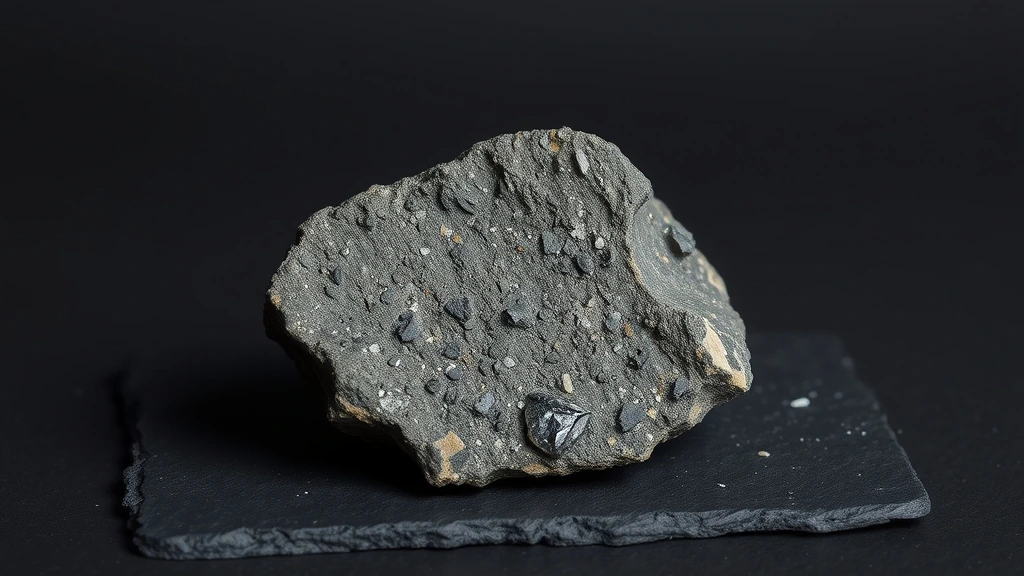
Tenorite belongs to the natural mineral group, forming as a primary oxide in the oxidation zones of copper deposits. It crystallizes in the monoclinic system, producing prismatic to tabular crystals that often aggregate into massive, botryoidal masses. Typically found in arid, oxidizing environments, tenorite records the late-stage supergene alteration of primary sulfide ores such as chalcopyrite. Its occurrence signals a mature weathering profile and provides valuable clues to the geochemical history of copper districts.
What is Tenorite? Geological Overview & Definition
Tenorite is the mineralogical name for the copper(II) oxide phase that precipitates from aqueous solutions rich in Cu²⁺ under oxidizing conditions. It appears as black, submetallic crystals or massive aggregates, frequently coating the surfaces of other copper minerals in the supergene envelope.
The mineral is classified within the oxide class of the Dana system and is the only naturally occurring CuO species. Its formation requires relatively low temperatures (often below 200 °C) and a supply of oxygenated groundwater, making it a reliable indicator of near-surface copper alteration.
Tenorite Chemical Composition & Crystallographic Properties
The ideal chemical formula of tenorite is CuO, reflecting a simple 1:1 ratio of copper to oxygen in a stoichiometric lattice. In nature, minor cation substitution (e.g., Zn²⁺ or Fe²⁺) can occur, subtly modifying its density and color without altering the fundamental oxide framework.
Tenorite crystallizes in the monoclinic crystal system, typically in space group C2/c, with lattice parameters that produce elongated, prismatic habits. The structure consists of edge‑sharing CuO₆ octahedra forming sheets that stack along the b‑axis, imparting the mineral its characteristic cleavage and fracture patterns.
Acid sensitivity is a notable property: dilute acids readily dissolve tenorite, releasing Cu²⁺ ions and producing a characteristic blue‑green solution. This reactivity underscores its role as a transient phase in the supergene oxidation sequence, often giving way to secondary carbonates such as malachite.
Color in tenorite arises from d‑electron transitions within the Cu²⁺ ion, creating black to dark gray tones that can appear metallic under reflected light. Upon heating above 400 °C, the mineral undergoes a reversible phase change to a higher‑symmetry tetragonal form, yet the monoclinic structure re‑establishes upon cooling, preserving its diagnostic crystallography.
| Property | Specification |
|---|---|
| Mineral Group | Natural Mineral / Crystal |
| Chemical Formula | CuO |
| Mohs Hardness | 3.5–4 |
| Crystal System | Monoclinic |
| Specific Gravity (Density) | 6.5 |
| Refractive Index | 2.05 – 2.10 |
| Color & Optical Properties | Natural Tenorite color spectrum and optical dispersion |
| Primary Mining Localities | Global primary localities |
| Water & Chemical Resistance | High (Safe for gentle water washing) |
| Chakra Alignment (Traditional) | Root Chakra |
| Zodiac Affinity (Traditional) | Taurus, Virgo, Capricorn |
| Symbolic Meaning (Traditional) | Grounding, stability, and protection |
Tenorite Varieties & Color Spectrum
Tenorite presents a limited but visually distinct range of natural color morphs, primarily dictated by crystal lattice purity and trace element substitution. The standard specimen exhibits a deep, opaque black with a metallic to sub-metallic luster, reflecting its high refractive index of 2.05 to 2.10. While pure CuO is strictly black, minor impurities can introduce subtle brownish or greenish tints in massive aggregates.
Classic Black Tenorite
This primary variety forms in the oxidized zones of copper deposits, often appearing as thin crusts or botryoidal masses. Its visual signature is defined by a velvety, matte surface that transitions to a bright metallic sheen on cleavage planes. The monoclinic crystal system allows for distinct prism faces, though well-formed crystals are exceptionally rare in commercial specimens.
Greenish-Brown Tenorite
Occurring in heavily weathered environments, this morph contains trace amounts of iron oxides and hydroxides within the crystal structure. The resulting hue shifts from pure black to a dark, earthy greenish-brown, often mimicking the appearance of malachite in rough form. Inclusions of chalcopyrite or pyrite are common, adding speckled metallic accents that complicate visual identification.
Botryoidal Tenorite
This variety grows in rounded, grape-like clusters, typically found lining cavities in host rocks such as limestone or dolomite. The surface texture is rough and granular, with individual crystals too small to resolve without magnification. Its high density of 6.5 g/cm³ provides a distinct heft, distinguishing it from lighter black minerals like hematite.
Crystalline Tenorite
Rarely found as isolated prisms, this variety displays the true monoclinic habit with well-defined basal and lateral faces. These specimens are highly sought after by mineral collectors due to their geometric precision and optical clarity. The Mohs hardness of 3.5–4 makes them susceptible to abrasion, requiring careful handling during extraction and display.
Where is Tenorite Found? Geological Mining & Extraction
Tenorite primarily occurs in the oxidized zone of copper ore bodies, forming through the weathering of primary sulfide minerals like chalcopyrite. It is frequently associated with other secondary copper minerals, including malachite, azurite, and chrysocolla, within host rock formations such as limestone and dolomite. These deposits are typically found in arid or semi-arid regions where oxidation processes are most active.
Major extraction regions include the Copper Canyon in Mexico, the Azincourt mines in France, and various sites in the United States and Australia. Mining operations often target the underlying sulfide ores, with tenorite recovered as a byproduct during the processing of oxidized material. Due to its low economic value compared to metallic copper, it is rarely mined specifically for gemstone purposes.
Historical Significance & Cultural Lore of Tenorite
Ancient civilizations utilized tenorite primarily as a source of copper oxide for metallurgical processes rather than as a decorative gemstone. Archaeological evidence suggests its use in early smelting techniques, where it served as a flux to lower the melting point of copper ores. The mineral’s deep black color also led to its occasional use in primitive pigment preparations for artistic and ritualistic applications.
In modern esoteric traditions, tenorite is associated with the Root Chakra, symbolizing grounding, stability, and protection. Practitioners often link its energy to the earth element, recommending it for individuals seeking emotional balance and physical resilience. This contemporary lore contrasts sharply with its industrial past, highlighting the mineral’s dual identity as both a raw material and a spiritual symbol.
Modern Uses & Jewelry Applications of Tenorite
Tenorite’s deep black‑green hue and high refractive index make it attractive for niche lapidary work, though its modest Mohs hardness limits extensive cutting. Artisans typically fashion it into cabochons or shallow facets, emphasizing its natural luster rather than intricate brilliance. Ornamental carving—often small pendants or beads—leverages its density for a satisfying heft in jewelry pieces.
- Cabochon pendants showcasing polished convex surfaces.
- Simple faceted stones set in bezel settings for rings.
- Carved miniatures such as amulets, keychains, or decorative inlays.
Safety & Mineral Profile of Tenorite
Handling tenorite requires basic laboratory precautions: wear gloves and eye protection, as the copper oxide can irritate skin and mucous membranes if dust is inhaled. The mineral is chemically stable under ambient conditions but may darken when exposed to prolonged humidity. It is primarily a collector’s specimen, valued for scientific study and display rather than any crystal‑healing claims; any historical metaphysical lore should be treated as cultural anecdote, not evidence of therapeutic benefit.
Mineralogical Group and Planetary Lore of Tenorite
Tenorite belongs to the monoclinic oxide group, sharing structural traits with other copper oxides such as cuprite. Its classification under the oxide category reflects a simple binary composition (CuO) that crystallizes in elongated prismatic habits, often forming botryoidal aggregates in oxidized copper deposits.
In planetary symbolism, tenorite has been linked to the planet Mars, echoing the metal copper’s association with the Red Planet’s fiery energy. Traditional folklore occasionally ascribes grounding and protective qualities to the stone, aligning it with the Root Chakra and the earth‑bound zodiac signs Taurus, Virgo, and Capricorn—though such attributions remain cultural rather than scientific.
How to Identify Real vs. Fake Tenorite
Artificial imitations of tenorite include dyed glass, polymer resins, and synthetic copper‑oxide powders that mimic its dark coloration. These substitutes lack the mineral’s characteristic density, crystal habit, and subtle internal inclusions. A careful visual and tactile assessment can usually separate genuine specimens from cheap replicas.
Practical At-Home Authenticity Tests
- Temperature Test (Thermal Feel): Tenorite feels noticeably cool to the touch and retains that coolness longer than glass or plastic, due to its higher thermal conductivity.
- Specific Gravity & Weight Test: With a density around 6.5 g/cm³, authentic tenorite feels substantially heavier than similarly sized quartz or glass, allowing a simple hand‑weight comparison.
- Scratch & Hardness Test (Mohs Comparison): Using a steel nail (≈5.5 on Mohs) will leave a faint scratch on tenorite, whereas glass (≈5.5–6) may not; a copper coin (≈3) will not mark it, confirming the 3.5–4 hardness range.
- Microscopic & Loupe Inspection (Internal Inclusions): Under 10×–30× magnification, natural tenorite shows microscopic crystal edges, botryoidal textures, or tiny mineral inclusions, whereas synthetic glass appears uniformly smooth and bubble‑free.
Tenorite Valuation Factors, Grading & Pricing
Specimen Aesthetic Quality drives the primary market value of tenorite, with collectors prioritizing deep, uniform black coloration and vitreous luster. High-grade specimens exhibit well-defined crystal faces that reflect light sharply, indicating minimal surface pitting or oxidation. The presence of an undamaged matrix enhances visual appeal, as it provides essential geological context for the crystal formation.
Rarity & Specimen Dimensions (Centimeters/Grams) significantly influence pricing, as large, intact crystal clusters are exceedingly difficult to extract without fracture. Collectors pay premiums for specimens exhibiting substantial mass and height, measured in centimeters and grams rather than gemstone units. The absence of handling damage, such as chipped edges or broken terminations, is critical for maintaining structural integrity and desirability.
Mineralogical Provenance & Locality Value plays a decisive role in scientific and museum acquisition markets. Specimens from historically significant localities, such as the famous deposits in Cornwall or the United States, command higher prices due to their documented geological importance. Verified origin certificates further authenticate the sample, ensuring its place within rigorous crystallographic and mineralogical research archives.
How to Clean and Care for Tenorite
Tenorite possesses a Mohs hardness of 3.5–4, making it relatively soft and susceptible to mechanical abrasion during routine maintenance. To preserve its surface, gently wash the specimen using warm soapy water and a soft, lint-free cloth to remove accumulated dust. This method effectively cleans the crystal faces without introducing harsh chemicals that could alter the oxide structure.
It is imperative to avoid ultrasonic cleaners entirely, as high-frequency vibrations can induce micro-fractures within the monoclinic lattice. After washing, rinse the mineral thoroughly with clean water and pat it dry immediately with a soft towel. Store the specimen in a dry, stable environment to prevent any potential moisture-related surface degradation over time.
Cleansing and Recharging Tenorite (Energetic Care)
For holistic energetic maintenance, practitioners often employ herbal smudging with sage or palo santo to clear perceived stagnant energies around the stone. This dry method respects the mineral’s physical structure while aligning with traditional metaphysical practices for grounding and stability. Ensure the area is well-ventilated to disperse smoke effectively without leaving residue on the crystal surfaces.
Alternatively, placing the tenorite on a selenite charging slab allows for gentle, passive energy renewal without direct environmental stress. This approach avoids the risks associated with intense light or heat, which could potentially destabilize the delicate crystal lattice. Maintaining a consistent, low-stress environment supports both the physical preservation and the intended esoteric properties of the specimen.
Frequently Asked Questions About Tenorite
Is tenorite safe to wear in the shower or while swimming?
Yes, tenorite tolerates gentle water exposure. Its high water resistance allows brief contact with water, such as a shower rinse or light swimming, but prolonged soaking should be avoided to prevent surface dulling. After exposure, gently pat dry with a soft cloth.
How should I clean a tenorite?
Clean tenorite with warm, soapy water and a soft cloth. Use a mild detergent, immerse the stone briefly, then wipe gently; avoid abrasive pads. This method removes oils without stressing the crystal lattice, preserving its monoclinic structure and luster.
Can I use an ultrasonic cleaner on tenorite jewelry?
No, ultrasonic cleaning is not recommended for tenorite. The high-frequency vibrations can create micro‑fractures in the relatively soft Mohs 3.5–4 mineral, leading to loss of clarity. Stick to manual cleaning with a soft cloth to maintain integrity.
What zodiac signs are associated with tenorite?
Tenorite aligns with Taurus, Virgo, and Capricorn. These earth‑signs are thought to resonate with the stone’s grounding energy, complementing its high density (6.5 g/cm³) and stabilizing properties in metaphysical practice.
Which chakra does tenorite activate?
Tenorite is linked to the Root Chakra. This connection supports grounding, stability, and protection, mirroring the mineral’s solid copper oxide (CuO) composition and its deep, earthy brown‑black hue.
Is tenorite suitable for everyday wear in jewelry?
Yes, tenorite can be set in everyday pieces with care. Its moderate hardness means it may scratch more easily than harder gems, so protect it from hard impacts. Regular cleaning with the recommended method will keep its refractive index (2.05‑2.10) bright.
Does tenorite have any notable physical properties that affect its use in lapidary work?
Tenorite’s monoclinic crystal system and density of 6.5 g/cm³ make it relatively heavy and prone to cleavage along specific planes. Lapidaries must orient the stone to minimize fracture risk, especially when polishing to reveal its metallic luster.
Can tenorite be used in metaphysical practices for protection?
Absolutely; tenorite is prized for protective qualities. Practitioners cite its ability to ground energy and shield against negative influences, aligning with the Root Chakra and the earth‑sign zodiac trio, thereby enhancing personal stability during meditation or ritual.