
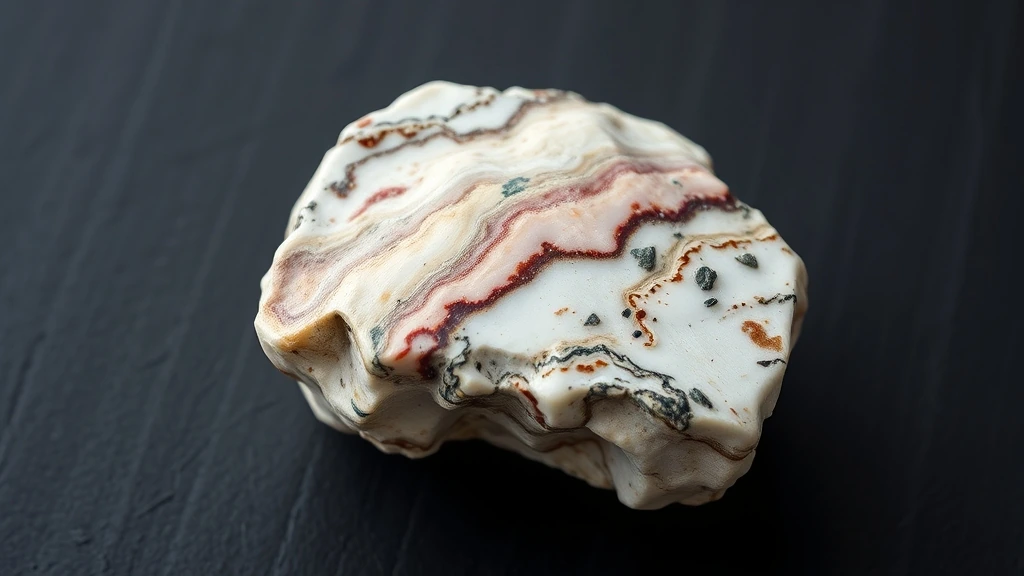
Unicorn Jasper belongs to the quartz group, specifically the chalcedony subgroup within the silicate mineral family. It is classified as a natural mineral aggregate rather than a single crystal, formed through the precipitation of silica-rich solutions in volcanic or sedimentary environments. This geological origin results in a microcrystalline structure that lacks visible individual grains to the naked eye. The stone is categorized under the broader Natural Mineral / Crystal parent group, distinguishing it from organic or synthetic gemstones.
What is Unicorn Jasper? Geological Overview & Definition
Unicorn Jasper is a banded jasper characterized by its unique ferroan inclusions that resemble ferns or unicorns. These patterns arise from the differential deposition of iron oxides within a silica matrix during diagenesis. The primary host material is chalcedony, a microcrystalline form of quartz that forms in cavities of volcanic rocks. This geological process creates the stone’s signature cryptocrystalline texture and intricate visual patterns. If you’re drawn to the earthy, volcanic origins of Unicorn Jasper, you may also appreciate the similarly grounded energy and striking banding of Volcano Agate.
The term “Unicorn Jasper” is a commercial lapidary name rather than a strict mineralogical classification. It refers to a specific aesthetic subset of jaspers found in various global deposits, including Brazil and the United States. The stone’s value is derived from the clarity and symmetry of its secondary mineral inclusions. Understanding this distinction is crucial for accurate gemological identification and market valuation.
Unicorn Jasper Chemical Composition & Crystallographic Properties
The fundamental chemical composition of Unicorn Jasper is silicon dioxide (SiO₂), identical to pure quartz. However, as a cryptocrystalline aggregate, it does not exhibit a single, large crystal lattice but rather a mosaic of microscopic crystals. The trigonal crystal system governs the atomic arrangement of the silica tetrahedra within each individual chalcedony grain. This lattice structure provides the stone with its characteristic isotropic optical properties and high chemical stability.
Coloration in Unicorn Jasper is driven by chromophore impurities, primarily iron oxides such as goethite (FeO(OH)) and limonite. These secondary minerals form the distinctive fern-like patterns against the colorless silica background. The cation substitution within the quartz lattice is minimal, as silica does not readily incorporate foreign ions without disrupting the tetrahedral bonding. This purity ensures the stone remains acid-resistant and chemically inert under standard environmental conditions.
Thermal behavior of chalcedony is stable, with no significant phase transitions occurring at ambient temperatures. The stone can withstand moderate heat, though extreme thermal shock may induce microfracturing within the aggregate structure. Its refractive index typically ranges from 1.53 to 1.54, consistent with quartz varieties. This optical consistency allows for precise gemological testing and differentiation from look-alike glass or plastic imitations.
| Property | Specification |
|---|---|
| Mineral Group | Natural Mineral / Crystal |
| Chemical Formula | SiO₂ |
| Mohs Hardness | 6.5 – 7.0 |
| Crystal System | Trigonal |
| Color & Optical Properties | Natural Unicorn Jasper color spectrum and optical dispersion |
| Primary Mining Localities | Global primary localities |
| Water & Chemical Resistance | High (Safe for gentle water washing) |
| Chakra Alignment (Traditional) | Throat Chakra (Vishuddha) |
| Zodiac Affinity (Traditional) | Sagittarius, Pisces |
| Symbolic Meaning (Traditional) | Spiritual awareness and universal harmony |
Unicorn Jasper Varieties & Color Spectrum
Unicorn Jasper displays distinct mineralogical characteristics across its geological varieties and structural habits. Gemologists evaluate these natural varieties based on crystal habit, trace chromophore concentrations, and visual luster.
Primary Natural Unicorn Jasper
The benchmark natural variety exhibiting diagnostic color saturation and classic crystallographic symmetry.
Distinct Geological Morphs of Unicorn Jasper
Secondary regional and structural varieties formed under localized geological temperature and pressure conditions.
Rainbow Unicorn Jasper
Formed in siliceous volcanic ash layers, Rainbow Unicorn Jasper displays a vivid banding of pink, green, and blue hues that appear to shift with light. Microscopic chalcedony inclusions create the characteristic iridescence, while iron oxide pigments impart the deeper reds. This variety is most common in Brazil’s Minas Gerais region and is prized for its striking visual depth, though high‑grade stones remain relatively scarce.
Aurora Unicorn Jasper
Aurora Unicorn Jasper originates from hydrothermal silica deposits within ancient basaltic flows, primarily in the United States’ western states. Its hallmark is a luminous, pastel spectrum of lavender, teal, and soft gold, produced by fine rutile needle inclusions that diffract light. The stone’s translucency and delicate color gradation make it a favorite among lapidaries, yet only a limited number of mines yield gem‑quality material.
Desert Unicorn Jasper
Found in arid sedimentary basins of Namibia, Desert Unicorn Jasper forms from silica cemented sandstones subjected to prolonged diagenesis. The stone exhibits earthy ochre, burnt orange, and muted mauve bands, punctuated by hematite specks that add a subtle sparkle. Its rugged texture and warm palette are abundant locally, but large, flaw‑free slabs are uncommon, driving up collector demand.
Oceanic Unicorn Jasper
Oceanic Unicorn Jasper is harvested from marine limestone formations along the coasts of Madagascar, where silica-rich fluids infiltrated carbonate matrices. The resulting stone showcases sea‑foam greens, aquamarine blues, and occasional pearl‑white veining, a result of calcite‑silica intergrowths. While the deposits are extensive, the finest pieces with uniform color transition are rare and highly sought after.
Alpine Unicorn Jasper
Alpine Unicorn Jasper emerges from high‑altitude quartzite veins in the Austrian Alps, where tectonic pressure induced recrystallization of silica. Its visual signature includes crisp white cores surrounded by pastel pink and sky‑blue halos, created by micro‑fracture filling with mineral pigments. The remote mining locations and limited output render this variety one of the most exclusive on the market.
Mystic Unicorn Jasper
Mystic Unicorn Jasper is a trade name for stones sourced from volcanic tuff deposits in Mexico’s Sierra Madre Oriental. The gem displays a swirling mix of violet, emerald, and amber, generated by fluorescent feldspar inclusions that react to UV light. Though marketed widely, true Mystic Unicorn Jasper with consistent coloration is scarce, making authenticated specimens valuable to collectors.
Where is Unicorn Jasper Found? Geological Mining & Extraction
Unicorn Jasper typically occurs within silica‑rich host rocks such as volcanic tuffs, basaltic flows, and quartzite veins, where hydrothermal fluids precipitate microcrystalline quartz. These deposits are often interlayered with iron oxides and rutile, producing the stone’s characteristic multicolored patterns; extraction requires careful blasting and hand‑sorting to preserve the delicate banding.
Major mining districts include Brazil’s Minas Gerais, Namibia’s Erongo Basin, Madagascar’s coastal limestone belts, and the Austrian Alps. In each locale, miners employ a combination of open‑pit and underground techniques, followed by meticulous washing and grading to separate gem‑quality Jasper from surrounding matrix material.
Historical Significance & Cultural Lore of Unicorn Jasper
Across ancient lapidary traditions, Unicorn Jasper was revered for its harmonizing colors, believed to balance the Throat Chakra (Vishuddha) and promote clear communication. In Greco‑Roman texts, the stone was described as “the rainbow of the earth,” used in amulets to ward off deceit, while Egyptian artisans incorporated it into funerary scarabs to symbolize rebirth.
Chinese records from the Han dynasty note the import of multicolored jasper for imperial seals, emphasizing its spiritual awareness qualities; Vedic scriptures similarly cite unicorn‑like jasper as a conduit for universal harmony, attributing it to the planet Jupiter. Archaeological finds of polished Jasper beads in Mesopotamian graves attest to its long‑standing value as a status symbol and protective talisman.
Modern Uses & Jewelry Applications of Unicorn Jasper
Unicorn Jasper is prized for its subtle, mottled hues that evoke the mythical creature’s mystique. Skilled lapidaries cut the stone into smooth cabochons or delicate faceted shapes, enhancing its natural play of light. The material also lends itself to ornamental carving, where artisans sculpt miniature unicorns or symbolic motifs that highlight the stone’s organic patterns.
- Cabochon and faceted settings for rings, pendants, and earrings
- Carved figurines and decorative panels for interior décor
- Engraved tabletops and mosaic tiles in contemporary design
Metaphysical Properties & Traditional Meaning of Unicorn Jasper
According to historical traditions and metaphysical lore, Unicorn Jasper is believed to foster spiritual awareness and promote universal harmony. Across ancient Mediterranean and Vedic lapidary lore, the stone is associated with the Throat Chakra (Vishuddha), encouraging honest expression and emotional balance. Its gentle, iridescent patterns are thought to soothe anxiety, inviting calmness and clarity in thought. In general lapidary lore, the stone’s mythical name reflects a belief in protection against negative energies and the encouragement of inner courage.
Which Chakra and Zodiac Signs Align with Unicorn Jasper?
Unicorn Jasper is canonically aligned with the Throat Chakra (Vishuddha), the energetic center governing communication and self‑expression. This alignment supports the stone’s role in enhancing clarity of speech and emotional honesty.
The stone’s celestial affinity is limited to the zodiac signs Sagittarius and Pisces. These signs are traditionally associated with expansive vision, intuition, and a deep connection to the metaphysical realm, resonating with Unicorn Jasper’s symbolic qualities.
How to Identify Real vs. Fake Unicorn Jasper
Collectors often encounter artificial imitations, such as dyed glass or synthetic quartz, that mimic the stone’s appearance. Genuine Unicorn Jasper displays a natural, irregular mottling and subtle color gradations that are difficult to replicate. Synthetic glass may exhibit a uniform sheen or a faint, artificial glow under light.
Practical At-Home Authenticity Tests
- Temperature Test (Thermal Feel): Hold the stone in your hand; real quartz feels cool to the touch for a few seconds, whereas glass warms quickly.
- Specific Gravity & Weight Test: Compare the stone’s weight to a known quartz sample of the same size; real quartz will be slightly heavier.
- Scratch & Hardness Test (Mohs Comparison): Use a steel file or a glass plate; real quartz will scratch glass but resist scratching by a steel file, reflecting a hardness of 6.5–7.0.
- Microscopic & Loupe Inspection (Internal Inclusions): Examine under a loupe for natural, irregular inclusions or subtle banding; synthetic replicas often show uniform patterns or artificial inclusions.
Unicorn Jasper Valuation Factors, Grading & Pricing
The market value of Unicorn Jasper hinges first on Color Saturation. Stones with vivid, evenly distributed hues and a natural energetic luster command premium prices, as collectors seek specimens that exhibit striking visual vibrancy.
Second, Crystal Size & Weight (Grams) plays a decisive role. Larger, well‑polished tumbled pieces that retain their natural matrix inclusions are prized over smaller, raw fragments. Buyers evaluate the overall mass and dimensions, preferring stones that demonstrate a balanced, robust form rather than those with uneven edges or excessive surface roughness.
Finally, Ethical Sourcing & Locality Premium influences pricing in both holistic and collector markets. Provenance from reputable, traceable mines—especially those adhering to fair‑trade practices—adds value, while stones sourced from renowned localities with a storied history of lapidary craftsmanship receive a premium due to their cultural significance and perceived authenticity.
How to Clean and Care for Unicorn Jasper
Cleaning Unicorn Jasper requires a gentle approach that respects its crystalline integrity. Use warm soapy water and a soft cloth, applying light pressure to remove surface dirt. After rinsing, pat the stone dry with a clean, lint‑free towel; avoid rubbing or scrubbing, which can induce microfractures. Never employ ultrasonic cleaners, as the vibration can compromise the structural stability of the quartz lattice.
Cleansing and Recharging Unicorn Jasper (Energetic Care)
To cleanse the energetic field of Unicorn Jasper, place the stone in a quiet space and allow it to absorb ambient moonlight for several hours. This gentle exposure revitalizes the crystal’s vibration without exposing it to heat.
Alternatively, rest the Jasper on a selenite charging slab while surrounding it with a small bundle of dried sage or palo santo. The subtle aromatic smoke can help clear residual energies, and the selenite slab serves as a conductive surface that facilitates the recharging of the stone’s natural frequencies.
Frequently Asked Questions About Unicorn Jasper
Unicorn Jasper displays distinct mineralogical characteristics across its geological varieties and structural habits. Gemologists evaluate these natural varieties based on crystal habit, trace chromophore concentrations, and visual luster.
Primary Natural Unicorn Jasper
The benchmark natural variety exhibiting diagnostic color saturation and classic crystallographic symmetry.
Distinct Geological Morphs of Unicorn Jasper
Secondary regional and structural varieties formed under localized geological temperature and pressure conditions.
Is Unicorn Jasper safe to wear in the shower?
Yes, Unicorn Jasper is water‑resistant and can be gently washed in the shower. The quartz‑based structure resists water damage, but avoid prolonged soaking or harsh detergents that could dull its surface. A light rinse and quick drying preserve its natural luster.
How should I clean my Unicorn Jasper to keep its color vibrant?
Use warm soapy water and a soft cloth, then pat dry with a microfiber towel. This gentle method removes surface grime without compromising the stone’s integrity. Avoid ultrasonic cleaners, which can induce microfractures in the quartz matrix.
Can I use ultrasonic cleaners on Unicorn Jasper?
No, ultrasonic cleaners should be avoided. The vibration can cause microfractures in the quartz structure, leading to surface damage. Stick to manual cleaning with warm soapy water and a soft cloth for best results.
What is the best way to store Unicorn Jasper when not in use?
Store it in a soft pouch or lined jewelry box away from direct sunlight. Light exposure can fade the stone’s natural patterns over time, while a padded environment protects it from scratches and accidental impacts.
Does Unicorn Jasper have any specific zodiac associations?
It is associated with Sagittarius and Pisces. These signs are believed to resonate with the stone’s energetic properties, enhancing intuition and creative expression in those born under these constellations.
Which chakra does Unicorn Jasper correspond to?
Unicorn Jasper aligns with the Throat Chakra (Vishuddha). This chakra governs communication and self‑expression, and the stone is thought to support clarity, confidence, and authentic dialogue.
Is Unicorn Jasper suitable for everyday jewelry?
Yes, it is suitable for everyday wear. Its moderate hardness (6.5–7.0 on the Mohs scale) provides durability, and its quartz composition resists scratching under normal conditions, making it a practical choice for daily accessories.
Can I use Unicorn Jasper for meditation or healing practices?
Absolutely, it is often used in meditation for spiritual awareness. The stone’s connection to the Throat Chakra encourages honest communication and inner truth, while its quartz nature supports clarity and focus during contemplative practices.