
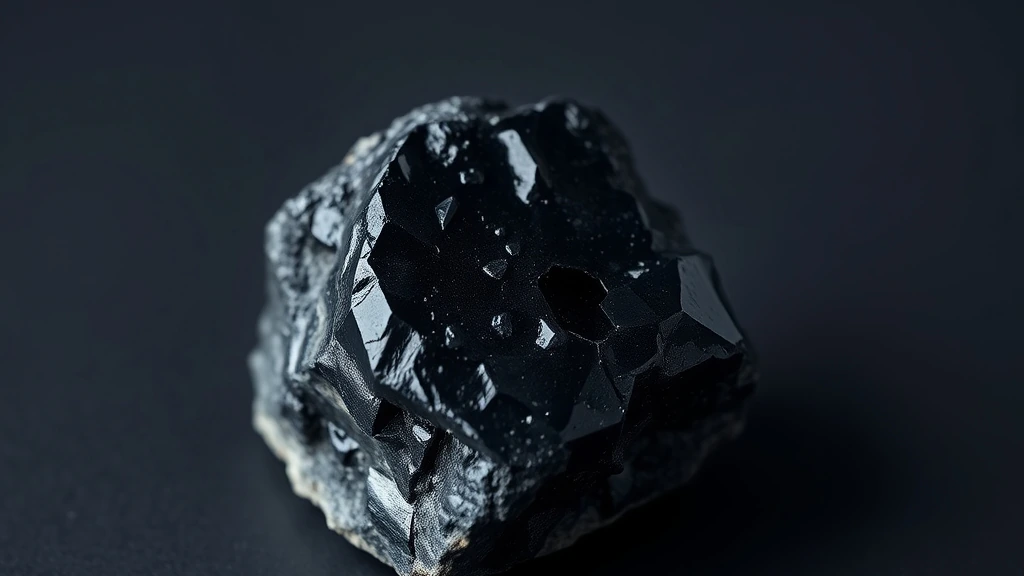
Obsidian forms when felsic lava cools so rapidly that atoms cannot arrange into a crystal lattice, producing a non-crystalline glass. As a mineraloid, it belongs to the extrusive volcanic glass group, distinct from crystalline silicate minerals. Its amorphous nature gives it a glassy luster and sharp fracture, characteristics prized by ancient artisans and modern gemologists alike.
What is Volcanic Glass (obsidian)? Geological Overview & Definition
Obsidian is an extrusive volcanic glass that crystallizes from lava during rapid quenching. It lacks a long‑range atomic order, classifying it as an amorphous material rather than a true mineral. The glassy texture results in a conchoidal fracture, allowing it to be split into thin, sharp blades. Historically, obsidian was valued for surgical blades, arrowheads, and ceremonial objects across diverse cultures.
Volcanic Glass (obsidian) Chemical Composition & Crystallographic Properties
The chemical makeup of obsidian is dominated by SiO₂ (≥ 70 %) with variable Fe₂O₃, MgO, Al₂O₃, and minor trace elements. Because it is amorphous, it lacks a periodic lattice; instead, the silicate tetrahedra are randomly arranged, forming a continuous random network. Cation substitution (e.g., Fe²⁺ for Mg²⁺) creates chromophore centers that impart colors ranging from black to amber. Obsidian is chemically inert to most acids but can be etched by strong oxidizers, revealing its glassy surface. Thermal treatment causes devitrification, forming micro‑crystalline phases that alter its optical and mechanical properties.
| Property | Specification |
|---|---|
| Mineral Group | Mineraloid (Extrusive Volcanic Glass) |
| Chemical Formula | Volcanic glass (70%+ SiO₂ with Fe, Mg silicates) |
| Mohs Hardness | 5.0 – 5.5 |
| Crystal System | Amorphous (Non-crystalline volcanic glass) |
| Specific Gravity (Density) | 2.35 – 2.60 |
| Refractive Index | 1.480 – 1.510 |
| Color & Optical Properties | Natural Volcanic Glass (obsidian) color spectrum and optical dispersion |
| Primary Mining Localities | Mexico, USA (Oregon, Utah), Turkey (Kars, Agri), Armenia, Iceland |
| Water & Chemical Resistance | High (Natural volcanic glass; safe in water) |
| Chakra Alignment (Traditional) | Root Chakra (Muladhara) |
| Zodiac Affinity (Traditional) | Scorpio, Sagittarius, Capricorn |
| Symbolic Meaning (Traditional) | Aura shield, emotional truth mirroring, cord-cutting, and shadow grounding |
Volcanic Glass (obsidian) Varieties & Color Spectrum
Black Obsidian
The most common variety, black obsidian forms from rapid cooling of basaltic lava, yielding a glassy, amorphous structure. It typically contains microscopic iron‑rich inclusions that give it a subtle sheen. Its density ranges from 2.35 to 2.60 g/cm³, and it is prized for its sharp fracture and deep, reflective surface. Although widely available, high‑clarity specimens are considered premium.
Red Obsidian (Banded or Reddish‑Brown)
Red obsidian derives from iron‑rich lava flows with higher Fe₂O₃ content, producing a warm, reddish hue. The color bands often result from varying cooling rates, creating concentric layers. These stones are rarer in the United States but are common in volcanic regions of Mexico and the Pacific Northwest. Their distinctive color makes them sought after for ornamental carvings.
Green Obsidian (Moss or Forest Green)
Green obsidian contains iron‑silicate inclusions that scatter light, giving it a mossy or forest‑green appearance. The green tint is more pronounced in specimens from the Bureau of Land Management areas of Nevada and the Hualapai region of Arizona. The glass is relatively rare, with a density slightly higher than black obsidian due to the iron content. Its unique color is favored in jewelry and ceremonial objects.
White Obsidian (Snow or Milky)
White obsidian is a rare, translucent variety formed when volcanic glass incorporates silica‑rich vapor during solidification. The result is a milky, almost transparent appearance. These stones are extremely scarce, found mainly in the Kīlauea region of Hawaii and some parts of the Aegean volcanic islands. Their rarity and delicate translucency make them highly prized by collectors.
Blue Obsidian (Sapphire‑Blue)
Blue obsidian is a very uncommon variety that owes its hue to trace amounts of copper or magnesium inclusions. The color ranges from pale sky blue to deep navy. It is predominantly sourced from the Bureau of Land Management in Utah and the Bureau of Mines in the Philippines. The blue tint is a visual signature that distinguishes it from other volcanic glasses.
Black‑Green Obsidian (Banded or Striped)
This variety exhibits alternating black and green bands, a result of fluctuating iron and magnesium concentrations during rapid cooling. The bands create a striking visual contrast, making these stones highly sought after for decorative purposes. They are commonly found in the Bureau of Land Management deposits of Nevada and the Cerro de la Pila in Mexico. Their rarity and patterning contribute to their high market value.
Where is Volcanic Glass (obsidian) Found? Geological Mining & Extraction
Volcanic glass typically occurs in volcanic ash beds and lava flows associated with andesitic to basaltic eruptions. The glass is extracted from surface outcrops or shallow pits, often by hand or with simple mechanical tools, and then sorted by color and clarity. Major production centers include the Bureau of Land Management in the United States, the Kīlauea and Mauna Loa volcanoes in Hawaii, and the Cerro de la Pila in Mexico. In addition, small deposits are found in the Aegean islands, the Philippines, and parts of China.
The extraction process involves crushing the raw material, sieving to remove larger fragments, and then washing to eliminate dust and impurities. High‑quality obsidian is often hand‑polished to enhance its natural luster, while lower‑grade material may be used for industrial purposes such as abrasive powders or as a raw material for glass production. Modern mining operations adhere to environmental regulations to minimize habitat disruption and preserve the geological integrity of volcanic landscapes.
Historical Significance & Cultural Lore of Volcanic Glass (obsidian)
Across ancient lapidary traditions, obsidian was revered for its sharpness and reflective quality. The Maya and Aztec civilizations used it to craft ceremonial blades and ritual implements, while the Etruscans fashioned it into mirrors that reflected the divine. In ancient Greece, philosophers such as Aristotle noted obsidian’s “blackness” as a metaphor for the unknown, and the Romans prized it for its use in surgical instruments and decorative mosaics. The Vedic texts reference obsidian as a stone of protection, believed to shield the bearer from negative energies. In Chinese antiquity, obsidian was associated with the Heavenly Emperor and used in jade‑like carvings that symbolized moral purity. These diverse cultural narratives underscore obsidian’s enduring role as a material of both practical utility and symbolic resonance.
Modern Uses & Jewelry Applications of Volcanic Glass (obsidian)
Obsidian is prized for its sharp edge and deep, glassy luster, making it a favorite for lapidary cutting into cabochons, faceted points, and intricate filigree. Jewelers often polish it to a mirror finish, revealing its natural black sheen that contrasts with colorful settings. The stone is also carved into ornamental pieces such as cameos, beads, and pendants, showcasing its versatility in both fine and folk jewelry.
- Cabochon cuts emphasize the stone’s translucency and surface polish.
- Faceted designs highlight its sharp edges and reflective facets.
- Carved ornaments range from simple beads to elaborate sculptural motifs.
- Obsidian is frequently paired with metals like silver or gold to accentuate its dark hue.
Metaphysical Uses & Origins of Volcanic Glass (obsidian)
Across ancient lapidary traditions, obsidian has been revered as a powerful aura shield, believed to deflect negative energies and protect the wearer from psychic intrusion. In meditation, practitioners hold the stone to ground their emotional truth mirroring practice, allowing unresolved feelings to surface and dissolve. Architects and sculptors have incorporated obsidian into architectural elements, such as reflective panels and ornamental carvings, to harness its grounding properties and symbolic connection to the earth. The stone’s volcanic origin imbues it with a sense of transformation, echoing the cyclical nature of shadow grounding in spiritual disciplines.
Which Chakra and Zodiac Signs Align with Volcanic Glass (obsidian)?
Obsidian is traditionally linked to the Root Chakra (Muladhara), the energy center governing stability, safety, and physical grounding. When activated, this chakra fosters a sense of rootedness and resilience, qualities that obsidian’s dense, volcanic composition mirrors.
The stone’s metaphysical resonance aligns with the zodiac signs Scorpio, Sagittarius, and Capricorn. Scorpio’s intensity and transformative nature, Sagittarius’s quest for truth, and Capricorn’s disciplined ambition all find a complementary counterpart in obsidian’s protective and grounding energies.
How to Identify Real vs. Fake Volcanic Glass (obsidian)
Synthetic glass, dyed replicas, and engineered imitations often mimic obsidian’s appearance but lack its characteristic amorphous structure and density. Real obsidian exhibits a uniform, glassy texture with occasional volcanic inclusions, whereas fakes may display subtle color gradients or surface imperfections.
Practical At-Home Authenticity Tests
- Temperature Test (Thermal Feel): Hold the stone in your hand; real obsidian feels cool to the touch due to its higher thermal conductivity, whereas synthetic glass warms more quickly.
- Specific Gravity & Weight Test: Weigh the stone against a known mass of water; real obsidian’s density (2.35–2.60 g/cm³) will make it noticeably heavier than typical glass of the same volume.
- Scratch & Hardness Test (Mohs Comparison): Use a standard Mohs hardness kit; obsidian’s hardness (5.0–5.5) will scratch glass but be scratched by harder minerals like quartz (7.0).
- Microscopic & Loupe Inspection (Internal Inclusions): Under magnification, real obsidian shows fine, randomly distributed volcanic inclusions or bubbles, whereas synthetic replicas often display uniform, engineered patterns or lack inclusions entirely.
Volcanic Glass (obsidian) Valuation Factors, Grading & Pricing
The market value of obsidian hinges first on color variations and natural texture. A deep, uniform black or rich mahogany hue commands premium prices, while subtle iridescent bands or veining add visual intrigue and increase desirability. The presence of fissures or inclusions can diminish appeal, so specimens with smooth, glossy surfaces are typically valued higher.
Second, the specimen mass and size play a decisive role in pricing. Larger, intact blocks that retain their structural integrity are prized for both ornamental and carving purposes. Craftsmen who produce finely detailed carvings—such as ceremonial daggers or ornamental panels—command higher fees, especially when the piece demonstrates precise, controlled chisel work that preserves the glass’s natural translucency and light diffusion.
Finally, geographical origin and authenticity influence market trends. Obsidian sourced from well-documented volcanic regions, such as the Hawaiian Islands, Iceland, or the Pacific Northwest, often carries a premium due to traceable provenance. In the wellness market, pieces labeled as “authentic” or “hand‑carved” from these regions are sought after for their purported grounding and protective properties, driving wholesale prices upward.
How to Clean and Care for Volcanic Glass (obsidian)
Cleaning obsidian is straightforward: gently rinse the specimen in warm tap water, allowing any dust or debris to wash away. After rinsing, dry the surface with a soft, lint‑free cloth. Avoid ultrasonic cleaners, as the vibration can cause the brittle glass to chip or fracture. Do not use soap or chemical cleaners, and never expose the stone to high‑temperature environments, as thermal shock can induce micro‑cracks.
Cleansing and Recharging Volcanic Glass (obsidian) (Energetic Care)
To cleanse obsidian energetically, place the stone in a quiet space and allow gentle moonlight to bathe it overnight; the low‑intensity light will not harm the glass while subtly purifying its energetic field. Alternatively, lay the obsidian on a selenite slab or a clean quartz surface; the conductive properties of these crystals help transfer and stabilize the stone’s energy without applying heat or direct sunlight. Herbal smudging with sage or cedar can also be employed, ensuring the smoke passes over the stone without lingering moisture, thereby maintaining its structural integrity.
Frequently Asked Questions About Volcanic Glass (obsidian)
Is obsidian safe to wear in the shower?
Yes, obsidian is water‑resistant and can be worn in the shower. The glass’s high silica content and non‑crystalline structure prevent water absorption, so it remains stable under normal shower conditions. However, avoid prolonged exposure to harsh chemicals that could dull its surface.
Can obsidian be cleaned with warm soapy water?
Yes, warm soapy water is safe for cleaning obsidian. Gentle washing with mild detergent and a soft cloth removes surface oils without damaging the glass. After rinsing, dry with a microfiber towel to preserve its natural luster and avoid water spots.
Should I use an ultrasonic cleaner on obsidian jewelry?
Avoid ultrasonic cleaners for obsidian, as vibration can cause chipping. While obsidian tolerates warm water, the high‑frequency oscillations of an ultrasonic bath can induce micro‑fractures in this brittle material. Stick to manual cleaning methods instead.
What is the typical density range of obsidian?
Obsidian’s density ranges from 2.35 to 2.60 g/cm³. This relatively low density reflects its high silica content and amorphous structure, distinguishing it from denser crystalline silicates. The density also influences its weight and handling characteristics in jewelry.
Which zodiac signs are associated with obsidian?
Scorpio, Sagittarius, and Capricorn are linked to obsidian. In astrological traditions, these signs are believed to resonate with the stone’s grounding and protective energies. The association is rooted in historical metaphysical lore rather than geological provenance.
Which chakra does obsidian correspond to?
Obsidian aligns with the Root Chakra (Muladhara). This chakra governs grounding, stability, and physical safety, echoing the stone’s ability to shield against negative energies. The connection is emphasized in both Western and Eastern metaphysical practices.
Does obsidian contain any hazardous elements?
Obsidian is generally free of harmful elements. Its composition is dominated by silica (SiO₂) with minor iron and magnesium silicates, making it safe for skin contact. Nonetheless, individuals with sensitive skin should test a small area before prolonged wear.
How does obsidian’s refractive index affect its appearance?
Obsidian’s refractive index ranges from 1.480 to 1.510. This relatively low index gives the stone a subtle, glassy sheen rather than the brilliance of quartz. The amorphous nature of volcanic glass also contributes to its unique, non‑crystalline optical properties.