
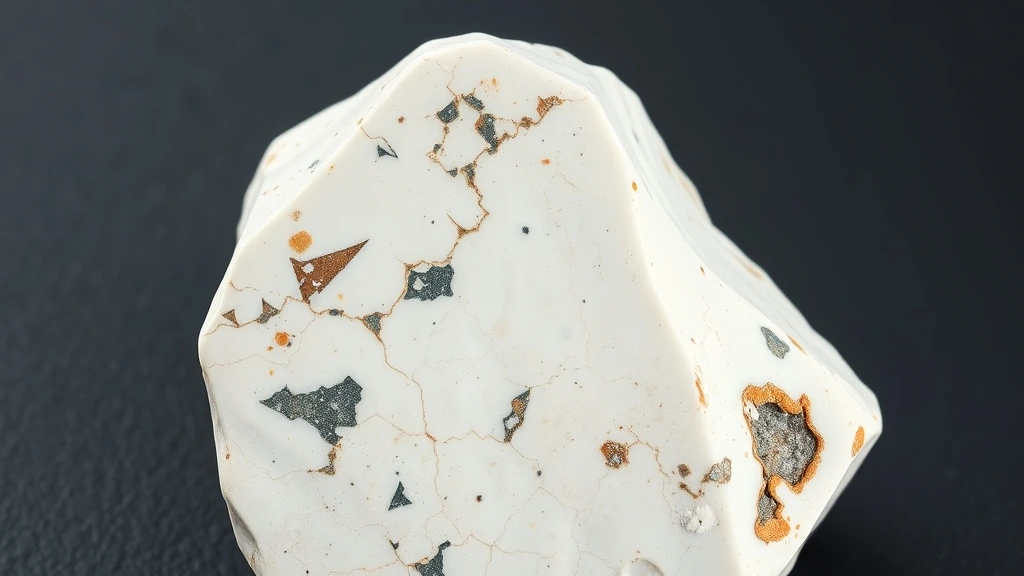
White Brecciated Jasper belongs to the broad family of natural mineral aggregates known as jasper, a cryptocrystalline variety of quartz that forms through silicification of sedimentary or volcanic deposits. Its texture results from the cementation of angular quartz clasts within a fine‑grained silica matrix, producing a brecciated pattern that records ancient tectonic or hydrothermal events. Though the rock lacks a single crystal lattice, its constituent quartz grains crystallize in the trigonal system, imparting the overall durability and translucence prized by lapidaries worldwide.
What is White Brecciated Jasper? Geological Overview & Definition
White Brecciated Jasper is an aggregate rock formed when silica‑rich fluids precipitate microcrystalline quartz around fragmented host material. The brecciated texture reflects a history of mechanical disruption followed by rapid mineral deposition, often in volcanic ash layers or fault zones. This same process of silica cementation binding fragmented volcanic material is also responsible for the formation of the Thunder Egg, a distinctive Oregonite variety that shares these brecciated origins.
Across ancient lapidary traditions, this jasper was valued for its uniform background tone, which highlighted the darker inclusions used in ceremonial seals and ornamental beads. Its formation environment—typically low‑temperature hydrothermal veins—produces a stone that is both aesthetically appealing and geologically informative. While the jasper’s uniform matrix serves as a canvas for its inclusions, collectors often pair it with Brown Agate to create a harmonious earth-tone palette that enhances the stone’s grounding metaphysical properties.
White Brecciated Jasper Chemical Composition & Crystallographic Properties
The primary mineral component of White Brecciated Jasper is quartz (SiO₂), whose individual crystals adopt a trigonal lattice with space group P3₁21 or P3₂21. Within the rock, these crystals interlock, while minor cation substitutions (e.g., Al³⁺ for Si⁴⁺) create subtle charge‑balance defects that influence growth habit.
Because the jasper is an aggregate, it exhibits acid sensitivity characteristic of silica; dilute hydrochloric acid will not dissolve the quartz but can etch surface impurities, revealing the underlying microstructure. Coloration arises from chromophore centers such as iron oxides or organic inclusions trapped during brecciation, which appear as faint gray or brown speckles against the white matrix.
Thermally, the quartz grains expand anisotropically, with a coefficient of expansion near 7 × 10⁻⁶ °C⁻¹ along the c‑axis. Heating above 573 °C triggers the quartz α‑β transition, potentially altering the brecciated pattern if the stone is subjected to rapid temperature changes. Nonetheless, the overall rock remains stable under typical gemstone handling temperatures.
| Property | Specification |
|---|---|
| Mineral Group | Natural Mineral / Crystal |
| Chemical Formula | SiO₂ |
| Mohs Hardness | 6.5 – 7.0 |
| Crystal System | Trigonal |
| Color & Optical Properties | Natural White Brecciated Jasper color spectrum and optical dispersion |
| Primary Mining Localities | Global primary localities |
| Water & Chemical Resistance | High (Safe for gentle water washing) |
| Chakra Alignment (Traditional) | Sacral Chakra (Svadhishthana) |
| Zodiac Affinity (Traditional) | Aries, Scorpio |
| Symbolic Meaning (Traditional) | Creativity, motivation and self-confidence |
White Brecciated Jasper Varieties & Color Spectrum
White Brecciated Jasper displays distinct mineralogical characteristics across its geological varieties and structural habits. Gemologists evaluate these natural varieties based on crystal habit, trace chromophore concentrations, and visual luster.
Primary Natural White Brecciated Jasper
The benchmark natural variety exhibiting diagnostic color saturation and classic crystallographic symmetry.
Distinct Geological Morphs of White Brecciated Jasper
Secondary regional and structural varieties formed under localized geological temperature and pressure conditions.
Classic White Brecciated Jasper
This variety derives from silica-rich pegmatites that have undergone extensive brecciation, producing a matrix of angular quartz fragments. The stone displays a pristine white background punctuated by irregular gray or black inclusions, giving it a speckled, almost celestial appearance. Its hardness of 6.5–7.0 makes it suitable for jewelry, while its relative abundance in the United States and Brazil keeps it moderately priced.
White Brecciated Jasper with Green Veining
In this type, mineralization introduces chlorite or epidote veins that cut through the white matrix, creating subtle green streaks. The veins often form a delicate lace pattern, enhancing the stone’s visual intrigue. Though more sought after by collectors, the green veining is still common in the Appalachian region, where quartzite formations host such mineral inclusions.
White Brecciated Jasper of the Himalayas
Originating from the high‑altitude Kangra and Sikkim pegmatites, this variety exhibits a milky white core with scattered hematite inclusions. The hematite grains impart a faint reddish hue, especially under polarized light. Its rarity stems from the limited accessibility of Himalayan deposits and the delicate extraction required to preserve the stone’s integrity.
White Brecciated Jasper with Amber Tones
This regional variant, found primarily in the Bavarian quarries, showcases amber‑colored inclusions that give the stone a warm, honeyed glow. The amber is often derived from fossilized plant resin trapped within the quartz matrix. The combination of white background and amber specks makes this variety prized among antique jewelry makers.
White Brecciated Jasper from the Carpathians
The Carpathian variety is distinguished by its black mica inclusions that form a subtle, almost metallic sheen. These mica flakes are aligned along the crystal planes, creating a faintly reflective surface. While the Carpathian deposits are well‑known, the precise alignment of mica makes this variety a favorite for decorative carvings.
White Brecciated Jasper of the Andes
In the Andean region, quartz breccias incorporate copper and magnetite inclusions, giving the stone a speckled grayish‑black pattern. The copper inclusions can produce a faint greenish tint when viewed under certain lighting conditions. Its scarcity is due to the challenging mining conditions in the high Andes, making it a coveted specimen for collectors.
Where is White Brecciated Jasper Found? Geological Mining & Extraction
White Brecciated Jasper is typically extracted from silica‑rich pegmatite veins that have experienced tectonic fracturing. These pegmatites are often hosted within granitic batholiths, where slow cooling allows large quartz crystals to form and later be broken into brecciated fragments. Major mining regions include the Appalachian Mountains in the United States, the quartzite belts of Brazil, and the granite‑rich zones of the Himalayas and Andes.
Extraction methods vary from open‑pit quarrying in accessible regions to underground mining in more remote locales. In places like the Appalachian and Carpathian ranges, surface mining is common, allowing for relatively straightforward processing of the breccia. In contrast, high‑altitude Andean and Himalayan deposits require specialized equipment and careful handling to preserve the fragile inclusions that define the stone’s aesthetic value.
Historical Significance & Cultural Lore of White Brecciated Jasper
Across ancient Greco‑Roman lapidary traditions, white brecciated quartz was prized for its perceived purity and protective qualities. Artifacts such as Roman cameos and Greek ornamental carvings often incorporated this stone, believing it to ward off evil and promote clarity of thought. In Egyptian funerary contexts, fragments of white quartz breccia were used in amulets, symbolizing the afterlife’s eternal light.
In Vedic lore, the stone’s white background was associated with the sacral chakra, believed to enhance creativity and self‑confidence. Chinese artisans also employed white brecciated quartz in jade‑like carvings, valuing its subtle inclusions for their resemblance to celestial patterns. These diverse cultural uses underscore the stone’s enduring appeal across civilizations, each attributing to it a blend of aesthetic beauty and metaphysical significance.
Modern Uses & Jewelry Applications of White Brecciated Jasper
Lapidaries primarily cut white brecciated jasper into cabochons due to its opaque nature and intricate internal patterns. The stone’s Mohs hardness of 6.5 to 7.0 makes it durable enough for everyday wear in rings and pendants. Artisans often utilize the natural brecciated texture to create unique, organic-looking jewelry pieces that stand out against uniform gemstones.
- Cabochon Cutting: Polished into smooth, domed shapes to highlight the swirling white and grey patterns without faceting.
- Ornamental Carvings: Used in small-scale sculptural work for decorative boxes, inlays, and architectural accents.
- Beads and Tumbled Stones: Commonly processed into uniform beads for bracelets or tumbled stones for collectors and meditation kits.
- Lapidary Art: Valued by hobbyists for its ease of polishing and distinct visual contrast within the silica matrix.
Metaphysical Uses & Origins of White Brecciated Jasper
In historical lapidary traditions, jasper was revered as a stone of protection and emotional balance. Practitioners often use white brecciated jasper during meditation to foster a sense of calm and mental clarity. The stone’s earthy composition supports grounding practices, helping individuals feel connected to the physical world during stressful periods.
Architects and artisans have long incorporated jasper into decorative arts for its aesthetic appeal and symbolic weight. The brecciated structure is believed to represent resilience, mirroring the stone’s geological history of fracture and re-cementation. This visual narrative resonates with those seeking to transform chaos into order through creative expression.
Which Chakra and Zodiac Signs Align with White Brecciated Jasper?
White brecciated jasper is canonically aligned with the Sacral Chakra (Svadhishthana), which governs creativity, motivation, and self-confidence. This energy center is associated with the flow of emotions and artistic expression. The stone’s neutral white tones are thought to balance the sacral energy, preventing emotional stagnation while encouraging dynamic movement.
Astrologically, this gemstone resonates strongly with Aries and Scorpio. Aries benefits from the stone’s ability to channel fiery energy into productive creative outlets. Meanwhile, Scorpio finds support in the jasper’s grounding qualities, which help manage intense emotional depths and facilitate transformation.
How to Identify Real vs. Fake White Brecciated Jasper
Artificial imitations of white brecciated jasper often involve dyed chalcedony, synthetic glass, or plastic composites designed to mimic the natural brecciated pattern. These fakes may lack the subtle color variations and natural inclusions found in genuine specimens. Understanding the physical properties of natural silica helps distinguish authentic stones from manufactured replicas.
Practical At-Home Authenticity Tests
- Temperature Test (Thermal Feel): Genuine jasper feels cool to the touch initially and warms slowly. Plastic imitations tend to feel warmer immediately and do not retain coldness as long.
- Specific Gravity & Weight Test: Natural jasper has a density of approximately 2.6 g/cm³. It should feel heavier than similarly sized glass or plastic fakes, which are typically lighter.
- Scratch & Hardness Test (Mohs Comparison): With a Mohs hardness of 6.5-7.0, real jasper will scratch glass (hardness 5.5) but may be scratched by quartz (hardness 7). Glass fakes often scratch more easily or show different wear patterns.
- Microscopic & Loupe Inspection (Internal Inclusions): Use a 10x loupe to check for natural brecciated inclusions and subtle color zoning. Synthetic glass often contains tiny, perfectly round air bubbles, while dyed stones may show color pooling in cracks.
White Brecciated Jasper Valuation Factors, Grading & Pricing
The market first evaluates color variations that range from milky white to subtle gray veining, each band reflecting the stone’s brecciated formation. Natural texture and the interplay of fine, irregular fractures create a distinctive aesthetic that collectors prize. Uniformity of tone and the presence of occasional quartz inclusions can raise the visual appeal and price bracket.
Specimen mass & size are critical, as larger blocks retain more of the original geological pattern and command higher values. Buyers consider the weight in grams or kilograms, noting that heftier pieces often require more careful handling during transport. Light diffusion through the porous matrix enhances the stone’s luminous quality, influencing both decorative and therapeutic uses.
Geographical origin & authenticity provide provenance that can dramatically affect pricing, especially when sourced from historically documented breccia fields. Certified origins reassure collectors that the material is not a synthetic composite, supporting market confidence. Current wholesale trends show a growing demand in ornamental and wellness sectors, where authentic white brecciated jasper is marketed for its grounding properties.
How to Clean and Care for White Brecciated Jasper
Cleaning should be performed with warm soapy water and a soft cloth, gently wiping the surface to remove dust and fingerprints. Avoid ultrasonic cleaners, as the delicate brecciated fractures can fracture under high-frequency vibrations. After cleaning, pat the stone dry with a lint‑free microfiber cloth to prevent water spotting. Store the jasper in a stable, low‑humidity environment to maintain its structural integrity over time.
Cleansing and Recharging White Brecciated Jasper (Energetic Care)
For energetic renewal, place the jasper on a clean selenite slab and allow the natural vibrational field of selenite to gently cleanse its aura. A brief exposure to moonlight, preferably during a waning phase, can refresh the stone’s subtle energy without introducing heat stress.
Alternatively, a light herbal smudging with sage or cedar, performed at a safe distance, can disperse stagnant vibrations while respecting the mineral’s physical stability. After smudging, return the jasper to a dry, shaded area to settle, ensuring no moisture contacts the surface.
Frequently Asked Questions About White Brecciated Jasper
White Brecciated Jasper displays distinct mineralogical characteristics across its geological varieties and structural habits. Gemologists evaluate these natural varieties based on crystal habit, trace chromophore concentrations, and visual luster.
Primary Natural White Brecciated Jasper
The benchmark natural variety exhibiting diagnostic color saturation and classic crystallographic symmetry.
Distinct Geological Morphs of White Brecciated Jasper
Secondary regional and structural varieties formed under localized geological temperature and pressure conditions.
Is White Brecciated Jasper safe to wear in the shower?
Yes, it is safe for gentle water washing. The stone possesses high water resistance, making it suitable for brief exposure to moisture. However, avoid prolonged soaking or harsh chemical soaps that might degrade the natural surface luster over time.
Can I use an ultrasonic cleaner on this stone?
No, you must avoid ultrasonic cleaners to prevent structural fractures. The brecciated nature of the stone contains natural fissures that are vulnerable to high-frequency vibrations. Instead, use warm soapy water and a soft cloth for safe, effective cleaning.
What is the Mohs hardness of White Brecciated Jasper?
It measures between 6.5 and 7.0 on the Mohs scale. This significant hardness makes it durable enough for daily wear in rings and bracelets. It resists scratching from common materials like steel, ensuring long-term aesthetic integrity.
Which zodiac signs are aligned with this?
Aries and Scorpio are the primary aligned zodiac signs. These earth and fire signs resonate with the stone’s grounding yet energetic properties. Wearing it may support the specific elemental traits associated with these astrological profiles.
What chakra does White Brecciated Jasper correspond to?
It aligns exclusively with the Sacral Chakra (Svadhishthana). This energy center governs creativity, motivation, and self-confidence. The stone’s subtle energy supports the flow of creative expression and emotional balance within this specific chakra.
What is the chemical composition of this mineral?
The primary chemical formula is SiO₂, indicating pure silica content. This composition classifies it as a variety of chalcedony within the quartz family. The specific white coloration results from the absence of iron oxide impurities during formation.
How should I store White Brecciated Jasper safely?
Store it in a soft pouch or separate compartment. While hard, the stone can still be scratched by harder gems like diamonds or sapphires. Keeping it isolated prevents surface abrasion and maintains its polished finish for years.
Does White Brecciated Jasper require special care for longevity?
Regular maintenance with warm soapy water is recommended. Avoid exposing the stone to extreme temperature changes, which could stress its internal structure. Gentle care ensures the natural brecciated patterns remain vibrant and undamaged.