
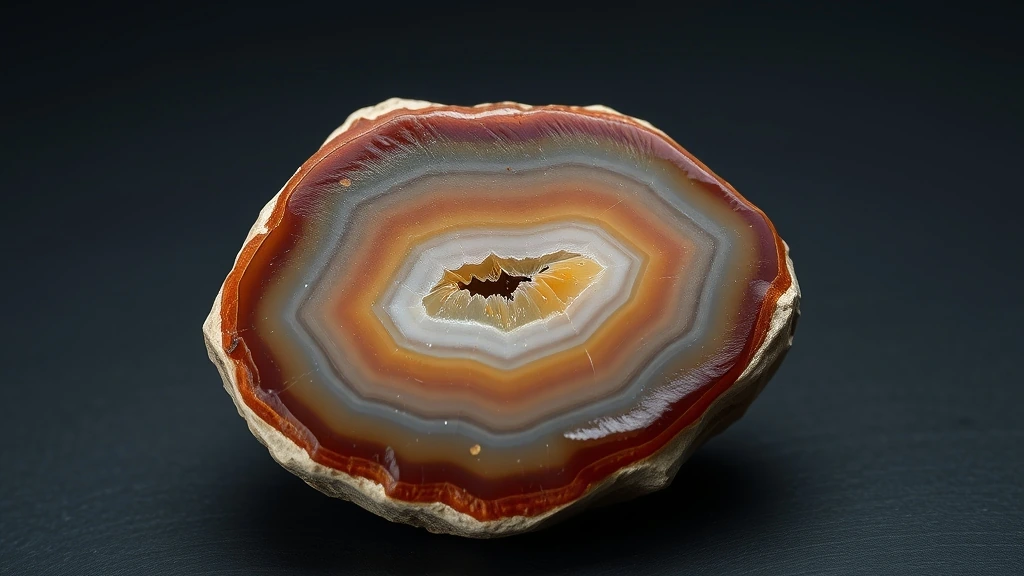
Brown agate belongs to the chalcedony family, a silicate aggregate composed of intergrown quartz and moganite fibers. These microcrystalline, fibrous aggregates crystallize in the trigonal system, giving the stone its characteristic translucency and banded patterns. Formed in volcanic cavities or sedimentary layers, the mineral’s fine‑grained texture results from rapid silica precipitation, often accompanied by iron oxides that impart its distinctive brown hues.
What is Brown Agate? Geological Overview & Definition
Brown agate is a cryptocrystalline chalcedony, a micro‑aggregate of quartz and moganite that lacks visible crystal faces. Its banded or mottled appearance arises from variations in iron content and silica layering, producing the rich brown palette prized by lapidaries worldwide.
In geological terms, agate forms when silica‑rich fluids fill voids in volcanic rocks, cooling slowly enough to produce concentric growth zones. Across ancient lapidary traditions, brown agate has been carved into seals, beads, and amulets, valued for both its aesthetic appeal and perceived protective qualities. While brown agate is prized for its earthy, protective energy, its visual cousin, Striped Agate, showcases the same silica-driven layering in vibrant, rhythmic bands that collectors often seek for their distinct aesthetic charm.
Brown Agate Chemical Composition & Crystallographic Properties
The material is an aggregate of SiO₂, without a single stoichiometric formula, composed of intergrown quartz (α‑quartz) and moganite crystals. Both components share the same trigonal crystal system, organized as microcrystalline fibrous aggregates that lack macroscopic cleavage. While the brown variety often displays earthy tones, the same microcrystalline fibrous structure that defines this stone is equally responsible for the serene hues found in Blue Agate.
Cation substitution is minimal; trace iron (Fe³⁺) replaces silicon in the lattice, creating chromophore color centers that generate the brown tones. These iron impurities also influence the stone’s response to acidic environments, where prolonged exposure can leach color‑bearing ions and dull the surface.
Thermally, brown agate remains stable up to about 600 °C; beyond this, dehydration of surface adsorbed water can cause micro‑fracturing. Heating can also induce subtle color shifts as iron oxidation states change, a technique sometimes employed by gem cutters to enhance depth of tone.
Overall, the trigonal microcrystalline framework imparts the stone’s characteristic hardness, refractive index (1.544–1.553), and density (2.60–2.65 g/cm³), confirming its classification within the chalcedony subgroup of the silicate mineral family.
| Property | Specification |
|---|---|
| Mineral Group | Silicates (Chalcedony / Cryptocrystalline Quartz) |
| Chemical Formula | SiO₂ (Silicon Dioxide) |
| Mohs Hardness | 6.5 – 7.0 |
| Crystal System | Trigonal (Microcrystalline / Cryptocrystalline fibrous aggregates) |
| Specific Gravity (Density) | 2.60 – 2.65 |
| Refractive Index | 1.544 – 1.553 |
| Color & Optical Properties | Natural Brown Agate color spectrum and optical dispersion |
| Primary Mining Localities | Brazil, Uruguay, Turkey, India, Madagascar |
| Water & Chemical Resistance | High (Safe for gentle warm water and mild soap; avoid harsh acids and chlorine) |
| Chakra Alignment (Traditional) | Root Chakra and Sacral Chakra |
| Zodiac Affinity (Traditional) | Gemini, Virgo, Taurus |
| Symbolic Meaning (Traditional) | Grounding, emotional balance, physical endurance, and protection |
Brown Agate Varieties & Color Spectrum
Brown agate exhibits a wide spectrum of earthy tones, ranging from pale tan to deep chocolate. These hues primarily result from trace amounts of iron oxides and organic matter within the silica matrix. The color distribution often follows the natural banding patterns characteristic of chalcedony. Understanding these variations is essential for accurate gemological identification and valuation.
Rio Grande Agate
Originating from the Rio Grande River in Texas, this variety features distinct brown and cream banding. It is prized for its high polish and durability in lapidary work. The cryptocrystalline structure allows for exceptional clarity in thinner slices. This type is commonly used in beads and cabochons for jewelry design.
Botswana Agate
Found in the Kalahari Desert, this variety often displays muted brown tones with subtle gray accents. The stones typically exhibit a smooth, waxy luster when polished. Desert weathering contributes to the rounded shapes and surface patina of these specimens. It is a popular choice for spiritual jewelry and meditation tools.
Brazilian Agate
Brazilian deposits yield agates with rich, dark brown bands and occasional red inclusions. The high silica content ensures a consistent Mohs hardness of 6.5 to 7.0. These stones are frequently cut into tumbled rocks for decorative purposes. Their vibrant coloration makes them a staple in the global gemstone market.
Siberian Agate
Sourced from Russia, this variety is known for its deep, uniform brown coloration. It often lacks the complex banding seen in other types, offering a solid appearance. The microcrystalline quartz structure provides excellent resistance to scratching. Collectors value its rarity and consistent hue for high-end carvings.
Madagascar Agate
Madagascar produces agates with unique brown and white zebra-like patterns. These stones often contain ferrous impurities that create the distinctive dark streaks. The high contrast makes them visually striking in polished form. They are widely exported for use in fashion jewelry and ornamental objects.
Indian Agate
Indian agates from the Deccan Plateau feature earthy brown tones with occasional greenish tints. The geological history of the region contributes to the diverse mineral inclusions. Volcanic activity played a key role in forming these silica-rich nodules. This variety is abundant and affordable, making it accessible for mass production.
Where is Brown Agate Found? Geological Mining & Extraction
Brown agate forms primarily in volcanic rock cavities and hydrothermal veins where silica-rich fluids cool slowly. These environments allow for the gradual deposition of silica layers, creating the characteristic banding. The host rocks are often basalt or rhyolite, which provide the necessary space for nodule growth. Understanding these geological contexts helps in locating high-quality deposits.
Major mining regions include Brazil, India, and the United States, where open-pit and riverbed extraction are common. In Brazil, agates are often found in alluvial deposits along riverbanks, facilitating easy collection. India’s Deccan Plateau offers extensive volcanic formations rich in agate nodules. These regions supply the majority of the global market for brown agate gemstones.
Historical Significance & Cultural Lore of Brown Agate
Ancient civilizations revered agate for its protective properties and connection to the earth. In Greco-Roman culture, agate was believed to ward off evil spirits and promote physical strength. Egyptian artisans used brown agate in amulets and scarabs for burial rituals. These artifacts often featured intricate carvings symbolizing protection in the afterlife.
In Vedic traditions, agate was associated with grounding and stability, enhancing physical endurance. Chinese jade carvers sometimes used agate as a substitute for jade in decorative items. The stone’s durability made it ideal for intaglio carving in ancient seals and signets. Its enduring presence in archaeological sites underscores its long-standing cultural significance.
Modern Uses & Jewelry Applications of Brown Agate
Brown agate is prized for its warm, earthy hues and subtle banding, making it a favorite in contemporary lapidary work. Artisans often cut the stone into cabochons for earrings, pendants, and rings, or leave it faceted to accentuate its natural texture. The material’s durability allows it to be carved into ornamental pieces such as cameos, seals, and decorative panels.
- Cabochon and faceted jewelry pieces
- Ornamental carvings and cameos
- Decorative panels and architectural accents
Metaphysical Properties & Traditional Meaning of Brown Agate
According to historical traditions and metaphysical lore, brown agate is revered as a stone of grounding and emotional balance. Ancient Mediterranean and Vedic lapidary texts describe it as a protector of the wearer, fostering physical endurance and shielding against negative energies. Across early archaeological records, the stone is linked to the Root and Sacral Chakras, symbolizing stability and creative vitality. Its warm tones are believed to soothe anxiety, encouraging calm and steady growth in personal endeavors.
Which Chakra and Zodiac Signs Align with Brown Agate?
Brown agate aligns with the Root Chakra, the energy center that governs grounding, safety, and basic survival instincts. Its connection to the Sacral Chakra enhances emotional expression and creative flow, supporting a balanced life rhythm.
The stone’s astrological affinity includes Gemini, Virgo, and Taurus. Those born under these signs are thought to resonate with brown agate’s stabilizing energies, fostering clarity, practicality, and a grounded approach to daily challenges.
How to Identify Real vs. Fake Brown Agate
Synthetic glass, dyed replicas, and artificial imitations often mimic the appearance of genuine brown agate. These copies may lack the stone’s natural microcrystalline structure and can exhibit unnatural optical properties.
Practical At-Home Authenticity Tests
- Temperature Test (Thermal Feel): Hold the stone in your hand; real agate feels cool to the touch initially but warms gradually, whereas glass heats up quickly and feels noticeably warmer.
- Specific Gravity & Weight Test: Weigh the stone against a known mass of water; genuine agate has a specific gravity of 2.60–2.65, making it noticeably heavier than glass of similar size.
- Scratch & Hardness Test (Mohs Comparison): Use a reference mineral of known hardness; agate (6.5–7.0) will scratch quartz (hardness 7) but not be scratched by a steel nail (hardness 5.5).
- Microscopic & Loupe Inspection (Internal Inclusions): Examine under a loupe for fibrous or cryptocrystalline inclusions typical of agate; glass will show uniform texture without natural banding or inclusions.
Brown Agate Valuation Factors, Grading & Pricing
Market value is primarily driven by Color Saturation, where deeper, uniform brown tones command higher premiums than pale or mottled specimens. Visual vibrancy and a natural, waxy luster significantly enhance aesthetic appeal for both collectors and holistic practitioners. Stones exhibiting consistent hue without abrupt color banding are considered superior in the global gemstone trade.
Pricing heavily depends on Crystal Size & Weight (Grams), as larger, intact pieces are rarer and more desirable for carving or display. Raw specimens with natural matrix inclusions often carry a premium over heavily processed tumbled stones due to their geological authenticity. Polish quality is critical, with smooth, defect-free surfaces reflecting superior craftsmanship and durability.
Ethical Sourcing & Locality Premium plays a growing role in holistic and collector markets, favoring transparent supply chains. Stones from renowned localities with verified provenance often fetch higher prices due to their historical and geological significance. Buyers increasingly prioritize vendors who provide detailed origin documentation and sustainable mining practices.
How to Clean and Care for Brown Agate
For routine maintenance, Warm soapy water is the ideal cleaning method for solid, untreated brown agate specimens. Gently scrub the surface with a soft-bristled toothbrush to remove accumulated dust and oils from natural fissures. Rinse thoroughly under lukewarm running water and dry immediately with a lint-free microfiber cloth to prevent water spots.
Ultrasonic cleaners must be avoided if the specimen is dyed, heavily fractured, or has undergone heat treatment. These high-frequency vibrations can exacerbate existing cracks or cause artificial colorants to leach out of the porous stone structure. Always inspect the stone for visible fractures before submerging it in any liquid solution.
Cleansing and Recharging Brown Agate (Energetic Care)
Holistic practitioners often recommend Herbal Smudging as a safe, dry method to clear perceived energetic stagnation from the stone. Pass the brown agate gently through the smoke of sage or palo santo for a brief period without direct flame contact. This traditional practice respects the mineral’s physical integrity while addressing metaphysical beliefs associated with grounding and protection.
Alternatively, place the stone on a Selenite Charging Slab or expose it to gentle moonlight overnight for passive recharging. Avoid direct, intense sunlight or domestic heating methods, as thermal stress can compromise the crystal lattice and cause internal fractures. These dry, low-energy techniques ensure the stone remains physically stable while aligning with its esoteric properties.
Frequently Asked Questions About Brown Agate
Brown Agate displays distinct mineralogical characteristics across its geological varieties and structural habits. Gemologists evaluate these natural varieties based on crystal habit, trace chromophore concentrations, and visual luster.
Primary Natural Brown Agate
The benchmark natural variety exhibiting diagnostic color saturation and classic crystallographic symmetry.
Distinct Geological Morphs of Brown Agate
Secondary regional and structural varieties formed under localized geological temperature and pressure conditions.
Is brown agate safe to wear in the shower?
Yes, it can be worn in the shower with care. Brown agate’s silicon dioxide structure gives it high water resistance, so gentle warm water and mild soap will not damage it. Avoid harsh acids, chlorine, or prolonged soaking, as these can etch the surface over time.
How should I clean a brown agate necklace?
Warm soapy water and a soft brush are ideal. Submerge the piece briefly in lukewarm water with a mild detergent, then gently scrub with a soft‑bristled brush to remove residues. Rinse with clean water and pat dry with a lint‑free cloth; ultrasonic cleaning is not recommended for treated stones.
Can I use an ultrasonic cleaner on brown agate?
Generally, you should avoid ultrasonic cleaning. While solid agate tolerates warm soapy water, ultrasonic vibrations can loosen fractures or affect dyed or heat‑treated sections. If the stone is untreated and flawless, a brief, low‑power cycle may be permissible, but caution is advised.
What zodiac signs are associated with brown agate?
Gemini, Virgo, and Taurus are the aligned signs. In astrological tradition, these earth and air signs are thought to benefit from the stone’s stabilizing energy. The gemstone is believed to enhance mental clarity for Gemini, practical grounding for Virgo, and sensual appreciation for Taurus.
Which chakras does brown agate influence?
It resonates with the Root and Sacral Chakras. The stone’s grounding properties support the Root Chakra, fostering security and physical endurance, while its warm hues stimulate the Sacral Chakra, encouraging emotional balance and creative flow. Use it during meditation to reinforce these centers.
Does brown agate improve physical endurance?
Yes, it is traditionally linked to enhanced stamina. The mineral’s dense cryptocrystalline matrix is thought to transmit steady vibrational energy, aiding muscular resilience and reducing fatigue. Athletes and laborers often wear it to promote sustained performance and recovery.
Is brown agate prone to scratching?
Its hardness of 6.5–7 on the Mohs scale offers good scratch resistance. While tougher than many gemstones, it can still be scratched by materials rated 7 or higher, such as quartz or topaz. Store it separately from harder stones and handle with care during setting.
Can brown agate be used in jewelry that is exposed to chemicals?
Mild chemicals are acceptable, but strong acids and chlorine should be avoided. Everyday exposure to perfume, lotion, or mild cleaning agents will not harm the stone, yet prolonged contact with harsh chemicals can cause surface etching or discoloration. Rinse and dry promptly after contact.