
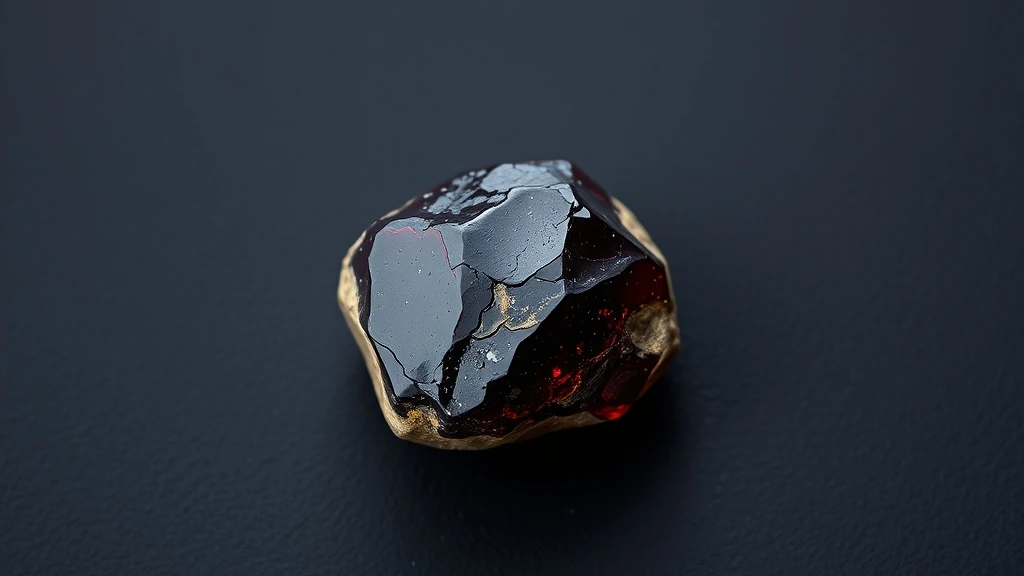
Almandine garnet belongs to the silicate family, specifically the nesosilicates of the garnet group. Its structure is built from isolated SiO₄ tetrahedra linked by Fe²⁺ and Al³⁺ cations, forming a robust isometric lattice. This mineral crystallizes in the cubic system, typically as dodecahedral or trapezohedral forms, and is a common component of metamorphic rocks such as schist and gneiss.
What is Almandine Garnet Gemstone? Geological Overview & Definition
Almandine is the iron‑dominant member of the garnet solid‑solution series, recognized for its characteristic deep red to brown‑violet color. It forms in high‑pressure, medium‑ to high‑temperature metamorphic environments, often coexisting with mica, quartz, and amphibole.
In the gemstone market, almandine is prized for its high refractive index (≈1.79) and strong dispersion, which give it a vivid sparkle. While abundant, gem‑quality crystals are valued for their clarity, uniform color, and well‑developed dodecahedral faces.
Almandine Garnet Gemstone Chemical Composition & Crystallographic Properties
Almandine’s formula Fe₃Al₂(SiO₄)₃ reflects a nesosilicate framework where isolated SiO₄ tetrahedra are charge‑balanced by Fe²⁺ and Al³⁺ occupying octahedral sites. The isometric (cubic) crystal system yields equal axial lengths and 90° angles, producing the classic dodecahedral or trapezohedral habit.
Cation substitution is limited; Fe²⁺ can be partially replaced by Mn²⁺ or Mg²⁺, creating the pyrope–almandine series, while Al³⁺ may host minor amounts of Cr³⁺, influencing hue. The chromophore responsible for almandine’s red tone is Fe²⁺–Fe³⁺ charge transfer, intensified by trace Ti⁴⁺.
Almandine is relatively acid‑resistant, but prolonged exposure to strong acids can leach Fe²⁺, dulling its color. Its thermal expansion is modest; heating above ~800 °C can induce a reversible color change as Fe²⁺ oxidizes, a property exploited in laboratory spectroscopic studies.
The mineral’s isometric lattice ensures isotropic optical behavior, meaning it shows no birefringence under polarized light. This symmetry contributes to its consistent brilliance across all viewing angles, a key factor in its desirability as a gemstone.
| Property | Specification |
|---|---|
| Mineral Group | Silicates (Nesosilicates / Garnet Group) |
| Chemical Formula | X₃Y₂(SiO₄)₃ (Complex Silicate / Nesosilicate Group) |
| Mohs Hardness | 6.5 – 7.5 |
| Crystal System | Isometric / Cubic (Dodecahedral or trapezohedral crystals) |
| Specific Gravity (Density) | 3.50 – 4.30 |
| Refractive Index | 1.714 – 1.888 |
| Color & Optical Properties | Natural Almandine Garnet Gemstone color spectrum and optical dispersion |
| Primary Mining Localities | India, Madagascar, Sri Lanka, Mozambique, USA |
| Water & Chemical Resistance | High (Water-resistant; safe for gentle warm water washing) |
| Chakra Alignment (Traditional) | Root Chakra (Muladhara) and Sacral Chakra |
| Zodiac Affinity (Traditional) | Capricorn, Aquarius, Aries |
| Symbolic Meaning (Traditional) | Grounding, passion, loyalty, physical vitality, and steadfast courage |
Garnet Varieties & Comprehensive Sub-Types
Almandine
Almandine forms in high‑grade metamorphic schists and gneisses where iron‑rich fluids replace silicate minerals. Typical inclusions are hematite needles, spinel platelets, and fluid‑filled cavities that give a subtle “star‑burst” effect under magnification. The crystal habit often shows well‑developed banded zoning, ranging from deep ruby‑red cores to brownish‑red rims, a hallmark of slow cooling. As the most abundant garnet, almandine dominates global trade, commanding steady demand for jewelry and industrial abrasives thanks to its Mohs hardness of 7.5‑8.5.
Pyrope
Pyrope crystallizes in mantle‑derived kimberlite pipes and ultramafic xenoliths, where magnesium‑rich melts interact with surrounding mantle peridotite. Common inclusions include olivine fragments, chromian spinel, and tiny diamonds, which are prized by gemologists for provenance studies. The stone exhibits a characteristic radial banding that transitions from vivid ruby‑red at the core to a softer blood‑red toward the surface. High‑quality pyrope from the Czech Republic and Tanzania enjoys premium market status, celebrated for its fiery hue and reputed “passion‑enhancing” metaphysical properties.
Spessartine
Spessartine grows in manganese‑rich metamorphic belts, especially within skarn deposits where carbonate rocks have been metasomatized by magmatic fluids. Its inclusions often consist of manganese‑bearing rutile needles and minute garnet‑on‑garnet intergrowths that create a distinctive “spessartine sparkle.” The gemstone displays zonal orange‑to‑mandarin coloration, with sharp color boundaries that are diagnostic in the field. Collector demand is high; fine spessartine from Brazil and Madagascar commands top prices due to its rarity and intense fire.
Demantoid
Demantoid is the emerald‑green member of the andradite series, forming in oxidized, calcium‑rich skarn environments associated with basaltic intrusions. Its signature horsetail inclusions—elongated, hair‑like rutile crystals—are a key identification tool for gemologists. The crystal habit is typically dodecahedral with a brilliant, diamond‑like fire that rivals true emeralds. Rare deposits in the Ural Mountains of Russia and, more recently, Namibia, make demantoid one of the most valuable garnet varieties on the market.
Tsavorite
Tsavorite originates in high‑temperature, low‑pressure metamorphic zones where chromium‑rich fluids infiltrate grossular‑type garnet precursors, producing a vivid chrome‑green hue. Inclusions often include chromian spinel and tiny glassy bubbles that give a subtle “jelly‑roll” appearance under magnification. The stone’s growth zoning is usually uniform, lacking the banding seen in almandine, which contributes to its optical clarity. Kenyan and Tanzanian mines have supplied the bulk of the world’s supply, and tsavorite now rivals fine emeralds in both price and desirability.
Rhodolite
Rhodolite represents a solid‑solution series between pyrope and almandine, forming in metamorphosed limestone and marble where iron and magnesium are both abundant. Typical inclusions are garnet‑on‑garnet twins and microscopic mica flakes that create a soft “silky” sheen. The gemstone exhibits purplish‑red to raspberry‑pink banding, often with a distinct color gradient from core to surface, which is a reliable field indicator. High‑grade rhodolite from Mozambique and Afghanistan fetches premium prices, prized for its vibrant hue and excellent durability.
Hessonite (Cinnamon Stone)
Hessonite develops in granitic pegmatites and metamorphic schists where calcium‑rich fluids are enriched with iron and manganese, yielding its warm cinnamon‑orange to honey‑brown color. Inclusions frequently appear as treacle‑like swirl patterns of fluid‑filled cavities, a hallmark that distinguishes it from other grossular varieties. The crystal habit shows concentric zoning with subtle color shifts that become more pronounced after heat treatment. Though less common than other garnets, high‑clarity hessonite from Sri Lanka and Brazil enjoys a niche market among collectors seeking its unique hue.
Comparative Summary
Gemologists differentiate these garnet varieties by examining chemical composition (Fe‑Al for almandine, Mg for pyrope, Mn for spessartine, Cr for tsavorite, etc.), characteristic inclusions such as horsetail rutile in demantoid or swirl cavities in hessonite, and distinct color zoning patterns observable under a polarizing microscope. Refractive index, specific gravity, and spectroscopic signatures further refine identification, enabling precise classification in lapidary practice.
Where is Almandine Garnet Gemstone Found? Geological Mining & Extraction
Almandine is most abundant in metamorphic terrains where iron‑rich fluids have altered pelitic rocks, especially within the Grenville and Baltic Shield provinces. In these settings, the stone occurs as massive aggregates within schistose host rocks, often mined through underground drift methods that follow the garnet‑bearing horizons.
Major commercial sources include the United States (North Carolina, New York), Brazil (Minas Gerais), and India (Madhya Pradesh). Open‑pit operations extract almandine from pegmatitic veins and metamorphic breccias, after which the ore is crushed, screened, and processed by gravity separation to isolate the dense garnet crystals for cutting and industrial use.
Historical Significance & Cultural Lore of Almandine Garnet Gemstone
Ancient Romans prized almandine for its deep red hue, embedding it in signet rings and military regalia to symbolize courage and victory. Archaeological finds from the 1st century CE, such as garnet‑inlaid mosaics in Pompeii, attest to its widespread ornamental use across the Mediterranean.
In Eastern traditions, almandine was associated with the Root and Sacral Chakras, believed to ground the wearer and ignite passionate energy. Medieval European lore linked the stone to loyalty and steadfastness, a belief that persisted into Renaissance jewelry, where almandine pendants were gifted to knights as talismans of unwavering resolve.
Modern Uses & Jewelry Applications of Almandine Garnet Gemstone
Almandine garnet is prized for its deep, velvety red hue and exceptional durability, making it a staple in both vintage and contemporary jewelry design. Lapidaries typically cut these stones into faceted gems to maximize brilliance or shape them into smooth cabochons for organic, artistic settings. Its high hardness allows for intricate detailing without significant risk of chipping during the polishing process.
- Faceted Cuts: Commonly fashioned into round, oval, and cushion shapes to enhance fire and luster.
- Cabochon Carvings: Used in intaglio carvings, signet rings, and ornamental pendants due to its uniform color.
- Industrial Abrasives: Coarse grains are utilized in sandpaper and grinding wheels for metalworking applications.
Carat, Quality Grades & Value Factors of Almandine Garnet
According to historical traditions and metaphysical lore, almandine garnet is revered as a stone of physical vitality and steadfast courage. Practitioners believe it fuels the wearer with passion and loyalty, helping to overcome fatigue and maintain focus during challenging times. This gemstone is often associated with the earth element, promoting a sense of stability and grounded presence.
The emotional resonance of almandine garnet is deeply tied to its ability to anchor the spirit while igniting the inner flame. It is traditionally worn to strengthen loyalty in relationships and to bolster passion in creative or professional endeavors. By connecting the wearer to the earth, it fosters a resilient mindset that thrives under pressure.
Which Chakra and Zodiac Signs Align with Almandine Garnet Gemstone?
In chakra theory, almandine garnet is primarily aligned with the Root Chakra (Muladhara) and the Sacral Chakra. The Root Chakra connection supports feelings of safety, security, and physical grounding, while the Sacral Chakra alignment enhances creativity, emotional flow, and personal vitality. This dual resonance helps balance stability with dynamic energy.
Astrologically, this gemstone is canonically linked to Capricorn, Aquarius, and Aries. Capricorns appreciate its grounding nature, Aquarians value its unique energy, and Aries resonate with its fiery courage. These zodiac signs benefit from the stone’s ability to amplify their inherent traits of determination and passion.
How to Identify Real vs. Fake Almandine Garnet Gemstone
Distinguishing natural almandine from imitations requires careful observation, as synthetic glass and dyed replicas are commonly used to mimic its appearance. Artificial imitations often lack the natural inclusions and specific gravity of genuine garnet, making them lighter and less dense. Understanding these subtle differences is crucial for collectors and buyers seeking authentic gemstones.
Practical At-Home Authenticity Tests
- Temperature Test (Thermal Feel): Genuine garnet feels cool to the touch initially and warms slowly, whereas plastic imitations warm up almost instantly due to low thermal conductivity.
- Specific Gravity & Weight Test: Almandine has a high density; it should feel noticeably heavier than glass or plastic of the same size when held in the hand.
- Scratch & Hardness Test (Mohs Comparison): With a hardness of 7-7.5, real garnet will scratch glass but can be scratched by a diamond or corundum; glass imitations will scratch more easily.
- Microscopic & Loupe Inspection (Internal Inclusions): Use a 10x loupe to look for natural inclusions like fluid bubbles or mineral traces; synthetic glass often contains perfect, spherical bubbles or swirls.
Almandine Garnet Gemstone Valuation Factors, Grading & Pricing
The primary driver of value is Color Saturation, which must exhibit a deep, uniform crimson hue. Gemologists assess tone consistency across the entire stone to ensure no zoning or pale areas are visible. High optical clarity and a vitreous luster further enhance the gem’s visual appeal and market desirability.
Carat Weight significantly influences pricing, as larger almandine specimens are rarer and command exponential premiums. Facet symmetry is critical, as precise cutting maximizes brilliance and minimizes light leakage. The presence of matrix or inclusions can reduce value, though some collectors appreciate unique geological features.
Geographical Provenance Premium often elevates the price of stones from renowned mines like Brazil or India. Wholesale prices fluctuate based on supply chains, while retail values reflect brand prestige and certification costs. Understanding these trends helps buyers negotiate fair market rates for high-quality stones.
How to Clean and Care for Almandine Garnet Gemstone
To maintain the stone’s integrity, always clean with warm soapy water and a soft cloth. This gentle method removes oils and dust without risking damage to the gem’s surface. Avoid abrasive materials that could scratch the polished facets or dull the natural luster.
Ultrasonic cleaners should generally be avoided or used with extreme caution, as high-frequency vibrations can cause microscopic fissures. Always inspect the gem for cracks before using high-frequency vibrations to prevent potential breakage. Regular professional inspections ensure long-term durability and preserve the stone’s aesthetic quality.
Cleansing and Recharging Almandine Garnet Gemstone (Energetic Care)
For energetic cleansing, use smoke smudging with sage or palo santo to purify the stone’s aura. This dry method avoids water exposure, respecting the mineral’s physical stability and structural integrity. Hold the gem in your hands while visualizing positive energy flowing through it.
Place the almandine on a selenite plate under moonlight to recharge its vibrational properties. Selenite’s high solubility in water makes it an ideal, safe companion for dry recharging rituals. This practice aligns with the stone’s association with grounding and physical vitality.
Frequently Asked Questions About Almandine Garnet Gemstone
Is almandine garnet safe to wear in the shower?
Yes, almandine garnet is highly water-resistant and safe for gentle warm water washing. The stone’s robust Mohs hardness of 7 to 7.5 ensures it withstands daily moisture without degradation. However, avoid harsh soaps that may leave residue on the facets. Regular rinsing keeps the gemstone’s deep red color vibrant and clear.
Can I clean almandine garnet in an ultrasonic cleaner?
Ultrasonic cleaners should generally be avoided or used with extreme caution, as high-frequency vibrations can cause microscopic fissures. The stone’s high durability allows it to withstand the vibrations effectively. Always use warm soapy water and a soft cloth for routine maintenance. Avoid ultrasonic cleaning if the stone has fractures or heavy inclusions.
Which zodiac signs are aligned with almandine garnet?
Almandine garnet is traditionally associated with Capricorn, Aquarius, and Aries. These signs resonate with the stone’s energy of grounding and steadfast courage. Wearing this gemstone can enhance physical vitality for these individuals. It serves as a powerful talisman for loyalty and passion in daily life.
What chakras does almandine garnet activate?
Almandine garnet primarily activates the Root Chakra (Muladhara) and Sacral Chakra. These energy centers govern stability, survival, and creative passion. The stone’s deep red hue aligns perfectly with these lower chakras. It helps anchor the wearer’s energy to the earth.
How hard is almandine garnet on the Mohs scale?
Almandine garnet ranks between 7 and 7.5 on the Mohs hardness scale. This makes it significantly harder than quartz and suitable for daily wear. The isometric crystal system contributes to its exceptional structural integrity. It resists scratching from common materials like steel or glass.
What is the chemical composition of almandine garnet?
Almandine is an iron-aluminum silicate with the formula Fe3Al2(SiO4)3. This specific composition gives it its characteristic deep red to purplish-red color. The iron content is responsible for the stone’s rich, earthy tones. Understanding this chemistry helps identify natural versus synthetic stones.
Is almandine garnet a good choice for engagement rings?
Yes, almandine garnet is an excellent and durable choice for engagement rings. Its high hardness ensures it survives the rigors of daily life without chipping easily. The stone symbolizes loyalty and passion, making it a meaningful alternative to diamonds. It offers a unique, vintage aesthetic for modern couples.
How should I store almandine garnet jewelry?
Store almandine garnet in a soft pouch or separate jewelry box compartments. Although hard, it can still scratch softer gems like opals or pearls. Keep it away from direct sunlight to preserve its color intensity. Proper storage prevents accidental impacts that could damage the setting.