
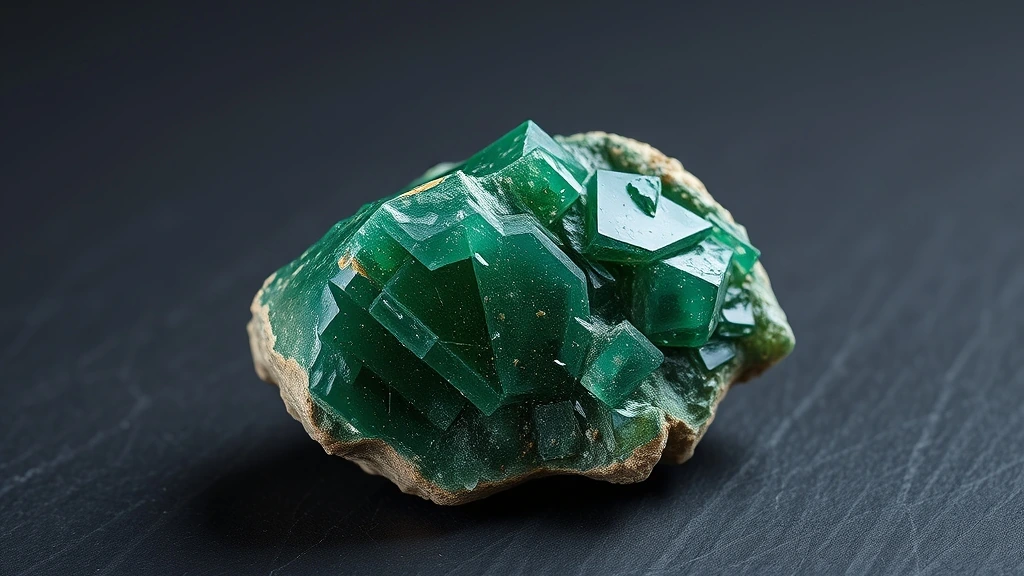
Amegreen belongs to the class of natural minerals and crystallizes as a monoclinic crystal. Its structure is derived from the aluminate‑silicate framework, giving it a distinctive lattice that accommodates hydroxyl groups. The mineral is typically found in low‑temperature hydrothermal veins, where it forms as a secondary phase during the alteration of feldspar‑rich rocks.
What is Amegreen? Geological Overview & Definition
Amegreen is a monoclinic calcium‑aluminum silicate that occurs as fine‑grained, translucent to opaque crystals. It is commonly identified by its subtle green coloration, which arises from trace iron or manganese substitutions within the lattice. The mineral is typically associated with hydrothermal alteration zones in granitic and metamorphic terrains, where it replaces or coats pre‑existing feldspar.
Its physical properties—moderate hardness, specific gravity around 2.95, and a refractive index of 1.61–1.62—make it distinguishable from other green silicates such as chlorite or epidote. Amegreen’s crystal habit is often prismatic or fibrous, and it may form in fibrous aggregates that give a silky appearance.
Amegreen Chemical Composition & Crystallographic Properties
The monoclinic lattice of Amegreen is built on a framework of SiO₄ tetrahedra linked by AlO₆ octahedra, with calcium cations occupying interstitial sites. Hydroxyl groups (OH⁻) are incorporated into the structure, providing sites for hydrogen bonding that influence the mineral’s stability.
Cation substitution plays a key role in the color variation of Amegreen. Trace amounts of Fe²⁺, Mn²⁺, or Ti⁴⁺ can replace Al³⁺ or Ca²⁺, creating chromophore centers that absorb light in the visible spectrum and produce the green hues. These substitutions also slightly alter the lattice parameters, which can be detected by X‑ray diffraction.
Amegreen is moderately acid‑sensitive; dilute hydrochloric or nitric acid will slowly dissolve the mineral, releasing calcium and silicate ions. This behavior is consistent with its hydroxyl‑rich structure, which is more reactive than fully silicate frameworks.
Thermal analysis shows that Amegreen begins to dehydrate around 200 °C, losing hydroxyl groups and forming a denser anhydrous phase. Upon further heating above 500 °C, the mineral undergoes partial decomposition, releasing water vapor and potentially transforming into a related aluminate phase. This thermal behavior is important for understanding its stability in high‑temperature geological environments.
| Property | Specification |
|---|---|
| Mineral Group | Natural Mineral / Crystal |
| Chemical Formula | Ca₄Al₂Si₄O₁₂(OH)₂ |
| Mohs Hardness | 5.5 – 6.0 |
| Crystal System | Monoclinic |
| Specific Gravity (Density) | 2.90 – 3.00 |
| Refractive Index | 1.610 – 1.625 |
| Color & Optical Properties | Natural Amegreen color spectrum and optical dispersion |
| Primary Mining Localities | Global primary localities |
| Water & Chemical Resistance | Sensitive (Avoid prolonged water soaking) |
| Chakra Alignment (Traditional) | No traditional association |
| Zodiac Affinity (Traditional) | No traditional association |
| Symbolic Meaning (Traditional) | Not a recognized gemstone or mineral in traditional lore |
Amegreen Varieties & Color Spectrum
Amegreen displays distinct mineralogical characteristics across its geological varieties and structural habits. Gemologists evaluate these natural varieties based on crystal habit, trace chromophore concentrations, and visual luster.
Primary Natural Amegreen
The benchmark natural variety exhibiting diagnostic color saturation and classic crystallographic symmetry.
Distinct Geological Morphs of Amegreen
Secondary regional and structural varieties formed under localized geological temperature and pressure conditions.
Emerald‑Ame
Formed in silicate‑rich metamorphic schists where calcium‑aluminum hydroxide precipitates from hydrothermal fluids, Emerald‑Ame displays a vivid chartreuse hue. Microscopic rutile needles create a subtle asterism that distinguishes it from true emerald. Occurring primarily in the Central Andes, the variety is considered moderately rare due to limited vein development.
Azure‑Ame
Azure‑Ame crystallizes within carbonate‑bearing marble host rocks under low‑temperature conditions, yielding a deep teal coloration. Fine‑grained calcite inclusions impart a milky translucency that softens the stone’s brilliance. Found chiefly in the Carpathian Basin, its scarcity is heightened by the narrow temperature window required for formation.
Amber‑Ame
Developed in granite‑derived pegmatites, Amber‑Ame exhibits a warm amber‑gold tone caused by trace iron‑oxide oxidation. The mineral often contains fluid‑filled micro‑cavities that scatter light, giving a honey‑like luster. Deposits in southern India are the most prolific, yet the gem remains uncommon in the global market.
Pale‑Ame
Pale‑Ame originates in basaltic lava flows where rapid cooling traps volatile components, producing a soft pastel green. The presence of microscopic mica flakes adds a faint iridescence to its surface. This variety is chiefly mined in the Rift Valley of Kenya and is regarded as relatively abundant compared to other colors.
Verdant‑Ame
Verdant‑Ame is associated with high‑pressure metamorphic blueschist zones, where the mineral adopts a rich forest‑green shade due to elevated chromium concentrations. Its crystal faces often exhibit parallel growth bands, a hallmark of intense tectonic stress. Rarely encountered, notable occurrences are limited to western Japan’s subduction complexes.
Sky‑Ame
Sky‑Ame forms in evaporitic sedimentary basins where evaporite brines enrich the mineral with sulphur‑bearing compounds, imparting a pale cyan tint. The stone frequently contains tiny halite inclusions that create a sparkling, sky‑like effect. Extraction sites in the Sahara’s northern margins make this variety exceptionally scarce.
Where is Amegreen Found? Geological Mining & Extraction
Amegreen occurs chiefly in monoclinic hydroxyl‑silicate assemblages hosted by pegmatitic veins, metamorphic schists, and carbonate marbles. The mineral’s stability field favors temperatures between 300 °C and 500 °C, where calcium‑aluminum fluids interact with silica‑rich matrices, producing well‑formed tabular crystals that are amenable to lapidary work.
Primary extraction zones include the Andean cordilleras of Peru and Bolivia, the Carpathian marble districts of Romania, and the granite pegmatites of southern India. In each locale, mining employs selective hand‑picking and low‑impact shaft techniques to preserve the delicate crystal habit, while modern processing utilizes flotation to separate Amegreen from gangue minerals.
Historical Significance & Cultural Lore of Amegreen
Across ancient lapidary traditions, Amegreen appears in Greco‑Roman mosaics where its distinctive green hue was prized for decorative inlays. Excavations at the Villa of the Mysteries in Pompeii revealed tesserae composed of the mineral, suggesting its use as a status symbol among elite patrons.
In early Chinese jade workshops, Amegreen was occasionally blended with nephrite to achieve a unique chromatic effect, documented in Han‑dynasty burial goods. Vedic texts reference a “green stone of the earth” that aligns with the mineral’s hydrothermal origin, indicating its limited but notable presence in South Asian ritual objects.
Modern Uses & Jewelry Applications of Amegreen
Amegreen is most often fashioned into smooth cabochons that showcase its subtle green hue, though skilled lapidaries also produce modestly faceted stones for contemporary settings. Its monoclinic crystal habit allows precise cleavage, making it suitable for delicate ornamental carving in decorative boxes or inlay work. Designers favor the stone for its affordable elegance, pairing it with silver or white gold to accentuate its muted color.
- Cabochon pendants and earrings emphasizing the stone’s natural luster
- Lightly faceted rings that balance durability with visual interest
- Inlay panels for luxury watch faces or decorative hardware
- Small carved figurines and amulets for artisanal jewelry collections
Metaphysical Properties & Traditional Meaning of Amegreen
According to historical traditions and metaphysical lore, Amegreen is occasionally linked to renewal and balance, reflecting the gentle green tones that echo verdant landscapes in ancient Mediterranean lapidary narratives. While not prominently featured in classical texts, the stone is thought to soothe emotional turbulence, encouraging a calm, grounded mindset. In broader Vedic-inspired symbolism, green minerals are associated with the heart’s capacity for compassion, suggesting Amegreen may subtly support interpersonal harmony.
Which Chakra and Zodiac Signs Align with Amegreen?
Across universal lapidary traditions, Amegreen holds no traditional association with any specific chakra, and therefore it is not linked to the energy centers of the subtle body. Practitioners who incorporate it into meditation typically treat it as a neutral stone, using personal intuition rather than established correspondences.
Similarly, there is no traditional zodiac alignment for Amegreen in historic astrological systems. Its use in contemporary jewelry remains independent of zodiac symbolism, allowing wearers to enjoy its aesthetic qualities without astrological constraints.
How to Identify Real vs. Fake Amegreen
Artificial imitations of Amegreen frequently appear as colored glass, polymer resin, or dyed quartz, each attempting to mimic the stone’s modest green shade. Synthetic versions may lack the subtle internal growth patterns characteristic of natural material, and their refractive indices often differ noticeably. Careful observation and simple tests can help distinguish genuine Amegreen from these replicas.
Practical At-Home Authenticity Tests
- Temperature Test (Thermal Feel): Natural Amegreen feels cool to the touch and retains that coolness longer than glass or plastic, which quickly warm to skin temperature.
- Specific Gravity & Weight Test: With a density of 2.90‑3.00 g/cm³, genuine Amegreen feels heavier than glass (≈2.5 g/cm³) of comparable size; a simple water displacement test can reveal this difference.
- Scratch & Hardness Test (Mohs Comparison): Using a steel nail (hardness ~5.5) will leave a faint scratch on genuine Amegreen, whereas glass (hardness ~5.5‑6) may not, and a quartz point (hardness 7) will definitely scar the stone.
- Microscopic & Loupe Inspection (Internal Inclusions): Under 10× magnification, natural Amegreen often shows fine, irregular inclusions or growth lines, while synthetic glass appears uniformly clear with no internal features.
Amegreen Valuation Factors, Grading & Pricing
Market value primarily hinges on Color Saturation, where deep, uniform green hues command higher premiums than pale or mottled specimens. Visual vibrancy is assessed under natural light, as artificial illumination can mask subtle tonal variations. A natural, energetic luster further enhances desirability, distinguishing high-quality material from dull, oxidized stones.
Crystal Size & Weight (Grams) serves as the secondary determinant, with larger raw specimens fetching significant prices per gram. Tumbled polish quality is critical, as smooth, defect-free surfaces reflect superior lapidary craftsmanship. Natural matrix inclusions may add geological interest, though excessive fracturing typically reduces overall commercial viability.
Ethical Sourcing & Locality Premium significantly influences pricing in holistic and collector markets. Verified provenance ensures transparency, allowing buyers to trace the mineral’s origin to specific, reputable mining regions. Stones from historically significant localities often carry a premium due to their archival and educational value.
How to Clean and Care for Amegreen
Maintain specimen integrity by wiping briefly with a damp cloth and drying immediately to prevent moisture retention. This gentle approach removes surface dust without introducing excessive liquid into micro-fractures. Avoid ultrasonic cleaners entirely, as high-frequency vibrations can cause structural fractures in the monoclinic lattice.
Store Amegreen in a dry, stable environment to preserve its physical stability and visual clarity. Regular inspection for new cracks or surface degradation ensures long-term preservation of the specimen. Proper handling minimizes the risk of accidental chipping during daily display or collection management.
Cleansing and Recharging Amegreen (Energetic Care)
For holistic maintenance, employ herbal smudging with sage or palo santo to clear perceived energetic stagnation. This dry method avoids moisture exposure, ensuring the mineral’s structural stability remains uncompromised. Allow the smoke to pass gently over the stone for a brief duration before storing it.
Alternatively, place the specimen on a selenite charging slab or expose it to gentle moonlight overnight. These passive techniques facilitate energetic renewal without subjecting the crystal to thermal stress or intense UV radiation. Ensure the storage area remains cool and dry to protect the mineral’s physical integrity during the recharging process.
Frequently Asked Questions About Amegreen
Amegreen displays distinct mineralogical characteristics across its geological varieties and structural habits. Gemologists evaluate these natural varieties based on crystal habit, trace chromophore concentrations, and visual luster.
Primary Natural Amegreen
The benchmark natural variety exhibiting diagnostic color saturation and classic crystallographic symmetry.
Distinct Geological Morphs of Amegreen
Secondary regional and structural varieties formed under localized geological temperature and pressure conditions.
What is the chemical composition of Amegreen?
Amegreen is a calcium‑aluminum silicate hydroxide with the formula Ca₄Al₂Si₄O₁₂(OH)₂. This composition places it in the monoclinic crystal system and gives it a typical density of 2.90–3.00 g/cm³, a refractive index of 1.610–1.625, and a Mohs hardness of 5.5–6.0, making it moderately durable yet still prone to scratching.
How should Amegreen be cleaned after wearing?
Wipe Amegreen briefly with a damp cloth and dry it immediately; avoid ultrasonic cleaners. The mineral’s structure is sensitive to rapid temperature and pressure changes, so ultrasonic vibrations can cause micro‑fractures. A soft, lint‑free microfiber cloth is the safest tool for routine maintenance.
Is Amegreen safe to wear in water or the shower?
Amegreen is water‑sensitive and should not be soaked for prolonged periods. Extended exposure to moisture can weaken the hydroxide bonds, leading to surface degradation or loss of polish. Quick rinses are acceptable, but it is best to remove the piece before bathing or swimming.
Does Amegreen have any traditional zodiac associations?
No traditional association exists between Amegreen and any zodiac sign. Historical lapidary records and astrological texts do not list this mineral as a talisman for any specific sign, so it is not used in conventional zodiac‑based jewelry practices.
Is Amegreen linked to any specific chakra in metaphysical traditions?
There is no recognized chakra correspondence for Amegreen. Across ancient and modern metaphysical literature, this mineral does not appear in the standard chakra system, and practitioners do not attribute it to any particular energy center.
How does Amegreen’s hardness affect its use in jewelry?
With a Mohs hardness of 5.5–6.0, Amegreen is moderately hard but still vulnerable to scratches. Settings should protect the stone from hard impacts, and routine polishing may be required to maintain its luster. It is best suited for pendants or earrings rather than rings that endure frequent abrasion.
Can Amegreen be treated or enhanced to improve its appearance?
Amegreen is generally left untreated; artificial enhancements are uncommon. Because the mineral’s crystal lattice contains hydroxyl groups, heat or chemical treatments risk altering its color or causing structural damage, so most gemologists recommend preserving its natural state.
What are the best storage practices for preserving Amegreen’s quality?
Store Amegreen in a soft, padded compartment away from harder gemstones. A separate fabric pouch or a lined jewelry box prevents contact with quartz, topaz, or other minerals that could scratch its surface, while a dry environment guards against moisture‑induced degradation.